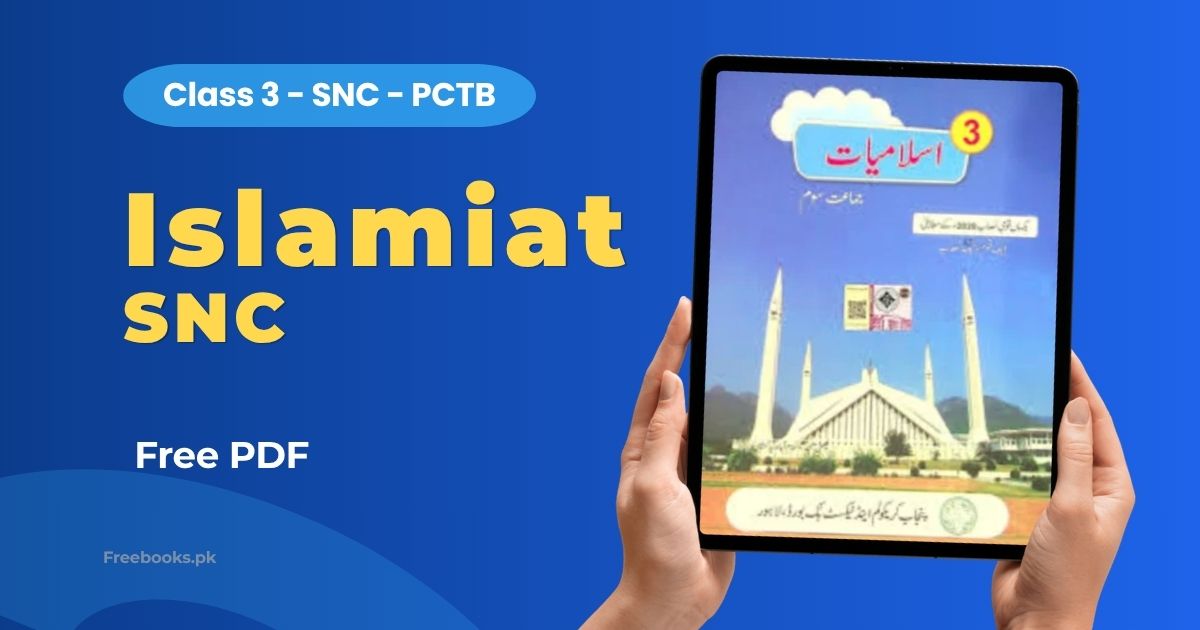
Islamiat for Class 3 is part of the official Punjab Curriculum and Textbook Board (PCTB) syllabus, based on the Single National Curriculum (SNC) 2020. This page covers all 7 chapters of the book, from the Quran and Hadith to beliefs and worship, the blessed life of the Prophet رَّسول اللّهِ صَلّى اللَّه عَلَيْهِ وَسَلَّم, and lessons from great Islamic figures.
For Class 3 students, this book builds early faith and good habits through short verses, hadith, and simple stories rather than long explanations. Each chapter summary and its important questions on this page make revision quicker before class tests, so key ideas stay clear without re-reading the whole chapter.
Book Overview
| Class | 3 |
| Subject | Islamiat |
| Board | Punjab Curriculum and Textbook Board (PCTB) |
| Curriculum | Single National Curriculum (SNC) 2020 |
| Total Chapters | 7 (+ Farhang Glossary) |
| Total Pages | 68 |
| Format | PDF (Free Download) |
Chapter List
Chapter 1: Quran Majeed o Hadees-e-Nabvi (قرآن مجید و حدیث نبوی)
This chapter opens with two short Surahs for memorisation, Al-Fatiha and An-Nasr, recited with correct pronunciation. It then teaches the meaning of short phrases like Allahu Akbar and Astaghfirullah, the Durood Ibrahimi, four short Hadith on niyyah (intention), learning and teaching the Quran, dua as the essence of worship, and every good deed being charity, followed by the everyday duas said before and after eating.
Important Questions:
- Which two Surahs does this chapter ask students to memorise? Answer: Surah Al-Fatiha and Surah An-Nasr.
- According to the hadith in this chapter, on what do deeds depend? Answer: Deeds depend on intentions (niyyah).
- What is the dua said before eating, according to this chapter? Answer: Bismillah, meaning starting in the name of Allah and seeking His blessing.
- Who does this chapter say is the best among people? Answer: The one who learns the Quran and teaches it to others.
Chapter 2: Imaniyat o Ibadaat (ایمانیات و عبادات)
This chapter first explains Tawheed, the belief that Allah is one, along with the meaning of the Kalima Tayyaba and Surah Al-Ikhlas, and then covers Nabuwat and Risalat, explaining why prophets were sent and that Prophet Muhammad رَّسول الّهِ صَلّى اللَّه عَلَيْهِ وَسَلَّم is the final prophet. The second half covers acts of worship: the Kalima Shahadat, the meaning and etiquette of Azaan, the importance of Wudu, the five daily prayers with their names, and the Qibla and the etiquette of the mosque.
Important Questions:
- What does the word Tawheed mean, according to this chapter? Answer: Believing that Allah is One and has no partner.
- What are the five daily prayers named in this chapter? Answer: Fajr, Zuhr, Asr, Maghrib, and Isha.
- Who was the first person to give the call to prayer (Azaan) in Islam? Answer: Hazrat Bilal (RA).
- What is the Qibla for Muslims, according to this chapter? Answer: The Baitullah (Khana Kaaba) in Makkah, the direction Muslims face during prayer.
Chapter 3: Seerat-e-Tayyaba (سیرتِ طیّبہ)
This chapter covers the early life of Prophet Muhammad رَّسول الّهِ صَلّى اللَّه عَلَيْهِ وَسَلَّم before prophethood, including his birth in Makkah, his nursing by Hazrat Halima Sadia, being orphaned young and raised first by his grandfather Abdul Muttalib and then his uncle Abu Talib, his journey to Syria at age twelve, and his role in the Hilf al-Fudul pact and the peaceful settling of the Hajar-e-Aswad dispute. It also introduces his marriage to Hazrat Khadija and his renowned truthfulness (Sidq) and trustworthiness (Amanat).
Important Questions:
- Who nursed and raised the Prophet رَّسول الّهِ صَلّى اللَّه عَلَيْهِ وَسَلَّم for the first four years of his life? Answer: Hazrat Halima Sadia (RA).
- Who took over raising the Prophet رَّسول الّهِ صَلّى اللَّه عَلَيْهِ وَسَلَّم after his grandfather Abdul Muttalib passed away? Answer: His uncle, Hazrat Abu Talib.
- What agreement was formed to help wronged people in Makkah, and how did the Prophet رَّسول الّهِ صَلّى اللَّه عَلَيْهِ وَسَلَّم settle the Hajar-e-Aswad dispute? Answer: The Hilf al-Fudul; he placed the Hajar-e-Aswad on a sheet and had the leaders of each clan lift it together, then set it in place himself.
- By what title was the Prophet رَّسول الّهِ صَلّى اللَّه عَلَيْهِ وَسَلَّم known before prophethood because of his truthfulness? Answer: Al-Sadiq (the truthful one).
Chapter 4: Akhlaq o Adaab (اخلاق و آداب)
This chapter teaches the importance of truthfulness (sach), explaining that Muslims are commanded to always speak the truth and stay in the company of truthful people, with a hadith warning that faith is incomplete while a person keeps lying, even in jest. It then covers the etiquette of good speech (guftagu ke aadab), including speaking gently, not interrupting others, respecting elders while talking, and avoiding backbiting and harsh words.
Important Questions:
- According to the hadith in this chapter, when is a person’s faith incomplete? Answer: As long as they keep lying, even in jest.
- What does truthfulness lead to, according to the hadith quoted in this chapter? Answer: Truthfulness leads to righteousness, and righteousness leads to Paradise.
- What does the chapter say should be avoided during a conversation? Answer: Interrupting others, backbiting, and using harsh or rude words.
- What advice does the Prophet’s رَّسول الّهِ صَلّى اللَّه عَلَيْهِ وَسَلَّم hadith give about speaking if you believe in Allah and the Last Day? Answer: Speak good words, or else remain silent.
Chapter 5: Husn-e-Muashrat (حسنِ معاملات و معاشرت)
This chapter introduces Huqooq-ul-Ibaad, the rights owed to fellow human beings, starting with the rights of parents and teachers, since Islam gives parents’ rights a place right after Allah’s own rights in the Quran. It then covers good conduct with siblings and relatives, being kind to neighbours and friends by helping them and protecting their secrets, and treating women with the respect and dignity Islam grants them, including rights to honour, inheritance, and education.
Important Questions:
- What does Huqooq-ul-Ibaad mean, according to this chapter? Answer: The rights owed to Allah’s creation, including parents, teachers, siblings, relatives, neighbours, and all human beings.
- Why is a teacher called a spiritual father in this chapter? Answer: Because, like parents, teachers nurture and educate their students.
- What example does this chapter give of a neighbour’s rights? Answer: Lending a neighbour money if they ask, helping them if they need it, and visiting them when they are sick.
- What rights does this chapter say Islam gave to women? Answer: The right to honour and respect, a share in inheritance, and the right to education.
Chapter 6: Hidayat Yafta Aur Gumrah Aqwaam Ke Waqiaat Aur Mashaheer-e-Islam (ہدایت یافتہ اور گمراہ اقوام)
This chapter tells the story of Hazrat Adam (AS), the first human and prophet, his creation, and the dua he was taught to seek Allah’s forgiveness, followed by Hazrat Nooh (AS), who called his people to Tawheed for nearly 950 years before Allah commanded him to build an ark to save the believers from the great flood. It closes with the life of the first Caliph, Hazrat Abu Bakr Siddique (RA), his close friendship with the Prophet رَّسول الّهِ صَلّى اللَّه عَلَيْهِ وَسَلَّم, how he earned the title Siddique, his generosity in freeing enslaved people, and his time as Caliph after the Prophet’s رَّسول الّهِ صَلّى اللَّه عَلَيْهِ وَسَلَّم passing.
Important Questions:
- Why is Hazrat Adam (AS) called Abul Bashar? Answer: It means “father of mankind,” since he was the first human being created by Allah.
- What did Allah command Hazrat Nooh (AS) to build, and why? Answer: An ark, to save the believers from the flood sent as punishment on his disbelieving people.
- Why was Hazrat Abu Bakr (RA) given the title Siddique? Answer: Because he was the first to confirm the truth of the Miraj (the Prophet’s رَّسول الّهِ صَلّى اللَّه عَلَيْهِ وَسَلَّم night journey) without hesitation.
- What role did Hazrat Abu Bakr (RA) hold after the Prophet’s رَّسول الّهِ صَلّى اللَّه عَلَيْهِ وَسَلَّم passing? Answer: He was chosen by the companions as the first Caliph of Islam.
Chapter 7: Islami Taleemat Aur Asr-e-Hazir Ke Taqaze (اسلامی تعلیمات اور عصرِ حاضر کے تقاضے)
This chapter explains how Islam links good health with faith, noting that acts of worship like Wudu, prayer, and fasting bring physical and spiritual cleanliness, and that Allah loves those who keep themselves pure. It covers practical rules of hygiene from the Prophet’s رَّسول الّهِ صَلّى اللَّه عَلَيْهِ وَسَلَّم own example, such as using the miswak, trimming nails, bathing, sleeping and waking early, and eating a balanced halal diet, along with the value of regular exercise through healthy games like football, hockey, and swimming.
Important Questions:
- How does this chapter connect Wudu and prayer to good health? Answer: Performing Wudu and praying repeatedly through the day brings both physical and spiritual cleanliness.
- What tool does the chapter mention for cleaning the mouth, following the Prophet’s رَّسول الّهِ صَلّى اللَّه عَلَيْهِ وَسَلَّم sunnah? Answer: The miswak.
- What kind of games does this chapter recommend for good health? Answer: Games with physical exercise, such as football, hockey, cricket, running, and swimming.
- What does this chapter say about food habits for good health? Answer: Eating a healthy, halal, and balanced diet, avoiding excess, and staying away from poor-quality market food.
Download Islamiat Class 3 SNC PDF
Click the button below to download the free PDF of Islamiat Class 3 SNC for Punjab Board (PCTB).
Who Should Read This
This book is meant for Class 3 students studying under the Punjab Board (PCTB) SNC syllabus. Parents and tutors helping with homework or early exam preparation will also find the chapter summaries and important questions useful for quick revision.
Applicable Boards
This book is designed for the Punjab Curriculum and Textbook Board (PCTB). Since it follows the Single National Curriculum (SNC) 2020, students from other boards that have also adopted the SNC syllabus for Class 3 Islamiat can use this book too.
FAQs
Is this Islamiat book for Class 3 students only?
Yes, this book is designed for Class 3 students under the Punjab Board SNC 2020 syllabus.
Can other students use this book?
Yes, students from other boards following the SNC syllabus for Class 3 Islamiat can also use it.
Is this the latest edition?
Yes, this is the latest SNC 2020 edition approved by the Punjab Curriculum and Textbook Board.
Does the PDF include all 7 chapters?
Yes, the PDF covers all 7 chapters of the book, from the Quran and Hadith to Islamic teachings for modern life.
Is the download free?
Yes, the PDF download is completely free.
Does this book include exercises and questions?
Yes, each chapter includes exercises, and this page also lists important questions with short answers for quick revision.
Related Books
- Urdu Class 3 SNC PDF Download – Punjab Board (PCTB)
- English Class 3 SNC PDF Download – Punjab Board (PCTB)
- Mathematics Class 3 SNC PDF Download – Punjab Board (PCTB)
- Islamiat Class 4 SNC PDF Download – Punjab Board (PCTB)
- General Knowledge Class 3 SNC PDF Download – Punjab Board (PCTB)
- Ethics (Ikhlaqiat) Class 3 PDF Download – Punjab Board (PCTB)
Related Books
© Copyright Policy
Freebooks.pk is an educational resource for students in Pakistan. Textbooks and other books belong to their respective boards, authors and publishers, and all rights remain with them. If you are the copyright holder of any material on this page and want it changed or removed, please contact us or file a request under our DMCA policy. We review every request and remove reported content promptly.