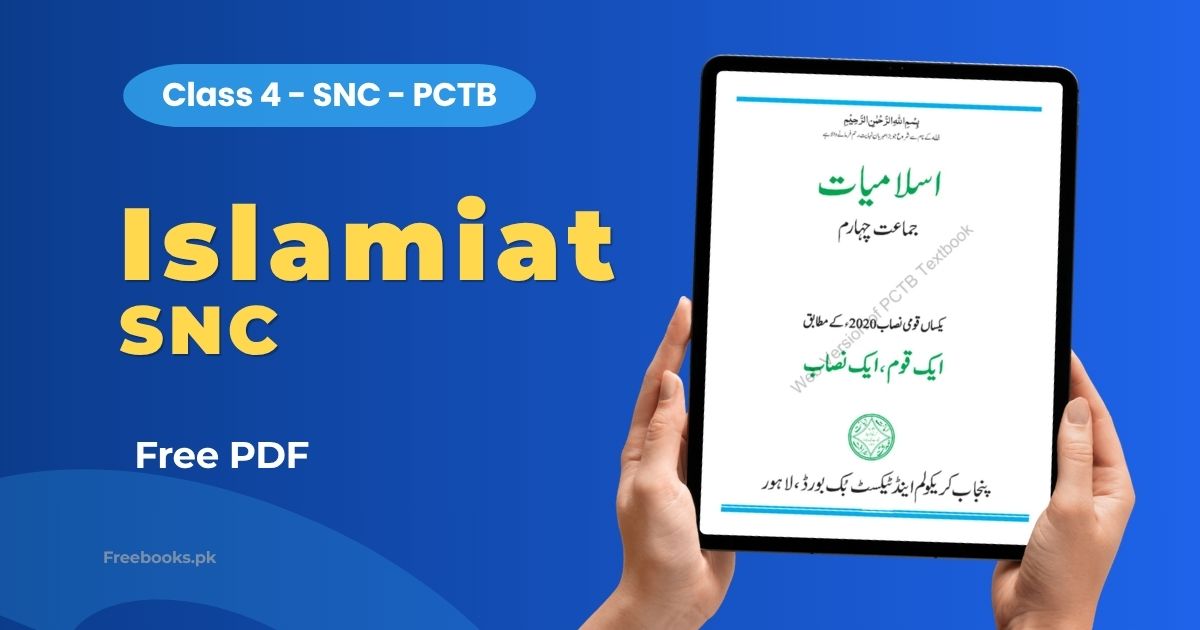
Islamiat for Class 4 is part of the official Punjab Curriculum and Textbook Board (PCTB) syllabus, based on the Single National Curriculum (SNC) 2020. This page covers all 7 chapters of the book, from Quranic verses and Hadith to the Seerah of the Prophet ﷺ, Islamic manners, and the lives of great Islamic figures.
For Class 4 students, this book builds a foundation in faith and character through short, memorable verses, hadith, and stories rather than long explanations. Each chapter summary and its important questions on this page make revision quicker before class tests, so key ideas stay clear without re-reading the whole chapter.
Book Overview
| Class | 4 |
| Subject | Islamiat |
| Board | Punjab Curriculum and Textbook Board (PCTB) |
| Curriculum | Single National Curriculum (SNC) 2020 |
| Total Chapters | 7 (+ Farhang Glossary) |
| Total Pages | 88 |
| Format | PDF (Free Download) |
Chapter List
Chapter 1: Quran Majeed o Hadees-e-Nabvi (قرآن مجید و حدیث نبوی)
This chapter opens with three short Surahs for memorisation, Al-Ma’un, Al-Kafirun, and Al-Lahab, along with the meaning of Surah Al-Kawthar and the tasbih recited during ruku and sujood in prayer. It then presents five short Hadith on gratitude, mercy, backbiting, good character, and being a good neighbour, followed by everyday duas for sleeping, waking, and entering and leaving the washroom and the mosque.
Important Questions:
- Which three short Surahs are given for memorisation in this chapter? Answer: Surah Al-Ma’un, Surah Al-Kafirun, and Surah Al-Lahab.
- What is recited three times during ruku? Answer: “سُبْحَانَ رَبِّيَ الْعَظِيمِ”, meaning glory be to my Lord, the Most Great.
- According to the hadith in this chapter, what happens to someone who does not thank people? Answer: They do not thank Allah either.
- What dua is recited when entering the mosque? Answer: “اللَّهُمَّ افْتَحْ لِي أَبْوَابَ رَحْمَتِكَ”, meaning O Allah, open the doors of Your mercy for me.
Chapter 2: Imaniyat o Ibadaat (ایمانیات و عبادات)
This chapter covers belief in angels, introducing Jibreel, Mikael, Israfeel, and Izrael and their duties, and belief in the four heavenly books, Tauraat, Zaboor, Injeel, and the Quran, as the final and protected revelation for all mankind. It then explains fasting (Roza) as abstaining from food, drink, and desires from dawn to sunset, its rewards, and the importance of Laylat al-Qadr, followed by the rights of Allah (Huqooq Allah) and the etiquette of reciting the Quran.
Important Questions:
- Name two angels and their duties mentioned in this chapter. Answer: Jibreel (A.S.) brings revelation to prophets, and Mikael (A.S.) manages rainfall and sustenance.
- What are the four heavenly books named in this chapter? Answer: Tauraat, Zaboor, Injeel, and the Quran.
- What is the meaning of Roza (fasting) according to this chapter? Answer: Abstaining from food, drink, and desires from true dawn until sunset.
- Name one etiquette of reciting the Quran given in this chapter. Answer: Performing wudu before starting recitation.
Chapter 3: Seerat-e-Tayyaba (سیرت طیبہ صلی اللہ علیہ وسلم)
This chapter narrates key events of the Prophet’s ﷺ life: the revelation of the first verses of Surah Al-Alaq in the Cave of Hira, the beginning of open and secret Dawah, the two migrations to Abyssinia where the just king Najashi protected the Muslims, the three-year boycott in Shab-e-Abi-Talib, the Year of Sorrow (Aam-ul-Huzn) following the deaths of Hazrat Khadijah and Abu Talib, and the difficult journey to Ta’if. Each event highlights the Prophet’s ﷺ patience and steadfastness in the face of hardship.
Important Questions:
- What were the first verses revealed to the Prophet ﷺ in the Cave of Hira? Answer: The first five verses of Surah Al-Alaq.
- Who was the king of Abyssinia that protected the migrating Muslims? Answer: Najashi (Negus).
- What was Shab-e-Abi-Talib, and how long did the boycott there last? Answer: A valley where Banu Hashim was confined under a Quraysh boycott, lasting about three years.
- Why is the tenth year of Prophethood called Aam-ul-Huzn (Year of Sorrow)? Answer: Because both Hazrat Khadijah (R.A.) and Abu Talib passed away in that year.
Chapter 4: Akhlaq o Adaab (اخلاق و آداب)
This chapter teaches simplicity (سادگی) as living without pretence and spending only according to need, following the Prophet’s ﷺ own simple lifestyle despite being a head of state. It covers the etiquette of gatherings (آدابِ مجلس), such as greeting on arrival, sitting wherever space allows, and listening attentively without interrupting, and closes with the importance of punctuality, from praying on time to organising a student’s daily routine.
Important Questions:
- What does simplicity (سادگی) mean according to this chapter? Answer: Living free of pretence and spending only according to need, avoiding wastefulness.
- Name one etiquette of a gathering (مجلس) mentioned in the chapter. Answer: Greeting with salam when entering a gathering.
- What does the Quran say about prayer and time? Answer: Prayer is obligatory on believers at fixed times.
- What did the Prophet ﷺ say is the most beloved deed to Allah? Answer: Prayer offered at its fixed time.
Chapter 5: Husn-e-Muashrat o Muamlaat (حسن معاشرت و معاملات)
This chapter defines honesty (دیانت داری) as doing every task with sincerity and safeguarding trusts, noting that the Prophet ﷺ was known in Makkah as Sadiq and Ameen for his honesty even before Prophethood. It explains Huqooq-ul-Ibad, the rights of Allah’s creation, through examples of the Prophet ﷺ helping a villager and milking a neighbour’s animals, and closes with love for the homeland, describing Pakistan’s founding on 14 August 1947 and the duties of a responsible citizen.
Important Questions:
- What titles was the Prophet ﷺ known by in Makkah because of his honesty? Answer: Sadiq (truthful) and Ameen (trustworthy).
- According to the hadith in this chapter, what happens to a person without trustworthiness? Answer: There is no complete faith for the one who has no trustworthiness.
- Give one example of Huqooq-ul-Ibad (khidmat-e-khalq) from the Prophet’s ﷺ life mentioned here. Answer: He regularly went to milk the animals of Hazrat Khabbab bin Aratt (R.A.) while he was away from home.
- On what date was Pakistan established, according to this chapter? Answer: 14 August 1947.
Chapter 6: Hidayat kay Sarchashme aur Mashaheer-e-Islam (ہدایت کے سرچشمے اور مشاہیر اسلام)
This chapter presents the lives of four great figures: Hazrat Ibrahim (A.S.), who broke the idols of his people and was saved unharmed from the fire of Namrud; Hazrat Musa (A.S.), who was saved from Pharaoh’s cruelty as a baby and later parted the sea to free the Bani Israel; Hazrat Umar Farooq (R.A.), who accepted Islam after hearing the Quran recited by his sister and became the second Caliph known for justice; and Hazrat Usman Ghani (R.A.), the third Caliph titled Zun-Noorayn for marrying two of the Prophet’s ﷺ daughters, known for his generosity.
Important Questions:
- Why was Hazrat Ibrahim (A.S.) thrown into a fire, and what happened? Answer: For breaking the idols of his people; Allah made the fire cool and safe for him.
- How was the infant Hazrat Musa (A.S.) saved from Pharaoh? Answer: His mother placed him in a basket and set it into the river, where Pharaoh’s household found and raised him.
- Why was Hazrat Umar (R.A.) given the title Farooq? Answer: Because it means one who distinguishes between right and wrong.
- Why is Hazrat Usman Ghani (R.A.) called Zun-Noorayn? Answer: Because he was married, one after the other, to two daughters of the Prophet ﷺ, Ruqayyah and Umm Kulthum.
Chapter 7: Islami Taleemat aur Asr-e-Hazir kay Taqazay (اسلامی تعلیمات اور عصر حاضر کے تقاضے)
This chapter explains the importance of cleanliness (صفائی) in Islam, citing the Quranic verse that Allah loves those who purify themselves, along with practical habits such as trimming nails weekly, using the miswak, and washing hands before and after meals. It then covers the importance of water as a blessing from Allah that must never be wasted, referencing the Prophet’s ﷺ instruction to avoid excess even while making wudu at a flowing river, and addresses the modern water shortage and pollution problems facing Pakistan.
Important Questions:
- What does the hadith say cleanliness is a part of? Answer: Cleanliness is half of faith (Iman).
- Name one cleanliness habit recommended in this chapter. Answer: Trimming nails once a week, or using the miswak, or washing hands before and after eating.
- What did the Prophet ﷺ tell Hazrat Sa’d (R.A.) about water even while making wudu at a river? Answer: Not to be wasteful, even if performing wudu at a flowing river.
- What two modern water problems does the chapter mention Pakistan faces? Answer: Shortage of clean drinking water and pollution of water sources.
Download Islamiat Class 4 PDF
Click the button below to download the Islamiat Class 4 PDF for free:
Who Should Read This
This book is meant for Class 4 students studying Islamiat under the Punjab Curriculum and Textbook Board’s SNC syllabus. It also helps build the basic Islamic knowledge foundation useful for entry test Islamic Studies sections in later years.
Applicable Boards
This book is published by the Punjab Curriculum and Textbook Board (PCTB) and is the primary Islamiat textbook for Class 4 in Punjab. Since it follows the Single National Curriculum (SNC), students in other provinces and boards using the same SNC syllabus can also refer to this book for their Class 4 Islamiat topics.
FAQs
Is this book for Class 4 students?
Yes, this is the official Islamiat textbook for Class 4 under the Punjab Curriculum and Textbook Board’s Single National Curriculum (SNC).
Can other board students use this book?
Yes. Since this book follows the SNC syllabus used across Pakistan, students from other boards following the same curriculum can also use it for Class 4 Islamiat.
Is this the latest edition?
Yes, this is the current SNC 2020 edition used in Punjab schools.
Does it include exercises and important questions?
Yes, each chapter has exercises, activities, and short questions. This page also lists important questions with short answers for quick revision.
How many chapters are in this book?
The book has 7 chapters, covering the Quran and Hadith, beliefs and worship, the Seerah of the Prophet, Islamic manners, social conduct, great figures of Islam, and cleanliness and water conservation, plus a glossary (Farhang) at the end.
Is the PDF free to download?
Yes, the PDF on this page is completely free to download.
Related Books
© Copyright Policy
Freebooks.pk is an educational resource for students in Pakistan. Textbooks and other books belong to their respective boards, authors and publishers, and all rights remain with them. If you are the copyright holder of any material on this page and want it changed or removed, please contact us or file a request under our DMCA policy. We review every request and remove reported content promptly.