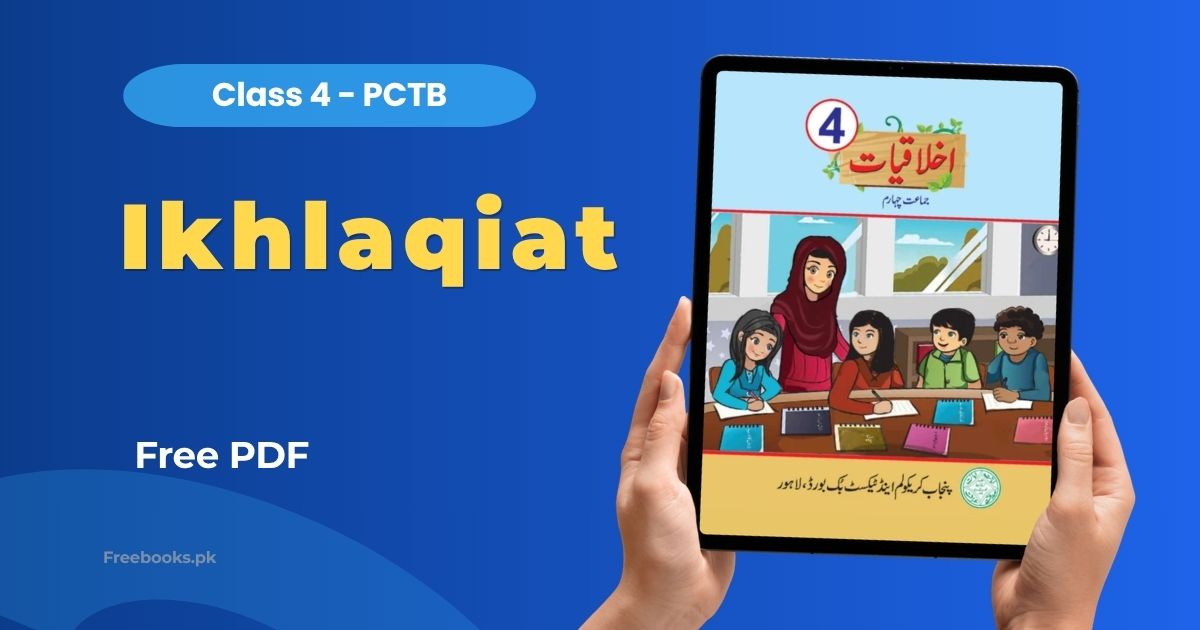
Class 4 students in Punjab who take Ethics instead of Islamiat follow this book as part of the SNC 2020 syllabus set by the Punjab Curriculum and Textbook Board (PCTB). It introduces the world’s major religions, looks closely at Hinduism and Buddhism, and teaches values like honesty and respect that matter in daily school life.
For Class 4 students, this book supports annual exam preparation with clear, story-based lessons instead of dry definitions. Each chapter uses simple dialogues between children and elders, which makes revision easier and helps students remember key facts, beliefs, and figures covered in the syllabus.
Book Overview
| Class | 4 |
| Subject | Ethics (Ikhlaqiat) |
| Category | Class 1-5 |
| Board | Punjab Curriculum and Textbook Board (PCTB) |
| Curriculum | SNC 2020 |
| Total Chapters | 5 (+ Glossary + Bibliography) |
| Total Pages | 74 |
| Format |
Chapter List
Chapter 1: Mazahib Ka Taaruf (Introduction to Religions)
Through conversations between children and their elders, this chapter introduces seven major world religions: Hinduism, Buddhism, Zoroastrianism, Judaism, Christianity, Islam, and Sikhism. Each section covers the founder, key beliefs, and sacred books in simple terms, such as Zoroaster’s five basic beliefs, the Ten Commandments given to Prophet Musa (AS), and the birth of Christianity through Jesus Christ (AS).
Important Questions:
- Who founded Sikhism? Answer: Baba Guru Nanak Sahib, who started it in the 15th century in Punjab.
- What is the holy book of Judaism? Answer: The Torah, which contains five books.
- Name any three major world religions mentioned in this chapter. Answer: Hinduism, Buddhism, and Christianity (also Islam, Judaism, Sikhism, and Zoroastrianism).
- What are the five basic beliefs of Zoroastrianism? Answer: Good and evil have separate powers, life should be lived with good deeds, humans can choose good or evil, and honesty and family life are valued.
Chapter 2: Hindu Dharam (Hinduism)
This chapter explains Hinduism’s Trimurti of Brahma (the creator), Vishnu (the preserver), and Shiva (the destroyer), along with the caste system described in the Vedas. It introduces the sacred texts: the four Vedas, the Mahabharata, the Ramayana, and the Bhagavad Gita. It also covers the meaning of Om and the three paths to moksha (liberation): the path of action, the path of knowledge, and the path of devotion.
Important Questions:
- Who are the three main gods of the Trimurti? Answer: Brahma, Vishnu, and Shiva.
- Which is the oldest sacred book of Hindus? Answer: The Vedas, particularly the Rig Veda.
- What are the three paths to moksha in Hinduism? Answer: The path of action, the path of knowledge, and the path of devotion.
- What does the symbol Om represent? Answer: A sacred sound representing the presence that exists everywhere and holds all power.
Chapter 3: Budh Mazhab (Buddhism)
This chapter traces Buddhism from its founding by Gautama Buddha in ancient India around 600 BC to its spread across Nepal, Sri Lanka, China, and beyond, helped along by rulers like Emperor Ashoka. It covers the eightfold path for overcoming desire and suffering, Buddha’s first sermon at Sarnath calling for a middle path of moderation, and his well-known sayings about overcoming hatred with love.
Important Questions:
- When and where did Buddhism begin? Answer: Around 600 BC, in present-day Nepal (then part of India).
- Which Buddhist king made Buddhism the state religion? Answer: Emperor Ashoka.
- Where did Buddha give his first sermon? Answer: In Sarnath, near Varanasi (Banaras).
- According to Buddha, how should hatred be overcome? Answer: Hatred should be conquered with love, not with more hatred.
Chapter 4: Akhlaqiyat aur Iqdaar (Ethics and Values)
Using short stories, this chapter teaches respect for parents, family, siblings, teachers, and classmates by showing how each religion values these relationships, including examples from Buddha’s teachings, Christian and Islamic guidance on honoring parents, and Allama Iqbal’s respect for his teachers. It also explains honesty as doing one’s duty sincerely, and truthfulness through examples such as Prophet Muhammad’s (PBUH) reputation as Sadiq and Ameen.
Important Questions:
- What is honesty, according to this chapter? Answer: Doing one’s assigned work or duty sincerely and properly.
- Whose teachers were Mir Hassan and Professor Arnold? Answer: Allama Iqbal’s teachers, whom he deeply respected.
- Why was Prophet Muhammad (PBUH) called Sadiq and Ameen before his Prophethood? Answer: Because he always spoke the truth and people trusted him with their belongings.
- What did Buddha say about parents? Answer: Parents deserve deep respect because of the hardships they face while raising their children.
Chapter 5: Aham Shakhsiyat (Important Personalities)
This chapter profiles two major religious figures. Lord Krishna’s birth in Mathura, his upbringing away from a threatening king, and his teachings in the Bhagavad Gita are covered in detail. The second part traces Gautama Buddha’s life from his birth as Prince Siddhartha in Lumbini, his encounters with suffering that led him to leave his palace, his years of meditation, and his gentle, story-based teaching style, illustrated through parables like the story of Kisa Gotami and the mustard seeds.
Important Questions:
- Where was Lord Krishna born? Answer: In Mathura, on the banks of the river Jamuna (Yamuna).
- What is the Bhagavad Gita? Answer: A dialogue between Lord Krishna and Arjuna that explains the concept of the divine.
- What was Gautama Buddha’s birth name? Answer: Siddhartha.
- What lesson did the story of Kisa Gotami teach? Answer: That death comes to every household, and everything in life is impermanent (fani).
Download Section
Click the button below to download the Ethics (Ikhlaqiat) Class 4 PDF for free and start your revision today.
Who Should Read This
This PDF is meant for Class 4 students who study Ethics instead of Islamiat under the Punjab Board (PCTB), following the SNC 2020 curriculum. It is also useful for parents and teachers who want a quick, chapter-wise overview of what students need to know before their annual exams.
Applicable Boards
This book is officially prescribed by the Punjab Curriculum and Textbook Board (PCTB) for Class 4 students. Since the SNC 2020 syllabus is shared across provinces, students following a similar Ethics syllabus in other boards may also find this PDF useful for revision.
Is this PDF for Class 4 students only?
Yes, this PDF is designed for Class 4 Ethics students following the Punjab Board (PCTB) SNC 2020 syllabus.
Can other students use this book?
Yes, students from other boards following a similar Ethics syllabus can also use this PDF for revision.
Is this the latest edition?
Yes, this PDF is based on the latest SNC 2020 edition prescribed by the Punjab Curriculum and Textbook Board.
Does it include solved exercises or important questions?
Yes, each chapter includes a short summary along with important questions and answers for quick revision.
How many chapters does this book have?
The book has 5 chapters, plus a glossary and bibliography, covering world religions, Hinduism, Buddhism, ethics and values, and important personalities.
Is the download free?
Yes, the Ethics Class 4 PDF is completely free to download.
Related Books
© Copyright Policy
Freebooks.pk is an educational resource for students in Pakistan. Textbooks and other books belong to their respective boards, authors and publishers, and all rights remain with them. If you are the copyright holder of any material on this page and want it changed or removed, please contact us or file a request under our DMCA policy. We review every request and remove reported content promptly.