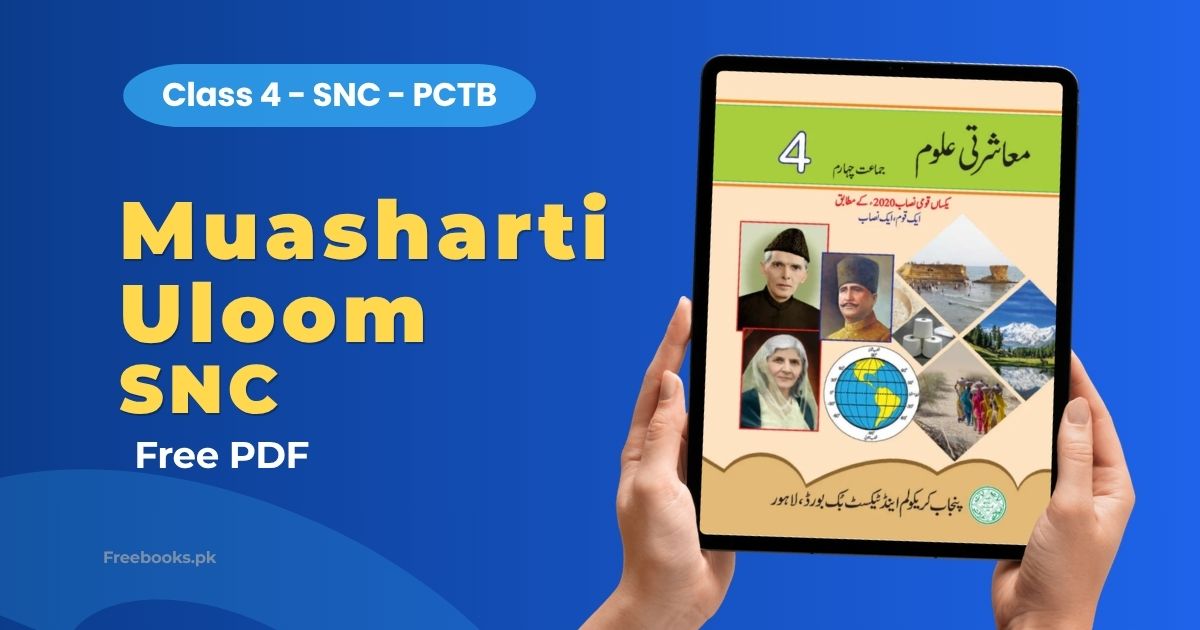
Class 4 students in Punjab study Social Studies as part of the SNC 2020 syllabus set by the Punjab Curriculum and Textbook Board (PCTB). This subject introduces young learners to citizenship, culture, state and government, history, geography and economics. It is part of the official syllabus taught in government and private schools across the province.
For Class 4 students, Social Studies lays the foundation for civic and general knowledge used in later grades. Understanding these six chapters well makes annual exam preparation easier. This free PDF helps with quick revision through chapter summaries and important questions that highlight what usually comes in tests.
Book Overview
| Class | 4 |
| Subject | Social Studies (Muasharti Uloom) |
| Category | Class 1-5 |
| Board | Punjab Curriculum and Textbook Board (PCTB) |
| Curriculum | SNC 2020 |
| Total Chapters | 6 |
| Total Pages | 108 |
| Format |
Chapter List
Chapter 1: Shehriyat (Citizenship and Human Rights)
This chapter explains what a citizen, a global citizen, and a digital citizen are, using the example of Dr. Ruth Pfau, who served leprosy patients in Pakistan for 57 years. It covers basic human rights such as education, healthcare, religious freedom, and freedom of expression, along with citizen responsibilities like paying taxes and respecting laws. The chapter also introduces diversity, tolerance, civic sense, and steps for resolving conflicts peacefully.
Important Questions:
- Who is called a global citizen? Answer: A person aware of world affairs who respects all races and religions, like Dr. Ruth Pfau.
- Name two responsibilities of a citizen. Answer: Being loyal to the country and paying taxes honestly and on time.
- What does tolerance mean? Answer: Respecting the beliefs and opinions of other people.
- What is the first step in resolving a conflict? Answer: Talking calmly and listening fully to the other person’s viewpoint.
Chapter 2: Saqafat (Culture)
This chapter describes Pakistan’s diverse culture, covering national dress, regional foods, and festivals like Eid and Milad-un-Nabi, as well as how minorities celebrate Christmas, Diwali, and Baisakhi. It explains religious harmony and national pride. The second part introduces means of communication, from ancient cave art and language to letters, radio, television, and email, noting that regular TV broadcasts in Pakistan began in 1964 from Lahore.
Important Questions:
- What is Pakistan’s national dress? Answer: Shalwar Qameez, worn differently across regions.
- Give two examples of means of communication. Answer: Radio and email.
- When did regular television broadcasting start in Pakistan? Answer: In 1964, from Lahore.
- What is nationalism? Answer: A feeling of unity and love among people who belong to the same nation.
Chapter 3: Riyasat aur Hukumat (State and Government)
This chapter defines a state through its four elements (territory, population, government, and sovereignty) and explains how it differs from a government. It covers the basic features of the 1973 Constitution, citizen rights and responsibilities, and the three organs of government: legislature, executive, and judiciary. It also explains the Senate, National Assembly, provincial assemblies, democracy, and the qualities of a good leader.
Important Questions:
- What are the four basic elements of a state? Answer: Territory, population, government, and sovereignty.
- Which constitution is currently in force in Pakistan? Answer: The Constitution of 1973.
- What does the federal legislature consist of? Answer: The Senate, the National Assembly, and the President of Pakistan.
- What is democracy? Answer: A government of the people, elected by the people’s votes, that works for the people.
Chapter 4: Tareekh (History)
This chapter introduces three early civilizations: Mesopotamia (between the Tigris and Euphrates rivers), the Egyptian civilization along the Nile with its pyramids and pharaohs, and the Indus Valley civilization with its cities of Mohenjo-daro and Harappa. It then covers the role of each province in the creation of Pakistan and profiles key leaders such as Quaid-e-Azam Muhammad Ali Jinnah, Allama Iqbal, and Mohtarma Fatima Jinnah, along with the contribution of minorities.
Important Questions:
- Which civilization is called the cradle of civilizations? Answer: Mesopotamia, home to the Sumerian, Assyrian, and Babylonian civilizations.
- Which province was the first to join Pakistan? Answer: Sindh, on 26 June 1947.
- When and where was the Lahore Resolution (Qarardad-e-Pakistan) presented? Answer: On 23 March 1940, in Lahore.
- When did Allama Iqbal present the idea of a separate Muslim state? Answer: On 30 December 1930, in Allahabad.
Chapter 5: Jughrafia (Geography)
This chapter teaches globe and map skills (including the BOLTS elements), the seven continents, and five oceans, then explores Pakistan’s major landforms: mountains, plateaus, plains, deserts, and coastal areas. It explains how human activities like deforestation and industry affect the environment, the difference between weather and climate, and natural disasters such as floods, earthquakes, cyclones, and avalanches, along with safety measures. It closes with population and the 2017 census figures.
Important Questions:
- Name Pakistan’s three major deserts. Answer: Thal, Thar, and Kharan deserts.
- What is the difference between weather and climate? Answer: Weather is short-term atmospheric condition, while climate is the weather pattern of a place over a long period.
- What was Pakistan’s population according to the 2017 census? Answer: About 207.77 million (20 crore 77 lakh).
- What safety measure should be taken before an earthquake? Answer: Stay informed and know a safe location to move to during an emergency.
Chapter 6: Muashiyat (Economics)
This chapter introduces economics and economy, economic choice, and the difference between goods, services, producers, and consumers. It explains inflation, trade, and Pakistan’s main imports (petroleum, machinery) and exports (textiles, rice, sports goods). It also covers types of entrepreneurs, such as sole proprietors and partnerships, and the services banks provide, including deposits, loans, and bill payments.
Important Questions:
- What is inflation? Answer: A continuous rise in the prices of goods in a country.
- Name two of Pakistan’s major exports. Answer: Cotton cloth and rice.
- What are the two types of entrepreneurs? Answer: Sole proprietor and partnership.
- What services does a bank provide? Answer: Accepting deposits, giving loans, and handling utility bill payments.
Download Section
Click the button below to download the Social Studies Class 4 PDF for free and start your revision today.
Who Should Read This
This PDF is meant for Class 4 students studying under the Punjab Board (PCTB) and following the SNC 2020 curriculum. It is also useful for parents and teachers who want a quick, chapter-wise overview of what students need to know before their annual exams.
Applicable Boards
This book is officially prescribed by the Punjab Curriculum and Textbook Board (PCTB) for Class 4 students. Since the SNC 2020 syllabus is shared across provinces, students following similar Social Studies content in other boards may also find this PDF useful for revision.
Is this PDF for Class 4 students only?
Yes, this PDF is designed for Class 4 Social Studies students following the Punjab Board (PCTB) SNC 2020 syllabus.
Can other students use this book?
Yes, students from other boards following a similar Social Studies syllabus can also use this PDF for revision.
Is this the latest edition?
Yes, this PDF is based on the latest SNC 2020 edition prescribed by the Punjab Curriculum and Textbook Board.
Does it include solved exercises or important questions?
Yes, each chapter includes a short summary along with important questions and answers for quick revision.
How many chapters does this book have?
The book has 6 chapters covering citizenship, culture, state and government, history, geography, and economics.
Is the download free?
Yes, the Social Studies Class 4 PDF is completely free to download.
Related Books
© Copyright Policy
Freebooks.pk is an educational resource for students in Pakistan. Textbooks and other books belong to their respective boards, authors and publishers, and all rights remain with them. If you are the copyright holder of any material on this page and want it changed or removed, please contact us or file a request under our DMCA policy. We review every request and remove reported content promptly.