This chapter covers Nuclear Physics from the 2nd Year (FSc Part-II) Physics syllabus of the Punjab Curriculum and Textbook Board (PTB/PCTB). It studies the atomic nucleus and isotopes, mass defect and binding energy, radioactivity and half-life, radiation detectors, nuclear reactions, fission and fusion, the biological effects and medical uses of radiation and the basic building blocks of matter. These notes are prepared by freebooks.pk.
The nucleus at the heart of the atom is tiny but holds enormous energy. Nuclear physics explains radioactivity, nuclear reactors, the energy of stars and the uses of radiation in medicine.
Learning Objectives
- Describe the nucleus, nucleons and isotopes.
- Explain mass defect and binding energy.
- Describe radioactivity and define half-life.
- Describe radiation detectors and nuclear reactions.
- Explain nuclear fission and fusion and their applications.
- Describe the biological effects and medical uses of radiation and the building blocks of matter.
Key Concepts
The Atomic Nucleus and Isotopes
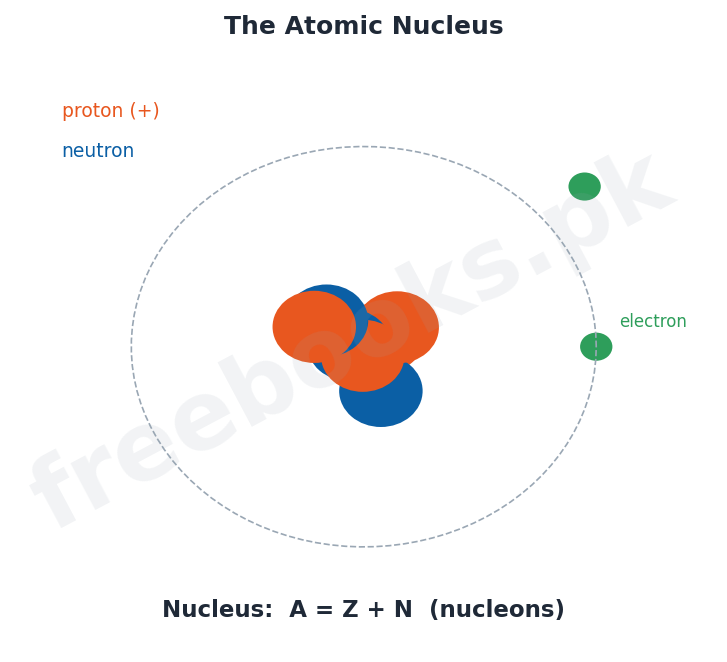
The nucleus of an atom is made up of protons, which carry positive charge, and neutrons, which are uncharged; together these are called nucleons. The number of protons is the atomic number Z, and the total number of nucleons is the mass number A, so the number of neutrons is A – Z. Isotopes are atoms of the same element (same Z) that have different numbers of neutrons and therefore different mass numbers; for example hydrogen has the isotopes protium, deuterium and tritium. Isotopes have the same chemical properties but different masses.
Mass Defect and Binding Energy
The mass of a nucleus is always found to be slightly less than the total mass of the separate protons and neutrons that make it up; this difference is called the mass defect. According to Einstein’s relation E = m c^2, this missing mass has been converted into the energy that binds the nucleons together, called the binding energy. The binding energy is the energy that would be needed to break the nucleus into its separate nucleons, and the binding energy per nucleon measures how tightly a nucleus is held together; it is greatest for nuclei of medium mass, which are the most stable.
Radioactivity
Radioactivity is the spontaneous breakdown of unstable nuclei with the emission of radiation. There are three main types: alpha particles (helium nuclei, positively charged, weakly penetrating), beta particles (fast electrons, negatively charged, more penetrating) and gamma rays (high-energy electromagnetic radiation, uncharged, very penetrating). When a nucleus emits an alpha or beta particle it changes into the nucleus of a different element, a process called radioactive decay or transmutation.
Half-Life
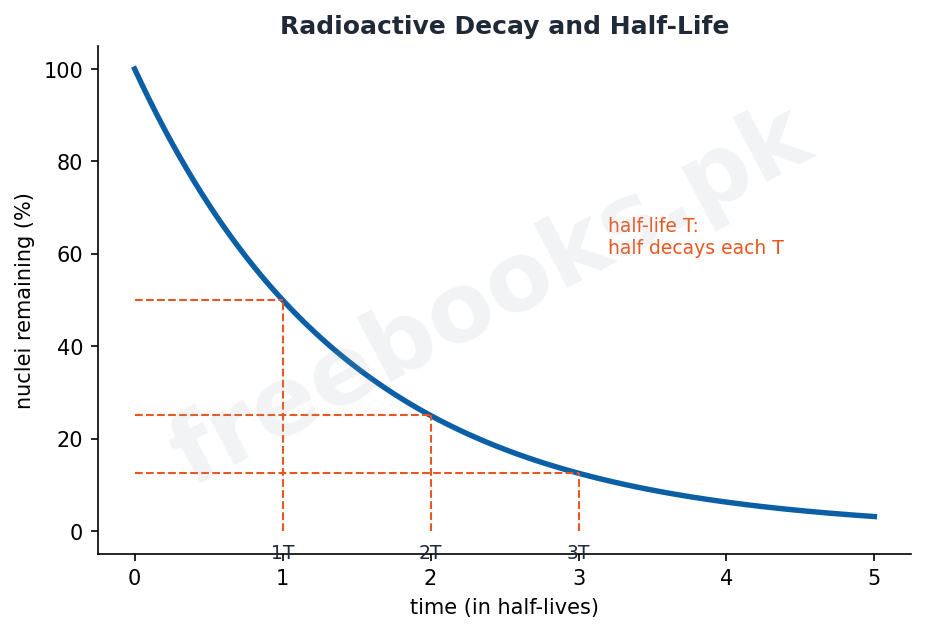
Radioactive decay is a random process, but for a large number of nuclei it follows a definite pattern. The half-life of a radioactive substance is the time taken for half of the nuclei present to decay. After one half-life half the original nuclei remain, after two half-lives one quarter remain, and so on. Different isotopes have very different half-lives, from fractions of a second to billions of years, and the half-life is used to date rocks and archaeological remains.
Radiation Detectors and Nuclear Reactions
Radiation cannot be seen directly, so special detectors are used. The Geiger-Muller counter detects individual particles of radiation by the ionisation they cause in a gas, giving a click or a count for each particle, while a cloud chamber shows the tracks of ionising particles as trails of tiny droplets. A nuclear reaction is one in which the nucleus of an atom is changed, for example by bombarding it with a particle; in such reactions the total charge and the total number of nucleons are conserved, and energy is released or absorbed according to E = m c^2.
Nuclear Fission and Fusion
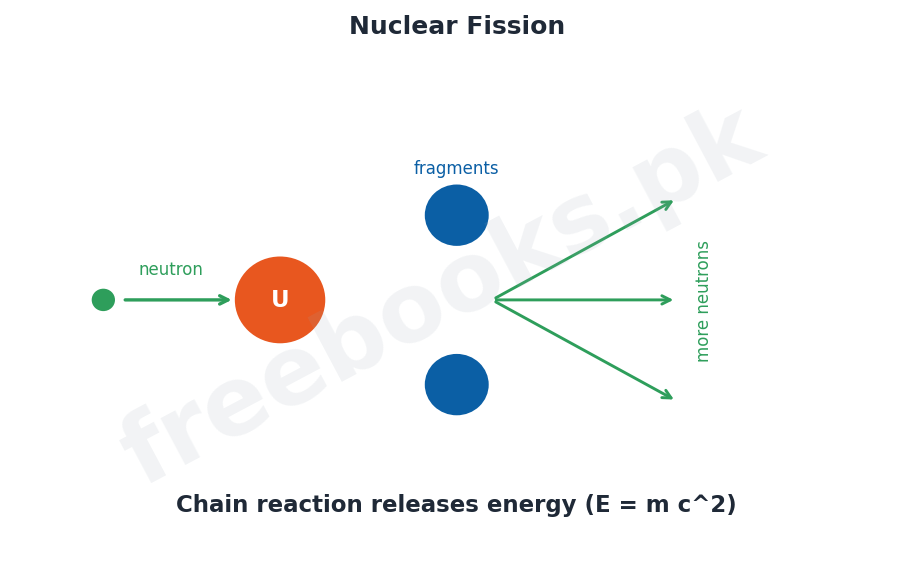
In nuclear fission a heavy nucleus such as uranium splits into two lighter nuclei when it absorbs a neutron, releasing a great deal of energy and two or three more neutrons; these neutrons can split further nuclei, giving a chain reaction. A controlled chain reaction in a nuclear reactor is used to generate electricity. In nuclear fusion two light nuclei, such as those of hydrogen, join to form a heavier nucleus, again releasing energy; fusion is the source of the energy of the Sun and stars. Both processes release energy because the products are more tightly bound (have greater binding energy per nucleon) than the starting nuclei.
Effects and Uses of Radiation
Radiation ionises the atoms of any material it passes through, and in living tissue this can damage cells and cause harm, so exposure to radiation must be limited and controlled. However, radiation also has many valuable uses. In medicine, radioactive tracers are used to study the working of organs, gamma rays are used to destroy cancer cells (radiotherapy) and to sterilise instruments, and X-rays and gamma rays are used in imaging. In industry radiation is used to detect flaws in metals and to control thickness.
Building Blocks of Matter
Matter is built from a small number of fundamental particles, and four basic forces act between them: the strong nuclear force (which holds the nucleus together), the electromagnetic force, the weak nuclear force (responsible for beta decay) and gravity. The fundamental particles are grouped into leptons, such as the electron, which are truly elementary, and hadrons, such as the proton and neutron, which are made of still smaller particles called quarks. This picture of quarks and leptons is the modern understanding of the ultimate building blocks of matter.
Important Definitions
Nucleon
A proton or a neutron in the nucleus.
Atomic number Z
The number of protons in the nucleus.
Mass number A
The total number of nucleons (protons + neutrons).
Isotopes
Atoms of the same element with different numbers of neutrons.
Mass defect
The difference between the mass of a nucleus and its separate nucleons.
Binding energy
The energy equivalent of the mass defect, holding the nucleus together.
Half-life
The time for half the nuclei of a radioactive sample to decay.
Nuclear fission
The splitting of a heavy nucleus into lighter ones with release of energy.
Formulas & Rules
| Item | Fact |
|---|---|
| Number of neutrons | N = A – Z |
| Mass-energy relation | E = m c^2 |
| Binding energy | E = (mass defect) x c^2 |
| Half-life decay | after n half-lives, fraction = (1/2)^n |
Diagrams & Illustrations
The atomic nucleus: the nucleus made of protons and neutrons (nucleons) with A = Z + N, surrounded by orbiting electrons.
Radioactive decay and half-life: a decay curve showing the number of radioactive nuclei halving after each half-life T.
Nuclear fission: a neutron splitting a uranium nucleus into fragments and releasing more neutrons, starting a chain reaction.
Solved Examples & Numericals
Number of neutrons
A nucleus has mass number A = 235 and atomic number Z = 92. Its number of neutrons is N = A – Z = 235 – 92 = 143.
Half-life
A sample has a half-life of 5 years. After 15 years (3 half-lives) the fraction remaining is (1/2)^3 = 1/8 of the original.
Binding energy
If the mass defect of a nucleus is 0.03 u (1 u gives about 931 MeV), its binding energy is about 0.03 x 931 = 28 MeV.
Fission energy
When a uranium nucleus undergoes fission, a small loss of mass appears as a large amount of energy through E = m c^2.
Short Questions & Answers
What are nucleons?
The particles in the nucleus, that is, protons and neutrons.
What are isotopes?
Atoms of the same element (same atomic number) that have different numbers of neutrons and hence different mass numbers.
Define mass defect.
The difference between the total mass of the separate nucleons and the actual mass of the nucleus.
Define half-life.
The time taken for half the nuclei of a radioactive sample to decay.
What is nuclear fission?
The splitting of a heavy nucleus into two lighter nuclei, with the release of energy and neutrons.
What is nuclear fusion?
The joining of two light nuclei to form a heavier nucleus, releasing energy; the source of the Sun’s energy.
Long Questions & Answers
Q1: Explain mass defect and binding energy and their significance for nuclear stability.
When the mass of any nucleus is measured, it is found to be a little less than the sum of the masses of the individual protons and neutrons that make it up. This difference in mass is called the mass defect. The explanation lies in Einstein’s mass-energy relation E = m c^2: when the separate nucleons come together to form a nucleus, some of their mass is converted into energy, which is released, and this same amount of energy would have to be supplied again to pull the nucleus apart into its separate nucleons. This energy is called the binding energy of the nucleus, and it is a measure of how strongly the nucleons are held together. A more useful quantity is the binding energy per nucleon, obtained by dividing the total binding energy by the number of nucleons. When the binding energy per nucleon is plotted against mass number, it rises steeply for light nuclei, reaches a maximum for nuclei of medium mass (around iron), and then falls slowly for the heaviest nuclei. Nuclei with the greatest binding energy per nucleon are the most stable. This curve explains why energy is released both when a very heavy nucleus splits into medium-sized fragments (fission) and when very light nuclei join together (fusion): in both cases the products are more tightly bound than the starting materials, so energy is given out.
Q2: Describe radioactivity, the three types of radiation, and the meaning of half-life.
Radioactivity is the spontaneous disintegration of unstable atomic nuclei, accompanied by the emission of radiation. It happens without any external cause and is not affected by ordinary chemical or physical conditions such as temperature or pressure. There are three main kinds of radiation. Alpha particles are helium nuclei, consisting of two protons and two neutrons; they carry a positive charge, are relatively heavy and slow, and are easily stopped, for example by a sheet of paper. Beta particles are fast-moving electrons emitted from the nucleus; they carry a negative charge and are more penetrating than alpha particles, being stopped by a few millimetres of aluminium. Gamma rays are very high-energy electromagnetic radiation, carry no charge, and are the most penetrating, requiring thick lead or concrete to reduce them. When a nucleus emits an alpha or beta particle it turns into the nucleus of a different element, a process called radioactive decay or transmutation. Although the decay of any single nucleus is entirely random and cannot be predicted, a large sample decays in a regular way described by the half-life, which is the time taken for half of the nuclei present to decay. After one half-life half the original nuclei remain, after two half-lives a quarter, after three an eighth, and so on. Half-lives range from tiny fractions of a second to billions of years, and measuring them allows scientists to date rocks and ancient remains.
Q3: Explain nuclear fission and fusion and describe the biological effects and medical uses of radiation.
Nuclear fission and fusion are two processes that release the enormous energy stored in the nucleus. In fission, a heavy nucleus such as uranium-235 captures a slow neutron and becomes so unstable that it splits into two lighter nuclei, releasing a large amount of energy together with two or three fresh neutrons. These neutrons can go on to split further uranium nuclei, so that the process multiplies rapidly in a chain reaction. If the chain reaction is allowed to run freely it produces the explosive energy of an atomic bomb, but if it is carefully controlled, by absorbing surplus neutrons, it becomes the steady, useful source of heat in a nuclear reactor, which is used to generate electricity. In fusion, the opposite happens: two very light nuclei, such as those of hydrogen isotopes, are made to join together to form a heavier nucleus, again releasing energy; this is the process that powers the Sun and the other stars. Both processes give out energy because the products are more tightly bound than the original nuclei. The radiation from nuclear processes ionises the matter it passes through, and in living tissue this ionisation can damage or kill cells, so exposure must be kept low and shielding and safety precautions are essential. At the same time, radiation is extremely useful in medicine: small amounts of radioactive substances are used as tracers to follow the working of organs and detect disease, carefully aimed beams of gamma rays are used to destroy cancerous tumours in radiotherapy, gamma radiation is used to sterilise surgical instruments, and X-rays and gamma rays are used to form images of the inside of the body. Thus the same nuclear radiation that can be harmful, when properly controlled, saves many lives.
MCQs with Answers
The particles in the nucleus are called: (a) ions (b) nucleons (c) photons (d) quanta
Correct Answer: (b) nucleons.
The atomic number is the number of: (a) neutrons (b) protons (c) electrons only (d) nucleons
Correct Answer: (b) protons.
Isotopes have the same number of ___ but different neutrons: (a) protons (b) nucleons (c) neutrons (d) mass
Correct Answer: (a) protons.
The missing mass of a nucleus is the: (a) binding energy (b) mass defect (c) half-life (d) isotope
Correct Answer: (b) mass defect.
Binding energy comes from the mass defect via: (a) V = IR (b) E = m c^2 (c) F = ma (d) PV = nRT
Correct Answer: (b) E = m c^2.
The most penetrating radiation is: (a) alpha (b) beta (c) gamma (d) all equal
Correct Answer: (c) gamma.
After 2 half-lives the fraction remaining is: (a) 1/2 (b) 1/4 (c) 1/8 (d) 0
Correct Answer: (b) 1/4.
Splitting a heavy nucleus is called: (a) fusion (b) fission (c) decay (d) ionisation
Correct Answer: (b) fission.
The Sun’s energy comes mainly from: (a) fission (b) fusion (c) combustion (d) friction
Correct Answer: (b) fusion.
A Geiger-Muller counter detects radiation by: (a) heating (b) ionisation (c) reflection (d) refraction
Correct Answer: (b) ionisation of a gas.
Quick Revision Summary
- Nucleus = protons + neutrons (nucleons); Z = protons, A = nucleons, N = A – Z.
- Isotopes: same Z, different N; mass defect -> binding energy (E = m c^2).
- Radioactivity: alpha (He nucleus), beta (electron), gamma (EM, most penetrating).
- Half-life = time for half the nuclei to decay; (1/2)^n remain after n half-lives.
- Fission (heavy nucleus splits, chain reaction, reactor); fusion (light nuclei join, powers the Sun).
- Radiation ionises tissue (harmful) but is used in tracers, radiotherapy and imaging; matter = quarks + leptons, four basic forces. Notes by freebooks.pk.
Exam Tips
- Define nucleon, Z, A and N = A – Z.
- Explain mass defect and binding energy with E = m c^2.
- List the three radiations in order of penetrating power.
- Use (1/2)^n for the fraction remaining after n half-lives.
- Distinguish fission (splitting) from fusion (joining).
- Give both the dangers and medical uses of radiation.