This chapter covers Physics of Solids from the 2nd Year (FSc Part-II) Physics syllabus of the Punjab Curriculum and Textbook Board (PTB/PCTB). It studies the classification of solids, their mechanical properties (stress, strain, Young’s modulus and elasticity), their electrical properties and energy bands, superconductors and the magnetic properties of solids. These notes are prepared by freebooks.pk.
Solids are all around us, from metals and glass to plastics and magnets. This chapter explains how their internal structure gives them their mechanical, electrical and magnetic properties.
Learning Objectives
- Classify solids as crystalline, amorphous and polymeric.
- Define stress, strain and Young’s modulus and describe elastic behaviour.
- Explain the electrical properties of solids using energy bands.
- Distinguish conductors, insulators and semiconductors.
- Describe superconductors.
- Explain the magnetic properties of solids and the hysteresis loop.
Key Concepts
Classification of Solids
Solids are classified by the arrangement of their particles. In crystalline solids (such as metals, diamond and common salt) the atoms are arranged in a regular, repeating three-dimensional pattern and the solid has a definite melting point. In amorphous or glassy solids (such as glass and plastic) the atoms have no long-range order, so these solids soften gradually rather than melting sharply. Polymeric solids (such as rubber and polythene) are made of very long chain molecules formed by joining many small units, and their properties lie between those of crystalline and amorphous solids.
Stress and Strain
When a force is applied to a solid it tends to change its shape or size. Stress is the force acting per unit area of the body, stress = F/A, measured in pascals, and strain is the fractional change produced, for example the change in length divided by the original length; strain has no units. Stress and strain describe how a material responds to applied forces and are the starting point for studying elasticity.
Elasticity, Hooke’s Law and Young’s Modulus
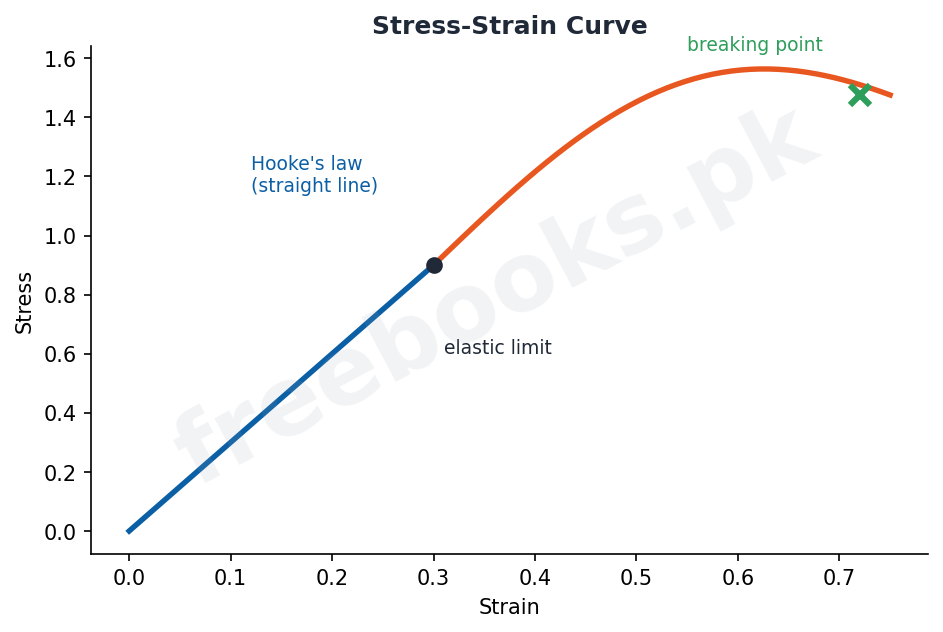
A body is elastic if it returns to its original shape when the deforming force is removed. Within a limit called the elastic limit, Hooke’s law holds: the strain is directly proportional to the stress. The ratio of stress to strain within this limit is a constant of the material called Young’s modulus, Y = stress/strain, which measures the stiffness of the material; a large Young’s modulus means the material is hard to stretch. Beyond the elastic limit the material is permanently deformed and eventually reaches its breaking point.
Electrical Properties and Energy Bands
The electrical behaviour of a solid is explained by the energy band theory. In a solid the allowed energies of the electrons form bands separated by forbidden gaps. The highest filled band is the valence band and the next higher band is the conduction band. Whether a solid conducts depends on the gap between these bands and whether the conduction band contains electrons free to move.
Conductors, Insulators and Semiconductors
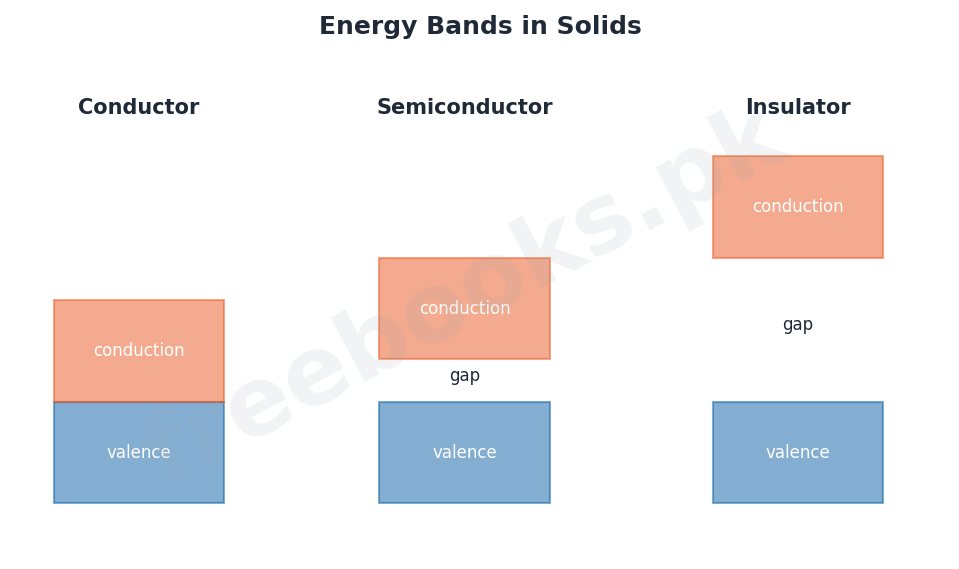
In a conductor (a metal) the valence and conduction bands overlap or the conduction band is partly filled, so there are many free electrons and the material conducts well. In an insulator the two bands are separated by a large energy gap that electrons cannot normally cross, so there are no free electrons and the material does not conduct. In a semiconductor the gap is small, so at ordinary temperatures a few electrons cross into the conduction band; its conductivity lies between that of conductors and insulators and increases with temperature. Semiconductors are the basis of all modern electronics.
Superconductors
Some materials, when cooled below a certain very low temperature called the critical (or transition) temperature, lose all their electrical resistance and become superconductors. A current once set up in a superconducting ring continues to flow indefinitely without any energy loss. Superconductors also expel magnetic fields from their interior. They are used to make very powerful electromagnets, for example in magnetic resonance imaging (MRI) machines.
Magnetic Properties of Solids
Solids are classified magnetically by how they respond to a magnetic field. Diamagnetic substances are weakly repelled by a field, paramagnetic substances are weakly attracted, and ferromagnetic substances (such as iron, nickel and cobalt) are strongly attracted and can be permanently magnetised. In ferromagnetic materials the atoms group into small regions called domains, each strongly magnetised; when the material is magnetised these domains line up with the field.
Hysteresis
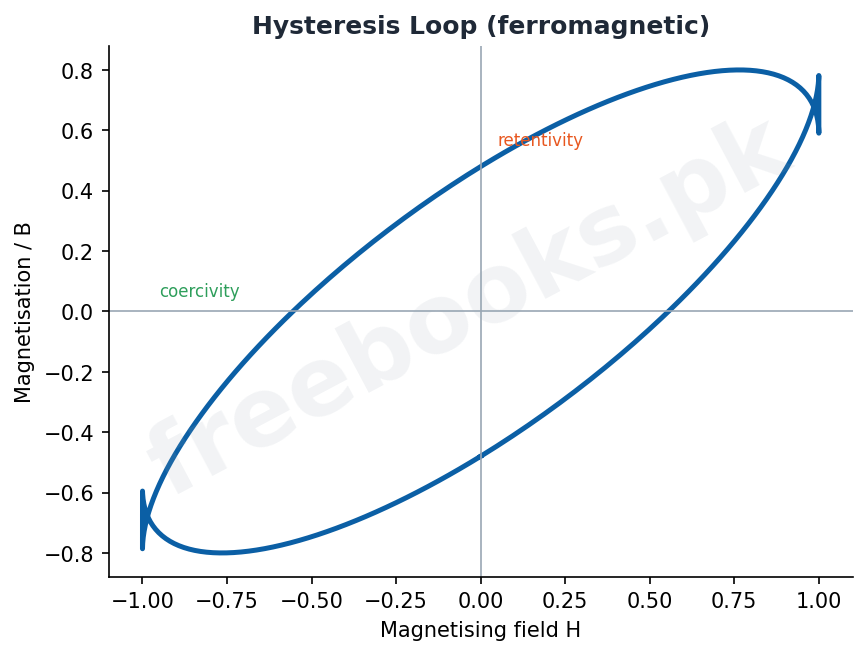
When a ferromagnetic material is taken through a cycle of magnetisation, the magnetisation lags behind the magnetising field; this lagging is called hysteresis. If the magnetisation is plotted against the magnetising field, a closed loop called the hysteresis loop is obtained. The magnetisation that remains when the field is removed is the retentivity, and the reverse field needed to remove it is the coercivity. The area of the loop represents the energy lost as heat in each cycle, which is important when choosing materials for transformer cores and permanent magnets.
Important Definitions
Crystalline solid
A solid whose atoms are arranged in a regular repeating pattern.
Amorphous solid
A solid with no long-range order in its atoms (e.g. glass).
Stress
The force per unit area on a body, stress = F/A.
Strain
The fractional change in size or shape produced by stress.
Young’s modulus
The ratio of stress to strain within the elastic limit, Y = stress/strain.
Semiconductor
A material whose conductivity lies between conductors and insulators.
Superconductor
A material with zero electrical resistance below a critical temperature.
Hysteresis
The lagging of magnetisation behind the magnetising field.
Formulas & Rules
| Item | Fact |
|---|---|
| Stress | stress = F / A |
| Strain (longitudinal) | strain = change in length / original length |
| Young’s modulus | Y = stress / strain |
| Hooke’s law | stress is proportional to strain (within elastic limit) |
Diagrams & Illustrations
Stress-strain curve: a stress-strain graph showing the straight-line Hooke’s law region, the elastic limit and the breaking point.
Energy bands: the valence and conduction bands for a conductor (overlapping), a semiconductor (small gap) and an insulator (large gap).
Hysteresis loop: a hysteresis loop of a ferromagnetic material, marking the retentivity and coercivity.
Solved Examples & Numericals
Stress
A wire of area 2 x 10^-6 m^2 carries a load of 40 N. Stress = F/A = 40 / 2×10^-6 = 2 x 10^7 Pa.
Strain
A wire 2 m long stretches by 1 mm. Strain = 1×10^-3 / 2 = 5 x 10^-4 (no units).
Young’s modulus
For the wire above, Y = stress/strain = 2×10^7 / 5×10^-4 = 4 x 10^10 Pa.
Semiconductor
As temperature rises, more electrons cross the small band gap of a semiconductor, so its resistance decreases (unlike a metal).
Short Questions & Answers
Distinguish crystalline and amorphous solids.
Crystalline solids have a regular repeating atomic arrangement and a sharp melting point; amorphous solids have no long-range order and soften gradually.
Define stress and strain.
Stress is the force per unit area (F/A) and strain is the fractional change in size or shape; strain has no units.
What is Young’s modulus?
The ratio of stress to strain within the elastic limit, Y = stress/strain; it measures stiffness.
Differentiate a conductor and an insulator using bands.
In a conductor the valence and conduction bands overlap giving free electrons; in an insulator a large gap separates them so there are no free electrons.
What is a superconductor?
A material that loses all electrical resistance below a critical temperature.
What is hysteresis?
The lagging of the magnetisation of a ferromagnetic material behind the magnetising field.
Long Questions & Answers
Q1: Define stress, strain and Young’s modulus, and describe elastic behaviour using the stress-strain curve.
When a solid is subjected to external forces, two quantities describe its response. Stress is the internal restoring force set up per unit area of cross-section and is equal in magnitude to the applied force per unit area, stress = F/A, measured in pascals. Strain is the resulting fractional deformation, for example the increase in length divided by the original length, and being a ratio it has no units. A body is said to be elastic if it regains its original shape and size once the deforming force is removed. If we gradually increase the stress on a wire and plot stress against strain, the graph is at first a straight line through the origin: in this region the strain is directly proportional to the stress, which is Hooke’s law, and the constant ratio of stress to strain is Young’s modulus, Y = stress/strain, a measure of the stiffness of the material. This straight-line behaviour continues up to a point called the elastic limit; up to this point the wire returns to its original length when unloaded. Beyond the elastic limit the material no longer obeys Hooke’s law and is permanently stretched even after the load is removed, and if the stress is increased still further the wire finally reaches its breaking point and snaps. Young’s modulus and the position of the elastic limit therefore tell engineers how stiff a material is and how much load it can safely bear.
Q2: Explain the electrical properties of solids using energy bands and distinguish conductors, insulators and semiconductors.
The wide range of electrical behaviour of solids is explained by the energy band theory. In an isolated atom the electrons can have only certain discrete energies, but when a very large number of atoms come together to form a solid these levels broaden into ranges of allowed energies called energy bands, which are separated by forbidden gaps in which no electron can exist. The highest band that is normally filled with electrons is called the valence band, and the next allowed band above it is the conduction band; only electrons in the conduction band (or in a partly filled band) are free to move through the solid and carry a current. Whether a solid conducts therefore depends on the arrangement of these bands. In a conductor, such as a metal, the valence and conduction bands overlap, or the highest band is only partly filled, so there are always plenty of free electrons and the material conducts electricity readily. In an insulator the valence band is completely filled and is separated from the empty conduction band by a large energy gap that electrons cannot ordinarily cross, so there are no free electrons and the material does not conduct. In a semiconductor the forbidden gap is quite small, so at room temperature the thermal energy is enough to lift a few electrons across into the conduction band, giving a conductivity between that of conductors and insulators; because more electrons cross the gap as the temperature rises, the conductivity of a semiconductor increases with temperature, the opposite of a metal. This controllable conductivity makes semiconductors the foundation of diodes, transistors and all modern electronics.
Q3: Describe the magnetic properties of solids and explain the hysteresis loop of a ferromagnetic material.
Solids differ greatly in how they respond to a magnetic field, and they are classified accordingly. Diamagnetic substances are very weakly repelled by a magnetic field. Paramagnetic substances are very weakly attracted by a field but lose their magnetism as soon as the field is removed. Ferromagnetic substances, such as iron, nickel and cobalt, are strongly attracted and can be made into permanent magnets; in these materials the atoms group themselves into small regions called domains, within each of which the atomic magnets are already aligned, and magnetising the material consists of lining up these domains with the applied field. When a ferromagnetic material is carried through a complete cycle of magnetisation, first magnetised in one direction, then demagnetised, then magnetised in the opposite direction and back again, its magnetisation always lags behind the magnetising field; this lagging is called hysteresis, and a graph of the magnetisation against the magnetising field forms a closed curve called the hysteresis loop. When the magnetising field is reduced to zero some magnetisation remains, called the retentivity, and a reverse field, called the coercivity, must be applied to remove it. The area enclosed by the loop represents the energy dissipated as heat in the material during each cycle. This is why soft magnetic materials with a thin loop and small energy loss are chosen for transformer cores, while hard materials with a large loop are used for permanent magnets.
MCQs with Answers
A solid with a regular repeating atomic pattern is: (a) amorphous (b) crystalline (c) polymeric (d) liquid
Correct Answer: (b) crystalline.
Stress is: (a) F A (b) F/A (c) A/F (d) F + A
Correct Answer: (b) F/A.
Strain has the unit: (a) pascal (b) newton (c) no unit (d) metre
Correct Answer: (c) no unit.
Young’s modulus is: (a) strain/stress (b) stress/strain (c) stress x strain (d) stress + strain
Correct Answer: (b) stress/strain.
Hooke’s law holds up to the: (a) breaking point (b) elastic limit (c) band gap (d) domain
Correct Answer: (b) elastic limit.
In a conductor the valence and conduction bands: (a) are far apart (b) overlap (c) are empty (d) do not exist
Correct Answer: (b) overlap.
A semiconductor has a ___ energy gap: (a) large (b) small (c) zero (d) infinite
Correct Answer: (b) small.
With rising temperature a semiconductor’s resistance: (a) increases (b) decreases (c) stays same (d) is infinite
Correct Answer: (b) decreases.
A superconductor has ___ resistance below its critical temperature: (a) high (b) zero (c) infinite (d) negative
Correct Answer: (b) zero.
The lagging of magnetisation behind the field is: (a) resonance (b) hysteresis (c) induction (d) polarisation
Correct Answer: (b) hysteresis.
Quick Revision Summary
- Solids: crystalline (regular), amorphous (glassy), polymeric (long chains).
- Stress = F/A; strain = fractional change; Young’s modulus Y = stress/strain.
- Hooke’s law up to the elastic limit; then permanent deformation and breaking point.
- Energy bands: conductor (overlap), semiconductor (small gap), insulator (large gap).
- Superconductor: zero resistance below critical temperature.
- Magnetism: dia (repelled), para (weakly attracted), ferro (strong, domains); hysteresis loop, retentivity, coercivity. Notes by freebooks.pk.
Exam Tips
- Classify solids with an example of each type.
- Learn stress = F/A, strain (no units) and Y = stress/strain.
- Link Hooke’s law to the straight part of the stress-strain curve.
- Explain conductor/insulator/semiconductor with band gaps.
- Remember a semiconductor’s resistance falls with temperature.
- Define retentivity and coercivity on the hysteresis loop.