
This chapter covers Current Electricity from the 2nd Year (FSc Part-II) Physics syllabus of the Punjab Curriculum and Textbook Board (PTB/PCTB). It studies electric current and its effects, Ohm’s law, resistivity and its temperature dependence, electrical power, electromotive force and potential difference, Kirchhoff’s rules, the Wheatstone bridge and the potentiometer. These notes are prepared by freebooks.pk.
Current electricity deals with charges in motion. Every electrical appliance, from a torch to a computer, works because charges flow through circuits, so understanding current, resistance and the rules that govern circuits is essential.
Learning Objectives
- Define electric current and describe its direction and effects.
- State and apply Ohm’s law.
- Explain resistivity and how resistance depends on temperature.
- Calculate electrical power and power dissipation in resistors.
- Distinguish electromotive force (EMF) from potential difference.
- State and apply Kirchhoff’s two rules.
- Explain the Wheatstone bridge and the potentiometer.
Key Concepts
Electric Current and Its Direction
Electric current is the rate of flow of electric charge through a conductor, I = Q/t, and its SI unit is the ampere (A); one ampere is one coulomb per second. In a metallic conductor the current is carried by free electrons, which drift from the negative to the positive terminal. However, by convention the direction of conventional current is taken as the direction in which positive charge would flow, that is, from the positive to the negative terminal in the external circuit, opposite to the electron flow. When a steady current flows, the same charge passes every cross-section of the wire in a given time.
Sources of Current and Effects of Current
A source of current, such as a cell, battery or generator, maintains a potential difference that keeps charges flowing round a circuit by converting some other form of energy (chemical, mechanical, and so on) into electrical energy. An electric current always produces three observable effects: a heating effect (the wire warms up, used in heaters and bulbs), a magnetic effect (a current sets up a magnetic field around it, used in electromagnets and motors) and a chemical effect (a current passing through a solution can cause chemical changes, used in electrolysis and electroplating).
Ohm’s Law
Ohm’s law states that the current passing through a conductor is directly proportional to the potential difference across its ends, provided the physical conditions such as temperature remain constant. This gives V = I R, where R is the resistance of the conductor, measured in ohms. Conductors that obey Ohm’s law are called ohmic (for example metals at constant temperature), while devices such as diodes and filament bulbs are non-ohmic because their resistance changes with the applied voltage or temperature.
Resistivity and Its Temperature Dependence
The resistance of a wire depends on its material, length and thickness: R = rho L / A, where L is the length, A the cross-sectional area and rho the resistivity, a property of the material. A long thin wire has more resistance than a short thick one of the same material. Resistivity itself depends on temperature: for metals the resistivity, and hence the resistance, increases with temperature because the atoms vibrate more and obstruct the electrons, while for semiconductors the resistance decreases with rising temperature. The fractional change per degree is described by the temperature coefficient of resistance.
Electrical Power and Power Dissipation
Electrical power is the rate at which electrical energy is converted into other forms, P = V I. Using Ohm’s law this can also be written as P = I^2 R or P = V^2 / R. When current flows through a resistor, electrical energy is dissipated as heat at the rate P = I^2 R; this is why wires and resistors warm up. The energy consumed in time t is W = P t, commonly measured in kilowatt-hours for domestic bills.
Electromotive Force and Potential Difference
The electromotive force (EMF) of a source is the energy it supplies to each unit of charge that passes through it, and equals the potential difference across its terminals when no current flows. Every real source has some internal resistance r, so when it drives a current I the terminal potential difference is less than the EMF: V = E – I r, where E is the EMF. Thus EMF is the total energy per unit charge provided by the source, while potential difference is the energy per unit charge delivered to the external circuit.
Kirchhoff’s Rules
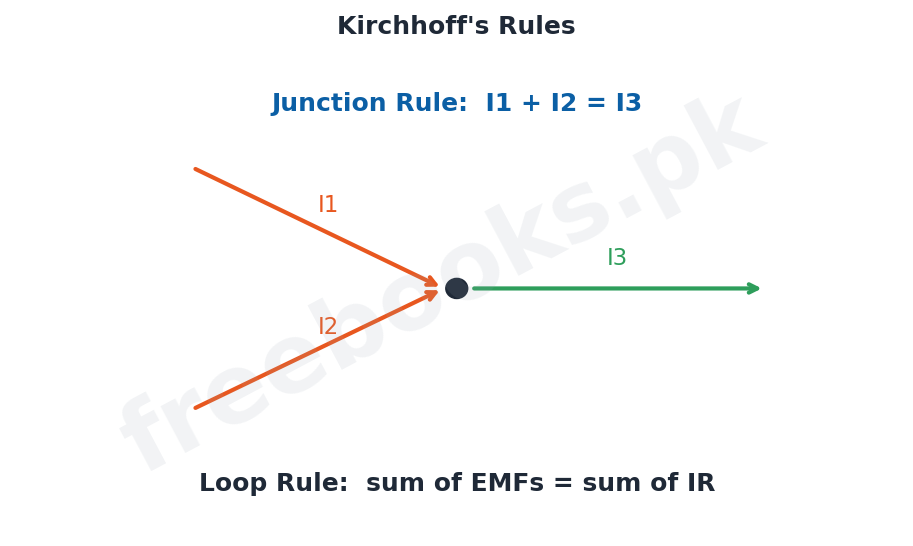
Kirchhoff’s rules allow the analysis of complicated circuits that cannot be reduced by simple series and parallel combinations. The first rule (junction or current rule) states that the sum of currents flowing into a junction equals the sum flowing out, which is a statement of conservation of charge. The second rule (loop or voltage rule) states that around any closed loop the sum of the EMFs equals the sum of the potential drops (IR terms), which is a statement of conservation of energy. Applying these two rules gives a set of equations that can be solved for the unknown currents.
Wheatstone Bridge and Potentiometer
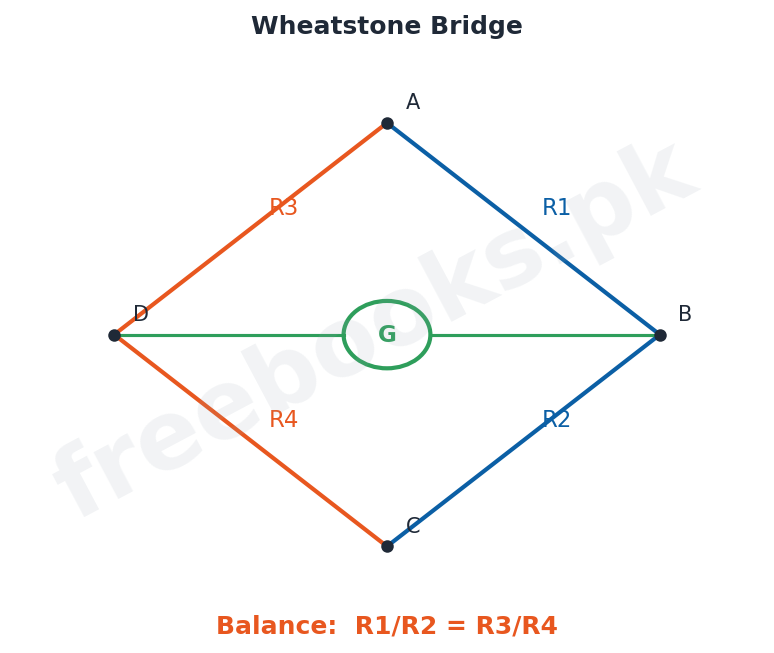
The Wheatstone bridge is a circuit of four resistances arranged in a diamond with a galvanometer across the middle; it is used to measure an unknown resistance accurately. When the bridge is balanced no current flows through the galvanometer and the resistances satisfy R1/R2 = R3/R4, from which the unknown value is found. The potentiometer is a device that measures potential difference (and EMF) without drawing current from the source at balance, by comparing it against the potential drop along a uniform resistance wire; because it draws no current at balance, it gives more accurate results than a voltmeter.
Important Definitions
Electric current
The rate of flow of electric charge, I = Q/t, unit ampere.
Conventional current
The direction in which positive charge would flow, opposite to electron flow.
Ohm’s law
Current is proportional to potential difference at constant temperature, V = I R.
Resistivity
A property of a material giving resistance, R = rho L/A.
Electrical power
The rate of conversion of electrical energy, P = V I.
Electromotive force
The energy supplied by a source per unit charge, E.
Kirchhoff’s first rule
The sum of currents into a junction equals the sum leaving it.
Wheatstone bridge
A four-resistor circuit used to measure an unknown resistance.
Formulas & Rules
| Item | Fact |
|---|---|
| Electric current | I = Q / t |
| Ohm’s law | V = I R |
| Resistance of a wire | R = rho L / A |
| Electrical power | P = V I = I^2 R = V^2 / R |
| Terminal voltage | V = E – I r |
| Kirchhoff junction rule | sum I(in) = sum I(out) |
| Kirchhoff loop rule | sum EMF = sum I R |
| Wheatstone balance | R1/R2 = R3/R4 |
Diagrams & Illustrations
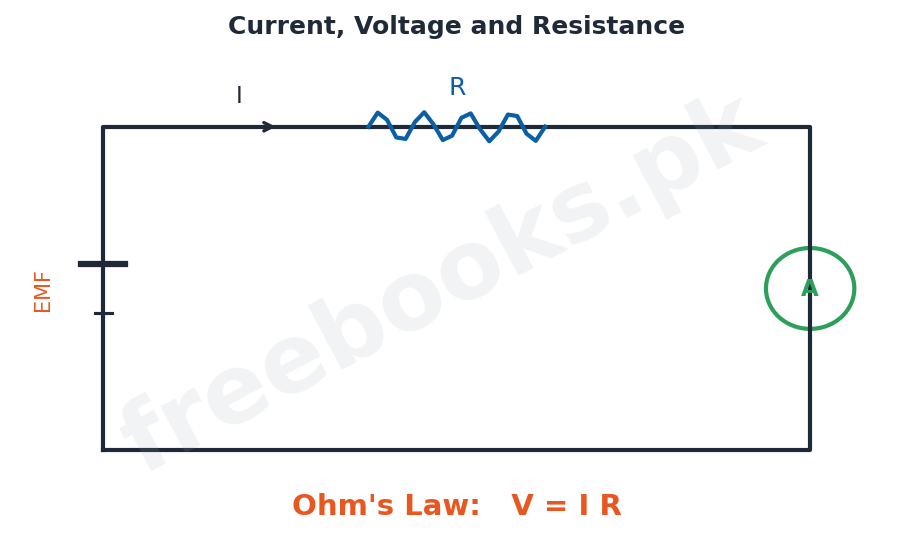
Ohm’s law circuit: a simple circuit with a source of EMF, a resistor R and an ammeter, illustrating current I and the relation V = I R.
Kirchhoff’s rules: a junction showing currents I1 and I2 entering and I3 leaving, with the junction rule I1 + I2 = I3 and the loop rule.
Wheatstone bridge: a Wheatstone bridge of four resistances R1, R2, R3, R4 with a galvanometer, balanced when R1/R2 = R3/R4.
Solved Examples & Numericals
Ohm’s law
A resistor of 20 ohm carries a current of 0.5 A. The potential difference across it is V = I R = 0.5 x 20 = 10 V.
Resistance of a wire
A wire has resistivity 1.7 x 10^-8 ohm m, length 2 m and area 1 x 10^-6 m^2. R = rho L/A = 1.7×10^-8 x 2 / 1×10^-6 = 0.034 ohm.
Electrical power
A bulb draws 0.5 A at 220 V. Its power is P = V I = 220 x 0.5 = 110 W.
Terminal voltage
A cell of EMF 1.5 V and internal resistance 0.5 ohm drives a current of 0.6 A. Its terminal voltage is V = E – I r = 1.5 – 0.6 x 0.5 = 1.2 V.
Wheatstone bridge
In a balanced bridge R1 = 10 ohm, R2 = 20 ohm, R3 = 15 ohm. Then R4 = R3 R2 / R1 = 15 x 20 / 10 = 30 ohm.
Short Questions & Answers
Define electric current and give its unit.
The rate of flow of electric charge, I = Q/t; its SI unit is the ampere.
What is conventional current?
The direction in which positive charge would flow, taken from + to – in the external circuit, opposite to electron flow.
State Ohm’s law.
At constant temperature the current through a conductor is directly proportional to the potential difference across it, V = I R.
How does resistance depend on length and area?
R = rho L/A: resistance increases with length and decreases with cross-sectional area.
Differentiate EMF and potential difference.
EMF is the total energy per unit charge supplied by a source; potential difference is the energy per unit charge delivered to the external circuit, V = E – I r.
State Kirchhoff’s first rule.
The sum of currents entering a junction equals the sum of currents leaving it (conservation of charge).
Long Questions & Answers
Q1: State Ohm’s law and explain resistivity and its dependence on temperature.
Ohm’s law states that the electric current passing through a conductor is directly proportional to the potential difference applied across its ends, provided the temperature and other physical conditions remain constant; this gives the relation V = I R, where the constant of proportionality R is the resistance of the conductor, measured in ohms. Conductors that obey this law, such as metals kept at constant temperature, are called ohmic, whereas devices whose resistance changes with voltage or temperature, such as diodes and filament lamps, are non-ohmic. The resistance of a particular conductor depends not only on the material but also on its dimensions, R = rho L/A, where L is its length, A its cross-sectional area and rho the resistivity, which is a characteristic property of the material. A long, thin wire therefore has greater resistance than a short, thick wire of the same material. Resistivity itself varies with temperature: in metals the free electrons are obstructed more as the atoms vibrate more vigorously at higher temperatures, so the resistivity and hence the resistance increase with temperature; in semiconductors, by contrast, more charge carriers become available as the temperature rises, so their resistance decreases. This temperature behaviour is described by the temperature coefficient of resistance.
Q2: Distinguish between electromotive force and potential difference, and derive the relation for terminal voltage.
The electromotive force (EMF) of a source such as a cell or generator is the amount of energy that the source gives to each unit of charge that passes through it, and it is measured by the potential difference across the terminals of the source when it is not delivering any current. The potential difference, on the other hand, is the energy delivered to each unit of charge as it moves through a part of the external circuit. The two differ because every real source has some internal resistance r of its own. When the source drives a current I round a circuit, part of the energy per unit charge is used up inside the source itself against this internal resistance, an amount equal to I r. Consequently the potential difference available at the terminals, called the terminal voltage, is less than the EMF by this amount, giving V = E – I r, where E is the EMF. When no current flows (I = 0) the terminal voltage equals the EMF, and the larger the current drawn, the more the terminal voltage falls below the EMF. This explains why the voltage of a battery drops when it supplies a heavy current.
Q3: State Kirchhoff’s rules and describe how the Wheatstone bridge is used to find an unknown resistance.
Kirchhoff gave two rules that make it possible to analyse circuits too complicated to be reduced by simple series and parallel combinations. His first rule, the junction (or current) rule, states that the sum of the currents flowing into any junction of a circuit is equal to the sum of the currents flowing out of it; this is a direct consequence of the conservation of electric charge. His second rule, the loop (or voltage) rule, states that around any closed loop in a circuit the algebraic sum of the electromotive forces equals the algebraic sum of the products of current and resistance (the IR drops); this expresses the conservation of energy. By writing down these equations for the junctions and loops of a network and solving them, the unknown currents can be found. An important application is the Wheatstone bridge, which consists of four resistances arranged in a diamond shape with a sensitive galvanometer connected between the two middle points and a battery across the other two. The values of the resistances are adjusted until no current flows through the galvanometer; the bridge is then said to be balanced, and the four resistances satisfy R1/R2 = R3/R4. If three of the resistances are known, the fourth (the unknown) can be calculated accurately from this relation. Because the measurement is made at balance, when no current flows through the galvanometer, it does not depend on the exact sensitivity of the galvanometer and is therefore very precise.
MCQs with Answers
The SI unit of electric current is the: (a) volt (b) ampere (c) ohm (d) coulomb
Correct Answer: (b) ampere.
Conventional current flows from: (a) – to + outside (b) + to – outside (c) electron direction (d) no direction
Correct Answer: (b) + to – in the external circuit.
Ohm’s law is: (a) V = I/R (b) V = I R (c) I = V R (d) R = V I
Correct Answer: (b) V = I R.
The resistance of a wire is: (a) rho A/L (b) rho L/A (c) L/(rho A) (d) rho L A
Correct Answer: (b) rho L/A.
With rising temperature the resistance of a metal: (a) decreases (b) increases (c) stays same (d) becomes zero
Correct Answer: (b) increases.
Electrical power is: (a) V/I (b) V I (c) I/V (d) V + I
Correct Answer: (b) V I.
Terminal voltage is: (a) E + I r (b) E – I r (c) I r – E (d) E I
Correct Answer: (b) E – I r.
Kirchhoff’s first rule is based on conservation of: (a) energy (b) charge (c) mass (d) momentum
Correct Answer: (b) charge.
Kirchhoff’s loop rule is based on conservation of: (a) charge (b) energy (c) mass (d) current
Correct Answer: (b) energy.
A balanced Wheatstone bridge satisfies: (a) R1 R2 = R3 R4 (b) R1/R2 = R3/R4 (c) R1 + R2 = R3 + R4 (d) R1 – R2 = R3 – R4
Correct Answer: (b) R1/R2 = R3/R4.
Quick Revision Summary
- Current I = Q/t (ampere); conventional current opposite to electron flow.
- Effects of current: heating, magnetic, chemical. Sources maintain potential difference.
- Ohm’s law: V = I R (ohmic conductors); R = rho L/A.
- Metals: resistance rises with temperature; semiconductors: falls.
- Power: P = V I = I^2 R = V^2/R; terminal voltage V = E – I r.
- Kirchhoff: junction (charge), loop (energy). Wheatstone balance R1/R2 = R3/R4; potentiometer draws no current at balance. Notes by freebooks.pk.
Exam Tips
- State Ohm’s law with the ‘constant temperature’ condition.
- Learn R = rho L/A and the temperature behaviour of metals vs semiconductors.
- Know all three forms of power: V I, I^2 R, V^2/R.
- Clearly distinguish EMF from terminal voltage (V = E – I r).
- Remember Kirchhoff’s rules and what each conserves.
- Memorise the Wheatstone balance condition.