
This chapter covers Atomic Spectra from the 2nd Year (FSc Part-II) Physics syllabus of the Punjab Curriculum and Textbook Board (PTB/PCTB). It studies line spectra, Bohr’s model of the hydrogen atom and its energy levels, inner-shell transitions and characteristic X-rays, the uncertainty principle and the laser. These notes are prepared by freebooks.pk.
The light given out by atoms comes in sharp, definite colours rather than a continuous range. Explaining these atomic spectra led Bohr to his model of the atom and confirmed that energy inside the atom is quantised.
Learning Objectives
- Explain the line spectrum of atoms.
- Describe Bohr’s model of the hydrogen atom and its energy levels.
- Explain how spectral lines arise from energy-level transitions.
- Describe inner-shell transitions and characteristic X-rays.
- State Heisenberg’s uncertainty principle.
- Explain the working of a laser.
Key Concepts
Atomic (Line) Spectra
When an element is heated or an electric discharge is passed through its vapour, it gives out light of only certain definite wavelengths, producing a line spectrum of separate coloured lines rather than a continuous band. Each element has its own characteristic set of lines, so a line spectrum acts like a fingerprint that can be used to identify the element. The line spectrum of hydrogen, the simplest atom, was studied in detail and became the key to understanding atomic structure.
Bohr’s Model of the Hydrogen Atom
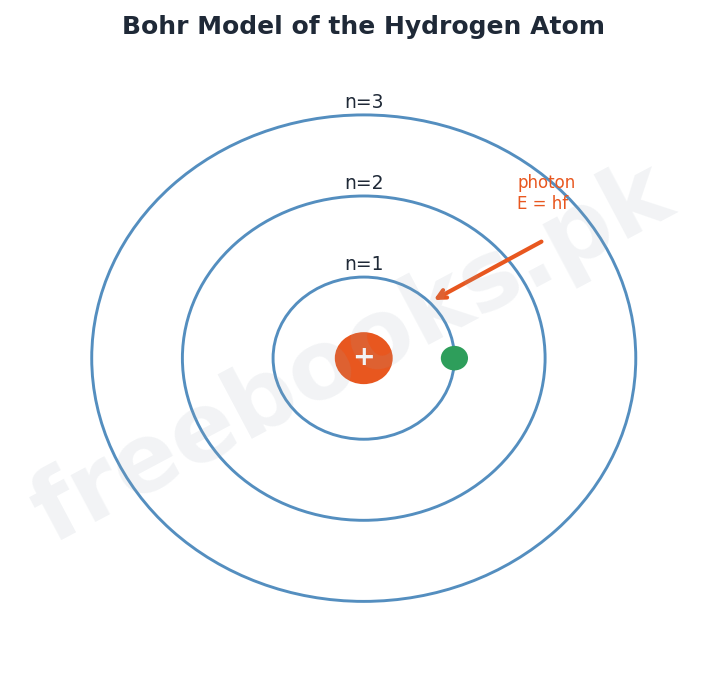
Bohr proposed that in a hydrogen atom the electron moves around the nucleus only in certain allowed circular orbits, in each of which it does not radiate energy; these are called stationary states or energy levels. The electron can only occupy these fixed orbits and not any orbit in between, so its energy is quantised. The allowed orbits are those in which the angular momentum of the electron is a whole-number multiple of h/(2 pi). This bold combination of classical and quantum ideas successfully explained the hydrogen spectrum.
Energy Levels and Spectral Lines
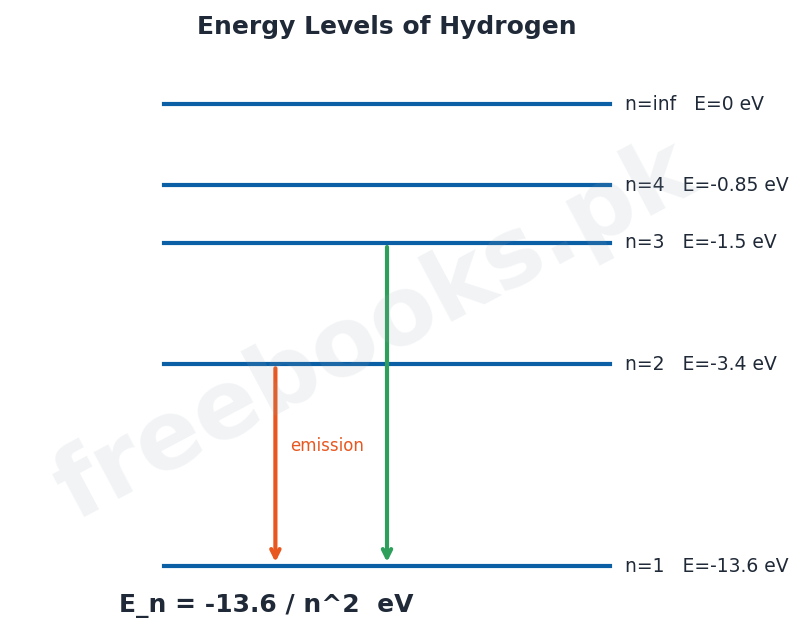
Each allowed orbit corresponds to a definite energy, given for hydrogen by E_n = -13.6 / n^2 electron volts, where n = 1, 2, 3, … is the quantum number; n = 1 is the lowest (ground) state and the levels get closer together as n increases. Normally the electron stays in the lowest level, but if it is given energy it jumps to a higher level. When it falls back to a lower level it emits a photon whose energy equals the difference between the two levels, h f = E_higher – E_lower. Because only certain energy differences are possible, only certain photon frequencies are emitted, which is why the spectrum consists of sharp lines.
Hydrogen Spectral Series
The spectral lines of hydrogen fall into groups called series, each corresponding to transitions that end on a particular level. Transitions ending on n = 1 give the Lyman series (in the ultraviolet), those ending on n = 2 give the Balmer series (in the visible region) and those ending on n = 3 give the Paschen series (in the infrared). The excellent agreement between the wavelengths predicted by Bohr’s model and those measured experimentally was a great triumph of the theory.
Inner-Shell Transitions and Characteristic X-rays
When fast electrons strike a metal target, they can knock electrons out of the inner shells of the target atoms. An electron from a higher shell then falls into the vacancy, and because inner-shell energy differences are very large, the emitted photon is highly energetic and lies in the X-ray region. These X-rays have definite wavelengths characteristic of the target element and are therefore called characteristic X-rays, used to identify elements and in X-ray analysis.
Heisenberg’s Uncertainty Principle
Heisenberg’s uncertainty principle states that it is impossible to measure both the position and the momentum of a particle exactly at the same time: the more precisely one is known, the less precisely the other can be known, with the product of the uncertainties at least of the order of Planck’s constant. A similar relation links energy and time. This principle is a fundamental feature of the quantum world and sets a natural limit on the precision of measurements at the atomic scale.
The Laser
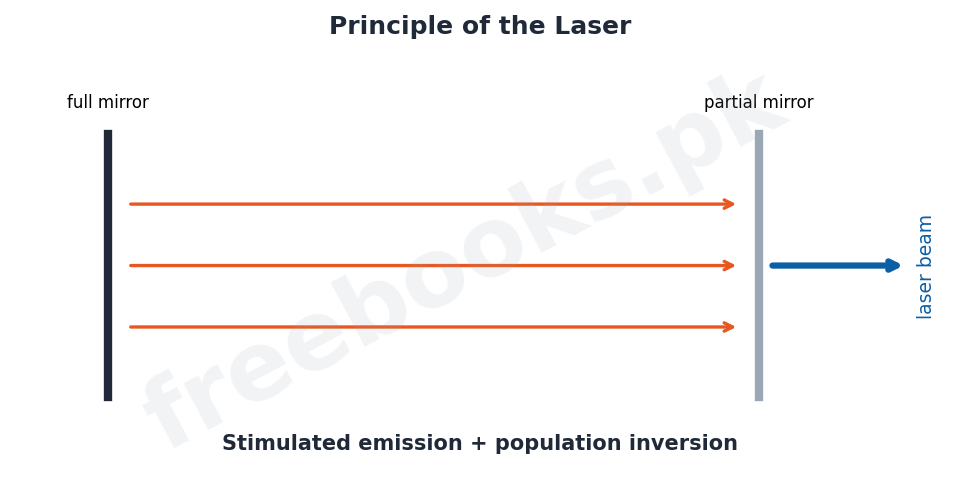
A laser is a device that produces an intense, narrow and highly coherent beam of single-colour light. It works by stimulated emission: an excited atom, struck by a photon of the right energy, is stimulated to emit a second identical photon, so the two travel together in step. To keep this going, most of the atoms must be raised to the excited state, a condition called population inversion, and the light is reflected back and forth between two mirrors to build up a strong beam, one mirror being partly transparent to let the beam out. Lasers are used in surgery, communication, CD and DVD players, cutting and welding, and many other applications.
Important Definitions
Line spectrum
A spectrum of separate lines of definite wavelength characteristic of an element.
Stationary state
An allowed orbit or energy level in which the electron does not radiate.
Energy level
A definite allowed energy of the electron, E_n = -13.6/n^2 eV for hydrogen.
Ground state
The lowest energy level (n = 1).
Characteristic X-rays
X-rays of definite wavelength emitted in inner-shell transitions of an element.
Uncertainty principle
Position and momentum cannot both be measured exactly at once.
Stimulated emission
Emission of a photon caused by another photon of the same energy.
Laser
A device giving an intense coherent single-colour beam by stimulated emission.
Formulas & Rules
| Item | Fact |
|---|---|
| Energy levels of hydrogen | E_n = -13.6 / n^2 eV |
| Photon of a transition | h f = E_higher – E_lower |
| Ground state energy | E_1 = -13.6 eV |
| Uncertainty principle | (delta x)(delta p) at least of order h |
Diagrams & Illustrations
Bohr model of the hydrogen atom: the Bohr model with the electron in allowed circular orbits (n = 1, 2, 3) around the nucleus, emitting a photon when it jumps to a lower orbit.
Energy levels of hydrogen: the energy-level diagram of hydrogen with E_n = -13.6/n^2 eV and downward transitions emitting photons.
Principle of the laser: light bouncing between two mirrors and being amplified by stimulated emission to form a laser beam.
Solved Examples & Numericals
Ground state energy
For hydrogen with n = 1, E_1 = -13.6/1^2 = -13.6 eV.
Second level
For n = 2, E_2 = -13.6/4 = -3.4 eV.
Transition energy
An electron falling from n = 2 to n = 1 emits a photon of energy E_2 – E_1 = -3.4 – (-13.6) = 10.2 eV.
Ionisation energy
The energy needed to remove the electron from the ground state (n = 1 to infinity) is 13.6 eV, the ionisation energy of hydrogen.
Short Questions & Answers
What is a line spectrum?
A spectrum consisting of separate lines of definite wavelength, characteristic of each element.
State a main postulate of Bohr’s model.
The electron moves only in certain allowed orbits (stationary states) in which it does not radiate energy.
Write the energy of the nth level of hydrogen.
E_n = -13.6/n^2 eV, with n = 1 the ground state.
How is a spectral line produced?
When an electron falls from a higher to a lower level it emits a photon of energy h f = E_higher – E_lower.
What are characteristic X-rays?
X-rays of definite wavelength emitted when electrons fall into inner-shell vacancies of an element.
State Heisenberg’s uncertainty principle.
The position and momentum of a particle cannot both be measured exactly at the same time.
Long Questions & Answers
Q1: Describe Bohr’s model of the hydrogen atom and explain how it accounts for the line spectrum.
Bohr put forward a model of the hydrogen atom that combined classical mechanics with new quantum ideas. He proposed that the single electron of the hydrogen atom moves around the nucleus only in certain allowed circular orbits, and that while it is in one of these orbits it does not radiate energy, contrary to classical expectation; these allowed orbits are called stationary states or energy levels. The orbits that are permitted are those for which the angular momentum of the electron is a whole-number multiple of h/(2 pi), so the electron’s energy can take only certain discrete values and is said to be quantised. For hydrogen these energies are given by E_n = -13.6/n^2 electron volts, where n = 1, 2, 3, … is the quantum number; the level n = 1 is the lowest, called the ground state, and the levels crowd closer together as n increases towards zero. Normally the electron occupies the ground state, but if the atom absorbs energy the electron is raised to a higher level. When the electron later falls back to a lower level, the atom emits a photon whose energy is exactly equal to the difference between the two levels, h f = E_higher – E_lower. Because only certain energy differences are possible, only photons of certain definite frequencies (and hence wavelengths) can be emitted, and these appear as the sharp bright lines of the line spectrum. In this way Bohr’s model explained not only why atomic spectra consist of discrete lines but also predicted their wavelengths for hydrogen with remarkable accuracy.
Q2: Explain how the spectral series of hydrogen arise and how characteristic X-rays are produced.
The many lines in the spectrum of hydrogen are not scattered at random but fall into distinct groups called spectral series, each of which corresponds to electron transitions that finish on a particular energy level. Transitions in which the electron falls to the level n = 1 form the Lyman series, whose lines lie in the ultraviolet; transitions ending on n = 2 form the Balmer series, whose lines lie in the visible part of the spectrum and were the first to be studied; and transitions ending on n = 3 form the Paschen series, in the infrared. Since the energy of each level is fixed by E_n = -13.6/n^2 eV, the energy, and therefore the wavelength, of every line can be calculated, and the close agreement between these calculated wavelengths and those measured in the laboratory was one of the great successes of Bohr’s theory. The same idea of transitions between levels explains characteristic X-rays. When very fast electrons strike a metal target, they can knock an electron out of one of the inner shells of a target atom, leaving a vacancy. An electron from a higher shell immediately falls into this vacancy, and because the energy difference between the inner shells is very large, the photon that is emitted is extremely energetic and lies in the X-ray region of the spectrum. These X-rays have sharply defined wavelengths that are characteristic of the particular target element, which is why they are called characteristic X-rays; they are widely used to identify elements and in X-ray spectroscopy.
Q3: State Heisenberg’s uncertainty principle and explain the working of a laser.
Heisenberg’s uncertainty principle is a fundamental limitation of the quantum world. It states that it is impossible, even in principle, to determine both the exact position and the exact momentum of a particle at the same instant: the more accurately the position is known, the less accurately the momentum can be known, and vice versa, the product of the two uncertainties being at least of the order of Planck’s constant. A similar relation connects the uncertainty in the energy of a state with the uncertainty in the time for which it exists. This principle does not arise from imperfect instruments but is built into nature at the atomic scale. A very different but equally important application of quantum ideas is the laser, a device that produces an intense, narrow, single-colour and highly coherent beam of light. Its action depends on stimulated emission: when an atom is already in an excited state and is struck by a photon whose energy matches the energy the atom is about to release, the atom is stimulated to emit a second photon that is identical to the first and travels in step with it. For this to build up into a strong beam, most of the atoms in the material must first be raised to the excited state, a situation called population inversion, achieved by an external energy source. The light is then reflected many times between two parallel mirrors so that it passes repeatedly through the material and is amplified at each pass; one of the mirrors is made partly transparent so that a portion of this intense, coherent beam emerges as the laser output. Because the beam is so narrow, intense and pure in colour, lasers are used in eye and other surgery, in optical-fibre communication, in reading CDs and DVDs, in cutting and welding metals, and in many measuring instruments.
MCQs with Answers
The spectrum of an element consists of: (a) a continuous band (b) separate lines (c) only one colour (d) no light
Correct Answer: (b) separate lines.
In Bohr’s model the electron in an allowed orbit: (a) radiates energy (b) does not radiate (c) gains mass (d) stops
Correct Answer: (b) does not radiate.
The energy of the nth level of hydrogen is: (a) -13.6 n^2 (b) -13.6/n^2 (c) 13.6 n (d) -13.6 n
Correct Answer: (b) -13.6/n^2 eV.
The ground state energy of hydrogen is: (a) -3.4 eV (b) -13.6 eV (c) 0 eV (d) +13.6 eV
Correct Answer: (b) -13.6 eV.
A photon is emitted when the electron: (a) stays put (b) jumps to a higher level (c) falls to a lower level (d) is removed
Correct Answer: (c) falls to a lower level.
The Balmer series lies in the ___ region: (a) ultraviolet (b) visible (c) infrared (d) X-ray
Correct Answer: (b) visible.
Characteristic X-rays come from ___ transitions: (a) outer-shell (b) inner-shell (c) nuclear (d) molecular
Correct Answer: (b) inner-shell.
The uncertainty principle links position and: (a) charge (b) momentum (c) mass (d) colour
Correct Answer: (b) momentum.
A laser works by: (a) spontaneous emission (b) stimulated emission (c) absorption only (d) reflection only
Correct Answer: (b) stimulated emission.
A laser beam is: (a) incoherent (b) coherent (c) many colours (d) weak
Correct Answer: (b) coherent.
Quick Revision Summary
- Line spectra are characteristic of each element (a fingerprint).
- Bohr: electron in fixed orbits (stationary states); energy quantised.
- E_n = -13.6/n^2 eV; ground state -13.6 eV; photon h f = E_higher – E_lower.
- Series: Lyman (UV, to n=1), Balmer (visible, to n=2), Paschen (IR, to n=3).
- Characteristic X-rays from inner-shell transitions; uncertainty principle limits position and momentum.
- Laser: stimulated emission + population inversion + mirrors; coherent monochromatic beam. Notes by freebooks.pk.
Exam Tips
- State that line spectra identify elements.
- Give Bohr’s key postulate (allowed non-radiating orbits).
- Memorise E_n = -13.6/n^2 eV and the transition photon relation.
- Match the series (Lyman/Balmer/Paschen) to their regions.
- State the uncertainty principle in words.
- Explain the laser using stimulated emission and population inversion.