This chapter covers the Dawn of Modern Physics from the 2nd Year (FSc Part-II) Physics syllabus of the Punjab Curriculum and Textbook Board (PTB/PCTB). It studies frames of reference, the special theory of relativity, black body radiation and Planck’s quantum, the photoelectric and Compton effects, pair production and annihilation, and the wave nature of particles. These notes are prepared by freebooks.pk.
Around the year 1900 two great ideas, relativity and the quantum, transformed physics. This chapter introduces these ideas, which reveal that at very high speeds and very small scales nature behaves quite differently from everyday experience.
Learning Objectives
- Explain frames of reference and the postulates of special relativity.
- State the results of relativity: time dilation, length contraction and mass-energy equivalence.
- Explain black body radiation and Planck’s quantum hypothesis.
- Describe the photoelectric and Compton effects.
- Explain pair production and annihilation.
- State de Broglie’s hypothesis of the wave nature of particles.
Key Concepts
Frames of Reference and Relativity
A frame of reference is a coordinate system with respect to which positions and motions are measured. An inertial frame is one moving at constant velocity, in which Newton’s laws hold. Einstein’s special theory of relativity is based on two postulates: (1) the laws of physics are the same in all inertial frames, and (2) the speed of light in vacuum has the same value for all observers, regardless of the motion of the source or observer. These simple postulates lead to surprising conclusions about space and time.
Consequences of Special Relativity
From the postulates of relativity it follows that measurements of time and length depend on the relative motion of the observer. A moving clock runs slow compared with one at rest, an effect called time dilation, and a moving object is measured to be shorter in the direction of motion, called length contraction. These effects become noticeable only at speeds approaching the speed of light and have been confirmed experimentally.
Mass-Energy Equivalence
One of the most famous results of relativity is that mass and energy are equivalent and interchangeable, expressed by E = m c^2, where c is the speed of light. This means that a small amount of mass is equivalent to an enormous amount of energy, since c^2 is very large. Mass-energy equivalence explains the huge energy released in nuclear reactions, where a tiny loss of mass appears as energy.
Black Body Radiation and Planck’s Quantum
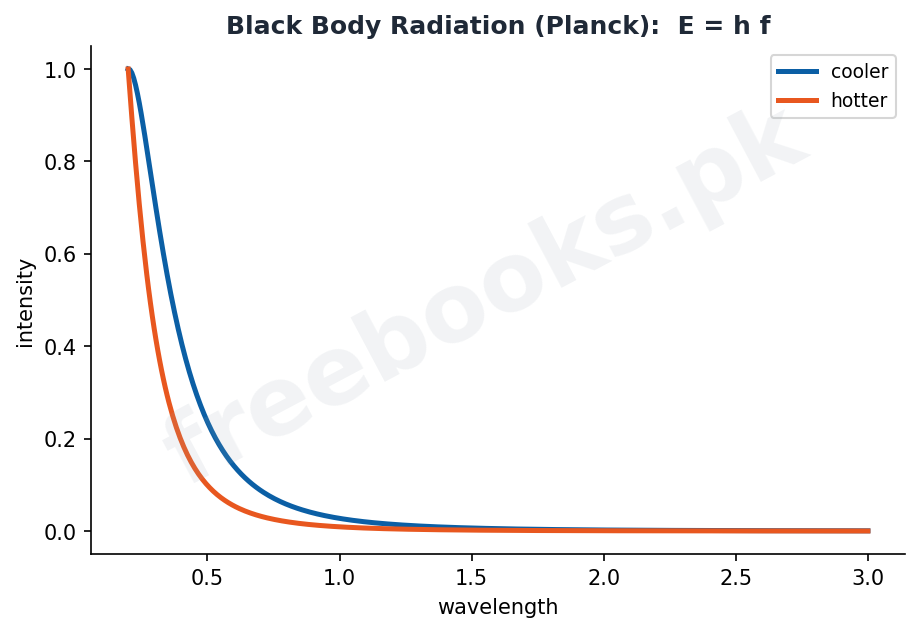
A black body is an ideal object that absorbs and emits all radiation falling on it. The way the intensity of black body radiation varies with wavelength could not be explained by classical physics. Planck solved the problem by proposing that energy is emitted or absorbed not continuously but in tiny discrete packets called quanta, each of energy E = h f, where h is Planck’s constant and f the frequency. This quantum hypothesis was the birth of quantum theory.
The Photoelectric Effect
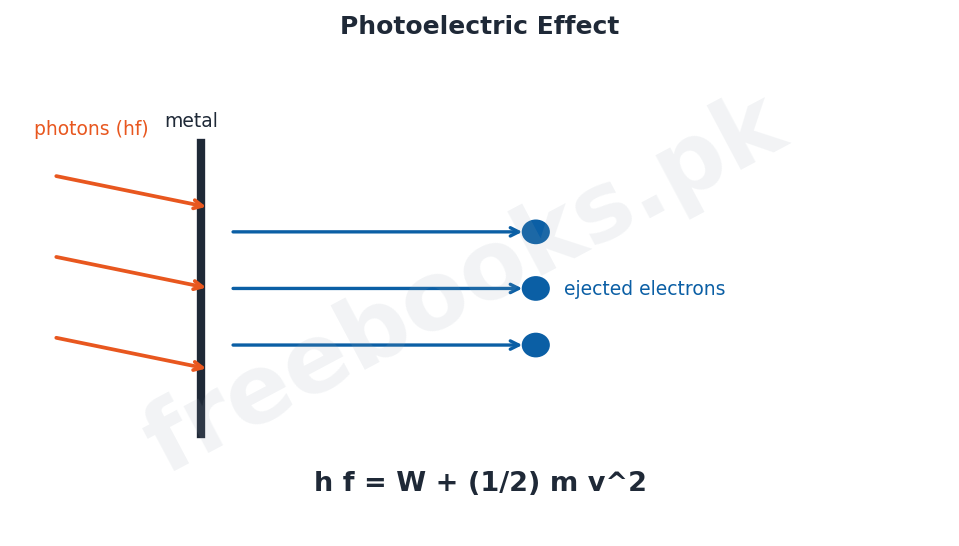
The photoelectric effect is the emission of electrons from a metal surface when light of high enough frequency falls on it. Einstein explained it by treating light as a stream of photons, each carrying energy h f. When a photon strikes the metal it gives all its energy to one electron; part is used to free the electron (the work function W) and the rest becomes its kinetic energy, so h f = W + (1/2) m v^2. Below a certain threshold frequency no electrons are emitted, however bright the light, which shows that light behaves as particles.
Compton Effect
In the Compton effect, X-rays scattered by matter are found to have a slightly longer wavelength than the incident X-rays. This is explained by treating the X-ray as a photon that collides with an electron like two particles: the photon gives some of its energy and momentum to the electron, so the scattered photon has less energy and therefore a longer wavelength. The Compton effect is further strong evidence that electromagnetic radiation has a particle nature and that photons carry momentum.
Pair Production and Annihilation
Pair production is a process in which a high-energy photon, passing near a nucleus, disappears and its energy is converted into a particle and its antiparticle, for example an electron and a positron; this shows energy being turned into matter. The reverse process is annihilation, in which a particle and its antiparticle meet and destroy each other, their mass being converted entirely into energy in the form of photons. Both processes are direct illustrations of the equivalence of mass and energy.
Wave Nature of Particles
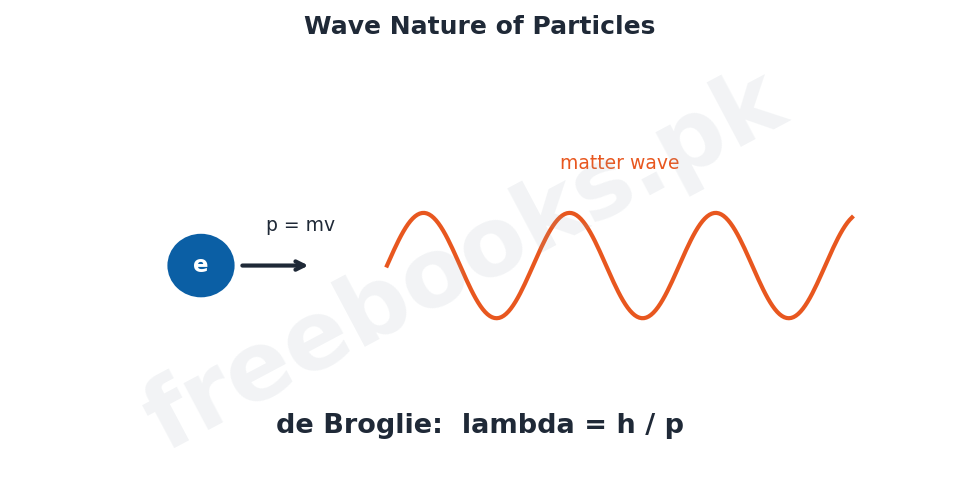
Just as light shows both wave and particle behaviour, de Broglie proposed that particles of matter also have a wave nature, with a wavelength lambda = h / p, where p is the momentum of the particle and h Planck’s constant. This wavelength is extremely small for ordinary objects but significant for tiny particles such as electrons, whose wave nature has been demonstrated by diffraction experiments and is used in the electron microscope. This wave-particle duality is a central idea of modern physics.
Important Definitions
Frame of reference
A coordinate system with respect to which motion is measured.
Postulates of relativity
Physics is the same in all inertial frames, and light speed is constant for all observers.
Time dilation
A moving clock runs slow compared with one at rest.
Mass-energy equivalence
Mass and energy are interchangeable, E = m c^2.
Quantum
A discrete packet of energy, E = h f.
Photoelectric effect
The emission of electrons from a metal when light of sufficient frequency falls on it.
Pair production
Conversion of a high-energy photon into a particle-antiparticle pair.
de Broglie wavelength
The wavelength of a moving particle, lambda = h/p.
Formulas & Rules
| Item | Fact |
|---|---|
| Quantum energy | E = h f |
| Mass-energy equivalence | E = m c^2 |
| Photoelectric equation | h f = W + (1/2) m v^2 |
| de Broglie wavelength | lambda = h / p |
| Threshold frequency | W = h f0 |
Diagrams & Illustrations
Photoelectric effect: photons of energy h f striking a metal surface and ejecting electrons, with the equation h f = W + (1/2) m v^2.
Black body radiation: intensity-wavelength curves of black body radiation for a cooler and a hotter body, explained by Planck’s quantum E = h f.
Wave nature of particles: a moving electron of momentum p associated with a matter wave of wavelength lambda = h/p (de Broglie).
Solved Examples & Numericals
Quantum energy
A photon has frequency 5 x 10^14 Hz. Its energy is E = h f = 6.63×10^-34 x 5×10^14 = 3.3 x 10^-19 J.
Mass-energy
A mass of 1 g (10^-3 kg) is equivalent to E = m c^2 = 10^-3 x (3×10^8)^2 = 9 x 10^13 J.
Photoelectric effect
Light of energy 5 eV strikes a metal of work function 2 eV. The maximum kinetic energy of the electrons is 5 – 2 = 3 eV.
de Broglie wavelength
An electron has momentum 2 x 10^-24 kg m/s. lambda = h/p = 6.63×10^-34 / 2×10^-24 = 3.3 x 10^-10 m.
Short Questions & Answers
State the postulates of special relativity.
(1) The laws of physics are the same in all inertial frames; (2) the speed of light in vacuum is the same for all observers.
What is time dilation?
The slowing down of a moving clock as measured by an observer at rest.
Write the mass-energy relation.
E = m c^2, showing mass and energy are equivalent.
State Planck’s quantum hypothesis.
Energy is emitted or absorbed in discrete packets called quanta, each of energy E = h f.
Write Einstein’s photoelectric equation.
h f = W + (1/2) m v^2, where W is the work function.
State de Broglie’s hypothesis.
A moving particle has a wave associated with it of wavelength lambda = h/p.
Long Questions & Answers
Q1: State the postulates of the special theory of relativity and describe its main consequences.
The special theory of relativity, put forward by Einstein in 1905, is built on two simple but far-reaching postulates. The first is that the laws of physics have the same form in all inertial frames of reference, that is, in all frames moving with constant velocity relative to one another, so that no experiment can single out one such frame as being at absolute rest. The second is that the speed of light in vacuum has the same value for every observer, whatever the motion of the source of the light or of the observer. Although these postulates seem harmless, taken together they force us to abandon the everyday belief that time and length are the same for everyone. Three important consequences follow. First, time dilation: a clock moving relative to an observer is found to run slow compared with an identical clock at rest beside the observer, so moving clocks tick more slowly. Second, length contraction: an object moving relative to an observer is measured to be shorter in the direction of its motion than when it is at rest. Third, and most famous, mass and energy are shown to be equivalent, related by E = m c^2, so that mass can be converted into energy and energy into mass. All these effects are negligible at everyday speeds but become large as the speed approaches that of light, and they have been confirmed by many experiments.
Q2: Explain black body radiation and the photoelectric effect and show how they led to the quantum theory of light.
Towards the end of the nineteenth century, classical physics failed to explain two experiments involving light, and their resolution gave birth to quantum theory. The first was black body radiation. A black body absorbs and re-emits all the radiation that falls on it, and the way the intensity of its radiation is distributed among the different wavelengths could not be accounted for by classical ideas, which wrongly predicted an infinite emission at short wavelengths. Planck solved this by making the bold assumption that energy is not emitted or absorbed continuously but only in tiny discrete packets, or quanta, each of energy E = h f, where h is Planck’s constant and f the frequency; with this assumption the observed radiation curve was correctly reproduced. The second experiment was the photoelectric effect, the emission of electrons from a metal surface illuminated by light. It was found that electrons are emitted only if the frequency of the light exceeds a certain threshold, no matter how bright the light, and that the energy of the emitted electrons depends on the frequency but not on the intensity. Einstein explained this by extending Planck’s idea: light itself consists of quanta, or photons, each carrying energy h f. When a photon strikes the metal it gives all its energy to a single electron; part of this energy, the work function W, is used to free the electron from the metal and the rest appears as the electron’s kinetic energy, giving Einstein’s photoelectric equation h f = W + (1/2) m v^2. Together, black body radiation and the photoelectric effect established that light has a particle nature and that energy is quantised.
Q3: Explain the wave-particle duality of matter, including de Broglie’s hypothesis, and mention pair production and annihilation.
The early quantum experiments showed that light, long regarded as a wave, also behaves as a stream of particles called photons, each carrying energy h f and momentum. In 1924 de Broglie made the bold suggestion that this duality is not confined to light but is a property of all matter: every moving particle, he proposed, has a wave associated with it, whose wavelength is given by lambda = h/p, where p is the momentum of the particle and h Planck’s constant. For ordinary objects this wavelength is far too small to notice, but for very light particles such as electrons it is comparable with atomic spacings, and the wave nature of electrons was soon confirmed by experiments in which beams of electrons were diffracted just like waves; this principle is used in the electron microscope. Matter therefore shows wave-particle duality, behaving as a wave in some experiments and as a particle in others. The interchange between matter and energy is further shown by two processes. In pair production, a high-energy photon passing close to a nucleus vanishes and its energy is turned into a particle and its antiparticle, such as an electron and a positron, so pure energy becomes matter. In the reverse process, annihilation, a particle meets its antiparticle and the two are destroyed, their entire mass reappearing as energy in the form of photons. Both processes are striking confirmations of Einstein’s relation E = m c^2 and of the deep unity of matter and energy in modern physics.
MCQs with Answers
The speed of light is the same for: (a) only the source (b) all observers (c) only fast observers (d) no one
Correct Answer: (b) all observers.
A moving clock runs: (a) fast (b) slow (c) stops (d) normally
Correct Answer: (b) slow.
The mass-energy relation is: (a) E = m c (b) E = m c^2 (c) E = m/c^2 (d) E = c/m
Correct Answer: (b) E = m c^2.
Planck’s quantum of energy is: (a) h/f (b) h f (c) f/h (d) h c
Correct Answer: (b) h f.
The photoelectric equation is: (a) h f = W – KE (b) h f = W + KE (c) h f = W x KE (d) h f = KE/W
Correct Answer: (b) h f = W + (1/2) m v^2.
Below the threshold frequency, electrons are: (a) always emitted (b) not emitted (c) emitted faster (d) doubled
Correct Answer: (b) not emitted.
In the Compton effect the scattered X-ray has a ___ wavelength: (a) shorter (b) longer (c) zero (d) same
Correct Answer: (b) longer.
Pair production converts energy into: (a) heat (b) matter (c) sound (d) light only
Correct Answer: (b) matter.
The de Broglie wavelength is: (a) h p (b) h/p (c) p/h (d) h c
Correct Answer: (b) h/p.
Wave-particle duality applies to: (a) light only (b) matter only (c) both light and matter (d) neither
Correct Answer: (c) both light and matter.
Quick Revision Summary
- Relativity postulates: physics same in all inertial frames; light speed constant.
- Consequences: time dilation, length contraction, E = m c^2.
- Planck: energy in quanta E = h f (black body radiation).
- Photoelectric effect: h f = W + (1/2) m v^2; threshold frequency; light as photons.
- Compton effect and pair production/annihilation: photons carry momentum; energy to matter and back.
- de Broglie: particles have waves lambda = h/p; wave-particle duality. Notes by freebooks.pk.
Exam Tips
- Learn the two postulates of special relativity.
- Remember E = m c^2 and what time dilation/length contraction mean.
- State Planck’s E = h f as the start of quantum theory.
- Write Einstein’s photoelectric equation and mention the threshold frequency.
- Give de Broglie’s lambda = h/p for the wave nature of particles.
- Link pair production and annihilation to E = m c^2.