
This chapter covers Kingdom Animalia from the 1st Year (FSc Part-I) Biology syllabus of the Punjab Curriculum and Textbook Board (PTB/PCTB). Kingdom Animalia (from the Latin anima, breath or soul) includes all multicellular, diploid, eukaryotic, ingestive heterotrophs that develop from two dissimilar haploid gametes, a large egg and a smaller sperm; virtually all biologists agree animals evolved from protoctists. These notes are prepared by freebooks.pk.
The chapter works through the basic body-organization concepts used to classify animals (Parazoa vs Eumetazoa, Radiata vs Bilateria, diploblastic vs triploblastic, acoelomate/pseudocoelomate/coelomate, and protostome vs deuterostome development), then surveys the major invertebrate phyla (Porifera, Cnidaria, Platyhelminthes, Nematoda, Annelida, Arthropoda, Mollusca, Echinodermata, Hemichordata) and the phylum Chordata, including the vertebrate classes Cyclostomata, Chondrichthyes, Osteichthyes, Amphibia, Reptilia, Aves and Mammalia.
Learning Objectives
- Describe the general characteristics of Kingdom Animalia and its basic organizational groupings.
- Differentiate radial and bilateral symmetry, and diploblastic and triploblastic organization.
- Differentiate acoelomate, pseudocoelomate and coelomate body plans, and protostome and deuterostome development.
- Describe the general characteristics of Porifera, Cnidaria, Platyhelminthes and Nematoda.
- Describe the general characteristics and classification of Annelida, Arthropoda, Mollusca and Echinodermata.
- Describe the characteristics of phylum Chordata and the major classes of vertebrates.
- Describe the adaptations that allowed animals to transition from aquatic to terrestrial life.
Key Concepts
Kingdom Animalia: Basic Body Organization
Kingdom Animalia includes all multicellular, diploid, eukaryotic, ingestive heterotrophs that develop from two dissimilar haploid gametes (a large egg and smaller sperm). In Robert Whittaker's five-kingdom system followed in this book, the traditional single-celled Protozoa belong instead to Kingdom Protoctista, leaving Animalia composed of about 29 multicellular phyla. Multicellularity, though present in Fungi and Plantae too, has developed most impressively in animals, whose cells are joined by complex junctions controlling communication and material flow between cells. The simplest animals, subkingdom Parazoa (phylum Porifera), lack tissues organized into organs and have an indeterminate, asymmetrical shape. Subkingdom Eumetazoa includes all other animal phyla, which have tissues organized into organs and organ systems, and is further divided into grade Radiata (radially symmetrical animals, e.g. phylum Cnidaria) and grade Bilateria (bilaterally symmetrical animals, comprising most remaining phyla).
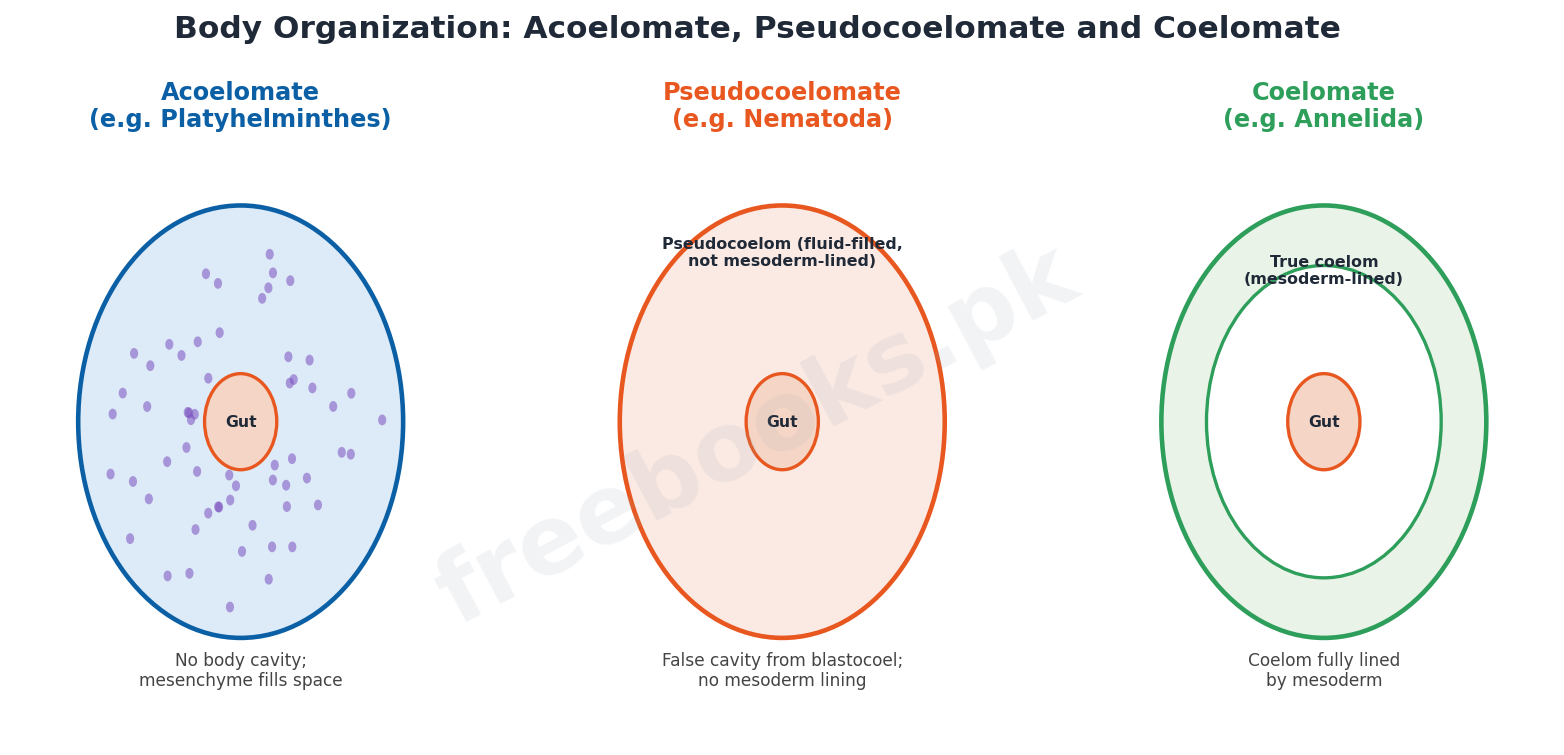
Animals are also classified by the presence, absence or type of body cavity: Acoelomata (no body cavity), Pseudocoelomata (a false body cavity, the pseudocoele, not lined by mesoderm), and Coelomata (a true, mesoderm-lined coelom). In radial symmetry, any plane passing through the central axis divides the animal into near-mirror-image halves (e.g. sea anemone); in bilateral symmetry, only one plane divides the animal into two equal halves, with a distinct anterior/posterior end and dorsal/ventral surfaces (most Bilateria, though adult echinoderms have secondarily re-evolved radial symmetry as an adaptation to their lifestyle, even though their larvae are bilateral).
Protostomes and Deuterostomes; Diploblastic and Triploblastic Organization
Bilateria is further split into two developmental series. In Protostomes (Platyhelminthes, Nematoda, Annelida, Mollusca, Arthropoda), cleavage of the zygote is spiral and determinate (the fate of each blastomere is fixed early), the mouth develops from or near the blastopore, and the coelom forms by a splitting of the mesoderm (schizocoelous). In Deuterostomes (Echinodermata, Hemichordata, Chordata), cleavage is radial and indeterminate (any one blastomere can still form a complete embryo), the mouth forms at a distance from the blastopore while the blastopore itself becomes the anus, and the coelom develops as an outpouching of the archenteron (enterocoelous).
Diploblastic animals (grade Radiata, phylum Cnidaria) have a body built of just two germ layers, ectoderm and endoderm, separated by a jelly-like, largely non-cellular mesogloea; they show a lower degree of specialization, lack a central nervous system (having only a diffuse nerve net) and a special transport system, and possess a single gastrovascular cavity (enteron) with only one opening serving as both mouth and anus (a sac-type digestive system). Triploblastic animals (grade Bilateria) have three true germ layers — ectoderm, mesoderm and endoderm — showing much greater specialization into organs and organ systems (ectoderm forming the integument and nervous system, mesoderm forming muscular, skeletal and reproductive systems, endoderm forming the gut lining and digestive glands); most have a tube-type digestive system with a separate mouth and anus, and may be acoelomate, pseudocoelomate or coelomate.
Parazoa (Porifera) and Grade Radiata (Cnidaria)
Phylum Porifera (sponges; ~5,000 species, mostly marine) are pore-bearing, sessile, asymmetrical animals lacking true tissues; the body wall has an outer pinacoderm (pinacocytes) and inner choanoderm (flagellated choanocytes), enclosing a central spongocoel, with water entering through numerous ostia and leaving through the osculum. Choanocyte flagella draw in water carrying food (zooplankton, phytoplankton and mostly detrital particles), and a needle-like calcareous or siliceous skeleton of spicules (or, in bath sponges, protein spongin fibres) provides support. Sponges reproduce asexually by budding (external buds or internal gemmules) and sexually (mostly hermaphroditic, often protandrous), producing a swimming larva. Examples include Sycon, Leucoselenia, Euplectella (Venus flower basket) and Spongilla (freshwater sponge); natural sponges remain commercially valuable for bathing, surgical fluid absorption and sound insulation.
Phylum Cnidaria (Coelenterata) are diploblastic, radially symmetrical, aquatic animals named for stinging cnidocyte cells bearing nematocysts, used for defence and capturing prey; their single gastrovascular cavity (enteron) opens through only one mouth surrounded by tentacles, and the nervous system is a diffuse nerve net without a brain. Cnidarians occur in two body forms: sessile, nutritive polyps (gastrozooids) and free-swimming, sexually reproducing medusae; many, such as Obelia, show alternation of generations between asexual polyp and sexual medusa stages, while others like Hydra exist only as polyps. Colonial cnidarians may show polymorphism, having more than two structurally and functionally distinct zooid types (e.g. Physalia, the Portuguese man-of-war, has up to five). Colonial corals (e.g. Madrepora) secrete a hard calcium carbonate exoskeleton that builds coral reefs and even small islands, found along coasts such as Florida, the West Indies, East Africa, Australia and the Coral Sea.
Acoelomate Platyhelminthes and Pseudocoelomate Nematoda
Phylum Platyhelminthes (flatworms) are soft, dorsoventrally flattened, triploblastic acoelomates with bilateral symmetry and an unsegmented body; mesoderm forms a loose packing tissue (mesenchyme/parenchyma) filling the space between ectoderm and endoderm rather than a true coelom. Most are endoparasites (e.g. Taenia solium, tapeworm; Fasciola hepatica, liver fluke; Schistosoma, blood fluke), though free-living forms like Dugesia (Planaria) exist in freshwater. They have a branching sac-type gut (reduced or absent in tapeworms), flame-cell excretory system, a well-developed nervous system with anterior sense organs, but no respiratory or circulatory system; reproduction is by fission (asexual) or as hermaphrodites (sexual). Parasitic flatworms show specific adaptations: a protective resistant cuticle instead of epidermis, adhesive suckers and hooks for attachment, degeneration of muscular and nervous systems, a simplified digestive system, complex reproductive systems producing huge numbers of eggs, and complex life cycles involving more than one host — as in Taenia, whose mature proglottids pass out in faeces, are ingested by an intermediate host (e.g. cattle) where the larva embeds in muscle, and infect humans who eat improperly cooked meat.
Phylum Nematoda (Aschelminthes; roundworms) are elongated, pointed-ended, triploblastic pseudocoelomates with bilateral symmetry and an unsegmented body; their pseudocoelom is derived from the embryonic blastocoel rather than from mesoderm splitting, and is filled with hydrostatic, protein-rich fluid. They have a complete alimentary canal (mouth and anus), a excretory system of longitudinal canals, a nerve ring with longitudinal cords, sensory papillae, but no circulatory or respiratory system (gas exchange occurs across the body surface); sexes are separate. Important parasitic nematodes include Ascaris lumbricoides (intestinal parasite of humans), Enterobius vermicularis (pinworm, causing intense anal itching), and Ancylostoma duodenale (hookworm, which attaches to intestinal villi, secretes an anticoagulant, and can cause severe anemia in children).
Coelomate Annelida and Arthropoda
Phylum Annelida (segmented worms) are triploblastic, coelomate, bilaterally symmetrical animals with a metamerically segmented body (repeating similar segments separated internally by septa, though the gut, blood vessels and nerve cord run continuously through them); examples include Nereis (marine), earthworms (soil-dwelling) and Hirudo (leech, a parasite). They have a complete, regionally specialized digestive tract, true coelom (formed by mesoderm splitting into parietal and visceral layers) serving as a hydrostatic skeleton, excretion via ciliated nephridia in each segment, a well-developed central nervous system (simple brain plus ventral nerve cord), and the first closed circulatory system among invertebrates; gas exchange occurs by diffusion across moist skin. Locomotion combines circular and longitudinal body-wall muscles acting against the hydrostatic (coelomic) skeleton, aided by chitinous chaetae/setae or parapodia; most annelids are hermaphroditic, though Nereis has separate sexes and produces a trochophore larva. Annelida includes class Polychaeta (parapodia, distinct head, mostly marine, e.g. Nereis), class Oligochaeta (setae, no distinct head, hermaphroditic, no larva, e.g. earthworms), and class Hirudinea (leeches, suckers, no locomotory organs, e.g. Hirudo medicinalis). Earthworms are called "nature's plough" for aerating and mixing the soil.
Phylum Arthropoda (jointed-legged animals) is the largest animal phylum, including insects, crustaceans, arachnids and myriapods; the segmented body bears jointed appendages modified for varied functions, covered by a waterproof, chitinous exoskeleton periodically shed through moulting (ecdysis). The coelom is reduced to a haemocoel (body cavity through which blood flows, part of an open circulatory system with a simple dorsal heart, colourless blood lacking haemoglobin), excretion is via Malpighian tubules (excreting solid uric acid), and gas exchange occurs mainly via a tracheal system with spiracles (or gills/book lungs in some). The nervous system has paired ganglia per segment connected to a ventral nerve cord, with compound eyes and antennae as major sense organs. Arthropod classes include Crustacea (aquatic, gills, carapace, two pairs of antennae, e.g. crabs, prawns), Insecta (largest class overall; head-thorax-abdomen body plan, 3 pairs of legs, often wings, metamorphosis, e.g. beetles, butterflies), Arachnida (cephalothorax and abdomen, 4 pairs of legs, chelicerae, book lungs, e.g. spiders, scorpions), and Myriapoda (many segments each with a pair of legs, e.g. centipedes, millipedes). Insects undergo metamorphosis (egg to larva to pupa to adult, or incomplete metamorphosis via a nymph); economically, harmful insects (mosquitoes, tsetse flies, locusts) transmit diseases like malaria and sleeping sickness and damage crops, while beneficial insects (honeybees, silkworms) provide honey, wax and silk.
Mollusca and Echinodermata
Phylum Mollusca is the second-largest invertebrate phylum (over 50,000 species), including snails, slugs, bivalves and cephalopods (the giant squid being the largest invertebrate); molluscs are triploblastic coelomates with bilateral symmetry, an unsegmented soft body differentiated into a head, muscular foot, and dorsal visceral mass, covered by a mantle that typically secretes a protective calcareous shell (reduced or lost in more active groups). Many possess a radula (rasping, tooth-bearing tongue) for feeding; the circulatory system (except in Cephalopoda) is open, using the blue respiratory pigment haemocyanin, gas exchange is mainly by gills, excretion by paired nephridia, and the nervous system has three pairs of interconnected ganglia; sexes are usually separate, with a trochophore larva. Major classes include Gastropoda (asymmetrical, usually coiled single shell, e.g. garden snail Helix, slug Limax), Bivalvia/Pelecypoda (bilaterally symmetrical, two-part shell, plate-like gills, e.g. mussels, oysters), and Cephalopoda (bilaterally symmetrical, reduced/internal or absent shell, highly active and intelligent, e.g. squid Loligo, cuttlefish Sepia, octopus). Economically, molluscs provide food (clams, oysters, mussels), pearls, and shell products, though slugs and shipworms (Teredo) cause damage to gardens and ships.
Echinodermata and Hemichordata, and Phylum Chordata Overview
Phylum Echinodermata ("spiny-skinned" animals; over 5,000 species, exclusively marine) are triploblastic coelomates with a mesodermal (endoskeleton) calcareous skeleton, and are radially symmetrical as adults (though bilaterally symmetrical as larvae, a secondary adaptation to their sedentary/slow-moving lifestyle). Their most distinctive feature is a water vascular system of coelomic canals and tube feet, with water entering via a sieve-like madreporite; they have specialized digestive and reproductive organs but poorly developed respiratory, excretory, circulatory and nervous systems (no true brain, only a nerve ring), and show strong powers of regeneration. Examples include Asterias (starfish), sea urchins, sea cucumbers and brittle stars. Echinoderms show striking developmental and biochemical resemblances to chordates (radial cleavage, blastopore forming the anus, shared biochemistry like phosphocreatine) and close affinities with Hemichordata (e.g. Balanoglossus, Saccoglossus), a small phylum of soft, worm-like animals with a body divided into proboscis, collar and trunk, gill slits, and features transitional between invertebrates and chordates — hence sometimes called "prechordates".
Phylum Chordata is defined by three key features present at some life stage: a notochord (a semi-rigid, rod-like skeletal axis of vacuolated cells), a dorsal, hollow central nervous system, and paired pharyngeal gill slits (functional throughout life in forms like Amphioxus and fishes, only in embryos or larvae in others). Chordata is divided into Protochordata (lower chordates, lacking a vertebral column: subphylum Urochordata/tunicates, e.g. Molgula, with notochord only in the larva; and subphylum Cephalochordata, e.g. Amphioxus, with notochord persisting the whole body length throughout life) and subphylum Vertebrata (Craniata, higher chordates with a vertebral column replacing the notochord and a cranium enclosing the brain). Vertebrates are grouped into superclass Pisces (classes Cyclostomata, Chondrichthyes, Osteichthyes — strictly aquatic) and superclass Tetrapoda (classes Amphibia, Reptilia, Aves, Mammalia — four-limbed, mostly land-dwelling), and separately into anamniotes (no foetal membranes: Cyclostomata, Chondrichthyes, Osteichthyes, Amphibia) and amniotes (with foetal membranes: Reptilia, Aves, Mammalia).
Vertebrate Classes: Fishes, Amphibians, Reptiles, Birds and Mammals
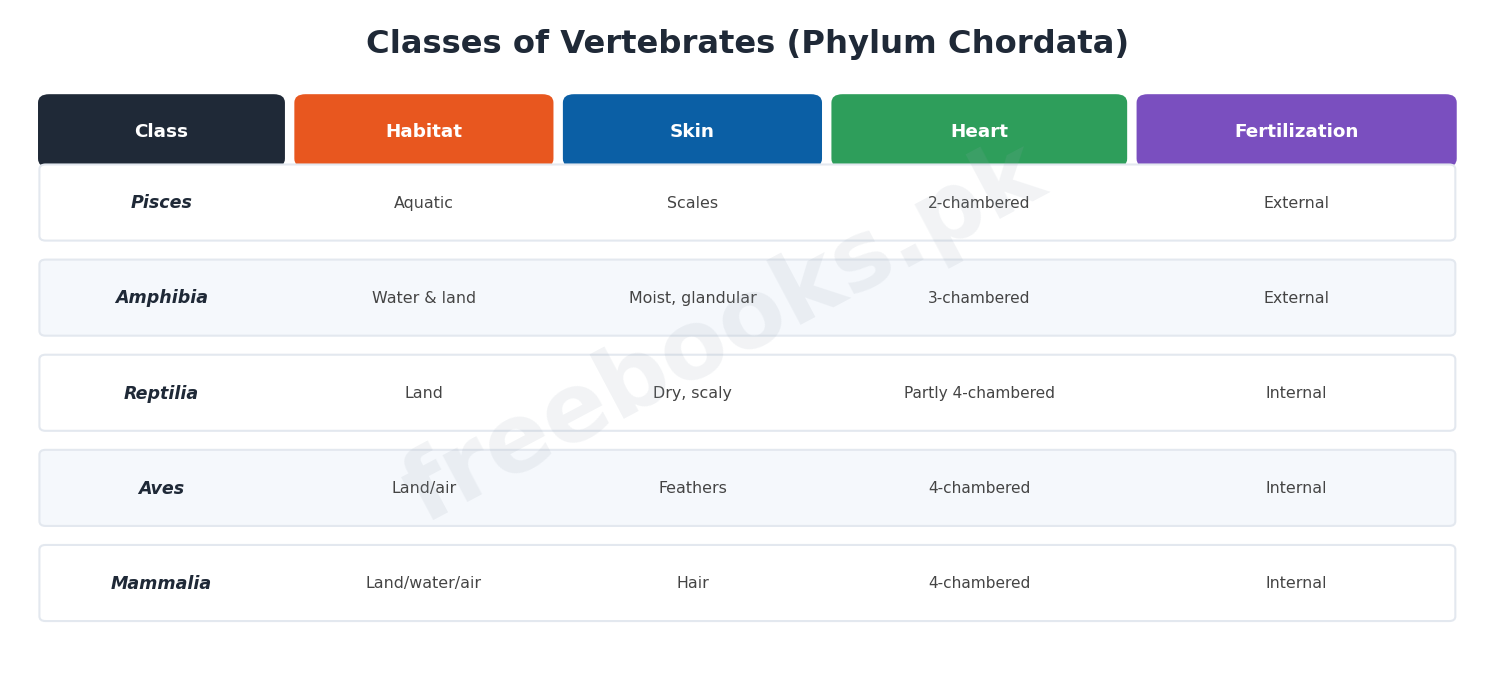
Superclass Pisces includes class Cyclostomata (jawless, eel-like, cartilaginous, e.g. lamprey, hagfish — the most primitive living vertebrates), class Chondrichthyes (sharks and rays; entirely cartilaginous skeleton, placoid scales, 5-7 pairs of gills without an operculum, no swim bladder, e.g. sharks reaching 30-50 feet), and class Osteichthyes (bony fishes; bony skeleton, dermal scales, gills covered by an operculum, usually a swim bladder for buoyancy, two-chambered heart). Key adaptations to aquatic life include a streamlined body, a hydrostatic swim bladder, paired and unpaired fins for balance and locomotion, and gills for gas exchange; the transition from water to land (pioneered by lobe-finned dipnoi fish in the Devonian) required skin for protection against drying, protective, food-storing shelled eggs, lungs in place of gills, circulatory changes, jointed limbs in place of fins, and more advanced sense organs.
Class Amphibia (frogs, toads, salamanders), the first vertebrates on land, remain structurally and reproductively tied to water: they have a mostly bony skeleton, four limbs (tetrapod, some legless), smooth, glandular, often poison-producing skin, gill respiration in larvae and lung/skin respiration in adults, a 3-chambered heart, external fertilization, a larval stage, and cold-blooded (poikilothermic), anamniotic biology with metamorphosis. Class Reptilia are fully terrestrial, with internal fertilization via a copulatory organ, leathery amniotic eggs (with amnion, allantois and chorion), dry scaly skin, an incompletely partitioned ventricle (fully partitioned in crocodiles), and are cold-blooded; reptiles flourished through the Mesozoic era and include today's lizards, snakes, tuatara and crocodiles. Class Aves (birds), believed to have evolved from reptiles (the fossil Archaeopteryx from the Jurassic shows both reptilian and avian traits), are warm-blooded (homeothermic) with a streamlined, feathered body, forelimbs modified into wings, a light, air-filled skeleton, a toothless horny beak, a muscular gizzard for grinding food, a 4-chambered heart, internal fertilization, and large yolky eggs. Class Mammalia, believed to have evolved from mammal-like reptiles (cotylosaurs) and dominant since the Cenozoic period, are named for nourishing young with milk from mammary glands; key features include hair, a muscular diaphragm, a single-boned lower jaw, three middle-ear bones (malleus, incus, stapes), a 4-chambered heart with a left aortic arch, non-nucleated red blood cells, and being warm-blooded and (mostly) viviparous. Mammals are divided into subclass Prototheria (egg-laying, e.g. duck-billed platypus, echidna — a reptile-mammal link), subclass Metatheria (pouched marsupials, e.g. kangaroo, opossum), and subclass Eutheria (placental mammals, including humans, whales and most familiar mammals).
Important Definitions
Coelom
A true body cavity between the body wall and alimentary canal, completely lined by mesoderm and filled with coelomic fluid.
Pseudocoelom
A false body cavity, derived from the embryonic blastocoel rather than from mesoderm, not lined by coelomic epithelium (as in nematodes).
Radial symmetry
A body organization in which any plane passing through the central axis divides the animal into near-mirror-image halves (e.g. Cnidaria).
Bilateral symmetry
A body organization in which only one plane divides the animal into two equal, mirror-image halves, with distinct anterior/posterior and dorsal/ventral surfaces.
Metamorphosis
An abrupt change of form/structure during an animal's life cycle, e.g. egg to larva to pupa to adult in insects.
Notochord
A semi-rigid, rod-like axis of vacuolated cells that supports and stiffens the body in all chordates at some life stage.
Polymorphism (Cnidaria)
The occurrence of more than two structurally and functionally distinct zooid types within a single colonial organism (e.g. Obelia, Physalia).
Amniote
A vertebrate (Reptilia, Aves, Mammalia) whose embryo develops within protective foetal membranes (amnion, chorion, allantois).
Key Facts
| Item | Fact |
|---|---|
| Kingdom Animalia definition | Multicellular, diploid, eukaryotic, ingestive heterotrophs developing from a large egg and small sperm. |
| Parazoa vs Eumetazoa | Parazoa (Porifera) lack tissues/organs; Eumetazoa have tissues organized into organs and organ systems. |
| Protostomes vs Deuterostomes | Protostomes: spiral/determinate cleavage, mouth from blastopore. Deuterostomes: radial/indeterminate cleavage, anus from blastopore. |
| Porifera | ~5,000 species, mostly marine; no true tissues; choanocytes, spicules, ostia and osculum. |
| Arthropoda | Largest animal phylum; jointed appendages, chitinous exoskeleton, moulting (ecdysis), open circulatory system. |
| Mollusca | 2nd largest invertebrate phylum (~50,000 species); mantle, radula, haemocyanin pigment; giant squid = largest invertebrate. |
| Chordata (3 features) | Notochord + dorsal hollow nerve cord + paired pharyngeal gill slits (at some life stage). |
| Mammalia subclasses | Prototheria (egg-laying), Metatheria (pouched), Eutheria (placental) – named for nourishing young with milk. |
Diagrams & Illustrations
Body Organization: Acoelomate, Pseudocoelomate and Coelomate: a comparison of three body-cavity plans in animals – acoelomate (mesenchyme-filled, e.g. Platyhelminthes), pseudocoelomate (false coelom, e.g. Nematoda) and coelomate (true, mesoderm-lined coelom, e.g. Annelida).
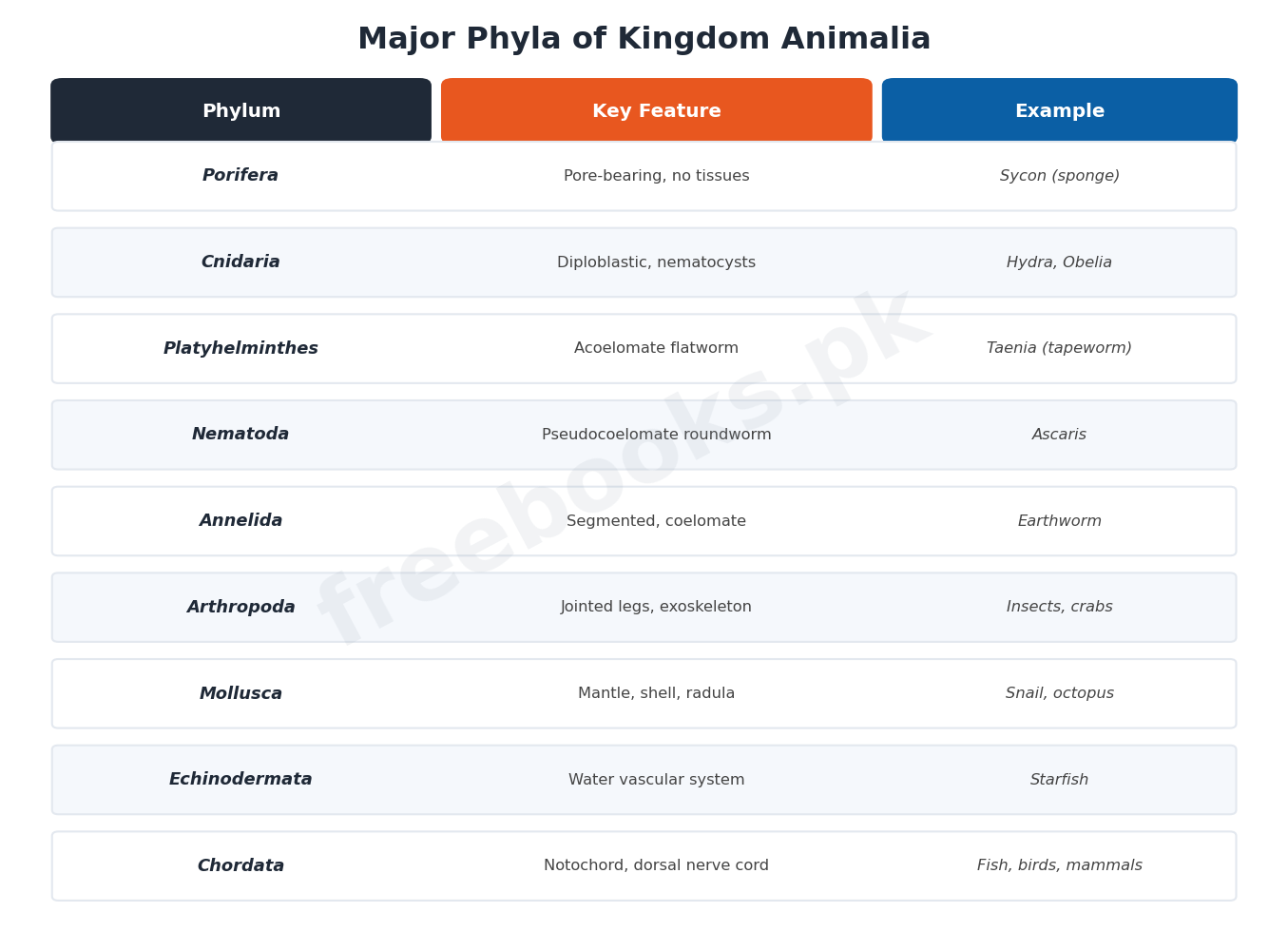
Major Phyla of Kingdom Animalia: a summary chart of the major animal phyla covered in this chapter – Porifera, Cnidaria, Platyhelminthes, Nematoda, Annelida, Arthropoda, Mollusca, Echinodermata and Chordata – with a key feature and example of each.
Classes of Vertebrates (Phylum Chordata): a comparison chart of the five main vertebrate classes – Pisces, Amphibia, Reptilia, Aves and Mammalia – showing habitat, skin covering, heart chambers and reproduction type.
Short Questions & Answers
Differentiate radial and bilateral symmetry.
In radial symmetry, any plane passing through the central axis divides the animal into near-mirror-image halves (e.g. Cnidaria), whereas in bilateral symmetry only one specific plane divides the animal into two equal halves, with distinct anterior/posterior ends and dorsal/ventral surfaces (most Bilateria).
Differentiate acoelomate, pseudocoelomate and coelomate.
Acoelomates (e.g. Platyhelminthes) have no body cavity, with mesenchyme filling the space between gut and body wall; pseudocoelomates (e.g. Nematoda) have a false coelom derived from the blastocoel, not lined by mesoderm; coelomates (e.g. Annelida onward) have a true coelom fully lined by mesoderm.
Differentiate protostomes and deuterostomes (any two points).
In protostomes, cleavage is spiral and determinate and the mouth develops from the blastopore, whereas in deuterostomes, cleavage is radial and indeterminate and the blastopore develops into the anus, with the mouth forming separately.
What is polymorphism in coelenterates? Give an example.
Polymorphism is the occurrence of more than two structurally and functionally distinct types of individuals (zooids) within the same colonial organism; Obelia shows polymorphism with gastrozooids (feeding), blastostyles (asexual reproduction) and medusae (sexual reproduction), while Physalia has up to five zooid types.
What is metamorphosis? Name its three stages in insects.
Metamorphosis is an abrupt change of form or structure during an animal's life cycle; in insects with complete metamorphosis, the three main stages are larva, pupa, and adult (following the egg stage).
Differentiate amniotes and anamniotes, giving examples.
Amniotes (Reptilia, Aves, Mammalia) develop protective foetal membranes (amnion, chorion, allantois) around the embryo, while anamniotes (Cyclostomata, Chondrichthyes, Osteichthyes, Amphibia) lack these membranes and generally depend more on water for reproduction.
Long Questions & Answers
What is Cnidaria? Explain the diploblastic organization and alternation of generations in Cnidaria.
Cnidaria (Coelenterata) are diploblastic, radially symmetrical, aquatic animals named for their cnidocyte cells, which produce stinging nematocysts used in defence and prey capture. Their body develops from just two germ layers, an outer ectoderm (forming the body covering and, in most species, nematocyst-producing cells) and an inner endoderm (specialized for digestion), separated by a jelly-like, largely non-cellular mesogloea. Cnidarians have only a single body cavity, the gastrovascular cavity (enteron), which opens to the outside through one mouth and serves both digestive and circulatory functions (a sac-type digestive system); a diffuse nerve net coordinates the body, since there is no central nervous system. Cnidarians occur in two basic forms: the sessile, cylindrical polyp (mainly nutritive, e.g. Hydra) and the free-swimming, umbrella-shaped medusa (mainly reproductive, bearing gonads). Many cnidarians, such as Obelia, show alternation of generations: an asexually reproducing polyp generation (via budding, producing medusa buds from a specialized blastostyle zooid) alternates with a sexually reproducing medusa generation, whose gametes fuse to form a zygote that develops into a new polyp colony; both generations are diploid, unlike the haploid/diploid alternation seen in plants. Hydra, by contrast, exists only in polyp form and shows no alternation of generations.
Describe the parasitic adaptations in phylum Platyhelminthes. How does the tapeworm affect a person?
Parasitic Platyhelminthes have evolved a distinctive set of adaptations for their endoparasitic lifestyle: the epidermis is replaced by a resistant protective cuticle; adhesive organs such as suckers and hooks develop for firm attachment to host tissue; the muscular and nervous systems undergo degeneration since active, independent movement is less necessary; the digestive system becomes simplified (or is absent altogether, as in tapeworms) due to increasing dependence on nutrients absorbed directly from the host; the reproductive system becomes highly complex, and enormous numbers of eggs are produced to maximize the chance of reaching a new host; and the life cycle typically becomes complex, often requiring more than one host species. Taenia solium (pork tapeworm) illustrates these effects well: its ribbon-like body is divided into segments called proglottids, largely filled with reproductive organs, and it lives in the small intestine of humans, its definitive host, attaching using hooks and suckers on its scolex (head). Its mature, egg-filled proglottids break off and pass out with faeces; if these eggs are ingested by an intermediate host such as a pig or cow, the resulting larva becomes embedded in the animal's voluntary muscles. If a person then eats improperly cooked, infected meat, the surviving larva develops into an adult tapeworm within the human intestine, where it can grow very long, absorb digested nutrients directly through its body surface (having no gut of its own), and cause malnutrition and digestive disturbance in the host; because the parasite can regenerate a new worm from just its head, complete removal (often requiring medication) is essential to cure the infection.
Give an account of the major classes of Arthropoda. What is the economic importance of insects?
Phylum Arthropoda, the largest animal phylum, contains segmented, bilaterally symmetrical, triploblastic, coelomate (haemocoelic) animals bearing jointed appendages and covered by a chitinous exoskeleton periodically shed by moulting (ecdysis). Its major classes include Crustacea (mostly aquatic, gill-breathing, e.g. crabs, prawns, Daphnia, Cyclops, with a carapace over the cephalothorax and two pairs of antennae), Insecta (the largest class in the entire animal kingdom, with a body divided into head, thorax and abdomen, three pairs of legs and often one or two pairs of wings on the thorax, a pair of antennae and compound eyes, separate sexes, and metamorphosis during development, e.g. beetles, butterflies, mosquitoes), Arachnida (a fused cephalothorax and typically unsegmented or segmented abdomen, chelicerae, pedipalps, and four pairs of legs but no antennae, respiration by book lungs or gills, e.g. spiders, scorpions, mites and ticks), and Myriapoda (many segments, each bearing a pair of legs, a single pair of antennae, e.g. centipedes and millipedes). Insects are of enormous economic importance to humans, both harmful and beneficial. Harmful insects transmit serious diseases (Anopheles mosquitoes transmit the malaria parasite Plasmodium; tsetse flies transmit Trypanosoma, causing sleeping sickness; house flies spread cholera and hepatitis-causing organisms) and destroy crops and stored food (locusts, and various pests of sugarcane, cotton and vegetables), causing major economic losses to farmers. Beneficial insects include honeybees (honey and wax), silkworms (silk), predatory insects that control other pest populations, and scavenger insects that help decompose dead organic matter.
Explain the two major classes of Pisces, and describe the adaptations of fishes for aquatic life.
Superclass Pisces includes three classes, though the two major, more familiar groups are Chondrichthyes and Osteichthyes. Class Chondrichthyes (sharks and rays) have an entirely cartilaginous endoskeleton (considered a secondarily degenerated rather than primitive feature), placoid scales, a J-shaped stomach, 5 to 7 pairs of gills without a covering operculum, no swim bladder, and separate sexes that may be oviparous or viviparous; some sharks reach 30-50 feet, among the largest living vertebrates. Class Osteichthyes (bony fishes) have a predominantly bony skeleton (the notochord may persist only in parts), dermal scales (ganoid, cycloid or ctenoid, never placoid), gills covered by a protective operculum, a swim bladder usually present for buoyancy, a two-chambered heart with nucleated red blood cells, and mostly external fertilization. Fishes show several key adaptations for aquatic life: a streamlined, boat-shaped body that minimizes water resistance during swimming; a swim bladder, a hydrostatic organ that allows the fish to control its buoyancy by adjusting internal gas volume; paired fins (pectoral and pelvic) and unpaired fins (dorsal, caudal, anal) that provide balance and propulsion; a two-chambered heart with an afferent-efferent branchial circulatory arrangement suited to gill respiration; and gills richly supplied with blood capillaries, allowing efficient extraction of dissolved oxygen from water and removal of carbon dioxide.
Describe the general characteristics of mammals and differentiate the three subclasses Prototheria, Metatheria and Eutheria.
Mammals, named by Linnaeus for young that are nourished by milk from the mother's mammary glands, are considered the most advanced animal group, largely due to their highly developed brain and nervous system; they are believed to have evolved from reptile-like ancestors called cotylosaurs (mammal-like reptiles), becoming dominant during the Cenozoic period. General characteristics of mammals include a body covering of hair rather than scales, a muscular diaphragm separating the thoracic and abdominal cavities, a lower jaw formed of a single bone articulating directly with the skull, an external ear (pinna) and a chain of three middle-ear bones (malleus, incus, stapes), deciduous (milk) and permanent tooth sets in many species, a 4-chambered heart with only a left aortic arch, non-nucleated red blood cells, a well-developed voice apparatus (larynx and epiglottis), and being warm-blooded (homeothermic) and, in most cases, viviparous. Mammals are divided into three subclasses. Subclass Prototheria are egg-laying mammals that form a reptile-mammal connecting link, combining mammalian traits (fur, mammary glands) with reptilian traits (a single cloacal opening for digestive and urinogenital systems); examples are the duck-billed platypus and echidna, found in Australia. Subclass Metatheria are pouched mammals (marsupials) whose young are born immature and complete their development while attached to a nipple within the mother's abdominal pouch (marsupium), as in the kangaroo and opossum. Subclass Eutheria are placental mammals, in which the developing young is nourished through a placenta (which also has endocrine/hormonal functions) and is born fully developed; this subclass, showing the fullest expression of mammalian characteristics, includes humans, whales, elephants, horses, rodents and bats.
MCQs with Answers
Kingdom Animalia consists of organisms that are: (a) autotrophic and unicellular (b) ingestive heterotrophs, multicellular, diploid (c) absorptive heterotrophs only (d) photosynthetic and motile
Correct Answer: (b) ingestive heterotrophs, multicellular, diploid. Animalia includes multicellular, diploid, eukaryotic, ingestive heterotrophs developing from two dissimilar gametes.
The simplest animals, lacking tissues organized into organs, belong to subkingdom: (a) Eumetazoa (b) Parazoa (c) Radiata (d) Bilateria
Correct Answer: (b) Parazoa. Subkingdom Parazoa (phylum Porifera) lacks true tissue organization into organs.
The stinging cells characteristic of Cnidaria are called: (a) choanocytes (b) cnidocytes (c) flame cells (d) nephridia
Correct Answer: (b) cnidocytes. Cnidocytes are specialized cells in Cnidaria that produce the stinging nematocysts.
Platyhelminthes are classified as: (a) coelomates (b) pseudocoelomates (c) acoelomates (d) hemocoelomates
Correct Answer: (c) acoelomates. Platyhelminthes (flatworms) are acoelomates, lacking a true body cavity; mesenchyme fills the space instead.
The pseudocoelom of nematodes develops from the: (a) mesoderm splitting (b) blastocoel (c) archenteron (d) ectoderm folding
Correct Answer: (b) blastocoel. The pseudocoelom is derived from the blastocoel of the embryo, not from a splitting of mesoderm.
Which is the largest phylum in the animal kingdom? (a) Mollusca (b) Annelida (c) Arthropoda (d) Chordata
Correct Answer: (c) Arthropoda. Arthropoda is the largest animal phylum, containing more species than any other.
The rasping, tooth-bearing structure found in many molluscs is called the: (a) radula (b) mantle (c) spicule (d) nephridium
Correct Answer: (a) radula. The radula is a rasping, tongue-like structure with horny teeth used for feeding in many molluscs.
The three defining features of phylum Chordata include the notochord, a dorsal hollow nerve cord, and: (a) a closed circulatory system (b) paired pharyngeal gill slits (c) a segmented exoskeleton (d) jointed appendages
Correct Answer: (b) paired pharyngeal gill slits. The three chordate hallmark features are the notochord, dorsal hollow nerve cord, and paired pharyngeal gill slits.
Vertebrates with protective foetal membranes around the embryo (Reptilia, Aves, Mammalia) are called: (a) anamniotes (b) amniotes (c) tetrapods (d) craniates
Correct Answer: (b) amniotes. Amniotes develop foetal membranes (amnion, chorion, allantois) protecting the embryo.
Egg-laying mammals such as the duck-billed platypus belong to subclass: (a) Eutheria (b) Metatheria (c) Prototheria (d) Chondrichthyes
Correct Answer: (c) Prototheria. Subclass Prototheria comprises egg-laying mammals like the platypus and echidna.
Quick Revision Summary
- Kingdom Animalia: multicellular, diploid, eukaryotic, ingestive heterotrophs. Parazoa (Porifera, no tissues) vs Eumetazoa (tissues/organs); Radiata (Cnidaria) vs Bilateria; Acoelomate/Pseudocoelomate/Coelomate; Protostomes vs Deuterostomes.
- Diploblastic (2 germ layers, Cnidaria, sac-type gut, no CNS) vs Triploblastic (3 germ layers, most Bilateria, tube-type gut, organ systems).
- Porifera: pore-bearing, no tissues, choanocytes/spicules. Cnidaria: cnidocytes/nematocysts, polyp+medusa, alternation of generations, polymorphism, corals/coral reefs.
- Platyhelminthes: acoelomate flatworms, mostly parasitic (Taenia, Fasciola). Nematoda: pseudocoelomate roundworms (Ascaris, hookworm, pinworm).
- Annelida: segmented, coelomate, closed circulation, nephridia (earthworm, Nereis, leech). Arthropoda: largest phylum, jointed legs, exoskeleton, moulting, Crustacea/Insecta/Arachnida/Myriapoda.
- Mollusca: 2nd largest invertebrate phylum, mantle+shell, radula, haemocyanin (Gastropoda/Bivalvia/Cephalopoda). Echinodermata: spiny-skinned, water vascular system, radial as adults (bilateral larvae).
- Hemichordata: prechordates (Balanoglossus). Chordata: notochord + dorsal hollow nerve cord + gill slits; Protochordata (Urochordata, Cephalochordata) vs Vertebrata (Pisces + Tetrapoda).
- Vertebrate classes: Cyclostomata (jawless), Chondrichthyes (cartilage, sharks/rays), Osteichthyes (bony fish), Amphibia (anamniote, metamorphosis), Reptilia (amniote, scaly), Aves (feathers, 4-chambered heart), Mammalia (hair, milk; Prototheria/Metatheria/Eutheria). Notes by freebooks.pk.
Exam Tips
- Master the classification hierarchy: Parazoa/Eumetazoa -> Radiata/Bilateria -> Acoelomate/Pseudocoelomate/Coelomate -> Protostome/Deuterostome — a recurring theme across many questions.
- Be ready to differentiate diploblastic vs triploblastic and radial vs bilateral symmetry with examples.
- Memorise one key defining feature + one example organism for each phylum covered (Porifera through Chordata) — a very common short-question/table format.
- Learn the 3 defining chordate characters (notochord, dorsal hollow nerve cord, pharyngeal gill slits) and the anamniote/amniote split among vertebrate classes.
- Practise the aquatic-to-land adaptation list (skin, shelled eggs, lungs, jointed limbs, sense organs) — a classic extensive question.
- Know the 3 mammalian subclasses (Prototheria, Metatheria, Eutheria) with one example and one key distinguishing feature each.