
This chapter covers Introduction from the 1st Year (FSc Part-I) Biology syllabus of the Punjab Curriculum and Textbook Board (PTB/PCTB). It sets the foundation for the whole course: what biology actually studies, the many branches into which the subject is divided, and the different levels at which living organisms can be organized and studied, from subatomic particles all the way up to the biosphere. These notes are prepared by freebooks.pk.
The chapter then looks at how life is distributed in space (biomes) and in time (through fossils and phyletic lineages), explains the biological method that scientists use to investigate problems, and closes with the many practical contributions biology has made to food production, disease control, cloning technology and environmental protection. Together these ideas give the vocabulary and the way of thinking needed for every later chapter.
Learning Objectives
- Define biology and describe the scope of the subject.
- Identify the major branches / fields of specialization of biology and state what each one studies.
- List the levels of biological organization from subatomic particles to the biosphere, and explain how each level is built from the one below it.
- Explain how biomes describe the distribution of living things in space.
- Describe how fossils and geological time are used to study the distribution of life in time, and explain the idea of a phyletic lineage.
- Explain the biological (scientific) method: observation, hypothesis, deductive and inductive reasoning, theory and scientific law.
- Describe the contribution of biology to food production, disease control, cloning and the protection of the environment.
Key Concepts
What Is Biology?
Biology is the study of living things; the word literally means the study of life. As a branch of science, it is a way of understanding nature, and biologists focus on the living part of nature together with the non-living factors that affect it. Defining life itself is difficult, and questions such as “why should there be life” are left to philosophers rather than biologists. Instead, biologists work with a practical description: living organisms are highly organized, are made of one or more cells, carry a genetic program, can acquire and use energy, carry out and control chemical reactions, grow, maintain a fairly constant internal environment, reproduce, and respond to their environment. Anything showing all of these characteristics together is considered a living thing and a proper subject for biological study.
Major Branches / Fields of Specialization
Because biology is such a wide subject, it is divided into many branches for convenience of study. Classical branches include Ecology (environmental relations), Embryology (development), Physiology (functions), Morphology or Anatomy (structure and form), Palaeontology (fossils), Histology (tissues), Evolution (ancestral history), Genetics (heredity) and Zoogeography (distribution of animals).
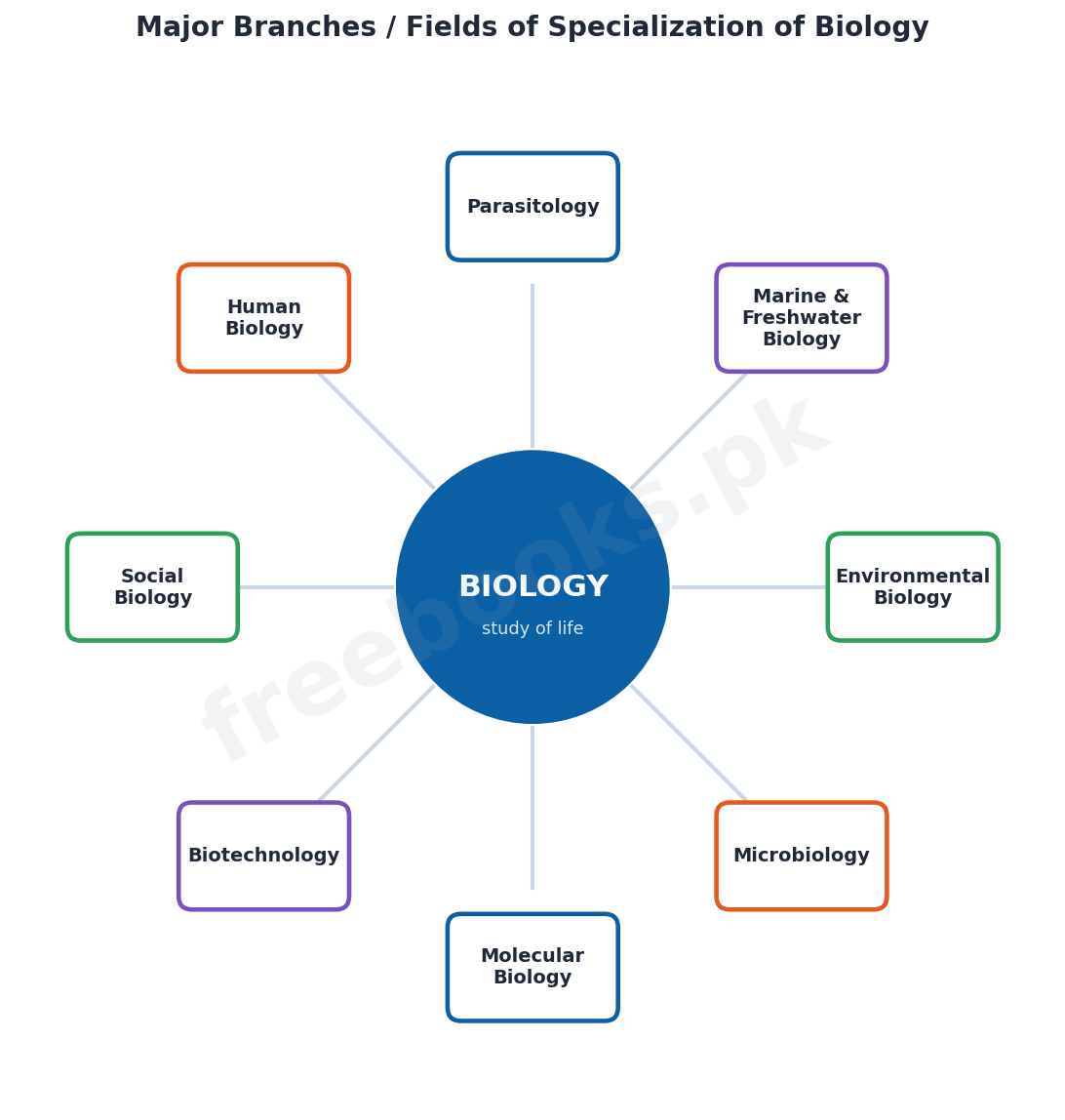
Newer, more specialised branches include Molecular Biology (the structure of organisms, cells and organelles at the molecular level), Environmental Biology (organisms in relation to their environment), Microbiology (bacteria, viruses, protozoa and microscopic algae and fungi), Freshwater Biology (organisms living in rivers, lakes and other freshwater bodies), Marine Biology (life in seas and oceans), Parasitology (parasites and host-parasite relationships), Human Biology (the structure, function and evolution of human beings), Social Biology (the social behaviour and communal life of human beings), and Biotechnology (the use of living organisms or their processes in manufacturing and services).
Levels of Biological Organization
Only 16 of the 92 naturally occurring chemical elements are commonly used to build the compounds that make up living organisms; these are called bioelements, and in the human body just six of them account for 99% of the total mass. Because these same 16 elements occur in every organism yet behave differently from non-living matter, bioelements must have special properties that make them suitable as the basis of life.
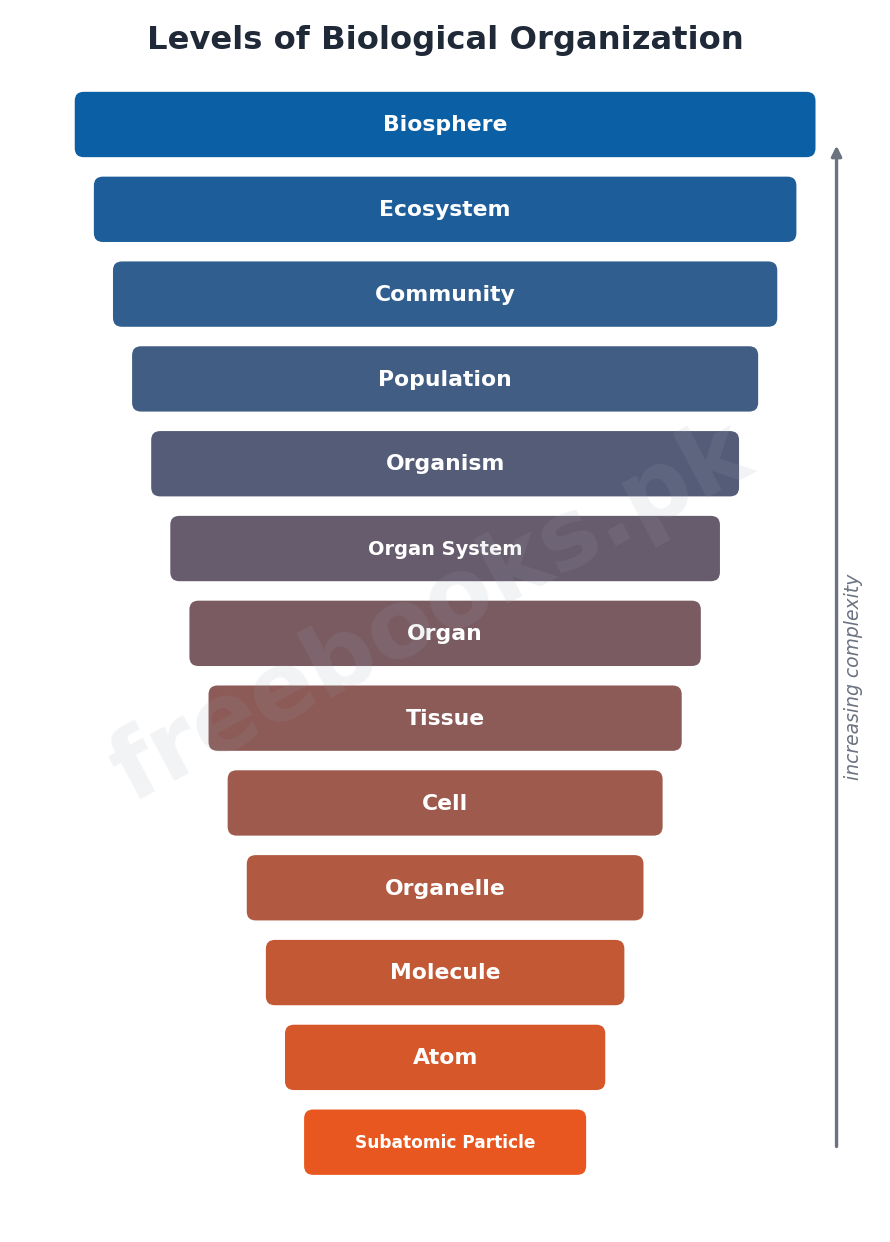
Biological organization is complex, and biologists study it at a series of levels, each built from the level below. Starting from the smallest: subatomic particles (protons, electrons, neutrons) combine to form atoms; atoms bond together to form molecules (micromolecules such as CO2 and water, or macromolecules such as starch and proteins); molecules arrange into organelles, which are the specialised working parts of a cell; organelles are organized within a cell, the basic unit of life; similar cells group into tissues; tissues combine into organs; organs work together as organ systems; organ systems make up an organism; organisms of the same species living in the same place form a population; populations of different species sharing a habitat form a community; a community together with its non-living surroundings forms an ecosystem; and all the ecosystems of the planet together make up the biosphere, the part of the Earth that supports life.
The prokaryotic cells of bacteria have only a limited number and type of organelles, while eukaryotic cells are rich in membranous organelles; a cell membrane, however, is present in every cell, prokaryotic or eukaryotic. Organisms interact with one another in several ways at these levels, including predation, parasitism, commensalism, mutualism and competition.
Living World in Space and Time
The living world is distributed in space as well as in time. In space, the distribution of organisms can be studied through biomes: a biome is a large regional community determined mainly by climate, and biomes are named after their dominant plant type or main ecosystem feature.
In time, the history of life is reconstructed mainly from fossils. As new sediment layers are laid down over geological time, older organisms are found in deeper layers (provided the sequence has not been disturbed), and comparing the radioactive isotopes in different layers gives an estimate of the relative age of the fossils they contain. This fossil record lets biologists place organisms in a time sequence and study how life has changed.
Today nearly 2.5 million species are known to science, of which insects alone make up about 53% and vascular plants about 17.6%; careful estimates put the true total number of species anywhere between 5 and 30 million, meaning the great majority are still undiscovered. The idea of a phyletic lineage describes how today's life arose: it is an unbroken series of species arranged from ancestor to descendant, with each later species evolving from the one immediately before it. A complete record of every lineage would trace back to the common origin of early life, but this record is incomplete because many soft-bodied ancient organisms left no fossils.
The Biological (Scientific) Method
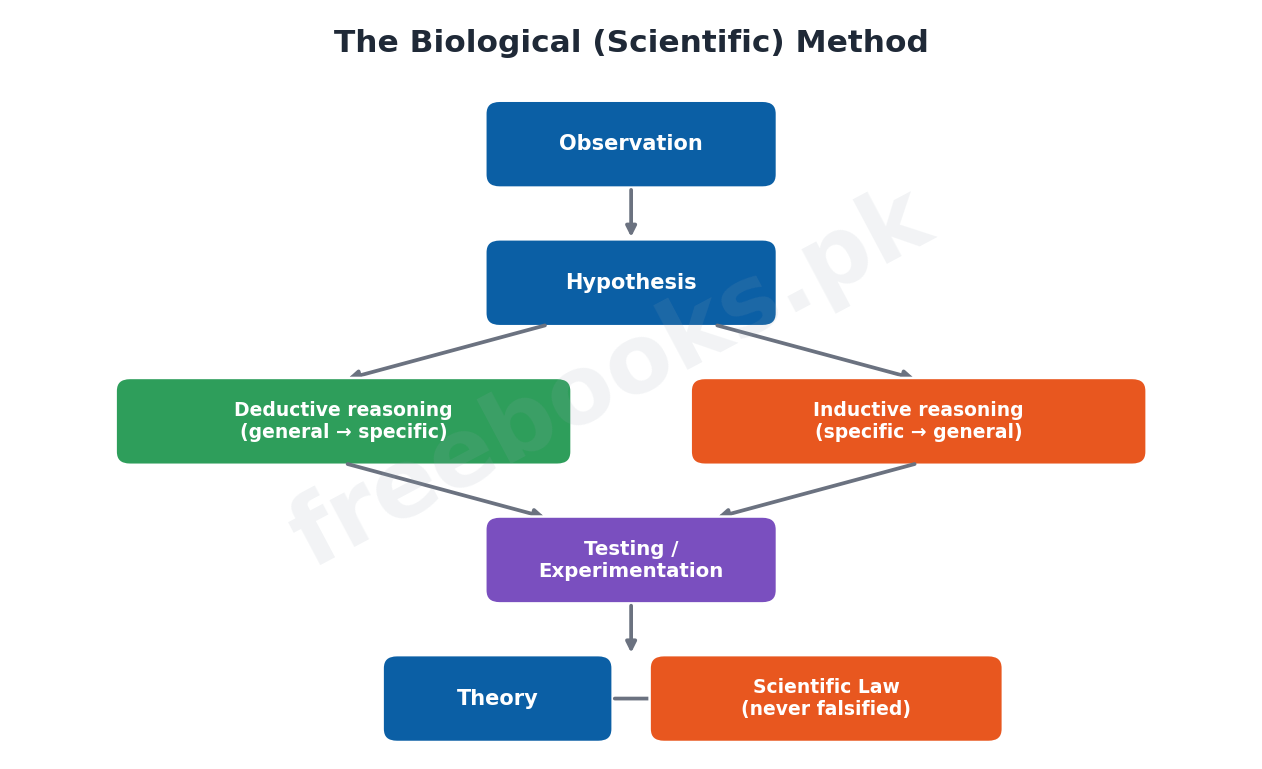
Biological science, like other sciences, is systematized knowledge built through experimental inquiry. The method begins with a chance observation, made using the senses and classified as either qualitative or quantitative (quantitative observations are more accurate because the variables are measurable and recorded as numbers). From organized observations, a scientist forms a hypothesis: a tentative explanation that still needs to be tested.
A hypothesis can be formed in two main ways. Deductive reasoning moves from the general to the specific: it applies an “if … then” style of logic to a general principle to predict a specific outcome (for example, if all birds have wings, and sparrows are birds, then sparrows have wings). Inductive reasoning moves the other way, from the specific to the general: it starts from particular observations and builds up a general principle (for example, noting that sparrows, eagles, parrots and crows all have wings and are birds, and concluding that all birds have wings). Hypotheses may also arise from intuition, aesthetic preference, philosophical ideas, analogy with other processes, or accidental discovery, but however they are formed they must still be tested rigorously.
A hypothesis that survives repeated attempts at falsification becomes well supported and is generally accepted; a series of such well-tested, related hypotheses is called a theory. A good theory is predictive, has explanatory power, and is productive if it suggests further new hypotheses. If a theory keeps surviving determined attempts to disprove it, it may eventually be accepted as a scientific law: a uniform, virtually irrefutable fact of nature. Because life is so variable, biology has comparatively few laws; examples include the Hardy-Weinberg law and Mendel's laws of inheritance, which are studied in later chapters.
Biology in the Service of Mankind: Food and Disease
Biology has helped raise living standards by improving food production and controlling disease. Selective breeding, guided by the principles of genetics, has produced better varieties of wheat, rice, corn, chicken, cattle and sheep, including broiler chickens bred for quick, cheap white meat. Genetic engineering introduces genes for disease resistance and other useful traits into plants, producing transgenic plants (plants carrying foreign DNA), which can then be multiplied by cloning techniques such as tissue culture. Biological control of pests, for example using a wasp that parasitizes the aphids attacking walnut trees, avoids the toxicity and resistance problems caused by chemical pesticides, and some bacteria are used directly as bio-pesticides. Hydroponic culture, in which plants are grown in aerated water with dissolved nutrient salts, is used to test which nutrients a plant actually needs, and food-preservation techniques such as pasteurization (developed by Louis Pasteur) protect milk and other foods from spoilage over long transport and storage.
In disease control, three approaches are used together: preventive measures (avoiding known modes of transmission, for example of HIV/AIDS or hepatitis through blood or contaminated instruments), vaccination or immunization (a technique first developed by Edward Jenner in 1796 using cowpox, from the Latin vacca meaning cow, which has since eliminated smallpox and controls diseases such as polio, whooping cough, measles and mumps), and drug treatment or gene therapy (antibiotics against bacteria that have not developed resistance, radiotherapy and chemotherapy against cancer, and gene therapy, which inserts a normal copy of a defective gene into the patient, often via bone-marrow cells). Combining all of these approaches with community awareness is called integrated disease management.
Biology in the Service of Mankind: Cloning and the Environment
Cloning produces a cell or individual and all of its genetically identical, asexually produced offspring. Few animals clone naturally, but in 1997 scientists in Scotland succeeded in cloning a sheep by replacing the nucleus of a fertilized egg with a nucleus from an adult cell and implanting the resulting embryo in a womb; other mammals such as mice and cows have since been cloned the same way. A second cloning method simply splits a single egg or early embryo into separate embryos, the same natural process that produces identical twins, and this has already been used to produce genetically identical farm animals. Possible future uses include commercial production of animals of known pedigree, though the idea of cloning human embryos as a source of transplant tissue remains highly controversial.
Industrialization has raised living standards but has also damaged the environment: industrial waste and effluents, including toxic and even carcinogenic materials and heavy metals such as lead and chromium, are released into air, soil and water. Biologists have pushed for compulsory treatment of industrial effluents and are investigating bioremediation, the removal of pollutants using living organisms (for example, algae that absorb heavy metals), as well as identifying endangered species that need protection. In Pakistan, rivers and canals are heavily polluted by city sewage and industrial waste, harming freshwater fish populations, and vehicle exhaust adds significant lead to city air, showing the practical need for measures such as lead-free petrol.
Important Definitions
Biology
The study of living things; literally, the study of life.
Bioelement
One of the 16 chemical elements (of the 92 that occur naturally) commonly used to build the compounds of living organisms.
Organelle
A specialised structure within a cell that performs a specific function, such as a mitochondrion or ribosome.
Population
A group of living organisms of the same species located in the same place at the same time.
Community
Populations of different species living and interacting together in the same habitat.
Biome
A large regional community of organisms determined mainly by climate and named after its dominant plant type.
Hypothesis
A tentative explanation of an observation, formed by deductive or inductive reasoning and still to be tested.
Scientific law
A uniform, virtually irrefutable fact of nature; a theory that has survived repeated, rigorous attempts at falsification.
Key Facts
| Item | Fact |
|---|---|
| Elements used by life | 16 of the 92 naturally occurring chemical elements are commonly used to build living matter (bioelements). |
| Bioelements in the human body | Just 6 bioelements account for 99% of the total mass of the human body. |
| Known species today | About 2.5 million species are currently known to science; insects alone make up roughly 53%. |
| Estimated total species | Careful estimates put the true total number of species between 5 and 30 million. |
| Reasoning in science | Deductive reasoning: general to specific. Inductive reasoning: specific to general. |
| Order of scientific confidence | Hypothesis -> Theory (well-tested, related hypotheses) -> Scientific law (never falsified). |
| First vaccination | Edward Jenner used cowpox to develop vaccination in 1796 (Latin vacca = cow). |
| First cloned mammal (sheep) | Scientists in Scotland successfully cloned a sheep in 1997. |
Diagrams & Illustrations
Levels of Biological Organization: a step diagram from the smallest to the largest level of biological organization: subatomic particle, atom, molecule, organelle, cell, tissue, organ, organ system, organism, population, community, ecosystem and biosphere.
Major Branches of Biology: a concept map with Biology at the centre and its major branches / fields of specialization around it, including Molecular Biology, Microbiology, Environmental Biology, Marine and Freshwater Biology, Parasitology, Human Biology, Social Biology and Biotechnology.
The Biological (Scientific) Method: a flowchart of the biological method: observation leads to a hypothesis, formed by deductive or inductive reasoning, which is tested experimentally; a well-tested hypothesis becomes a theory, and a theory that is never falsified becomes a scientific law.
Short Questions & Answers
Differentiate between Environmental Biology and Freshwater Biology.
Environmental Biology studies organisms in relation to their whole environment, including human impact, while Freshwater Biology specifically studies organisms living in rivers, lakes and other freshwater bodies along with the physical and chemical properties of that water.
What are bioelements, and why are they significant in the human body?
Bioelements are the 16 (of 92 naturally occurring) chemical elements commonly used to build living matter; in the human body just six of them make up 99% of the total mass, showing how a small set of elements supports almost all of life's chemistry.
Differentiate between population and community.
A population is a group of organisms of the same species living in the same place at the same time, while a community consists of populations of different species living and interacting together in the same habitat.
What is a hypothesis, and how does it differ from a theory?
A hypothesis is a tentative explanation of an observation that still needs to be tested, while a theory is a series of related hypotheses that have been repeatedly tested without being falsified, giving it stronger, more general support.
Differentiate between deductive and inductive reasoning.
Deductive reasoning moves from a general principle to a specific conclusion (if all birds have wings and sparrows are birds, then sparrows have wings), while inductive reasoning moves from specific observations to a general principle (several birds are seen to have wings, so all birds are concluded to have wings).
Define cloning and give one example of its practical use.
Cloning is the production of a cell or individual and all of its genetically identical, asexually produced offspring; for example, in 1997 scientists in Scotland cloned a sheep by transferring an adult cell's nucleus into an egg whose own nucleus had been removed.
Long Questions & Answers
Describe the levels of biological organization from atoms to the biosphere.
Living matter is built up in a series of levels, each formed from the level below it. Subatomic particles such as protons, electrons and neutrons combine to form atoms, the basic units of the chemical elements. Atoms bond to form molecules, which may be simple micromolecules such as water and carbon dioxide or large macromolecules such as starch and proteins. Molecules are organized into organelles, the specialised working parts of a cell such as mitochondria and ribosomes, and organelles function together inside a cell, the basic unit of life. Groups of similar cells performing the same job form tissues, and different tissues working together form organs, such as the stomach. Organs that cooperate to carry out one overall function make up an organ system, and organ systems together make up a whole organism. Organisms of the same species sharing a place and time form a population, and populations of different species sharing a habitat form a community. A community together with its non-living surroundings, such as soil, water and climate, forms an ecosystem, and all of Earth's ecosystems together make up the biosphere, the zone of the planet that supports life. Each level shows properties that are not found at the level below it, which is why biologists study organisms at all of these levels rather than just one.
Explain the biological method used in solving a biological problem, including the role of deductive and inductive reasoning.
The biological, or scientific, method begins with a chance observation made through the senses; observations may be qualitative (descriptive) or quantitative (numerical and more precise). From these observations a scientist proposes a hypothesis, a tentative explanation that must be tested. A hypothesis can be formed by deductive reasoning, which starts from an accepted general principle and predicts a specific outcome using “if … then” logic (for example, if all green plants need sunlight for photosynthesis, then a green plant kept in the dark will not make glucose), or by inductive reasoning, which starts from specific observed cases and builds up a general principle (for example, observing that several different kinds of birds all have wings and concluding that wings are a general feature of birds). Occasionally hypotheses also arise from intuition, analogy, or accidental discovery. Once formed, a hypothesis is tested repeatedly; if it survives many honest attempts at falsification, confidence in it grows, and a set of such well-supported, related hypotheses becomes a theory. A good theory both explains existing observations and predicts new ones. If a theory continues to withstand rigorous testing over time and is never falsified, it may eventually be accepted as a scientific law, a virtually irrefutable statement of how nature behaves; because life is so complex and variable, biology has comparatively few laws, such as the Hardy-Weinberg law and Mendel's laws of inheritance.
Discuss the major branches of biology and how newer specializations like biotechnology have developed alongside the classical branches.
Because biology covers every aspect of living things, it has been divided into many branches for convenience of study. The classical branches focus on particular aspects of organisms: Ecology studies environmental relations, Embryology studies development, Physiology studies functions, Morphology or Anatomy studies structure and form, Palaeontology studies fossils, Histology studies tissues, Evolution studies ancestral history, Genetics studies heredity, and Zoogeography studies the distribution of animals. Alongside these, more specialised, often more applied branches have grown in importance: Molecular Biology examines organisms, cells and organelles at the molecular level; Environmental Biology and, more specifically, Freshwater Biology and Marine Biology study organisms in relation to their surroundings on land, in fresh water and in the sea; Microbiology studies bacteria, viruses, protozoa and microscopic fungi and algae; Parasitology studies parasites and their relationships with hosts; Human Biology and Social Biology focus on the structure, function and social behaviour of human beings; and Biotechnology applies living organisms and biological processes to manufacturing, agriculture and medicine. These newer branches did not replace the classical ones; rather, they grew out of them as scientists combined biology with chemistry, physics and technology to solve practical problems in food, health, and industry, which is why biology today is described as an extremely wide-based science with volumes of information organized into many specialized fields.
Explain the contribution of biology to disease control, with reference to preventive measures, vaccination and drug treatment/gene therapy.
Biology contributes to disease control through three combined approaches. Preventive measures rely on biological knowledge of how diseases spread; for instance, knowing that AIDS is caused by HIV and hepatitis by its causative virus, both transmitted through blood transfusion, contaminated syringes or surgical instruments, or (for HIV) sexual contact, allows doctors to advise people to avoid these specific points of contact. Vaccination or immunization, a technique that traces back to Edward Jenner's use of cowpox in 1796 (the word vaccine comes from the Latin vacca, meaning cow), trains the body's immunity in advance and has eliminated smallpox worldwide while keeping diseases such as polio, whooping cough, measles and mumps under control through routine childhood immunization; experimental vaccines, including one against AIDS, continue to be developed. Drug treatment and gene therapy act once a person is already sick: antibiotics can kill bacteria that have not developed resistance, radiotherapy exposes cancerous tissue to short-wave radiation at intervals, chemotherapy uses anticancer chemicals that unfortunately can also affect normal cells, and gene therapy repairs defective genes by isolating a normal copy of the gene and inserting it into the patient, often through bone-marrow cells. Using all of these methods together, combined with community awareness of a disease's causes and remedies, is known as integrated disease management, and it is considered a highly effective way to eliminate or control dangerous diseases in a population.
What is the role of the study of biology in the welfare of mankind, considering food production, cloning and the environment?
Biology has improved human welfare in several connected ways. In food production, selective breeding based on genetics has produced higher-yielding, disease-resistant crop and livestock varieties, genetic engineering has created transgenic plants carrying useful foreign genes, biological pest control using natural enemies (such as a wasp that parasitizes aphids) avoids the toxicity and resistance problems of chemical pesticides, hydroponic culture allows precise study and growth of plants without soil, and techniques such as pasteurization preserve food during storage and transport. In cloning, techniques developed from the successful cloning of a sheep in Scotland in 1997, and from splitting early embryos, can multiply animals of known genetic value, though the cloning of human embryos remains ethically controversial. In environmental protection, biology has drawn attention to the damage caused by industrial effluents and heavy metals, promoted bioremediation methods such as using algae to absorb pollution, and pushed for the identification and protection of endangered species; in Pakistan specifically, biologists have highlighted the pollution of rivers and canals by sewage and industrial waste and the need for measures such as lead-free petrol to protect both freshwater life and human health. Taken together, these contributions show biology moving beyond pure classification of living things into an applied science that directly improves food security, health and the environment.
MCQs with Answers
Biology is best defined as the study of: (a) matter and energy (b) living things (c) the earth's crust (d) chemical reactions only
Correct Answer: (b) living things. The word biology literally means the study of life / living things.
Which branch of biology studies organisms living in seas and oceans? (a) Freshwater Biology (b) Marine Biology (c) Parasitology (d) Microbiology
Correct Answer: (b) Marine Biology. Marine Biology studies life in seas and oceans and the physical/chemical characteristics of the sea.
Which branch of biology deals with bacteria, viruses, protozoa and microscopic fungi/algae? (a) Human Biology (b) Social Biology (c) Microbiology (d) Biotechnology
Correct Answer: (c) Microbiology. Microbiology is the study of microorganisms such as bacteria, viruses, protozoa and microscopic algae and fungi.
How many bioelements commonly form the compounds of living organisms? (a) 6 (b) 10 (c) 16 (d) 92
Correct Answer: (c) 16. 16 of the 92 naturally occurring elements are commonly used to build living matter; these are the bioelements.
Which is the smallest level of biological organization mentioned in the chapter? (a) Cell (b) Molecule (c) Subatomic particle (d) Organelle
Correct Answer: (c) Subatomic particle. Subatomic particles (protons, electrons, neutrons) are the smallest level, combining to form atoms and then molecules.
A group of organisms of the same species living in the same place at the same time is called a: (a) Community (b) Population (c) Ecosystem (d) Biome
Correct Answer: (b) Population. This is the definition of a population; a community includes populations of different species.
Reasoning that moves from a general principle to a specific conclusion is called: (a) Inductive reasoning (b) Deductive reasoning (c) Experimental reasoning (d) Analogical reasoning
Correct Answer: (b) Deductive reasoning. Deductive reasoning moves from the general to the specific, using "if … then" logic.
The technique of vaccination was first developed by: (a) Louis Pasteur (b) Gregor Mendel (c) Edward Jenner (d) Charles Darwin
Correct Answer: (c) Edward Jenner. Edward Jenner developed vaccination in 1796 using cowpox (Latin vacca = cow).
In 1997, scientists in Scotland succeeded in cloning a: (a) Cow (b) Mouse (c) Sheep (d) Goat
Correct Answer: (c) Sheep. The first successfully cloned mammal from an adult cell was a sheep, cloned in Scotland in 1997.
The removal or degradation of environmental pollutants using living organisms is called: (a) Biotechnology (b) Bioremediation (c) Biodiversity (d) Biogeography
Correct Answer: (b) Bioremediation. Bioremediation uses living organisms, such as algae absorbing heavy metals, to reduce pollution.
Quick Revision Summary
- Biology is the study of living things; living organisms are organized, made of cells, carry genetic information, use energy, grow, maintain internal balance, reproduce and respond to the environment.
- Major branches include Molecular Biology, Environmental Biology, Microbiology, Freshwater and Marine Biology, Parasitology, Human Biology, Social Biology and Biotechnology, alongside classical branches like Ecology, Genetics and Evolution.
- Levels of organization (smallest to largest): subatomic particle, atom, molecule, organelle, cell, tissue, organ, organ system, organism, population, community, ecosystem, biosphere.
- 16 of 92 natural elements are bioelements; just 6 make up 99% of human body mass.
- Biomes describe life's distribution in space; fossils and geological time chart describe life's distribution in time; a phyletic lineage is an unbroken ancestor-to-descendant series of species.
- Biological method: observation -> hypothesis (deductive or inductive reasoning) -> testing -> theory -> scientific law (e.g. Hardy-Weinberg law, Mendel's laws).
- Biology serves mankind through better food production (selective breeding, genetic engineering, biological pest control), disease control (prevention, vaccination since Jenner 1796, drug treatment/gene therapy), cloning (sheep, Scotland, 1997), and environmental protection (bioremediation, endangered species). Notes by freebooks.pk.
Exam Tips
- Learn the exact order of levels of biological organization (subatomic particle to biosphere) by heart; a common MCQ and short-question topic.
- Be ready to define at least 5-6 branches of biology in your own words, not just name them.
- Practise distinguishing similar pairs: population vs community, deductive vs inductive reasoning, theory vs scientific law.
- Remember key names and dates: Edward Jenner (vaccination, 1796), Louis Pasteur (pasteurization), Scotland 1997 (first cloned sheep).
- For "role of biology in welfare of mankind" questions, cover all four angles: food, disease control, cloning, environment — examiners often ask for at least two.
- In fill-in-the-blank and true/false questions from the exercise, watch for commonly confused facts, e.g. vaccination history and which bioelements dominate body mass.