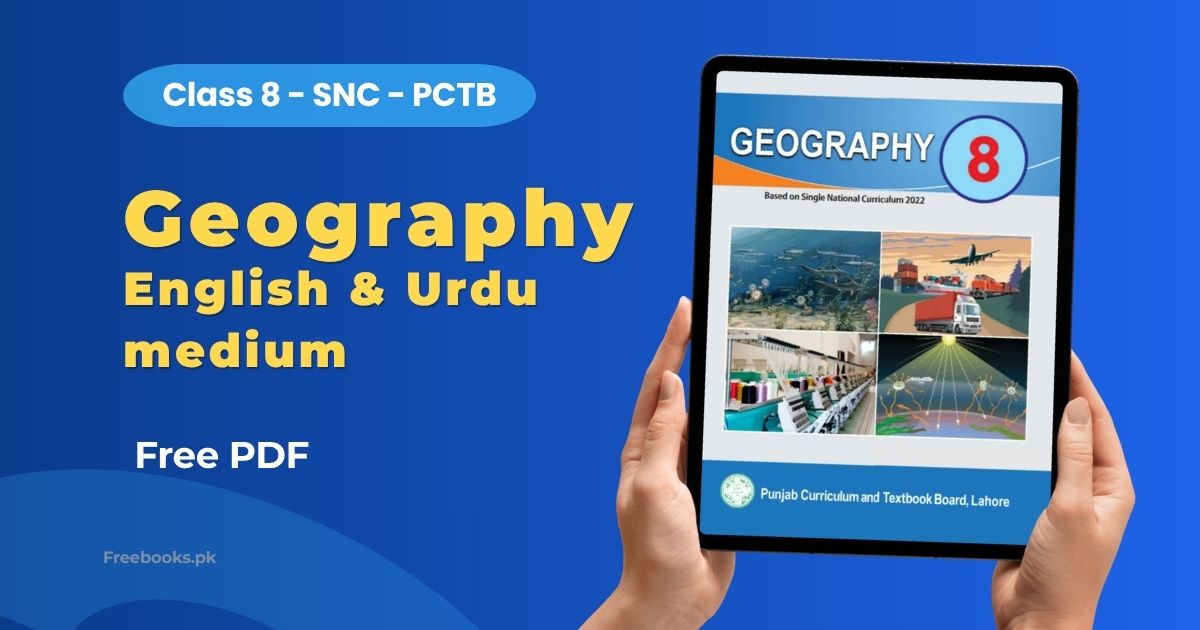
Geography for Class 8 is the official textbook published by the Punjab Curriculum and Textbook Board (PCTB), Lahore, based on the Single National Curriculum (SNC) 2022. It is part of the official Class 8 syllabus and is available in both English and Urdu medium editions. The book covers seven units, from oceans and climate to pollution, industrialization, transport, and Pakistan’s economic development, written by Nadeem Fiaz, Atif Bukhari, and M. Ramzan.
For Class 8 students, this book builds real geography knowledge alongside exam preparation, connecting Pakistan’s economy, trade, and environment to global ideas like climate change and sustainable development. The unit summaries and important questions on this page make revision faster before exams, in either the English or Urdu medium edition.
Book Overview
| Class | 8 |
| Subject | Geography |
| Board | Punjab Curriculum and Textbook Board (PCTB) |
| Curriculum | Single National Curriculum (SNC) 2022 |
| Authors | Nadeem Fiaz, Atif Bukhari, M. Ramzan |
| Publisher | Punjab Curriculum and Textbook Board (PCTB), Lahore |
| Edition | Experimental Edition, 2023-24 |
| Total Chapters | 7 |
| Total Pages | 89 |
| Medium | English and Urdu (both editions available) |
| Format |
Chapter List
Chapter 1: Oceans and Seas (بحر اور بحیرے)
This chapter explains the difference between an ocean and a sea, then introduces the world’s five oceans, Pacific, Atlantic, Indian, Antarctic, and Arctic, with their area, depth, and unique features. Students learn key sea features such as peninsula, isthmus, gulf, bay, strait, and island, along with how ocean water moves through waves, currents, and tides, including spring and neap tides caused by the Moon’s gravity. The chapter covers the importance of oceans as a source of food, minerals, oxygen, and global transport, and closes with the growing threats oceans face today, from pollution to overfishing, and practical ways to reduce them.
Important Questions:
- Define gulf. A large but narrow part of the ocean that extends far inland, such as the Persian Gulf.
- Differentiate between spring and neap tides. Spring tides are unusually high tides when the Sun, Moon, and Earth align; neap tides are unusually low tides when the Sun and Moon pull at right angles to each other.
- Differentiate between ocean and sea. An ocean is a huge body of salt water; a sea is a smaller part of an ocean partly enclosed by land.
- What is the difference between strait and isthmus? A strait is a narrow channel of water connecting two seas or oceans, while an isthmus is a narrow strip of land connecting two larger landmasses.
Chapter 2: Living with Climate (آب و ہوا اور زندگی)
This chapter distinguishes weather from climate and covers real examples of extreme weather in Pakistan, including the deadly 2015 Karachi heatwave and the 2022 floods in Sindh and Balochistan. It explains the main causes of climate change, greenhouse gases, deforestation, industrial and agricultural activity, and the greenhouse effect that keeps Earth’s temperature stable but is now overheating the planet. Students learn the consequences of global warming, from rising sea levels to disrupted ecosystems, along with remedies such as renewable energy and forestation. The chapter closes by comparing the climates of Karachi and New York, and contrasting how people live in tropical and polar regions.
Important Questions:
- Define extreme weather condition. A weather event that is significantly different from the usual or average weather pattern of a place.
- What are the two major threats of climate change? Rising sea levels causing coastal flooding, and disruption of biodiversity and ecosystems.
- What is greenhouse effect? The process where greenhouse gases trap the Sun’s heat in the atmosphere, warming the Earth’s surface.
- Define global warming. The gradual rise in the Earth’s surface temperature caused mainly by human activities increasing greenhouse gases.
Chapter 3: Environmental Pollution (ماحولیاتی آلودگی)
This chapter explains pollution as harmful material added to the environment and links it directly to climate change. It covers five major types of pollution, water, soil, air, noise, and light, with their real causes and health effects, from waterborne diseases to hearing loss. Students learn the 3R rule (reduce, refuse, recycle) and individual, national, and global responsibilities for cutting pollution, including the 2015 Paris climate agreement signed by 196 countries. The chapter also explains the greenhouse effect, ozone layer depletion, and how air and water pollution damage biodiversity, ending with practical steps to protect the ozone layer.
Important Questions:
- What is meant by pollution? The addition of harmful substances, called pollutants, into the environment that damage air, water, or land.
- What are the causes of greenhouse effect? Carbon dioxide, water vapour, and dust particles trapping the Earth’s heat and keeping the lower atmosphere warm.
- Name the types of pollution. Water, land/soil, air, noise, and light pollution.
- What is meant by global warming? The gradual increase in the Earth’s terrestrial temperature caused by human interference with the natural environment.
Chapter 4: Industrialization and International Trade (صنعت کاری اور بین الاقوامی تجارت)
This chapter covers Pakistan’s main industries, textile, fertilizer, cement, sugar, and iron and steel, and explains how industrialization drives immigration and urbanization. It walks through the textile industry’s stages, ginning, spinning, and weaving, and highlights the role of cottage industries in providing local employment. Students learn Pakistan’s major imports and exports, the role of the WTO and TDAP in regulating trade, and practical ways Pakistan can boost exports and reduce imports. The chapter closes with Pakistan’s bilateral trade relationship with China, including CPEC projects like the Gwadar Port, and the role science and technology play in industrial growth.
Important Questions:
- Enlist the main industries of Pakistan. Textile, fertilizer, cement, sugar, and iron and steel industries.
- Give three examples of small-scale industries. Electric fans, cutlery, and sports goods manufacturing, among others.
- Define bilateral trade. Trade conducted directly between two countries, such as Pakistan and China.
- Define urbanization. The growth and development of cities as large numbers of people settle permanently in relatively small areas.
Chapter 5: Transport and its Importance (نقل و حمل اوران کی اہمیت)
This chapter introduces the three main types of transport, land (road and rail), water, and air, along with their characteristics and typical uses. It explains how an efficient transport system drives economic development by connecting buyers and sellers, mobilizing labour, and stabilizing prices. Students learn about Pakistan’s own transport network, including its roads, railways, PIA’s domestic and international air routes, and its three major seaports, Karachi, Port Qasim, and Gwadar. The chapter closes with the real strengths and weaknesses of Pakistan’s transport infrastructure, from rural-urban connectivity to traffic congestion and maintenance costs.
Important Questions:
- What is the significance of transport system? It connects buyers and sellers, moves goods and people, and drives a country’s economic development.
- Write the name of major modes of transportation. Land, water, and air transport are the three major modes.
- Which road has the highest traffic density? The Grand Trunk (G.T.) Road running from Peshawar to Karachi.
- Write the names of seaports of Pakistan. Karachi (Keamari) Port, Port Qasim, and Gwadar Port.
Chapter 6: Social and Economic Development (معاشرتی اور معاشی ترقی)
This chapter distinguishes economic growth from economic development and covers the key indicators used to measure a nation’s progress, per capita GNP, energy consumption, and the share of labour force in primary activities. It introduces the Human Development Index (HDI), based on life expectancy, education, and standard of living, and explains why Pakistan ranked 161 out of 192 countries in 2021-22. Students learn how inflation, unemployment, and technology affect development, along with the importance of a strong health care system. The chapter closes with the role of the OECD in promoting economic and social wellbeing worldwide.
Important Questions:
- Define economic development. A change in national income over time, along with improvements in the technical and institutional structure that produces it.
- Enlist the development indicators. Per capita GNP, per capita energy consumption, and the percentage of labour force in primary activities.
- What are the main Human Development Indicators? Healthy life (life expectancy), education, standard of living, per capita income, and GDP growth rate.
- What is the role of OECD? It produces independent analysis and statistics to promote policies that improve economic and social wellbeing around the world.
Chapter 7: Glossary and Bibliography (فرہنگ، کتابیات)
This closing section brings together a glossary of more than 20 key geography terms used throughout the book, such as biodiversity, greenhouse gas, urbanization, and fossil fuel, along with a bibliography listing the reference sources used to compile the textbook. It is a useful quick-reference section for students revising terminology before exams.
Download Geography Class 8 PDF
Click the button below to download the Geography Class 8 SNC PDF for free. Both English and Urdu medium editions are available:
⬇ Download PDF (English Medium)
Older PCTB editions of this book are also available:
⬇ Download PDF (English Medium, Old PCTB Edition)
⬇ Download PDF (Urdu Medium, Old PCTB Edition)
Who Should Read This
This book is meant for Class 8 students studying under the PCTB Single National Curriculum, in both English and Urdu medium schools. It is also useful for students preparing for entry test screening at the middle school level, where basic geography and current affairs questions often appear.
Applicable Boards
This book is published by the Punjab Curriculum and Textbook Board (PCTB) and is the primary textbook for Class 8 Geography in Punjab. Since it follows the Single National Curriculum (SNC) 2022, students in other provinces and boards using the same SNC syllabus can also refer to this book for their Class 8 Geography topics.
FAQs
Is this Geography book for Class 8?
Yes, this is the official Class 8 Geography textbook published by the Punjab Curriculum and Textbook Board (PCTB) under the Single National Curriculum (SNC) 2022.
Can other students use it?
Yes, students from other boards following the same SNC 2022 syllabus can also use this book for their Class 8 Geography topics.
Is this the latest edition?
This PDF follows the Experimental Edition 2023-24, the current PCTB edition based on the SNC 2022 curriculum.
Does it include solved exercises?
The book follows the official textbook content as published, with exercise questions, activities, and key points for each unit.
Is this book available in Urdu medium too?
Yes, both English medium and Urdu medium editions are available for download on this page.
Who are the authors of this book?
The book is written by Nadeem Fiaz, Atif Bukhari, and M. Ramzan, all Geography subject specialists at PCTB.
How many pages does this book have?
The complete Geography Class 8 textbook has 89 pages across its 7 units.
Related Books
- Geography Class 7
- Mathematics Class 8 (English Medium)
- Mathematics Class 8 (Urdu Medium)
- Mathematics Class 8
- Computer Science Class 8
- History Class 8
© Copyright Policy
Freebooks.pk is an educational resource for students in Pakistan. Textbooks and other books belong to their respective boards, authors and publishers, and all rights remain with them. If you are the copyright holder of any material on this page and want it changed or removed, please contact us or file a request under our DMCA policy. We review every request and remove reported content promptly.