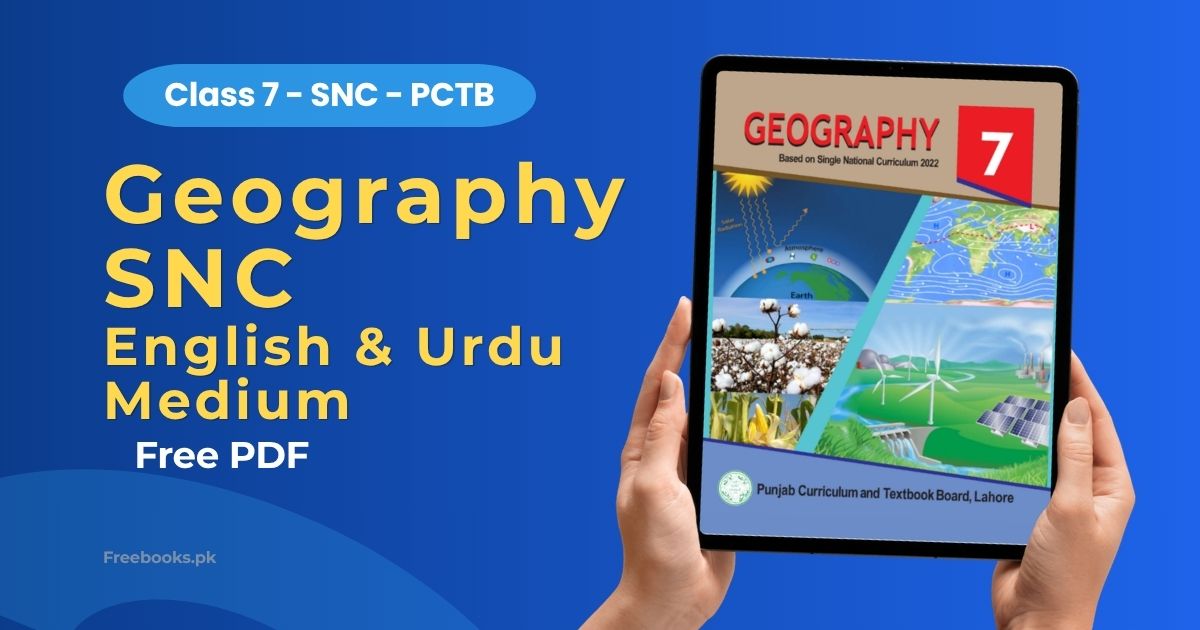
Geography for Class 7 is the official textbook published by the Punjab Curriculum and Textbook Board (PCTB), Lahore, based on the Single National Curriculum (SNC) 2022. It is part of the official Class 7 syllabus and is available in both English and Urdu medium editions. The book covers six units, from plains and rivers to water sources, settlements, agriculture, climate change, and minerals and power, written by Muhammad Ramzan Khan.
For Class 7 students, this book builds real geography knowledge alongside exam preparation, connecting Pakistan’s landforms, water resources, and economy to global ideas like climate change and renewable energy. The unit summaries and important questions on this page make revision faster before exams, in either the English or Urdu medium edition.
Book Overview
| Class | 7 |
| Subject | Geography |
| Board | Punjab Curriculum and Textbook Board (PCTB) |
| Curriculum | Single National Curriculum (SNC) 2022 |
| Author | Muhammad Ramzan Khan (PhD Scholar) |
| Publisher | Punjab Curriculum and Textbook Board (PCTB), Lahore |
| Edition | Experimental Edition, 2023-24 |
| Total Chapters | 6 (plus Glossary and Bibliography) |
| Total Pages | 93 |
| Medium | English and Urdu (both editions available) |
| Format | PDF (Free Download) |
Chapter List
Chapter 1: Plains and Rivers (میدان اور دریا)
This unit explains that a plain is a broad, flat stretch of land covering more than a third of Earth’s surface, and introduces types like erosional, depositional, alluvial, flood, glacial, lacustrine, coastal, and wind plains, comparing plains with plateaus, mountains, and valleys. It then covers river systems, tracing features formed in the upper, middle, and lower courses such as V-shaped valleys, meanders, ox-bow lakes, natural levees, and deltas, and explains why rivers are vital for biodiversity and the economy, from irrigation and hydroelectricity to fishing and tourism.
Important Questions:
- Define the term plain. A broad area of relatively flat land that covers more than one-third of the world’s land area.
- What are plateaus? Flat land raised significantly above the surrounding ground, unlike a plain, which is flat and low-lying.
- Write three features of the middle course of a river. U-shaped valleys, meanders, and ox-bow lakes (also flood plains and levees).
- Why is a delta found on the lower course of a river? Because sediments carried by the river are deposited at its mouth as it enters a larger body of water, forming a low, fan- or triangular-shaped landform.
Chapter 2: Water Sources and Management (پانی کے ذرائع اور انتظام)
This unit lists the major sources of water on Earth and in Pakistan, oceans, rivers, lakes, glaciers, ponds, springs, aquifers, and rainwater, then explains precipitation types (orographic, convectional, and cyclonic rainfall, snowfall, hailing, and sleet) and walks through the water cycle’s steps: evaporation, condensation, sublimation, precipitation, transpiration, runoff, and infiltration. It closes with uses of sewage/grey water, biogas as a renewable energy source, and four water purification methods: boiling, filtration, distillation, and chlorination.
Important Questions:
- What is orographic rainfall? Rainfall that occurs when mountains block moist air, forcing it upward until it cools and condenses into rain.
- Write two uses of biogas. It can be used as vehicle fuel and for heating and electricity generation.
- Define the term chlorination. A water purification method that uses chlorine tablets or liquid chlorine to kill germs, parasites, and disease-causing organisms in water.
- What are aquifers? Underground porous rocks that contain water, providing it for irrigation, industrial use, and household needs, especially in arid areas.
Chapter 3: Settlements and Land Use (بستیاں اور زمین کا استعمال)
This unit classifies settlements into rural (dispersed, nucleated, linear, and planned) and urban types, and ranks them by size and function, from hamlet and village to town, city, metropolitan city, and megalopolis. It explains settlement functions like market towns, mining towns, port cities, and administrative or religious centres, the conditions suitable for a settlement such as water supply and flat land, and compares the advantages and disadvantages of rural versus urban life, ending with the difference between a conurbation and a megapolis.
Important Questions:
- What is meant by administrative centre? A place where government offices and departments are located, such as Islamabad.
- Differentiate between conurbation and megapolis. A conurbation is several merged cities and towns forming one continuous urban area, while a megapolis is a large, densely populated city or group of towns forming an urban complex, like New York City.
- Define the term settlement. A place where people live together, which can be permanent or temporary and ranges in size from a hamlet to a large city.
- What kinds of activities are held in an industrial town? Raw materials are processed into manufactured products, such as textile processing in Faisalabad.
Chapter 4: Agriculture (زراعت)
This unit explains agriculture as the cultivation of crops and rearing of livestock, covering types like subsistence, intensive, extensive, plantation, commercial, and mixed farming. It highlights agriculture’s role in Pakistan’s economy, contributing about 22.7% to GDP, and introduces Rabi and Kharif crops such as wheat, rice, cotton, sugarcane, and maize, along with traditional farming methods (agroforestry, crop rotation, intercropping, polyculture, monoculture), livestock farming’s environmental impact, and how farming and fishery raw materials generate revenue.
Important Questions:
- What is meant by intensive agriculture? Better production obtained from a small area using good fertilizers, water, and pesticides for higher crop yield and financial gain.
- Name Pakistan’s two major rice-producing provinces. Punjab and Sindh, which together account for more than 88% of the country’s total rice production.
- Differentiate between cash crops and food crops. Cash crops like cotton, rice, sugarcane, and tobacco are grown for profit, while food crops like wheat and maize meet the population’s food needs.
- What is crop rotation? Growing different crops on the same land based on the season, which preserves soil productivity and reduces pests.
Chapter 5: Climate Change (موسمیاتی تبدیلی)
This unit distinguishes weather from climate and defines climate change as the long-term shift in temperature and weather patterns caused mainly by greenhouse gases like carbon dioxide, methane, and water vapour trapping heat near Earth’s surface. It explains the greenhouse effect, ozone layer depletion, and major climate change events like the 2022 Pakistan floods and 2021 heatwaves, and closes with the 3R’s of going green (reduce, reuse, recycle) and renewable energy sources such as solar, wind, and geothermal power.
Important Questions:
- What is the difference between weather and climate? Weather is the short-term state of the atmosphere at a particular time and place, while climate is the average weather condition of a place over 25 to 35 years.
- What is the greenhouse effect? The trapping of heat near Earth’s surface by greenhouse gases like carbon dioxide, methane, and water vapour, which keeps the planet warm.
- Why is the ozone layer important? It blocks harmful ultraviolet rays from reaching Earth, which otherwise cause skin cancer and eye diseases.
- What are the 3R’s of being green? Reduce, Reuse, and Recycle.
Chapter 6: Minerals and Powers (معدنیات اور توانائی)
This unit introduces minerals as naturally occurring crystalline substances, divided into metallic (like iron and copper) and non-metallic (like limestone and gypsum) types, and surveys Pakistan’s mineral wealth: mineral oil, natural gas (discovered at Sui in 1952), copper, coal, iron ore, rock salt, chromite, gypsum, marble, and limestone. It explains mining methods (hand-panning, shaft tunnel, open-pit, adit tunnel, and drill mining), the risks of coal mining, and alternate energy sources like solar, wind, and hydro power, including Tarbela Dam and the Quaid-e-Azam Solar Power Park.
Important Questions:
- What is the difference between metallic and non-metallic minerals? Metallic minerals have a lustre and contain metals like iron and copper; non-metallic minerals like limestone and gypsum lack this shine and extractable metal content.
- Where was natural gas first discovered in Pakistan? At Sui in Sibi, Balochistan, in 1952, which is why it is commonly called Sui Gas.
- How is wind electricity generated? Wind turns turbine blades mounted on tall poles, and this motion is converted into electric power, as at the Jhimpir Wind Power Plant in Thatta.
- What are the major products of mineral oil? Gasoline, kerosene oil, wax, and coal tar.
Glossary and Bibliography (اصطلاحات، کتابیات)
This closing section brings together a glossary of key geography terms used throughout the book, such as grassland, precipitation, biogas, distillation, karez, and mining, along with a bibliography of reference books used to compile the textbook, a useful quick-reference for students revising terminology before exams.
Download Geography Class 7 SNC PDF
Click the button below to download the Geography Class 7 SNC PDF for free. Both English and Urdu medium editions are available:
⬇ Download PDF (English Medium)
Who Should Read This
This book is meant for Class 7 students studying under the PCTB Single National Curriculum, in both English and Urdu medium schools. It is also useful for students preparing for entry test screening at the middle school level, where basic geography and current affairs questions often appear.
Applicable Boards
This book is published by the Punjab Curriculum and Textbook Board (PCTB) and is the primary textbook for Class 7 Geography in Punjab. Since it follows the Single National Curriculum (SNC) 2022, students in other provinces and boards using the same SNC syllabus can also refer to this book for their Class 7 Geography topics.
FAQs
Is this Geography book for Class 7?
Yes, this is the official Class 7 Geography textbook published by the Punjab Curriculum and Textbook Board (PCTB) under the Single National Curriculum (SNC) 2022.
Can other students use it?
Yes, students from other boards following the same SNC 2022 syllabus can also use this book for their Class 7 Geography topics.
Is this the latest edition?
This PDF follows the Experimental Edition 2023-24, the current PCTB edition based on the SNC 2022 curriculum.
Does it include solved exercises?
The book follows the official textbook content as published, with exercise questions, activities, and key points for each unit.
Is this book available in Urdu medium too?
Yes, both English medium and Urdu medium editions are available for download on this page.
Who is the author of this book?
The book is written by Muhammad Ramzan Khan, a Geography subject specialist, and reviewed by a panel of PCTB Geography experts.
How many pages does this book have?
The complete Geography Class 7 textbook has 93 pages across its 6 units, plus a glossary and bibliography.
Related Books
- Geography Class 6
- Geography Class 8
- Guide Class 7
- Social Studies Class 7
- Mathematics Class 7 (English Medium)
- General Science Class 7 (English Medium)
© Copyright Policy
Freebooks.pk is an educational resource for students in Pakistan. Textbooks and other books belong to their respective boards, authors and publishers, and all rights remain with them. If you are the copyright holder of any material on this page and want it changed or removed, please contact us or file a request under our DMCA policy. We review every request and remove reported content promptly.