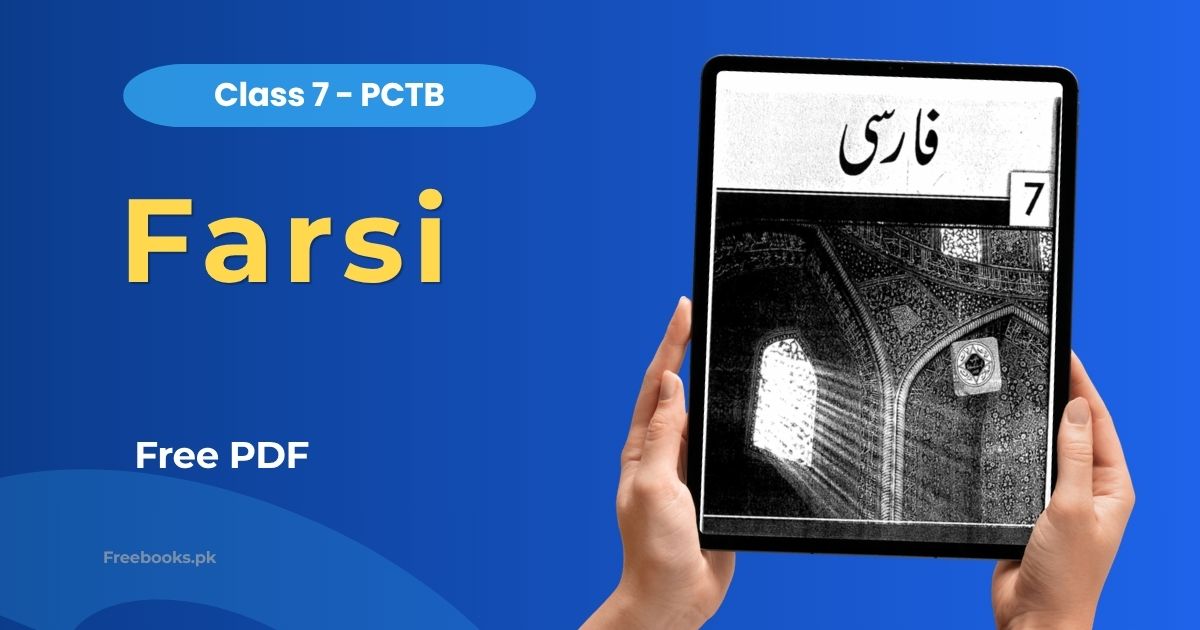
Farsi (“Kitab-e-Jadeed Farsi”) for Class 7 is the official textbook published by the Punjab Curriculum and Textbook Board (PCTB), Lahore, prepared with support from the Culture House of the Islamic Republic of Iran, Lahore. It is part of the official syllabus for Class 7 students who take Farsi as their language subject.
This book introduces Class 7 students to Persian through short poems, dialogues, and prose lessons on religious, historical, and everyday topics. Each lesson comes with vocabulary notes and Urdu translation support, helping students build vocabulary and revise clearly before their board exam.
Book Overview
| Class | 7 |
| Subject | Farsi (Persian Language) |
| Board | Punjab Board (PCTB, Lahore) |
| Authors | Dr. Muhammad Bashir Hussain (late), Mirza Hadi Ali Baig (late), Syed Naseer Shadani |
| Revised By | Dr. Aftab Asghar |
| Publisher | Shahid Book Centre, Lahore |
| Printer | Hashim & Samad Printers, Lahore |
| Total Lessons | 38 |
| Total Pages | 88 |
| Medium | Persian (Farsi), with Urdu translation and notes |
| Format | PDF (Free Download) |
Chapter List
Lesson 1: Munajat
This poem is a prayer of repentance from Attar’s Pand Nama. The poet confesses that human beings are sinners while God is endlessly forgiving, admits countless faults committed knowingly and unknowingly, and asks that God’s mercy reach the servant before death, so the soul may leave this world purified and full of faith.
Important Questions:
- What does the poet ask God for in this poem? Forgiveness for countless sins, and a heart purified by faith before death.
- Whose poem is “Munajat” taken from? It is taken from the Pand Nama of the Persian poet Attar.
Lesson 2: Naat Rasool Akram
This naat, written by Fariduddin Attar, praises the Holy Prophet (PBUH) as the noblest guide of both worlds, unmatched in eloquence and virtue, whom the poet feels unworthy and unable to fully describe. It closes by calling him the greatest and best of all the prophets and the guide of the chosen and pious.
Important Questions:
- Why does the poet feel unable to fully describe the Prophet’s virtues? Because the poet feels too humble and the Prophet’s excellence too vast to fully capture in words.
- What titles does the poem give the Prophet? “The greatest and best of all the prophets” and “the guide of the chosen and pious.”
Lesson 3: Sabr Wa Payedari
This lesson recounts how the Meccan disbelievers threatened the Prophet’s uncle Abu Talib, demanding he stop his nephew from preaching Islam. The Prophet’s reply was firm: even if the sun were placed in his right hand and the moon in his left, he would never abandon his mission until God’s truth prevailed or he lost his life trying.
Important Questions:
- What did the Meccan leaders demand from Abu Talib? That he stop the Prophet from preaching Islam, or face war.
- What was the Prophet’s reply to his uncle? That he would never give up preaching Islam, even if offered the sun and the moon.
Lesson 4: Payambar Ma Wa Kodakan
This lesson describes the Prophet’s affection for children. He greeted children even before they greeted him and always urged Muslims to be kind to them, saying that anyone who is not kind to children is not a true Muslim. A companion recalls children running to greet the Prophet, who caressed them and spoke to them warmly.
Important Questions:
- What did the Prophet say about kindness to children? That whoever is not kind to children is not a true Muslim.
- How did the Prophet greet children? He would greet them first, even before they greeted him.
Lesson 5: Che Khosh Bashad Namaz-e-Pancgana
This poem calls believers to rise at dawn when the call to prayer sounds from the minarets, perform ablution with sincerity, and turn toward the Qibla for prayer. It says the heart finds true peace only through the five daily prayers performed at dawn, noon, afternoon, evening, and night, remembering God.
Important Questions:
- What does the poem say brings the heart true peace? Remembering God through the five daily prayers.
- What should a believer do before turning to the Qibla? Perform ablution (wudu) with sincerity.
Lesson 6: Payetakht-e-Pakistan
This lesson describes Islamabad, Pakistan’s capital, built near Rawalpindi in 1961 at the foot of the Margalla Hills. It highlights the city’s wide, tree-lined streets, parks like Shakarparian, mosques including Faisal Mosque and Lal Masjid, and its drinking water supply from Rawal Dam, calling Islamabad the cleanest and most beautiful city in Pakistan.
Important Questions:
- When and near which city was Islamabad built? It was built in 1961 near Rawalpindi.
- Where does Islamabad get its drinking water from? From Rawal Dam.
Lesson 7: Pand-Hai Luqman Ba Pisar-e-Khud
This lesson presents wise sayings of Hazrat Luqman to his son, urging him to sit among the wise and listen carefully to their words, always speak the truth since a liar’s face loses its glow, never make an ignorant person a friend nor a wise one an enemy, and always consult the learned in his affairs.
Important Questions:
- What does Luqman say happens to a liar’s face? It loses its glow and becomes dull.
- What advice does Luqman give about friendship? Never befriend the ignorant, and never make an enemy of the wise.
Lesson 8: Tabnanda Pakistan Ma
This patriotic poem celebrates Pakistan’s unity, naming Sindh, Balochistan, and every province as bound together as one people under one faith, the Quran, and belief in the Prophet Muhammad (PBUH). It compares the provinces to milk and sugar mixed together, “one soul in two bodies,” and calls Islam their strong fortress.
Important Questions:
- Which regions does the poem describe as united into one nation? Sindh, Balochistan, the frontier, and Punjab, joined together as one.
- What comparison does the poem use for Pakistan’s unity? “Milk and sugar” mixed together, or “one soul in two bodies.”
Lesson 9: Yarghaar (Hazrat Abu Bakr Siddiq)
This lesson tells the story of Hazrat Abu Bakr Siddiq (RA), a cloth merchant and the Prophet’s close friend who was the first adult male to accept Islam. It recounts his loyalty during the migration to Medina, his generosity in giving away his entire wealth for the cause of Islam, and how he earned the title “Siddiq,” meaning the truthful one.
Important Questions:
- What was Hazrat Abu Bakr’s profession before accepting Islam? He was a cloth merchant.
- Why was Hazrat Abu Bakr given the title “Siddiq”? Because he immediately and fully believed the Prophet’s account of the night journey, showing his complete trust and truthfulness.
Lesson 10: Kitabfrooshi (Dialogue)
This dialogue lesson follows two brothers, Ahmad and Hamid, who come home overjoyed after passing their exams and being promoted to Class 7. Their mother sends them with their sister Zahra to Urdu Bazaar in Lahore, where they buy new textbooks, notebooks, and stationery items like pencils, erasers, ink, and rulers from a shopkeeper.
Important Questions:
- Why were Ahmad and Hamid so happy on their way home? They had passed their exams and ranked first and second in their class.
- Who went with the brothers to buy books, and where? Their sister Zahra, to Urdu Bazaar in Lahore.
Lesson 11: Rubah Wa Zagh
This verse fable tells of a crow that finds a piece of cheese and perches on a tree. A cunning fox flatters the crow’s black feathers and voice, asking it to sing so he may judge its beauty. The vain crow opens its beak to caw, drops the cheese, and the fox snatches it away.
Important Questions:
- What did the fox praise about the crow to trick it? Its beautiful black feathers, and asked it to sing so he could judge its voice.
- What happened when the crow opened its mouth to sing? The cheese fell from its beak and the fox grabbed it.
Lesson 12: Farooq-e-Azam (Hazrat Umar)
This biography describes Hazrat Umar bin Khattab (RA), a skilled horseman and orator known for his strength before accepting Islam, when he initially opposed and harmed early Muslims. After his sister’s influence led him to Islam, the Prophet prayed for strength through him, and Umar’s public declaration of faith let Muslims pray openly for the first time.
Important Questions:
- What was Hazrat Umar known for before accepting Islam? His strength, skill in horse riding and swordsmanship, and his opposition to early Muslims.
- What changed after Hazrat Umar accepted Islam? Muslims were able to pray openly at the Kaaba for the first time.
Lesson 13: Hazrat Aisha Siddiqa
This lesson honors Hazrat Aisha (RA), daughter of Hazrat Abu Bakr and the Prophet’s beloved wife, noting her simple wedding, her devotion in personally caring for the Prophet’s household needs, and her deep religious knowledge, which made companions turn to her after the Prophet’s death for guidance on Islamic teachings.
Important Questions:
- Whose daughter was Hazrat Aisha (RA)? She was the daughter of Hazrat Abu Bakr Siddiq (RA).
- Why did companions consult Hazrat Aisha after the Prophet’s death? Because of her deep religious knowledge and understanding of Islamic teachings.
Lesson 14: Cheshma Wa Sang
In this poem, a spring separates from the mountains and gently asks a hard rock to let it pass. The stubborn rock refuses and mocks it, but the spring persists with quiet effort until it wears a path through the stone, teaching that patience and steady effort can overcome even the hardest obstacles.
Important Questions:
- What did the spring ask of the hard rock? To make way and let it pass.
- How did the spring eventually get past the rock? Through patient, persistent effort, wearing a path through the stone over time.
Lesson 15: Wafai Be Ehad (Ifa-e-Ahd)
This story tells of a poor stranger sentenced to death for a wrongdoing, who is granted permission to visit his family one last time on condition that someone stands as his guarantor. A kind-hearted man agrees to be executed in his place if he fails to return; the stranger keeps his word and returns just in time, moving the townspeople to pardon them both.
Important Questions:
- What condition did the judge set before the stranger could visit his family? That someone must stand as guarantor, to be killed in his place if he did not return.
- What happened on the tenth day? The stranger returned just in time, and the townspeople pardoned both him and his guarantor.
Lesson 16: Ittifaq-o-Ittihad
This fable tells of free pigeons that spot tempting grain under a tree and fly down without their leader’s permission, only to find themselves caught in a hunter’s net. Their leader tells them not to lose hope, and directs them to fly together in unity, lifting the net itself into the air until they escape, and a mouse later frees them completely.
Important Questions:
- How did the pigeons get trapped? They flew down to eat grain without their leader’s permission and landed in a hunter’s net.
- How did the pigeons escape the net? By flying together in unity at their leader’s command, lifting the net into the air.
Lesson 17: Qabool Ranj Farma, Danish Aamoz
This poem urges young students to accept hardship and pursue knowledge and skill while still young, so that they may enjoy the rewards of their effort in old age. It warns that knowledge without practice is like poison without an antidote, and that a wise child benefits from every piece of advice offered.
Important Questions:
- What does the poem compare knowledge without practice to? Poison without an antidote.
- What does the poem advise young people to do while still young? To accept hardship and gain skill and knowledge in their youth.
Lesson 18: Mecca Muazzama
This lesson recounts how Hazrat Ibrahim (AS) left his wife Hajira and infant son Ismail in the desert by God’s command, and how Hajira ran seven times between the hills of Safa and Marwa searching for water until the Zamzam spring appeared beneath the baby’s feet. Traders later settled near the water, and this settlement grew into the city of Mecca, where the Kaaba was later built. The lesson also covers Abraha’s failed attack on the Kaaba with elephants, remembered as a warning to disbelievers for all time.
Important Questions:
- How did the Zamzam spring appear? It sprang up under baby Ismail’s feet while Hajira searched for water between Safa and Marwa.
- What happened when Abraha attacked the Kaaba with elephants? His army was destroyed, remembered as a lasting warning to disbelievers.
Lesson 19: Saat (Dialogue)
In this dialogue, six-year-old Ahmad and ten-year-old Hamid ask their father Mahmood what the ticking clock on the wall is telling them. He explains that the clock warns them to stay alert and not waste time in idleness, that its big hand warns that sleep may be sweet but its results are bitter unless time is spent on study, and its small hand warns that a moment’s carelessness can cause loss.
Important Questions:
- What does the clock’s big hand tell the children, according to their father? That sleep is sweet but its outcome is bitter, so time should be used for study.
- What does the father say happens to someone who wastes their life in laziness? Their future is ruined, and they remain poor and without respect.
Lesson 20: Namaz
This lesson stresses the importance of the five daily prayers, quoting hadiths that call prayer the key to paradise and the foundation of faith. It uses the Prophet’s example of a stream flowing outside someone’s house: bathing in it five times a day leaves no dirt on the body, just as five daily prayers cleanse a Muslim of sin.
Important Questions:
- What comparison did the Prophet use to explain the five daily prayers? Bathing five times a day in a clear stream, which leaves no dirt on the body.
- Besides the five daily prayers, what other prayers does the lesson mention as obligatory? Friday prayer (Jumma) and the Eid prayers.
Lesson 21: Ihtaram-e-Pedar-o-Madar
This lesson teaches that a good child must love and respect their parents from the heart, since their love and guidance bring happiness in this world and salvation in the next. It advises children not to raise their voice or laugh loudly in front of parents, to stand and greet them respectfully, and to support them in old age just as they were cared for in childhood.
Important Questions:
- Why does the lesson say children should respect their parents? Because no one cares for a child more sincerely than their parents, and honoring them brings happiness in this life and the next.
- What duty does the lesson say children owe their parents in old age? To support and care for them, just as parents cared for their children when young.
Lesson 22: Frotani
This poem from Saadi’s Bostan tells of a raindrop that, seeing the vastness of the sea, feels ashamed of its own smallness and asks how it can compare to something so great. Its humility is rewarded when a pearl-oyster nurtures it in its embrace, eventually turning it into a famous, precious pearl, showing that true greatness comes through humility.
Important Questions:
- What did the raindrop feel when it saw the sea? Shame and humility, questioning its own insignificance next to the sea.
- What did the raindrop eventually become, and how? It became a famous pearl, nurtured inside a pearl-oyster because of its humility.
Lesson 23: Mujahid-e-Lasani (Syed Jamaluddin Afghani)
This biography traces the life of Syed Jamaluddin Afghani, born in 1839 near Hamadan, Iran, who studied in Kabul from childhood and later traveled through India, the Hijaz, Turkey, Europe, Iran, Egypt, and Iraq. In Paris he published an Arabic newspaper warning Muslims worldwide that colonial powers sought to exploit their lands, and calling them to unite and free themselves.
Important Questions:
- Where and when was Syed Jamaluddin Afghani born? Near Hamadan, Iran, in 1839.
- What did he do in Paris? He published an Arabic newspaper that warned and united Muslims against colonial exploitation.
Lesson 24: Chiragh-e-Barq
This lesson traces the history of artificial light, from ancient times when people simply slept once the sun set, through the discovery of fire and the invention of torches made from fat, wick, and wood, to oil lamps and candles, and eventually kerosene lamps that lit streets. It ends with the American scientist Edison’s invention of the electric lamp, which lights homes and streets today.
Important Questions:
- What did people use for light before torches and lamps were invented? Fire, gathered around at night for warmth and light.
- Who invented the electric lamp, according to the lesson? Edison, an American scientist.
Lesson 25: Jawan-e-Rastgo
This story tells of a young man who asks Quaid-e-Azam Muhammad Ali Jinnah to recommend him for a job. When Jinnah learns the young man never took part in sports or literary activities at college, he initially refuses to help someone he calls lazy. But when the young man insists he will never tell a lie even if it costs him the recommendation, Jinnah calls him back and agrees to help, on condition that he always remains truthful.
Important Questions:
- Why did Quaid-e-Azam first refuse to recommend the young man? Because the young man had never taken part in sports or literary activities during his studies.
- Why did Quaid-e-Azam change his mind and help him? Because the young man refused to lie even to secure the recommendation, showing his honesty.
Lesson 26: Warzesh
This lesson explains that exercise is necessary for everyone, young and old, and not just for the young as some assume. It recommends walking and outdoor exercise as the best forms, along with swimming, football, and gardening, and warns that exercising in a closed, cramped space is not just useless but harmful, urging everyone to exercise according to their age and condition.
Important Questions:
- What does the lesson say is the best form of exercise? Walking and moving about in the open air.
- Why does the lesson say exercise should not be done in a closed space? Because it is not just useless there, it can actually be harmful.
Lesson 27: Iqbal
This biography of Allama Iqbal, Pakistan’s national poet, describes his birth in Sialkot in 1877, his early education under Maulana Mir Hasan, and his higher studies at Government College Lahore and later in England and Germany. It lists his major Persian and Urdu poetry collections, including Asrar-e-Khudi, Bang-e-Dara, and Bal-e-Jibril, and credits his poetry with awakening Muslims of India toward the movement that created Pakistan.
Important Questions:
- In which city and year was Allama Iqbal born? Sialkot, in 1877.
- Name one of Iqbal’s Persian poetry collections mentioned in the lesson. Asrar-e-Khudi, Zabur-e-Ajam, Payam-e-Mashriq, or Javed Nama.
Lesson 28: Bekhandim (Dastoor-e-Zaban)
This short humorous classroom anecdote shows a grammar teacher asking a student to conjugate the future tense of the verb “to steal.” Without missing a beat, the student stands up and jokes, “I will go to prison, you will go to prison…”, turning the grammar exercise into a witty punchline about the consequence of the verb itself.
Important Questions:
- What verb was the teacher asking the student to conjugate? “To steal,” in the future tense.
- What was the student’s humorous answer? “I will go to prison, you will go to prison…” — turning the grammar drill into a joke.
Lesson 29: Chahar Fasl-e-Saal (Dialogue)
In this classroom dialogue, Ahmad and Hamid ask their teacher about Pakistan’s seasons. The teacher explains that Pakistan has four seasons of roughly three months each: spring beginning around March, summer lasting through August with heavy heat and rain, a cooler autumn in September-October, and winter from January to March, noting that Pakistan’s season lengths differ slightly from Iran’s.
Important Questions:
- How many seasons does Pakistan have, according to the teacher? Four seasons, each roughly three months long.
- When does spring begin in Pakistan, according to the lesson? Around the beginning of March.
Lesson 30: Ba Khalq-e-Khuda Kun Nekooyi
This short story by Saadi tells of a woman of bad reputation who finds a dog dying of thirst in the desert. Moved by pity, she uses her shoe tied to her scarf to draw water from a nearby well and saves the dog’s life. A pious man later dreams that God has forgiven all her sins because of this single act of kindness to a creature.
Important Questions:
- How did the woman save the dying dog? She tied her shoe to her headscarf, drew water from a well, and gave it to the dog to drink.
- What did the pious man see in his dream? That God had forgiven all the woman’s sins because of her kindness to the dog.
Lesson 31: Bahr-e-Ma Mushkil Gusha Ilm Ast, Ilm
This poem repeats the refrain “Knowledge, knowledge” to praise learning as the true guide and problem-solver for both men and women, the source of growth, light for the soul, and the very reason humankind was created. It states that whoever lacks knowledge should not even be called human, and that hardships in life can only be overcome through knowledge.
Important Questions:
- According to the poem, why was mankind created? For the sake of knowledge, as the poem repeats throughout.
- What does the poem say about a person without knowledge? That such a person should not even be called human.
Lesson 32: Eid-e-Fitr
This lesson describes Eid-ul-Fitr, the greatest Islamic festival, celebrated on the first of Shawwal after a month of fasting in Ramadan. It covers the excitement of moon-sighting on the 29th night, girls applying henna, families buying new clothes and sweets, giving Fitrana to the poor before Eid prayers, and visiting relatives and friends in a day full of joy.
Important Questions:
- On which day is Eid-ul-Fitr celebrated? The first day of the month of Shawwal.
- What do Muslims give to the poor before the Eid prayer? Fitrana, a form of charity.
Lesson 33: Khawar-o-Bar Foroshi (Dialogue)
This dialogue follows Ahmad and Hamid as they go shopping with their father Mahmood at a grocery store, politely greeting the shopkeeper and requesting items one by one, including sugar, sandalwood syrup, cooking oil, lentils, soap, tea, salt, turmeric, and spices, ending with the shopkeeper preparing everything and the father paying the bill.
Important Questions:
- What items did the father ask the shopkeeper for first? A kilo of sugar and a bottle of sandalwood syrup.
- What did Ahmad and Hamid each ask their father to buy for themselves? Almond syrup for Ahmad, and chocolate and biscuits for Hamid.
Lesson 34: Bekhandim (Kiraya-e-Taxi)
This short humorous dialogue shows a passenger asking a taxi driver for the fare to the railway station, then jokingly asking what he would charge for his luggage. When the driver says he will carry the luggage for free, the passenger replies that in that case, the driver can take just the luggage while he walks instead.
Important Questions:
- What did the passenger ask the taxi driver about, besides the ride fare? The fare for carrying his luggage.
- How did the passenger respond to the driver’s offer to carry the luggage for free? He joked that the driver should take the luggage instead, while he walks.
Lesson 35: Otobus (Dialogue)
This story follows Ahmad and Hamid taking the bus to school after their family car breaks down. On the ride, Ahmad gives up his seat for a standing woman, explaining that his teacher taught him young people should stand for women and the elderly. The bus later gets a flat tyre, which the conductor changes, before they stop for fuel and finally reach their school.
Important Questions:
- Why did Ahmad and Hamid take the bus that day? Because their family car would not start and needed repairs.
- Why did Ahmad give up his seat to a woman on the bus? Because his teacher taught that young people should give their seats to women and elderly passengers.
Lesson 36: Madar-e-Millat
This biography honors Fatima Jinnah, known as “Mother of the Nation,” the younger sister of Quaid-e-Azam Muhammad Ali Jinnah, born in Karachi in 1891. It describes her lifelong devotion to her brother, caring for his health and needs, her own role in the Pakistan movement, and her preference for a simple Islamic lifestyle over Western influence despite her education in Europe.
Important Questions:
- What relation was Fatima Jinnah to Quaid-e-Azam? She was his younger sister.
- What lifestyle did Fatima Jinnah prefer, despite her education in Europe? A simple Islamic lifestyle and dress, rather than Western customs.
Lesson 37: Choopan-e-Dorooghgo
This fable tells of a shepherd who repeatedly and falsely shouted “Wolf! Wolf!” for fun, drawing villagers who rushed to help only to find no wolf and realize he was mocking them. When a real wolf attacked his flock one day, his genuine cries for help were ignored because no one believed him anymore, and the wolf killed his sheep.
Important Questions:
- Why did the villagers stop believing the shepherd’s cries? Because he had falsely cried wolf as a joke many times before.
- What happened when a real wolf finally attacked? No one came to help since they thought he was lying again, and the wolf killed his sheep.
Lesson 38: Ahwal Porsi (Dialogue)
In this closing dialogue, Ahmad and Hamid receive a letter from their sick friend Gohar and visit him the next day. They learn he has a recurring fever (malaria) and has been resting and taking medicine on the doctor’s advice, with Hamid recalling the lesson that prevention is better than cure. They wish him a quick recovery and pass on their greetings to his father before leaving.
Important Questions:
- What illness did Gohar have? A recurring fever, which the doctor diagnosed as malaria.
- What advice had the doctor given Gohar? To rest for at least a week and eat only fruit juice and milk.
Download Farsi Class 7 Book PDF (PCTB)
Click the button below to download the complete Farsi Class 7 PDF for free. The file opens in a new tab and is ready to read or save on any device.
⬇ Download PDFWho Should Read This
Class 7 students following the Punjab Board (PCTB) syllabus who have chosen Farsi as their language subject need this book. It also suits any student learning Persian who wants a mix of poetry, dialogues, and prose with Urdu translation support.
Applicable Boards
PCTB (Punjab Curriculum and Textbook Board), Lahore, publishes this Farsi book for Punjab Board students who choose Farsi as their language subject. Students from other boards offering Farsi as an elective can also use it, since classical and modern Persian literature is largely common across syllabi.
FAQs
Is this Farsi book for Class 7 students?
Yes. This is the official Class 7 Punjab Board (PCTB) Farsi textbook for students who choose Farsi as their language subject.
Can other students use it?
Students from other boards offering Farsi as an elective subject can also use this book, since Persian language content is largely similar across syllabi.
Is this the latest edition?
Yes, this PDF follows the official PCTB Farsi Class 7 textbook, prepared with the Culture House of the Islamic Republic of Iran, Lahore.
Does it include solved exercises?
This page covers all 38 lessons with a summary and important questions for each, alongside the original book’s vocabulary and exercise sections.
Is this book in Urdu or Persian?
This book teaches the Persian (Farsi) language, with Urdu translations and vocabulary notes provided for each lesson.
Who are the authors of this book?
The book was written by Dr. Muhammad Bashir Hussain, Mirza Hadi Ali Baig, and Syed Naseer Shadani, revised by Dr. Aftab Asghar.
Related Books
- Farsi Class 8
- Farsi Class 6
- Guide Class 7
- Social Studies Class 7
- Mathematics Class 7 (English Medium)
- General Science Class 7 (English Medium)
© Copyright Policy
Freebooks.pk is an educational resource for students in Pakistan. Textbooks and other books belong to their respective boards, authors and publishers, and all rights remain with them. If you are the copyright holder of any material on this page and want it changed or removed, please contact us or file a request under our DMCA policy. We review every request and remove reported content promptly.