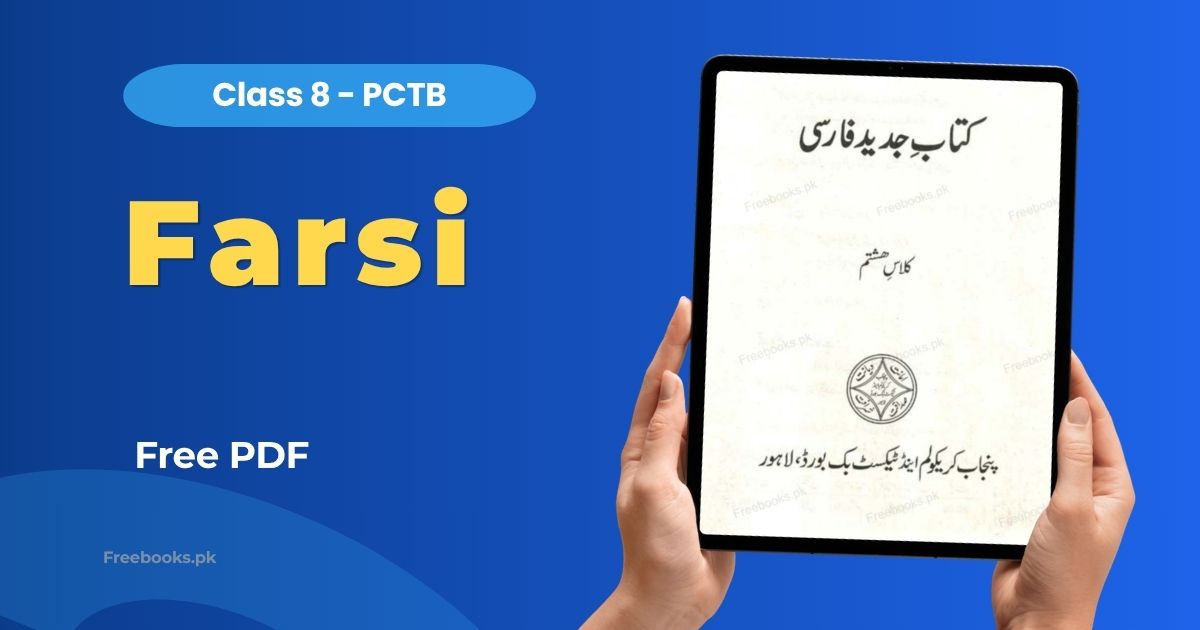
Farsi (“Kitab-e-Jadeed Farsi”) for Class 8 is the official textbook published by the Punjab Curriculum and Textbook Board (PCTB), Lahore, prepared in cooperation with the Culture House of the Islamic Republic of Iran, Lahore. It is part of the official syllabus for students who take Farsi as their language subject.
This book introduces Class 8 students to Persian through short poems, dialogues, and prose pieces on religious, historical, and everyday topics. Each lesson comes with Urdu translation support, helping students build vocabulary and revise clearly before their board exam.
Book Overview
- Class: 8
- Subject: Farsi (Persian Language)
- Board: Punjab Board (PCTB, Lahore)
- Authors: Dr. Aftab Asghar, Mirza Ahmad Ali Baig, Prof. Shujaat Hussain Bukhari
- Total Lessons: 40
- Medium: Persian (Farsi), with Urdu translation and notes
- Format: PDF
Note: A few lesson titles in the source table of contents were partly unclear in the scan. These have been transcribed to the best possible reading and are flagged for review below.
Chapter List
Lesson 1: Dua (Prayer) (دعا)
A short devotional prayer piece.
Lesson 2: Salutation to the Noble Prophet (سلام بر نبی مکرمؐ)
A devotional poem in praise of the Holy Prophet (peace be upon him).
Lesson 3: Gratitude for Blessings (شکرِ نعمت)
A piece on being thankful for God’s blessings.
Lesson 4: Wisdom (حکمت)
A short piece reflecting on wisdom.
Lesson 5: Do Not Harm the Ant That Carries a Grain (میازار موری که دانه کش است)
A famous verse by Saadi teaching kindness to small creatures: do not harm even an ant carrying a grain, for it too has life.
Lesson 6: Hazrat Musa (AS) and the Stray Sheep (حضرت موسی و میشک گمراہ)
A story involving Hazrat Musa (AS) and a stray sheep that wandered away from the flock.
Lesson 7: Justice of the Noble Prophet (PBUH) (عدلِ پیغمبرِ اکرم صلی اللہ علیہ وآلہ وسلّم)
A piece about the justice of the Holy Prophet.
Lesson 8: Bad Company Diminishes Wisdom (کم کند صحبت بدان خردت)
A verse warning that keeping bad company diminishes one’s wisdom and judgment.
Lesson 9: Halal and Haram (حلال و حرام)
A piece explaining lawful and unlawful things.
Lesson 10: Tales of Saadi (حکایاتِ سعدیؒ)
Short moral tales from the Persian poet Saadi.
Lesson 11: Proverbs (ضرب الامثال)
A lesson on common Persian proverbs and idioms.
Lesson 12: Manners and Bad Manners (ادب و بی ادبی)
A piece contrasting good manners with bad manners.
Lesson 13: Anecdotes (لطائف)
Short humorous anecdotes.
Lesson 14: The Greedy Dog (سگِ طمع کار)
A moral story about a greedy dog.
Lesson 15: At the Hotel (Dialogue) (در ہتل (مکالمہ))
A conversational lesson set at a hotel, for practicing spoken Farsi.
Lesson 16: Homeland (وطن)
A piece about love for one’s homeland.
Lesson 17: Hospitality (میہمان نوازی)
A piece on the value of hospitality.
Lesson 18: Hazrat Usman Ghani (RA) (حضرت عثمان غنی رضی اللہ تعالیٰ عنہ)
A biographical piece on Hazrat Usman Ghani, the third Caliph.
Lesson 19: The Fox and the Rooster (روباہ و خروس)
A fable about a fox and a rooster.
Lesson 20: The Disobedient Chick (جوجہ نافرمان)
A moral story about a disobedient chick.
Lesson 21: The Foolish Turtle (لاک پُشتِ احمق)
A fable about a foolish turtle.
Lesson 22: Eid-ul-Adha (عید قربان)
A piece about the festival of Eid-ul-Adha.
Lesson 23: Hazrat Ali (AS) (حضرت علی علیہ السلام)
A biographical piece on Hazrat Ali.
Lesson 24: Knowledge and Skill (علم و ہنر)
A piece on the value of knowledge and skill.
Lesson 25: Nothing Is Without Wisdom (ہیچ چیز بدون مصلحت نیست)
A reflective piece on the hidden wisdom behind things.
Lesson 26: Respect for the National Flag (احترام بہ پرچمِ ملی)
A piece on respecting the national flag.
Lesson 27: At the Tailor’s Shop (Dialogue) (در خیاط خانہ (مکالمہ))
A conversational lesson set at a tailor’s shop.
Lesson 28: The Kind Gardener (باغبانِ نیکوکار)
A story about a kind-hearted gardener.
Lesson 29: Hazrat Khadija (RA) (حضرت خدیجہؓ)
A biographical piece on Hazrat Khadija, wife of the Holy Prophet.
Lesson 30: The Class Library (کتاب خانۂ کلاس)
A piece about a classroom library.
Lesson 31: Advice and Counsel (پند و نصائح)
A collection of short pieces of advice.
Lesson 32: Benefits of Standing in Rows (فائدہ ہائے صف بستن)
A piece on the benefits of standing together in order.
Lesson 33: Hafez Shirazi (حافظ شیرازی)
A piece on the life of the Persian poet Hafez Shirazi.
Lesson 34: The Eagle’s Advice to Its Young (پندِ عقاب بہ بچہ خویش)
A story of an eagle advising its offspring.
Lesson 35: Do It Yourself (کارِ خود بہ دستِ خود)
A piece on self-reliance.
Lesson 36: Let’s Have a Laugh (بفرمایید بخندیم)
A light, humorous piece.
Lesson 37: Father of the Nation (Dialogue) (بابای ملت (مکالمہ))
A conversational lesson about the Father of the Nation.
Lesson 38: Unity of the World’s Muslims (اتحادِ مسلمانانِ جہان)
A piece on the unity of Muslims around the world.
Lesson 39: The Foolish Friend (دوستِ نادان)
A moral story about a foolish friend.
Lesson 40: History of Pakistan (Dialogue) (تاریخ پاکستان (مکالمہ))
A conversational lesson about the history of Pakistan.
Download Farsi Class 8 Book PDF (PCTB)
Click the button below to download the complete Farsi Class 8 PDF for free. The file opens in a new tab and is ready to read or save on any device.
⬇ Download PDFWho Should Read This
Class 8 students following the Punjab Board (PCTB) syllabus who have chosen Farsi as their language subject need this book. It also suits any student learning Persian who wants a mix of poetry, dialogues, and prose with Urdu translation support.
Applicable Boards
PCTB (Punjab Curriculum and Textbook Board), Lahore, publishes this Farsi book for Punjab Board students who choose Farsi as their language subject. Students from other boards offering Farsi as an elective can also use it, since classical and modern Persian literature is largely common across syllabi.
FAQs
Is this Farsi book for Class 8 students?
Yes. This is the official Class 8 Punjab Board (PCTB) Farsi textbook for students who choose Farsi as their language subject.
Can other students use it?
Students from other boards offering Farsi as an elective subject can also use this book, since Persian language content is largely similar across syllabi.
Is this book in Urdu or Persian?
This book teaches the Persian (Farsi) language, with Urdu translations and vocabulary notes provided for lessons.
Does it include solved exercises?
The book follows the official textbook content as published, including all 40 lessons and their exercises.
Related Books
- Farsi Class 9
- Farsi Class 7
- Mathematics Class 8 (English Medium)
- Mathematics Class 8 (Urdu Medium)
- Mathematics Class 8
- Computer Science Class 8
© Copyright Policy
Freebooks.pk is an educational resource for students in Pakistan. Textbooks and other books belong to their respective boards, authors and publishers, and all rights remain with them. If you are the copyright holder of any material on this page and want it changed or removed, please contact us or file a request under our DMCA policy. We review every request and remove reported content promptly.