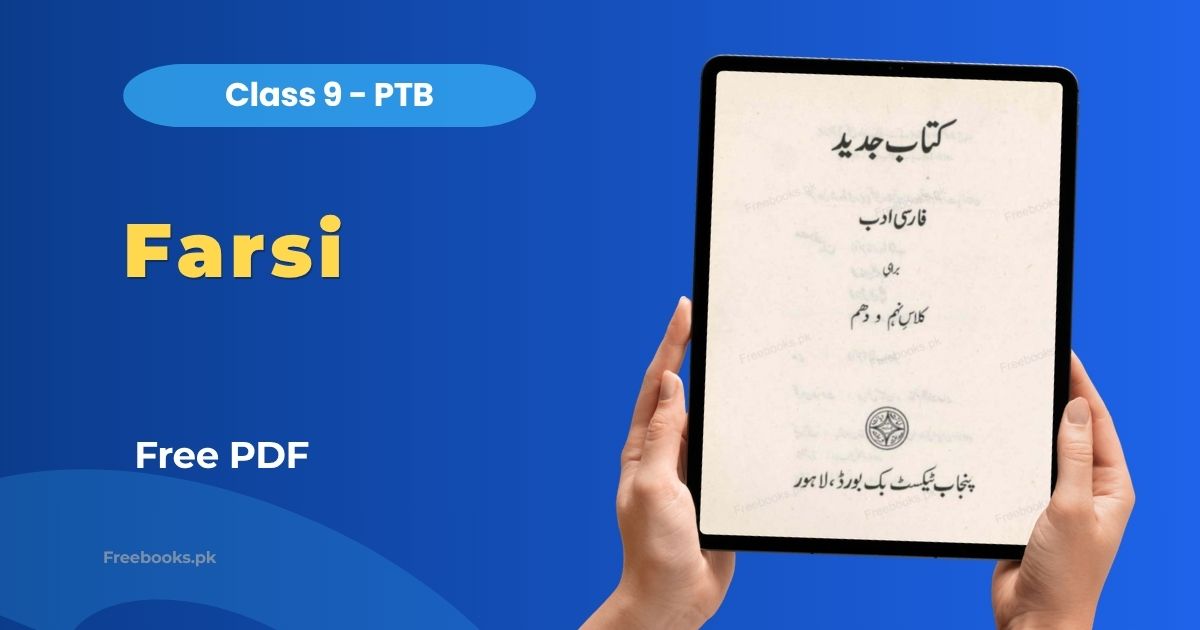
Farsi for Class 9 is the official textbook published by the Punjab Textbook Board (PTB), Lahore, under the title “Kitab-e-Jadeed Farsi Adab” (New Book of Persian Literature). This is a combined Class 9-10 edition, prepared in cooperation with the Culture House of the Islamic Republic of Iran, Lahore, and follows the official Punjab Board syllabus.
For Class 9 students, this book introduces Persian through short poems, dialogues, and prose pieces on religious, historical, and everyday topics. Each lesson comes with Urdu translation support, helping students build vocabulary and revise clearly before their board exam.
Book Overview
- Class: 9
- Subject: Farsi (Persian Language)
- Board: Punjab Board (PTB, Lahore)
- Authors: Dr. Khalida Aftab, Muhammad Khan Kaleem, Nawazish Ali Sheikh, Ghulam Moinuddin Nizami
- Editor: Dr. Aftab Asghar
- Publisher: Punjab Textbook Board, Lahore (in cooperation with the Culture House of the Islamic Republic of Iran, Lahore)
- Total Lessons: 42 across the combined book (this page covers Lessons 1-21)
- Medium: Persian (Farsi), with Urdu translation and notes
- Format: PDF
Note: This is a combined Class 9-10 Farsi textbook (“Kitab-e-Jadeed Farsi Adab”) with 42 lessons total. The book’s table of contents does not mark exactly where Class 9 ends and Class 10 begins, so this page covers the first half (Lessons 1-21) as a working split — please confirm the exact lesson boundary against your copy before relying on this for exam prep. For the second half, see the Farsi Class 10 page.
Chapter List
Lesson 1 – Hamd, a Poem (حمد)
A poem in praise of God.
Lesson 2 – Naat, a Poem (نعت)
A devotional poem in praise of the Holy Prophet Muhammad (peace be upon him).
Lesson 3 – Keeping One’s Word (ایفائے عہد)
A lesson on the importance of keeping promises and honouring commitments.
Lesson 4 – Hazrat Fatima al-Zahra (حضرت فاطمة الزہرا)
A biographical piece on Hazrat Fatima al-Zahra, daughter of the Holy Prophet.
Lesson 5 – Telephone Conversation, a Dialogue (گفتگوئے تلفنی)
A conversational lesson set on a phone call, for practicing spoken Farsi.
Lesson 6 – Muhammad bin Qasim (محمد بن قاسم)
An account of Muhammad bin Qasim, the young general known for the conquest of Sindh.
Lesson 7 – I Ask From You a Glance of Kindness, a Poem (از تو خواہم یک نگاہ التفات)
A devotional poem asking for a moment of divine kindness and attention.
Lesson 8 – Sufi Saints of the Subcontinent (عرفائے شبہ قارہ)
An introduction to well-known Sufi saints of the Indian subcontinent.
Lesson 9 – Selling Fruit, a Dialogue (میوہ فروشی)
A conversational lesson set at a fruit shop, for practicing everyday spoken Farsi.
Lesson 10 – Sir Syed Ahmad Khan (سرسید احمد خان)
A biographical piece on Sir Syed Ahmad Khan, the noted reformer and educationist.
Lesson 11 – Knowledge and Skill are Like Alchemy (علم و ہنر کیمیاست)
A piece reflecting on the transformative value of knowledge and skill.
Lesson 12 – At the Salon, a Dialogue (در آرائشگاہ)
A conversational lesson set at a barber shop or salon, for practicing spoken Farsi.
Lesson 13 – He Smiled for a Moment (دمی بخندید)
A short narrative or poem built around a fleeting moment of joy.
Lesson 14 – Selling Shoes (کفش فروشی)
A lesson set at a shoe shop, covering everyday shopping vocabulary.
Lesson 15 – Selection from Tazkirat-ul-Awliya (انتخاب از تذکرة الاولیاء)
A selected passage from Attar’s classic biographical work on Sufi saints.
Lesson 16 – Goodness, a Poem (نیکی)
A poem reflecting on the value of goodness and kindness.
Lesson 17 – Allama Iqbal (علامہ اقبال)
A biographical piece on Allama Muhammad Iqbal, the poet-philosopher of the East.
Lesson 18 – The Holy Quran, a Poem (قرآن مجید)
A devotional poem in praise of the Holy Quran.
Lesson 19 – Doing the Laundry, a Dialogue (لباس شوئی)
A conversational lesson about washing and caring for clothes.
Lesson 20 – Sense of Duty (وظیفہ شناسی)
A lesson on recognizing and fulfilling one’s responsibilities.
Lesson 21 – Quaid-e-Azam Muhammad Ali Jinnah (قائد اعظم محمد علی جناح)
A biographical piece on Quaid-e-Azam Muhammad Ali Jinnah, the founder of Pakistan.
Download Farsi Class 9 Book PDF (PTB)
Click the button below to download the complete Farsi Class 9-10 PDF for free. This combined book covers both classes — the file opens in a new tab and is ready to read or save on any device.
⬇ Download PDFWho Should Read This
Class 9 students following the Punjab Board (PTB) syllabus who have chosen Farsi as their language subject need this book. It also suits any student learning Persian who wants a mix of poetry, dialogues, and prose with Urdu translation support.
Applicable Boards
PTB (Punjab Textbook Board), Lahore, publishes this Farsi book for Punjab Board students who choose Farsi as their language subject. Students from other boards offering Farsi as an elective can also use it, since classical and modern Persian literature is largely common across syllabi.
FAQs
Is this Farsi book for Class 9 students?
Yes. This is the official Class 9 portion of the Punjab Board (PTB) Farsi textbook for students who choose Farsi as their language subject.
Is this a separate book from the Class 10 Farsi book?
No. Class 9 and Class 10 Farsi are combined into a single PTB textbook with 42 lessons. This page covers the first 21 lessons; the remaining lessons are on our separate Class 10 Farsi page.
Is this book in Urdu or Persian?
This book teaches the Persian (Farsi) language, with Urdu translations and vocabulary notes provided for every lesson.
How is the Class 9 and Class 10 split determined?
The book’s table of contents does not explicitly mark the Class 9-10 boundary, so this page uses an even split (Lessons 1-21) as a working division. Please cross-check the exact boundary with your teacher or school before relying on it for exam prep.
Related Books
- Farsi Class 10
- Farsi Class 8
- English Grammar & Composition Class 9
- Mathematics Class 9 (English Medium)
- Mathematics Class 9 (Urdu Medium)
- Biology Class 9 (English Medium)
© Copyright Policy
Freebooks.pk is an educational resource for students in Pakistan. Textbooks and other books belong to their respective boards, authors and publishers, and all rights remain with them. If you are the copyright holder of any material on this page and want it changed or removed, please contact us or file a request under our DMCA policy. We review every request and remove reported content promptly.