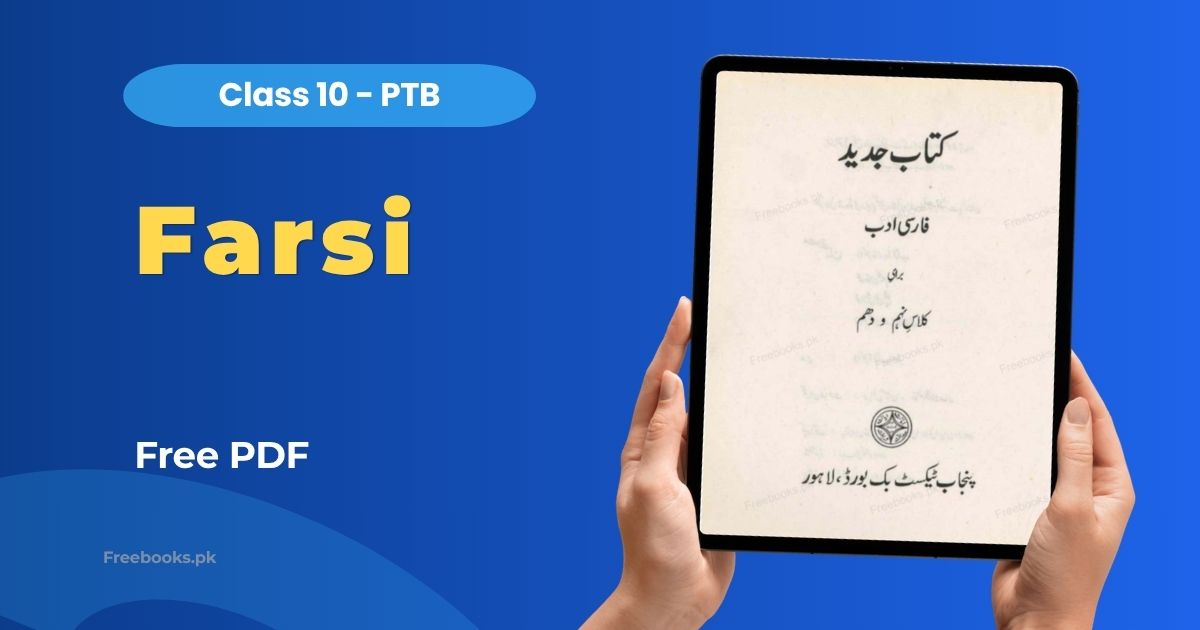
Farsi for Class 10 is the official textbook published by the Punjab Textbook Board (PTB), Lahore, under the title “Kitab-e-Jadeed Farsi Adab” (New Book of Persian Literature). This is a combined Class 9-10 edition, prepared in cooperation with the Culture House of the Islamic Republic of Iran, Lahore, and follows the official Punjab Board syllabus.
For Class 10 students, this book continues with poems, dialogues, and prose on moral values, historical figures, and everyday situations, building on the Class 9 foundation. Each lesson comes with Urdu translation support, helping students revise clearly before their board exam.
Book Overview
- Class: 10
- Subject: Farsi (Persian Language)
- Board: Punjab Board (PTB, Lahore)
- Authors: Dr. Khalida Aftab, Muhammad Khan Kaleem, Nawazish Ali Sheikh, Ghulam Moinuddin Nizami
- Editor: Dr. Aftab Asghar
- Publisher: Punjab Textbook Board, Lahore (in cooperation with the Culture House of the Islamic Republic of Iran, Lahore)
- Total Lessons: 42 across the combined book (this page covers Lessons 22-42)
- Medium: Persian (Farsi), with Urdu translation and notes
- Format: PDF
Note: This is a combined Class 9-10 Farsi textbook (“Kitab-e-Jadeed Farsi Adab”) with 42 lessons total. The book’s table of contents does not mark exactly where Class 9 ends and Class 10 begins, so this page covers the second half (Lessons 22-42) as a working split — please confirm the exact lesson boundary against your copy before relying on this for exam prep. For the first half, see the Farsi Class 9 page.
Chapter List
Lesson 22 – Tales of Saadi (حکایات سعدی)
Selected stories from the works of the classical Persian poet Saadi.
Lesson 23 – O Dear Mother, My Life is Sacrificed for You, a Poem (ای مادر عزیز کہ جانم فدای تو)
A devotional poem expressing love and gratitude toward one’s mother.
Lesson 24 – The Post Office, a Dialogue (پستخانہ)
A conversational lesson set at a post office, for practicing spoken Farsi.
Lesson 25 – Sayings of Khwaja Abdullah Ansari (سخنان خواجہ عبداللہ انصاری)
A collection of sayings from the Sufi scholar Khwaja Abdullah Ansari.
Lesson 26 – My Eyes Opened From Sleep, a Poem (باز شد دیدگان من از خواب)
A reflective poem on awakening from sleep and complacency.
Lesson 27 – Traffic Rules (مقررات عبور و مرور)
Covers basic traffic rules and road safety etiquette.
Lesson 28 – Famous Women in the History of Muslims of the Subcontinent (بانوان معروف در تاریخ مسلمانان شبہ قارہ)
Profiles notable Muslim women from the history of the subcontinent.
Lesson 29 – Etiquette of Eating Food (آداب طعام خوردن)
Covers proper manners and etiquette while eating.
Lesson 30 – Rights of Mother and Father (حقوق مادر و پدر)
Discusses the rights and respect owed to parents.
Lesson 31 – At the Doctor’s Clinic (مطب پزشک)
A lesson set at a doctor’s clinic, covering health-related vocabulary.
Lesson 32 – Sayings of Great People (کلمات بزرگان)
A collection of wise sayings from respected historical figures.
Lesson 33 – Two Poems by Allama Muhammad Iqbal (دو قطعہ از اشعار علامہ محمد اقبال)
Two selected verses from Allama Iqbal’s Persian poetry.
Lesson 34 – The Railway Station, a Dialogue (ایستگاہ راه آہن)
A conversational lesson set at a railway station, for practicing spoken Farsi.
Lesson 35 – Wonders of Nature (شگفتی ہای طبیعت)
Describes remarkable and inspiring aspects of the natural world.
Lesson 36 – Do Not Harm the Ant That Carries a Grain (میازار موری کہ دانہ کش است)
A classical Persian verse about kindness toward even the smallest creatures.
Lesson 37 – Hospitality (میهمان دوستی)
Discusses the value of hospitality and being a good host.
Lesson 38 – Let’s Not Waste (اسراف نکنیم)
A lesson on avoiding extravagance and wastefulness.
Lesson 39 – God’s Power, a Poem (قدرت خدا)
A devotional poem reflecting on the power and majesty of God.
Lesson 40 – From the Cradle to the Grave, Seek Knowledge (ز گہواره تا گور دانش بجوی)
A well-known Persian proverb encouraging lifelong learning.
Lesson 41 – At the Bank, a Dialogue (در بانک)
A conversational lesson set at a bank, for practicing spoken Farsi.
Lesson 42 – Prayer, a Poem (دعا)
A closing poem of supplication.
Download Farsi Class 10 Book PDF (PTB)
Click the button below to download the complete Farsi Class 9-10 PDF for free. This combined book covers both classes — the file opens in a new tab and is ready to read or save on any device.
⬇ Download PDFWho Should Read This
Class 10 students following the Punjab Board (PTB) syllabus who have chosen Farsi as their language subject need this book. It also suits any student learning Persian who wants a mix of poetry, dialogues, and prose with Urdu translation support.
Applicable Boards
PTB (Punjab Textbook Board), Lahore, publishes this Farsi book for Punjab Board students who choose Farsi as their language subject. Students from other boards offering Farsi as an elective can also use it, since classical and modern Persian literature is largely common across syllabi.
FAQs
Is this Farsi book for Class 10 students?
Yes. This is the official Class 10 portion of the Punjab Board (PTB) Farsi textbook for students who choose Farsi as their language subject.
Is this a separate book from the Class 9 Farsi book?
No. Class 9 and Class 10 Farsi are combined into a single PTB textbook with 42 lessons. This page covers the last 21 lessons; the earlier lessons are on our separate Class 9 Farsi page.
Is this book in Urdu or Persian?
This book teaches the Persian (Farsi) language, with Urdu translations and vocabulary notes provided for every lesson.
How is the Class 9 and Class 10 split determined?
The book’s table of contents does not explicitly mark the Class 9-10 boundary, so this page uses an even split (Lessons 22-42) as a working division. Please cross-check the exact boundary with your teacher or school before relying on it for exam prep.
Related Books
- Farsi Class 9
- English Grammar & Composition Class 10
- Chemistry Class 10 (Urdu Medium)
- Biology Class 10 (English Medium)
- Biology Class 10 (Urdu Medium)
- Chemistry Class 10 (English Medium)
© Copyright Policy
Freebooks.pk is an educational resource for students in Pakistan. Textbooks and other books belong to their respective boards, authors and publishers, and all rights remain with them. If you are the copyright holder of any material on this page and want it changed or removed, please contact us or file a request under our DMCA policy. We review every request and remove reported content promptly.