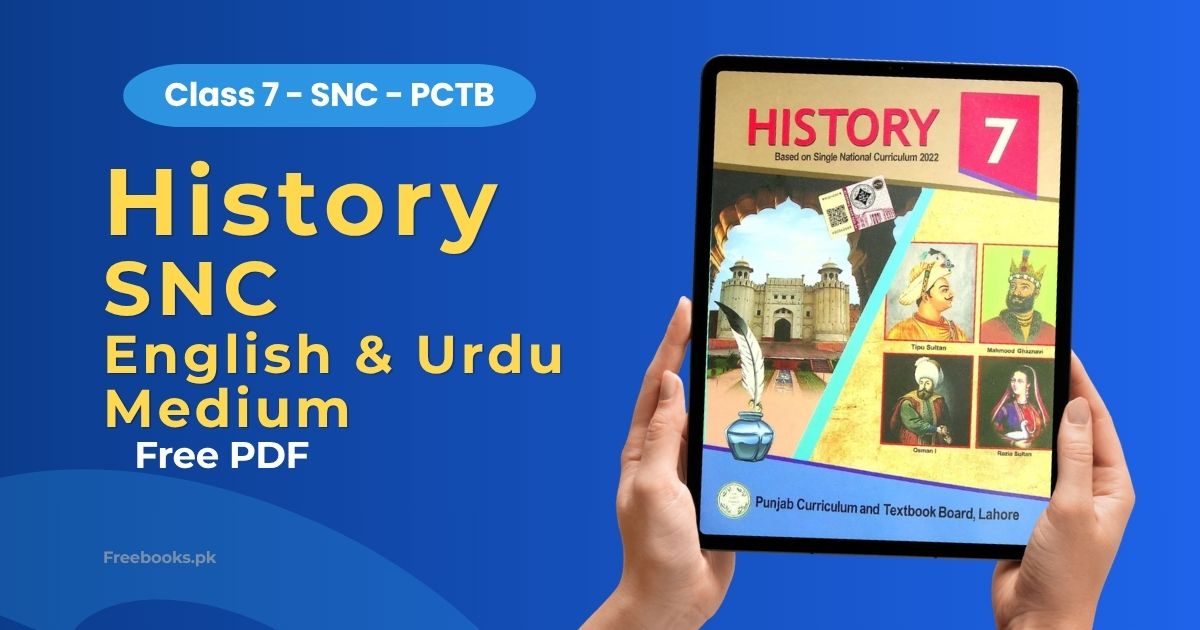
History for Class 7 is the official textbook published by the Punjab Curriculum and Textbook Board (PCTB), Lahore, based on the Single National Curriculum (SNC) 2022. It is part of the official Class 7 syllabus and is available in both English and Urdu medium editions. The book covers five chapters, from medieval Europe and the spread of Islam to Muslim dynasties, Muslims in South Asia, and the modern period in Europe.
For Class 7 students, this book builds real historical knowledge alongside exam preparation, connecting European history with the spread of Islam, the Delhi Sultanate, and the Mughal Empire in the subcontinent. The chapter summaries and important questions on this page make revision faster before exams, in either the English or Urdu medium edition.
Book Overview
| Class | 7 |
| Subject | History |
| Board | Punjab Curriculum and Textbook Board (PCTB) |
| Curriculum | Single National Curriculum (SNC) 2022 |
| Supervision | Ghiyas Aamir (S.S. History) |
| Publisher | Punjab Curriculum and Textbook Board (PCTB), Lahore |
| Edition | Experimental Edition, January 2023 |
| Total Chapters | 5 (plus Glossary) |
| Total Pages | 108 |
| Medium | English and Urdu (both editions available) |
| Format | PDF (Free Download) |
Chapter List
Chapter 1: Middle Ages in Europe (500-1500 CE) (یورپ میں قرونِ وسطیٰ)
This chapter covers the Middle Ages in Europe (500-1500 CE), from the fall of the Roman Empire and the rise of Charlemagne’s Frankish empire to Viking invasions, the feudal system, and the Magna Carta of 1215 CE. It traces daily life, agriculture, trade, education, inventions, religion, literature, and economy of the period, along with the concept of a king’s court and how kings were selected, crowned, and funded. It closes with the Hundred Years’ War, the Black Death, the invention of printing, and the fairs, festivals, art, sports, and games that shaped medieval European life.
Important Questions:
- How were kings crowned in the Middle Ages in Europe? In a religious ceremony called a coronation, where a church leader such as the pope or a bishop crowned the king and anointed him with holy oil.
- Which religion played a major role in Europe during the Middle Ages? Christianity, with the pope as head of the church holding great power and influence over daily life.
- Who was Charlemagne? The most successful king of the early Middle Ages, who ruled the Franks and was crowned Emperor of the Romans by the pope in the 8th century CE.
- What type of literature was introduced during the Middle Ages in Europe? Religious literature written mainly by priests and monks, including works like The Canterbury Tales by Geoffrey Chaucer and The Divine Comedy by Dante Alighieri.
Chapter 2: Spread of Islam in Europe and Asia (یورپ اور ایشیا میں اسلام کا پھیلاؤ)
This chapter traces the Umayyad Dynasty (661-750 CE), founded by Muawiyah-I with its capital at Damascus, and the Abbasid Dynasty (750-1258 CE and 1261-1517 CE), founded afterwards with Baghdad as its capital and remembered as the Golden Age of Islam under rulers like Haroon-al-Rashid. It highlights Muhammad Bin Qasim’s conquest of Sindh in 712 CE and his role in spreading Islam in the subcontinent, along with both dynasties’ architectural, administrative, and scientific advancements.
Important Questions:
- In which year did Muhammad Bin Qasim conquer Sindh? In 712 CE.
- Until which year did Haroon-al-Rashid rule as the most famous Abbasid Caliph? He ruled from 786 CE to 809 CE.
- In which year did Umar Ibn Abd-al-Aziz’s rule start? In 717 CE.
- Where did the Umayyad Dynasty establish its capital? At Damascus, from where it ruled the Islamic Empire until 750 CE.
Chapter 3: Muslim Dynasties and Crusades (مسلم حکومتیں اور صلیبی جنگیں)
This chapter covers the Seljuk (1037-1194 CE), Fatimid (909-1171 CE), Ayyubid (1171-1260 CE), Safavid (1501-1736 CE), and Ottoman (1299-1923 CE) dynasties, describing their founders, territories, and social structures, from Salah-ud-Din Ayubi’s Egypt to the Ottoman capture of Constantinople in 1453 CE. It then traces the causes, four major Crusades, and consequences of the Crusades, the centuries-long wars between European Christians and Muslims over control of Jerusalem and the Holy Land.
Important Questions:
- In which year was the Ottoman Dynasty formed? In 1299 CE, by Osman I.
- Who founded the Safavid Dynasty in 1501 CE? Shah Ismail.
- Who founded the Seljuk Dynasty, and when? Tughril Beg and his brother Chaghri Beg, in 1037 CE.
- What was the immediate cause of the Crusades? The preaching of holy war against the Muslims by Pope Urban II, after the Seljuk Turks took control of the Holy Land and restricted Christian pilgrims.
Chapter 4: Muslims in South Asia (مسلمان جنوبی ایشیا میں)
This chapter traces the Delhi Sultanate (1206-1526 CE) through its five dynasties, Mamluk, Khilji, Tughlaq, Sayyid, and Lodhi, including Sultan Mahmood Ghaznavi’s invasions, Muhammad Ghori’s conquest of India, and the rule of Iltutmish and Ala-ud-Din Khilji. It then covers the Mughal Empire (1526-1857 CE), from Babar’s victory at the First Battle of Panipat through Akbar, Jahangir, Shah Jahan’s architecture, Aurangzeb, and the rise of the Marathas, to the last emperor Bahadur Shah Zafar, ending with the British takeover and the challenges Muslims faced afterward.
Important Questions:
- Who founded the Delhi Sultanate, and in which year? Qutb-ud-Din Aibak, in 1206 CE, under the Mamluk Dynasty.
- What was the First Battle of Panipat, and what did it establish? A battle fought in 1526 CE between Babar and Ibrahim Khan Lodhi, which Babar won, establishing the Mughal Empire in the subcontinent.
- Why is Akbar considered the greatest Mughal ruler? He introduced reforms like the Mansabdari system, expanded the empire significantly, and won the Second Battle of Panipat in 1556 CE to secure Delhi and Agra.
- What is Shah Jahan’s greatest architectural achievement? The Taj Mahal in Agra, built as the tomb of his wife Mumtaz Mahal, counted among the Seven Wonders of the World.
Chapter 5: Modern Period in Europe (یورپ میں جدید دور)
This chapter covers the Renaissance (15th-16th centuries CE), the cultural rebirth led by figures like Leonardo da Vinci, Michelangelo, and Galileo Galilei, along with the Age of Exploration led by Columbus and Vasco da Gama, the Reformation started by Martin Luther, and the Enlightenment. It closes with the French Revolution of 1789 CE and the Industrial Revolution (1760-1840 CE), explaining how the steam engine, developed by Savery, Newcomen, and Watt, drove industrial growth and brought economic benefits to Britain, Belgium, Germany, France, the USA, and Japan.
Important Questions:
- Who was Galileo Galilei? An Italian philosopher, astronomer, and mathematician who pioneered the use of the telescope to study the planets and stars.
- Who invented the first successful commercial steamboat? Robert Fulton, an American engineer, with his steamboat Clermont in 1807 CE.
- What is meant by “Renaissance”? A cultural and socio-political “rebirth” of the 15th and 16th centuries CE that revived classical art, literature, and learning, beginning in Italy.
- When did the Enlightenment movement start? In the 17th and 18th centuries CE, as an intellectual movement stressing reason over blind faith.
Glossary (اصطلاحات)
This closing section brings together a glossary of key history terms used throughout the book, such as feudal, dynasty, crusade, renaissance, colonialism, and capitalism, a useful quick-reference for students revising terminology before exams.
Download History Class 7 SNC PDF
Click the button below to download the History Class 7 SNC PDF for free. Both English and Urdu medium editions are available:
⬇ Download PDF (English Medium)
Who Should Read This
This book is meant for Class 7 students studying under the PCTB Single National Curriculum, in both English and Urdu medium schools. It is also useful for students preparing for entry test screening at the middle school level, where basic history and general knowledge questions often appear.
Applicable Boards
This book is published by the Punjab Curriculum and Textbook Board (PCTB) and is the primary textbook for Class 7 History in Punjab. Since it follows the Single National Curriculum (SNC) 2022, students in other provinces and boards using the same SNC syllabus can also refer to this book for their Class 7 History topics.
FAQs
Is this History book for Class 7?
Yes, this is the official Class 7 History textbook published by the Punjab Curriculum and Textbook Board (PCTB) under the Single National Curriculum (SNC) 2022.
Can other students use it?
Yes, students from other boards following the same SNC 2022 syllabus can also use this book for their Class 7 History topics.
Is this the latest edition?
This PDF follows the Experimental Edition, printed in January 2023, the current PCTB edition based on the SNC 2022 curriculum.
Does it include solved exercises?
The book follows the official textbook content as published, with exercise questions, timelines, and key points for each chapter.
Is this book available in Urdu medium too?
Yes, both English medium and Urdu medium editions are available for download on this page.
What topics does this book cover?
It covers the Middle Ages in Europe, the spread of Islam under the Umayyads and Abbasids, Muslim dynasties and the Crusades, Muslims in South Asia including the Delhi Sultanate and Mughal Empire, and the modern period in Europe.
How many pages does this book have?
The complete History Class 7 textbook has 108 pages across its 5 chapters, plus a glossary.
Related Books
- History Class 8
- History Class 6
- Guide Class 7
- Social Studies Class 7
- Mathematics Class 7 (English Medium)
- General Science Class 7 (English Medium)
© Copyright Policy
Freebooks.pk is an educational resource for students in Pakistan. Textbooks and other books belong to their respective boards, authors and publishers, and all rights remain with them. If you are the copyright holder of any material on this page and want it changed or removed, please contact us or file a request under our DMCA policy. We review every request and remove reported content promptly.