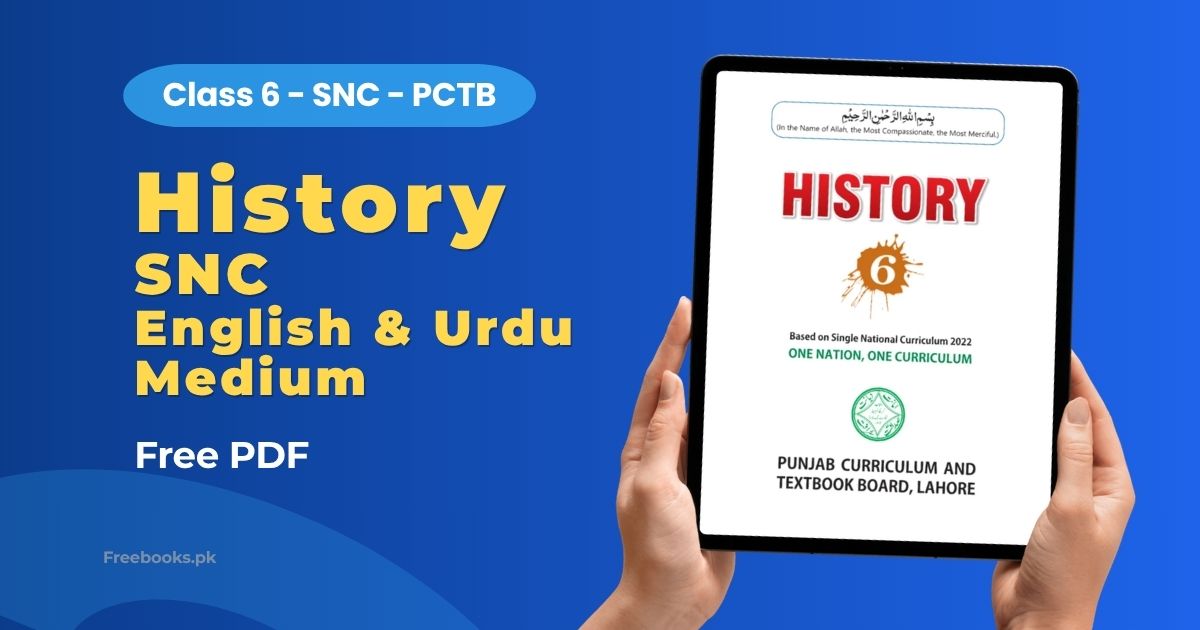
History for Class 6 is the official textbook published by the Punjab Curriculum and Textbook Board (PCTB) under the Single National Curriculum (SNC). It is part of the official Class 6 syllabus and is available in both English and Urdu medium editions. The book has four chapters, moving from the earliest human civilizations to the rise of Islamic civilization in Arabia.
For Class 6 students, this book introduces the story of early human societies in a simple, sequential way. It moves from Mesopotamia and Egypt to Persia, Greece, Rome, and the Indian subcontinent, ending with the life of the Holy Prophet (PBUH) and the four Khulafah-e-Rashideen. The chapter summaries and important questions on this page make revision quicker, in either the English or Urdu medium edition.
Book Overview
| Class | 6 |
| Subject | History |
| Board | Punjab Curriculum and Textbook Board (PCTB) |
| Curriculum | Single National Curriculum (SNC) |
| Author | Dr. Saima Naz, Assistant Professor, Department of History, B.Z. University Multan |
| Supervision | Ghiyas Aamir (S.S. History) |
| Publisher | Ch. Ghulam Rasul and Sons, Urdu Bazar, Lahore, for PCTB |
| Edition | Experimental Edition |
| Total Chapters | 4 |
| Total Pages | 104 |
| Medium | English and Urdu (both editions available) |
| Format | PDF (Free Download) |
Chapter List
Chapter 1: Ancient Civilizations (پرانی تہذیبیں)
This chapter introduces primary and secondary historical sources, then covers four early civilizations. It starts with Mesopotamia, its Sumerian city-states, the Code of Hammurabi, ziggurats, and trade, then moves to ancient Egypt, its social classes, religion, hieroglyphic script, and pyramid-building Pharaohs. It also traces the Indus Valley Civilization, from the early settlement at Mehrgarh to the planned cities of Mohenjo-Daro and Harappa, and closes with ancient China, its architecture, the Silk Road, agriculture, and religious traditions including Confucianism, Taoism, and Buddhism.
Important Questions:
- What was the Code of Hammurabi? One of the earliest written law codes, created by the Babylonian king Hammurabi to set rules and punishments for Mesopotamian society.
- Which two cities are the best known sites of the Indus Valley Civilization? Mohenjo-Daro and Harappa, known for their planned streets, drainage systems, and brick architecture.
- Who ruled ancient Egypt as head of government and religion? The Pharaoh, regarded as both king and a religious figure by the Egyptian people.
- Which trade route connected ancient China with other civilizations? The Silk Road, which carried goods such as silk and enabled cultural exchange.
Chapter 2: Persian, Greek and Roman Civilizations (فارسی، یونانی اور رومی تہذیبیں)
This chapter traces the Persian Empire from Cyrus the Great founding it in 550 BCE through Darius the Great, his system of satrapies, the Royal Road, and the religion of Zoroastrianism. It then covers Greek civilization, from the rivalry between Athens and Sparta to the Battle of Marathon and Plato Academy, followed by Roman civilization, from the legendary founding by Romulus and Remus in 753 BCE through the Republic, the Punic Wars, Julius Caesar, and Augustus as the first emperor. It closes with Alexander the Great, whose conquests spanned three continents, including a campaign into India.
Important Questions:
- Who founded the Persian Empire, and when? Cyrus the Great, in 550 BCE, establishing the Achaemenid Empire.
- What event is remembered by the modern marathon race? The run of the messenger Pheidippides from Marathon to Athens to announce a Greek victory over the Persians.
- Who was the first Roman emperor? Augustus Caesar, who took power after the death of Julius Caesar and the fall of the Roman Republic.
- Which Indian king did Alexander the Great fight in 327 BCE? King Porus, during Alexander campaign into the Indian subcontinent.
Chapter 3: Aryans, Kushans and Guptas (آریہ، کوشان اور گپتا)
This chapter explains the migration of the Aryans into South Asia around 1500 BCE, along with their caste system of Brahmins, Kshatriyas, Vaishyas, and Shudras, and their religious texts, the four Vedas. It then covers the Mauryan Empire, founded by Chandragupta Maurya in 321 BCE and expanded by Ashoka the Great, who adopted Buddhism after the Kalinga war. The chapter continues with the Kushan Empire under Kanishka, whose capital was Peshawar and who supported the Silk Route and Gandhara art, and closes with the Gupta Empire, founded by Chandragupta-I in 320 CE and remembered as a golden age.
Important Questions:
- Who founded the Mauryan Empire, and in which year? Chandragupta Maurya, in 321 BCE.
- Which war led Ashoka the Great to adopt Buddhism? The Kalinga war, whose bloodshed made Ashoka turn toward peace and Buddhism.
- Where was the capital of the Kushan Empire under Kanishka? Peshawar, in present day Pakistan.
- Which Gupta ruler founded the empire, and when? Chandragupta-I, in 320 CE, starting what is remembered as a golden age in the subcontinent.
Chapter 4: Rise of Islamic Civilization (اسلامی تہذیب کا عروج)
This chapter covers the early life of the Holy Prophet Muhammad (PBUH), born in 571 CE in Makkah, from his titles Al-Sadiq and Al-Amin to the first revelation in the Cave of Hira in 610 CE and the Migration to Madinah in 622 CE. It traces key events including the Battles of Badr, Uhud, and the Trench, the Conquest of Makkah in 630 CE, and the Farewell Pilgrimage in 632 CE. It then covers the four Khulafah-e-Rashideen, Hazrat Abu Bakr, Hazrat Umar, Hazrat Usman, and Hazrat Ali, and their role in spreading and organizing the early Islamic state.
Important Questions:
- In which year did the Holy Prophet (PBUH) receive the first revelation? In 610 CE, in the Cave of Hira near Makkah.
- What is the Hijrah? The Migration of the Holy Prophet (PBUH) from Makkah to Madinah in 622 CE, marking the start of the Islamic calendar.
- Who was known as Al-Farooq among the Khulafah-e-Rashideen? Hazrat Umar Bin Khattab, the second Caliph, who ruled from 634 to 644 CE.
- Who compiled the standard copy of the Holy Quran? Hazrat Usman Ghani, the third Caliph, known as Zun-Noorain.
Download History Class 6 SNC PDF
Click the button below to download the History Class 6 SNC PDF for free. Both English and Urdu medium editions are available:
⬇ Download PDF (English Medium)
Who Should Read This
This book is meant for Class 6 students studying under the PCTB Single National Curriculum, in both English and Urdu medium schools. It also builds a foundation in world history and Islamic history that is useful for general knowledge sections in future entry tests.
Applicable Boards
This book is published by the Punjab Curriculum and Textbook Board (PCTB) and is the primary textbook for Class 6 History in Punjab. Since it follows the Single National Curriculum (SNC), students in other provinces and boards using the same SNC syllabus can also refer to this book for their Class 6 History topics.
FAQs
Is this History book for Class 6?
Yes, this is the official Class 6 History textbook published by the Punjab Curriculum and Textbook Board (PCTB) under the Single National Curriculum (SNC).
Can other students use it?
Yes, students from other boards following the same SNC syllabus can also use this book for their Class 6 History topics.
Is this the latest edition?
This PDF follows the Experimental Edition, the current PCTB edition based on the SNC curriculum.
Does it include solved exercises?
The book follows the official textbook content as published, with important points, MCQs, and detailed questions for each chapter.
Is this book available in Urdu medium too?
Yes, both English medium and Urdu medium editions are available for download on this page.
What topics does this book cover?
It covers Mesopotamian, Egyptian, Indus Valley, and Chinese civilizations, Persian, Greek, and Roman civilizations, the Aryans, Kushans, and Guptas, and the rise of Islamic civilization.
How many pages does this book have?
The complete History Class 6 textbook has 104 pages across its 4 chapters.
Related Books
© Copyright Policy
Freebooks.pk is an educational resource for students in Pakistan. Textbooks and other books belong to their respective boards, authors and publishers, and all rights remain with them. If you are the copyright holder of any material on this page and want it changed or removed, please contact us or file a request under our DMCA policy. We review every request and remove reported content promptly.