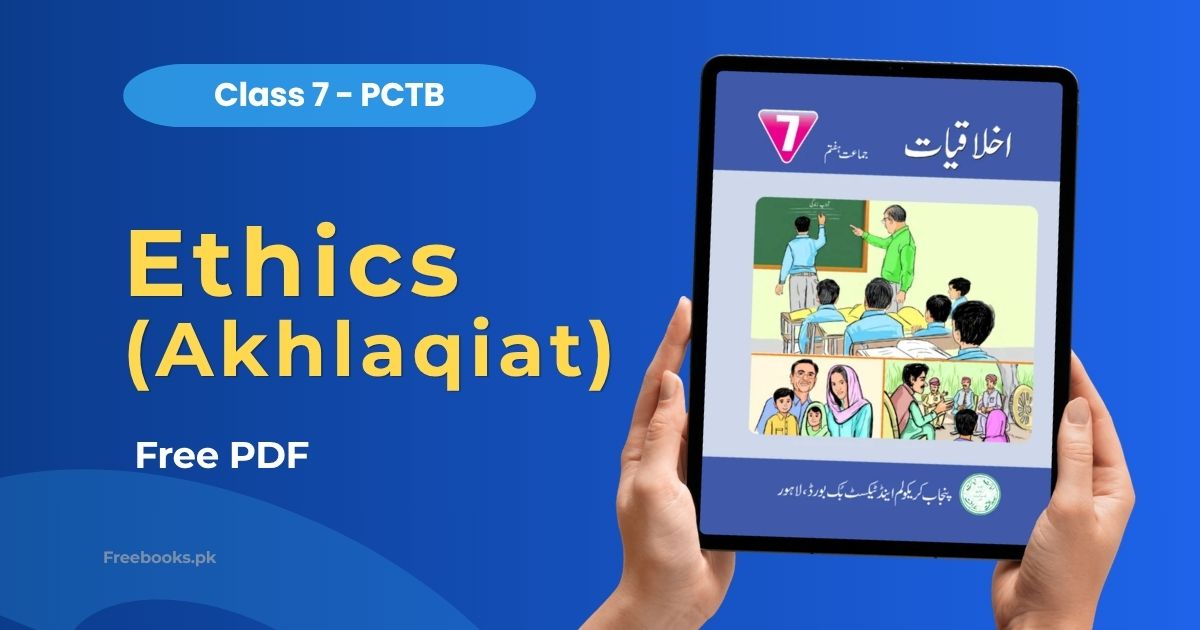
Ikhlaqiyat (Ethics) for Class 7 is the official textbook published by the Punjab Curriculum and Textbook Board (PCTB), Lahore, in Urdu medium. It is part of the official syllabus for Class 7 students and introduces the subject through eight chapters covering world religions, Pakistani festivals, ethical values, happiness, etiquette, and notable religious personalities. The book is authored by Dr. Syed Shafqat Ali Shah, Assistant Professor at the University of Gujrat.
For Class 7 students, this book builds tolerance and character alongside exam preparation, introducing young learners to the beliefs and traditions of Pakistan’s different religious communities. Reading the chapter summaries and important questions on this page makes revision faster before exams, and helps students understand the moral values the subject aims to build.
Book Overview
| Class | 7 |
| Subject | Ethics (Akhlaqiyat) |
| Board | Punjab Curriculum and Textbook Board (PCTB) |
| Author | Dr. Syed Shafqat Ali Shah (Assistant Professor, Department of Education, University of Gujrat) |
| Publisher | Punjab Curriculum and Textbook Board (PCTB), Lahore |
| Total Chapters | 8 |
| Total Pages | 98 |
| Medium | Urdu |
| Format |
Chapter List
Chapter 1: Introduction to Religions (مذاہب کا تعارف)
This chapter explains the meaning of “religion” and its three universal elements, belief (Aqeedah), rituals (Rusoom), and morals (Akhlaq), found in every faith. It profiles major world religions, Hinduism, Zoroastrianism, Buddhism, Christianity, Islam, and Sikhism, by population and origin, then examines religion’s role in human development through fine arts, Sufi poetry, and architecture. Students see how each faith expressed itself through painting, music, calligraphy, and iconic buildings such as the Badshahi Mosque and the Taj Mahal.
Important Questions:
- What are the three basic elements of religion? Belief (Aqeedah), rituals (Rusoom), and morals (Akhlaq), present in every religion.
- What is the literal Arabic meaning of “Mazhab” (religion)? A path, or the way to live one’s life.
- What is meant by “fine arts”? The means through which humans express creative ability, including painting, music, and sculpture, reflecting mental, emotional, and spiritual thought.
- Name a few Islamic buildings cited as architectural examples. Badshahi Mosque, Shalimar Gardens, Faisal Mosque, Data Darbar Mosque, Wazir Khan Mosque, and the Taj Mahal.
Chapter 2: Zoroastrianism (مذہب زرتشت)
This chapter traces Zoroastrianism to the ancient Aryan migration, which split into Indian and Iranian branches, and describes pre-Zoroastrian Iran’s nature worship and reverence for fire. It covers Zoroaster’s teachings about Ahura Mazda, the eternal struggle between good and evil, and the ethical triad of Good Thoughts, Good Words, and Good Deeds. Students also learn about the sacred text Avesta and Zoroastrian beliefs about the afterlife and judgment.
Important Questions:
- What is the sacred book of Zoroastrianism called? The Avesta, meaning “the original text,” written in the ancient Iranian language.
- What do Yazdan and Ahriman represent? Yazdan (Ahura Mazda) is the source of goodness and truth; Ahriman is the source of evil and falsehood, and the two are locked in eternal conflict.
- Why is fire used as a symbol of Yazdan? Because fire is pure and purifies other things, so Zoroastrian fire-temples keep flames continuously lit.
- How many chapters does the Yasna contain? 72 chapters; it is the oldest, most sacred part of the Avesta and contains the Gathas, Zoroaster’s own hymns.
Chapter 3: Religious Festivals in Pakistan (پاکستان میں مذہبی تہوار)
This chapter covers four festivals celebrated by Pakistan’s religious communities: Eid ul Adha, marking the story of Hazrat Ibrahim (AS) and the tradition of dividing sacrificial meat into three parts; Easter, the Christian celebration of Christ’s resurrection; Holi, the Hindu festival built on the story of Prahlad and the bonfire ritual; and Nowruz, the Iranian and Zoroastrian new year centered on the symbolic Haft-Seen table. Students learn how each festival is observed and what it symbolizes for its community.
Important Questions:
- How do Muslims divide the sacrificial meat on Eid ul Adha? Into three equal parts, one for relatives, one for the needy, and one kept for the family itself.
- How is the date of Easter determined? It falls on the first Sunday after the first full moon following 21 March, the spring equinox.
- Why is the Holi bonfire lit? To commemorate Prahlad’s survival, celebrating truth’s victory over falsehood.
- What does the Haft-Seen table symbolize during Nowruz? Seven items starting with the letter “S,” symbolizing life, health, wealth, love, and patience.
Chapter 4: Ethical Values (اخلاقی اقدار)
This chapter presents a set of moral stories built around real values. “Punctuality Is Nation-Building” uses an incident from Napoleon Bonaparte’s life to show how tardiness has real consequences, while “Blessings of Brotherhood” shows a class starting a fund to help needy classmates. “My Friend” follows a student who starts a school food bank for a classmate who cannot afford lunch, and “We Are One” shows villagers of all faiths uniting to repair a flood embankment together.
Important Questions:
- How did a delay affect Napoleon Bonaparte in battle? One of his divisions arrived just two minutes late to reinforce him, causing him to be surrounded and defeated.
- What did the students decide to do in “Blessings of Brotherhood”? They agreed to save a small amount from their daily pocket money to buy necessities for needy classmates.
- What lesson does “We Are One” teach? People of different faiths can unite beyond religious differences to work together for the common good, such as saving their village from a flood.
- How did David Gill help his classmate Petras? Noticing Petras skipped lunch because his family was poor, David organized a school food bank funded by voluntary student contributions.
Chapter 5: Happiness and Prosperity (خوشحالی)
This chapter opens by explaining inflation through supply and demand, and shows how a family reduces household costs through kitchen gardening. The rest of the chapter focuses on honesty, including a boy returning a stolen sweet at his father’s insistence, a schoolgirl returning found cash after being inspired by an honest policeman, and a gardener rewarded with a kingdom for honestly admitting his seed never sprouted. The chapter closes with a poem about a lying wife exposed by simple arithmetic.
Important Questions:
- What is the basic economic reason for inflation given in the chapter? When the supply of goods doesn’t grow at the same rate as demand or population, prices rise.
- How did Anand’s family cut household expenses? By kitchen gardening, growing vegetables in small home spaces to save money while getting fresh produce.
- What reward did the honest gardener Ping Li receive? He was named heir to the throne for honestly bringing his empty pot, unlike other gardeners who deceived the king.
- What moral does the poem “Always Speak the Truth” convey? Lies always eventually surface, no matter how carefully they are hidden.
Chapter 6: Etiquette and Manners (آداب)
This chapter covers three lessons on conduct. “Etiquette of Conversation” lists rules for good speech, such as telling the truth, avoiding excess talk, and respecting elders. “Sign Language” explores gesture-based communication and its use in the military, sports, and traffic control. “Telecommunication” introduces Alexander Graham Bell’s invention of the telephone alongside proper phone, SMS, and internet etiquette for students using mobile phones responsibly.
Important Questions:
- Name two conversation-etiquette rules given in the chapter. Always speak the truth even if it costs you, and avoid unnecessary or excessive talk.
- Who is credited with inventing the telephone? Alexander Graham Bell.
- Why is sign language considered humanity’s first language? Because before spoken language existed, early humans communicated through hand, eye, and body gestures.
- What etiquette should be followed when using mobile phones? Call at appropriate times so as not to disturb others, keep calls brief and purposeful, and avoid offensive language.
Chapter 7: Personalities (شخصیات)
This chapter profiles three revered religious figures. Hazrat Rabia Basri (RA) is remembered for her childhood poverty, later devotion, and famous sayings on the love of God. Zoroaster’s profile covers his birth, mountain revelation from Ahura Mazda, and his ethical philosophy of Good Thoughts, Good Words, and Good Deeds. Saint Thomas the Apostle is presented as one of Jesus Christ’s twelve apostles, known for his thoughtful nature and his missionary journey and martyrdom in the Subcontinent.
Important Questions:
- How did Hazrat Rabia Basri (RA) come to be enslaved as a child? During a Basra famine, after her parents’ deaths, a merchant took her for a small sum, later freeing her after witnessing her piety.
- What ethical philosophy did Zoroaster’s teachings rest on? Good Thoughts, Good Words, and Good Deeds, with their opposites to be avoided.
- Why is Saint Thomas significant to Christianity in the Subcontinent? He was the apostle who brought Christianity to the Subcontinent, and was martyred there in 72 AD.
- What distinguished Saint Thomas’s character? He was reserved and thoughtful, wanting to examine and verify things fully before accepting them.
Chapter 8: Glossary (فرہنگ)
This closing chapter is a reference glossary of difficult Urdu vocabulary from every lesson in the book, organized lesson by lesson, from Introduction to Religion through Saint Thomas. It is a useful quick-reference section for students revising terminology before exams, and the book closes with the printed lyrics of Pakistan’s National Anthem.
Download Ikhlaqiyat Class 7 PDF
Your free PDF is ready. Click the button below to download the complete Ikhlaqiyat (Ethics) Class 7 textbook.
Who Should Read This
This book is for Class 7 students following the Punjab Board (PCTB) syllabus who study Ethics (Akhlaqiyat). It is also useful for students who want to build a stronger understanding of moral values, honesty, and tolerance for different religious communities.
Applicable Boards
This book is published mainly for Punjab Board (PCTB) Class 7 students. Students from other boards following a similar Ethics or Akhlaqiyat syllabus can also use it as a reference.
FAQs
Is this Ethics book for Class 7?
Yes, this is the official Class 7 Ikhlaqiyat (Ethics) textbook published by the Punjab Curriculum and Textbook Board (PCTB), Lahore.
Can other students use it?
Yes, students from other boards following a similar Ethics or Akhlaqiyat syllabus can use it as a reference, though it is designed for PCTB Class 7 students.
Is this the latest edition?
This PDF follows the official PCTB Ikhlaqiyat Class 7 curriculum and chapter structure.
Does it include solved exercises?
The book follows the official textbook content as published, including the exercise questions for each chapter.
What topics does this book cover?
It covers eight chapters including world religions, Zoroastrianism, religious festivals in Pakistan, ethical values, happiness and honesty, etiquette and manners, notable personalities, and a glossary.
Who is the author of this book?
The book is authored by Dr. Syed Shafqat Ali Shah, Assistant Professor in the Department of Education at the University of Gujrat.
How many pages does this book have?
The complete Ikhlaqiyat Class 7 textbook has 98 pages across its 8 chapters.
Related Books
- Ikhlaqiyat Class 8
- Ikhlaqiyat Class 6
- Guide Class 7
- Social Studies Class 7
- Mathematics Class 7 (English Medium)
- General Science Class 7 (English Medium)
© Copyright Policy
Freebooks.pk is an educational resource for students in Pakistan. Textbooks and other books belong to their respective boards, authors and publishers, and all rights remain with them. If you are the copyright holder of any material on this page and want it changed or removed, please contact us or file a request under our DMCA policy. We review every request and remove reported content promptly.