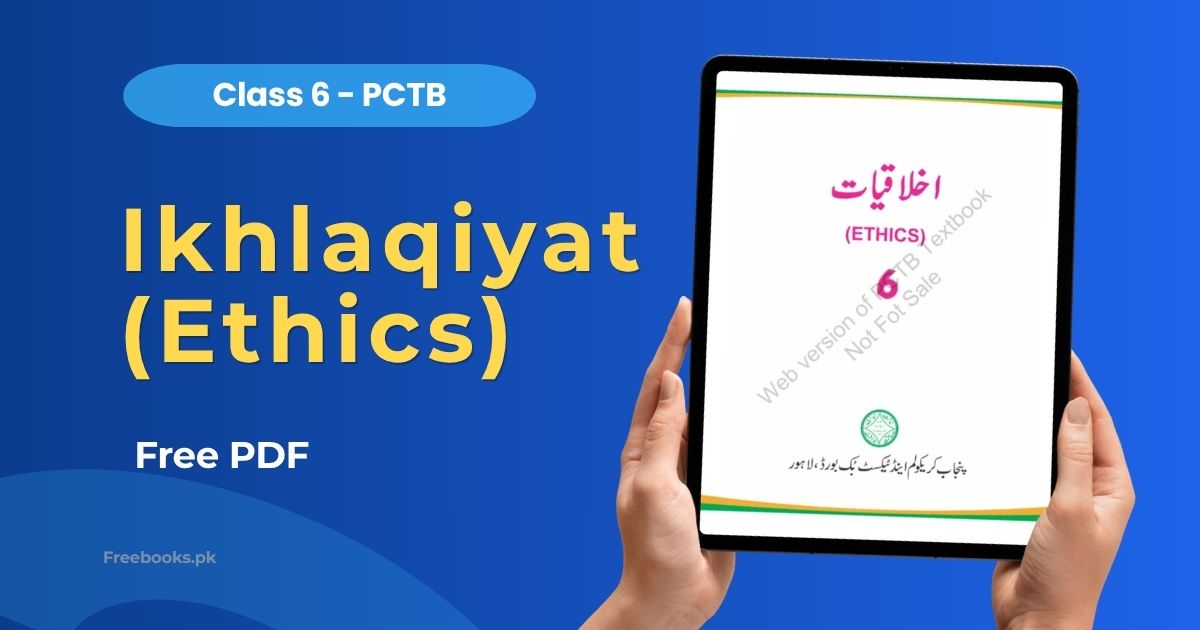
Ikhlaqiyat (Ethics) for Class 6 is the official textbook published by the Punjab Curriculum and Textbook Board (PCTB), Lahore, in Urdu medium. It is part of the official syllabus for Class 6 students and introduces the subject through seven chapters covering wisdom and character, Sikhism, Pakistani religious festivals, ethical values, life etiquette, and notable personalities. The book is authored by Dr. Abdullah Shah Hashmi and Dr. Muhammad Shafiq Mirza.
For Class 6 students, this book builds character and tolerance alongside exam preparation, introducing young learners to moral stories, the traditions of Pakistan’s different religious communities, and everyday etiquette. Reading the chapter summaries and important questions on this page makes revision faster before exams, and helps students connect classroom lessons to real-life values.
Book Overview
| Class | 6 |
| Subject | Ethics (Akhlaqiyat) |
| Board | Punjab Curriculum and Textbook Board (PCTB) |
| Authors | Dr. Abdullah Shah Hashmi, Dr. Muhammad Shafiq Mirza |
| Publisher | Punjab Curriculum and Textbook Board (PCTB), Lahore |
| Total Chapters | 7 |
| Total Pages | 72 |
| Medium | Urdu |
| Format |
Chapter List
Chapter 1: Introduction to Wisdom (زہن کا تعارف)
This opening chapter uses a grandfather’s conversation with his grandchildren to introduce the idea that all religions build humanity, brotherhood, and tolerance. It is followed by moral stories about an unfulfilled king’s endless desires, gratitude versus ingratitude, a philanthropist doctor, and forgiveness, along with poems and closing scripture quotations from Islam, Christianity, Hinduism, Zoroastrianism, and Sikhism on the value of knowledge.
Important Questions:
- How does religion help human beings? Religion teaches humanity, equality, brotherhood and tolerance, and belief in accountability in the afterlife keeps people from lying, cheating, and harming others.
- Why can’t intellect and the five senses alone reliably guide humans in making life’s laws? They have limits and can be deceived, so humans need laws from a higher, all-knowing being rather than relying on reasoning alone.
- What does the story “Shukar Guzari” (Gratitude) teach? The grateful blind beggar kept receiving more blessings from God, while others who forgot gratitude once wealthy lost everything again.
- What message does the poem “Saaji Zimedari” (Social Responsibility) give? It teaches readers to notice and help vulnerable people, illustrated by a boy helping a struggling old woman cross a hail-covered street.
Chapter 2: Sikhism (سکھ مذہب)
Framed as a school trip to Panja Sahib in Hasan Abdal, this chapter introduces Sikhism’s founding, spread, and core beliefs. It covers Guru Nanak Dev’s life and rejection of caste symbols, the succession of all ten Gurus and their contributions, including founding Amritsar, compiling the Guru Granth Sahib, and instituting the Five Ks and the Khalsa under Guru Gobind Singh, and closes with a reflection on Sikhism’s role in religious harmony in the Punjab.
Important Questions:
- Where is Panja Sahib located and why is it significant? In Hasan Abdal, about 65 km northwest of Rawalpindi; tradition holds Guru Nanak Dev left a handprint on a rock there, making it a major Sikh pilgrimage site.
- What did Guru Nanak Dev teach about caste? He rejected caste distinctions from childhood and taught that all humans are equal regardless of caste, race, or color.
- Who compiled the Guru Granth Sahib into its final form? The fifth Guru, Guru Arjan Dev, compiled the hymns of the first four Gurus along with those of various saints and Sufis.
- What five items (Five Ks) did Guru Gobind Singh make compulsory for Sikh men? Kesh (uncut hair), kangha (comb), kara (bracelet), kachha (undergarment), and kirpan (sword).
Chapter 3: Religious Festivals in Pakistan (پاکستان میں مذہبی تہوار)
This short chapter surveys how three religious communities in Pakistan celebrate their most important festivals: Christmas, with church services, a decorated tree, and gift-giving; Eid-ul-Fitr, with moon-sighting, new clothes, communal prayer, and charity for the poor before prayers; and Guru Nanak Dev’s birthday, marked by the continuous Akhand Path recitation of the Guru Granth Sahib and shared prasad. The chapter highlights how Pakistanis of different faiths often join each other’s celebrations.
Important Questions:
- How is Christmas celebrated in the Christian world? With weeks of special church services and hymns beforehand, a decorated Christmas tree with gifts, feasts, and special worship on Christmas Eve.
- How is Eid-ul-Fitr celebrated by Muslims? Muslims wear new clothes, offer Eid prayer together, embrace one another, visit relatives, and give Fitrana to the poor before the Eid prayer.
- How do Sikhs celebrate Guru Nanak Dev’s birthday? Through a continuous recitation of the Guru Granth Sahib called Akhand Path, followed by prasad shared among all regardless of faith.
- Why do Pakistanis of different faiths join each other’s festivals? Because it fosters social harmony and unity among communities of different beliefs.
Chapter 4: Ethical Values (اخلاقی اقدار)
The book’s largest chapter covers six related topics through short stories and direct instruction: children as the emotional center of a family, sharing household responsibilities, gender equality in rights and opportunities, respect for human dignity including domestic workers, the value of discipline and time, and home and school rules. Its longest section covers traffic laws for pedestrians, cyclists, and vehicle passengers.
Important Questions:
- How do children help hold a family together? They are the center of joy for parents and relatives, linking generations and even helping heal small family disagreements.
- Why should men and women be treated as equals? Because rights and duties go together, and girls deserve equal opportunities in education, food, and health just as boys do.
- Why should we treat household helpers and workers with respect? Because human dignity is equal for everyone, and misfortune can change anyone’s circumstances overnight.
- Why is knowledge of traffic laws necessary? Because thousands die or are permanently disabled yearly due to accidents caused by lack of awareness of traffic rules such as using zebra crossings.
Chapter 5: Etiquette of Life (زندگی کے آداب)
This short chapter focuses on table manners as a real-life application of etiquette. It covers washing hands before and after meals, not criticizing served food, eating together as a family or community act, not wasting food especially at weddings, chewing thoroughly with a closed mouth, and the danger of talking or laughing while eating.
Important Questions:
- Why is washing hands before and after eating important? It maintains hygiene and greatly reduces the chances of illness.
- What should you do if you don’t like the food served? Eat a little of it without complaint rather than criticizing it, since finding fault with food is considered bad manners.
- Why should food not be wasted at gatherings like weddings? Because the wasted food could feed many poor and needy people instead of being thrown away.
- What can happen if you talk or laugh while eating? Food can enter the windpipe and cause choking, which can be fatal.
Chapter 6: Personalities (مشاہیر)
This chapter profiles three revered figures from different faith traditions as moral exemplars: Hazrat Maryam (AS), honored in both the Quran and Bible as a chosen, pious woman; Emperor Ashoka of the Maurya dynasty, whose brutal Kalinga war led him to embrace Buddhism, non-violence, and large-scale public welfare works; and St. Thomas Aquinas, the 13th-century Catholic philosopher known for reconciling reason and faith.
Important Questions:
- What lineage does Hazrat Maryam (AS) belong to? The lineage of Aal-e-Imran; she is honored in both Quran and Bible, with Surah Maryam named after her in the Quran.
- What turned Ashoka’s life around? The bloody Kalinga war deeply affected him, leading him to renounce warfare and hunting and embrace Buddhism and public welfare.
- What welfare works did Ashoka undertake? He planted shady roadside trees, dug wells, built rest houses for travelers, and cared for the poor, orphans, and widows.
- What was St. Thomas Aquinas’s view on reaching religious truth? He held that reason alone suffices for worldly things, but understanding divine truths requires revelation in addition to reason.
Chapter 7: Glossary (فرہنگ)
This closing chapter is a reference glossary of difficult Urdu words and phrases from every lesson in the book, organized topic by topic from the introduction to wisdom through the personalities chapter. It is a useful quick-reference section for students revising terminology before exams.
Download Ikhlaqiyat Class 6 PDF
Your free PDF is ready. Click the button below to download the complete Ikhlaqiyat (Ethics) Class 6 textbook.
Who Should Read This
This book is for Class 6 students following the Punjab Board (PCTB) syllabus who study Ethics (Akhlaqiyat). It is also useful for students who want to build a stronger understanding of moral values, honesty, and tolerance for different religious communities from an early age.
Applicable Boards
This book is published mainly for Punjab Board (PCTB) Class 6 students. Students from other boards following a similar Ethics or Akhlaqiyat syllabus can also use it as a reference.
FAQs
Is this Ethics book for Class 6?
Yes, this is the official Class 6 Ikhlaqiyat (Ethics) textbook published by the Punjab Curriculum and Textbook Board (PCTB), Lahore.
Can other students use it?
Yes, students from other boards following a similar Ethics or Akhlaqiyat syllabus can use it as a reference, though it is designed for PCTB Class 6 students.
Is this the latest edition?
This PDF follows the official PCTB Ikhlaqiyat Class 6 curriculum and chapter structure.
Does it include solved exercises?
The book follows the official textbook content as published, including the exercise questions for each chapter.
What topics does this book cover?
It covers seven chapters including wisdom and character, Sikhism, religious festivals in Pakistan, ethical values, etiquette of life, notable personalities, and a glossary.
Who are the authors of this book?
The book is authored by Dr. Abdullah Shah Hashmi and Dr. Muhammad Shafiq Mirza.
How many pages does this book have?
The complete Ikhlaqiyat Class 6 textbook has 72 pages across its 7 chapters.
Related Books
© Copyright Policy
Freebooks.pk is an educational resource for students in Pakistan. Textbooks and other books belong to their respective boards, authors and publishers, and all rights remain with them. If you are the copyright holder of any material on this page and want it changed or removed, please contact us or file a request under our DMCA policy. We review every request and remove reported content promptly.
Why is it important to respect people from different religious communities and participate in their festivals?