A function has an inverse only when it is one-to-one (bijective) — every output must come from exactly one input. Trigonometric functions like sin x, cos x, and tan x fail this test on their natural domains because they are periodic: infinitely many values of x give the same sine, cosine, or tangent. To make each trigonometric function invertible, its domain is restricted to a principal interval on which it is one-to-one — for sine, [-π/2, π/2]; for cosine, [0, π]; for tangent, (-π/2, π/2) — and the resulting inverse function, restricted to this principal range, is written sin⁻¹x, cos⁻¹x, and tan⁻¹x respectively (also called arcsine, arccosine, and arctangent).
This unit defines all six inverse trigonometric functions — sin⁻¹, cos⁻¹, tan⁻¹, csc⁻¹, sec⁻¹, and cot⁻¹ — together with their principal domains and ranges, and shows how each one's graph is obtained by reflecting the corresponding restricted trig graph about the line y=x. It covers evaluating principal values and composite expressions, finding the domain of composite inverse trig functions, proving reciprocal and complementary identities, and deriving the sum and difference formulas for inverse trigonometric functions, including the double-angle corollaries used to simplify identities and solve equations.
Learning Objectives
- Explain why trigonometric functions must have their domains restricted before they can be inverted
- State the principal domain and range of each of the six inverse trigonometric functions
- Sketch the graph of an inverse trigonometric function as the reflection of its restricted trig function about y=x
- Evaluate the principal value of expressions like sin⁻¹(1/2) and tan⁻¹(-1/√3)
- Evaluate composite expressions such as sec[tan⁻¹(-√3)] using reference triangles
- Determine the domain of composite inverse trigonometric functions like cos⁻¹(3x-1)
- Prove and apply the reciprocal identities (e.g. csc⁻¹x=sin⁻¹(1/x)) and complementary identities (e.g. sin⁻¹x+cos⁻¹x=π/2)
- Apply the sum and difference formulas for inverse trigonometric functions, including the double-angle corollaries, to prove identities and solve equations
Key Concepts
9.1 Why Trigonometric Functions Need Domain Restriction
An inverse function f⁻¹ exists only when f is one-to-one (bijective): each output value must correspond to exactly one input. Trigonometric functions are periodic — sin x repeats every 2π, so infinitely many x-values share the same sine value — meaning sin x, cos x, and tan x are NOT one-to-one over their full natural domains, and therefore have no inverse in the usual sense unless their domains are cut down.
To fix this, each trigonometric function's domain is restricted to a principal interval on which it is strictly one-to-one and still covers the full range of output values. On this restricted domain the function becomes invertible, and its inverse is called the corresponding inverse trigonometric function, defined only on this principal branch.
9.2 Inverse Sine, Cosine, and Tangent
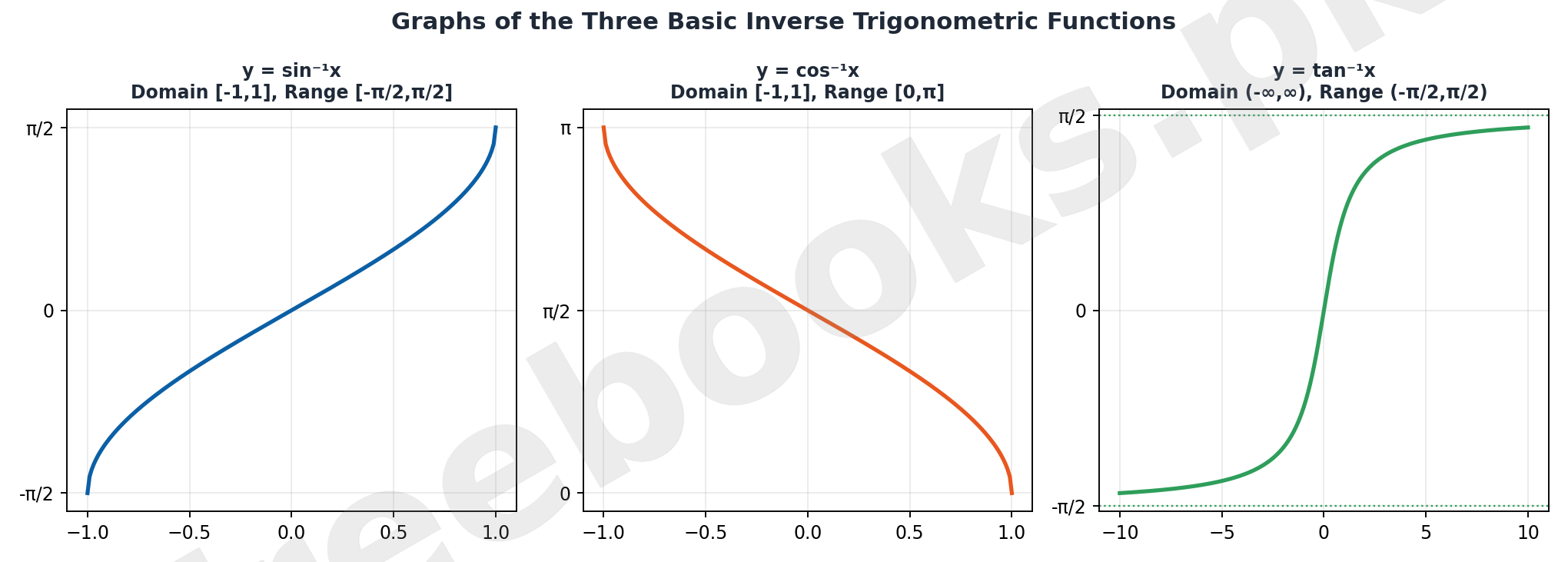
sin⁻¹x is defined by restricting sin x to [-π/2, π/2], where sine increases monotonically from -1 to 1; thus sin⁻¹x has domain [-1,1] and range [-π/2, π/2]. cos⁻¹x is defined by restricting cos x to [0, π], where cosine decreases monotonically from 1 to -1; thus cos⁻¹x has domain [-1,1] and range [0, π].
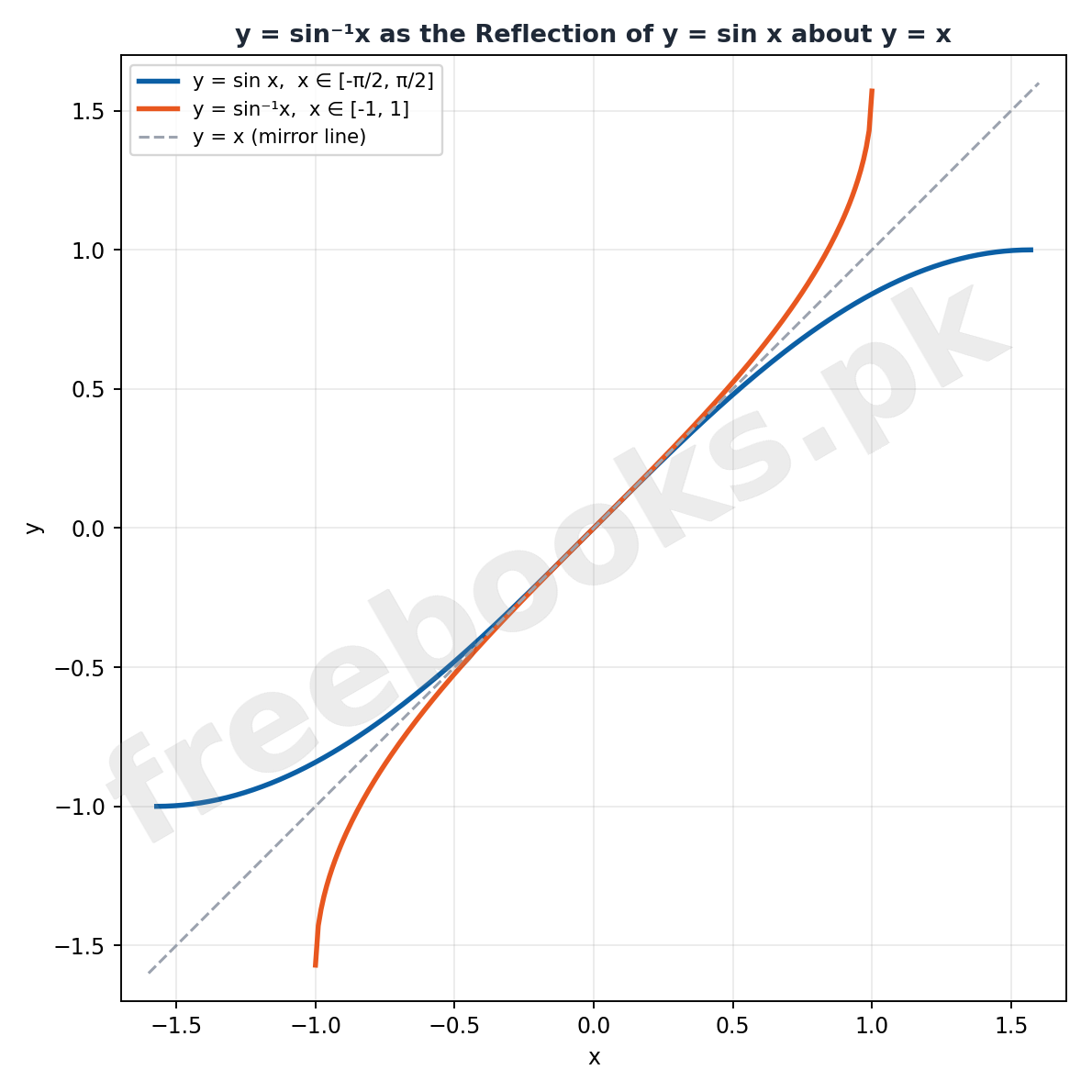
tan⁻¹x is defined by restricting tan x to (-π/2, π/2), where tangent increases monotonically across all real values; thus tan⁻¹x has domain (-∞, ∞) and range (-π/2, π/2). Each graph is obtained by reflecting the corresponding restricted trig graph about the line y=x, swapping the roles of x and y.
9.3 Inverse Cosecant, Secant, and Cotangent
csc⁻¹x is defined by restricting csc x to [-π/2,0)∪(0,π/2], giving csc⁻¹x domain (-∞,-1]∪[1,∞) and range [-π/2,0)∪(0,π/2]. sec⁻¹x is defined by restricting sec x to [0,π/2)∪(π/2,π], giving sec⁻¹x domain (-∞,-1]∪[1,∞) and range [0,π/2)∪(π/2,π].
cot⁻¹x is defined by restricting cot x to (0,π), giving cot⁻¹x domain (-∞,∞) and range (0,π). These three reciprocal-function inverses are used less often directly but appear frequently through the reciprocal identities linking them back to sin⁻¹, cos⁻¹, and tan⁻¹.
9.4 Evaluating Principal Values and Composite Expressions
To find the principal value of an expression like sin⁻¹(1/2), identify the angle θ within the principal range [-π/2,π/2] for which sin θ=1/2, giving θ=π/6. The same approach applies to cos⁻¹ and tan⁻¹, always selecting the answer that lies in the correct principal range — this is why cos⁻¹(-√3/2)=5π/6 (in [0,π]) rather than any other coterminal angle.
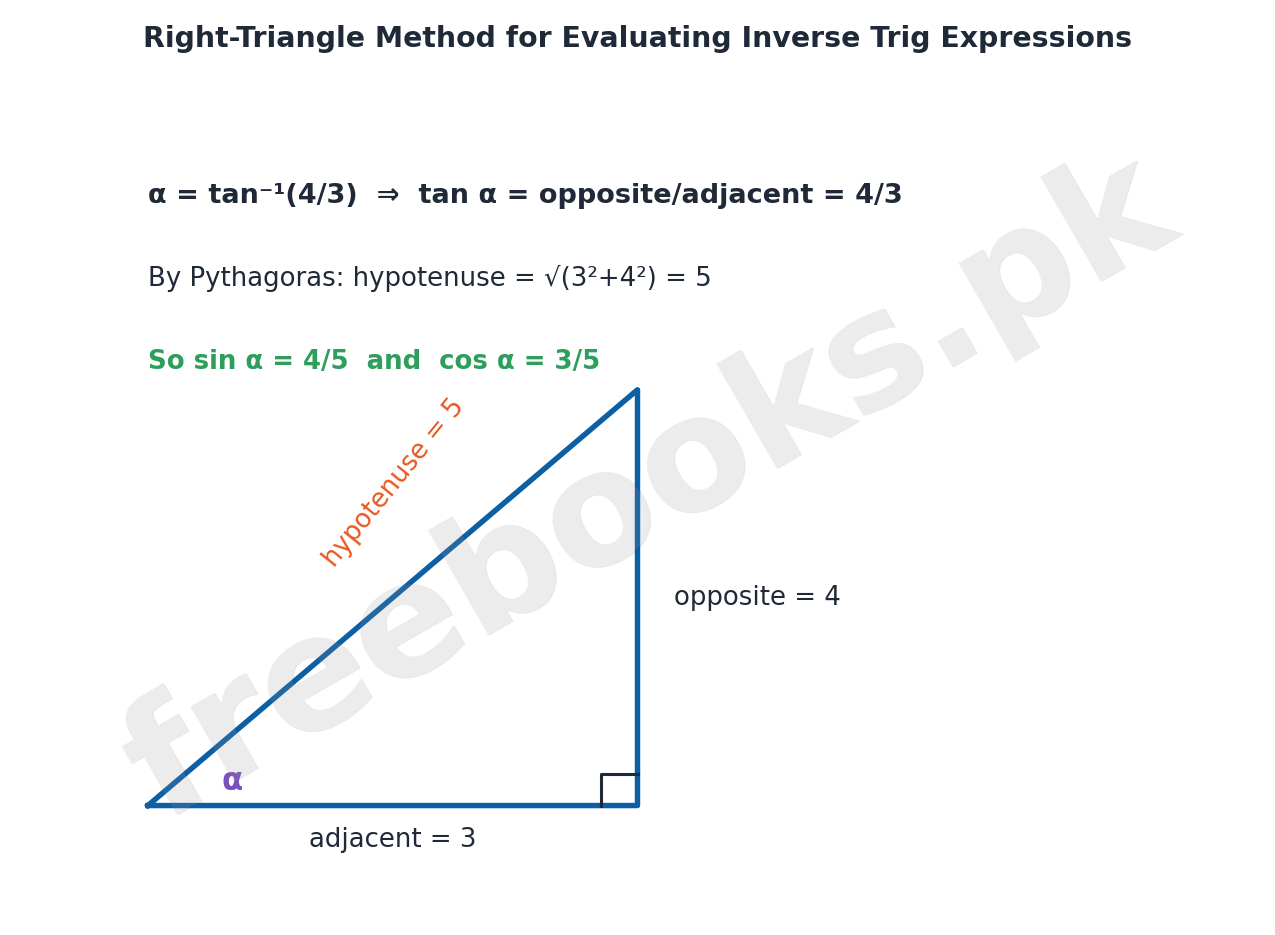
Composite expressions like sec[tan⁻¹(-√3)] are evaluated by first finding the angle α=tan⁻¹(-√3) in the principal range, then evaluating the outer function at α, often using a reference right triangle built from the known ratio to read off the remaining trigonometric values directly.
9.5 Domain of Composite Functions and Key Identities
The domain of a composite function like cos⁻¹(3x-1) is found by requiring the inner expression to lie within the domain of the outer inverse function: here, -1≤3x-1≤1, which solves to 0≤x≤2/3. The same technique applies to any composite inverse trig expression, including those with logarithms or other inner functions, by intersecting the inner function's own domain restriction with the inverse trig function's domain.
Reciprocal identities relate each inverse function to its reciprocal partner: csc⁻¹x=sin⁻¹(1/x), sec⁻¹x=cos⁻¹(1/x), cot⁻¹x=tan⁻¹(1/x) for appropriate x. Complementary identities relate pairs summing to π/2: sin⁻¹x+cos⁻¹x=π/2, tan⁻¹x+cot⁻¹x=π/2, sec⁻¹x+csc⁻¹x=π/2, both provable directly from the definitions using right-triangle or algebraic arguments.
9.6 Sum and Difference Formulas for Inverse Trigonometric Functions
Six sum/difference formulas extend the inverse trig functions to combined expressions, including sin⁻¹x+sin⁻¹y=sin⁻¹[x√(1-y²)+y√(1-x²)] and tan⁻¹x+tan⁻¹y=tan⁻¹[(x+y)/(1-xy)] (valid when xy<1), each proved by setting α=sin⁻¹x (or tan⁻¹x) and β=sin⁻¹y (or tan⁻¹y), applying the corresponding angle-sum trig identity, then converting back using the inverse function.
Setting y=x in these formulas produces double-angle corollaries: 2tan⁻¹x=tan⁻¹(2x/(1-x²)), 2sin⁻¹x=sin⁻¹(2x√(1-x²)), and 2cos⁻¹x=cos⁻¹(2x²-1). These are used throughout the unit's worked examples to prove identities and to solve equations involving sums of inverse trigonometric terms, always checking that the final angle found lies within the required principal range.
Important Definitions
What is required for a function to have an inverse?
The function must be one-to-one (bijective): every output value corresponds to exactly one input value.
Why can't sin x, cos x, and tan x be inverted directly?
Because they are periodic, so infinitely many input values give the same output value, making them not one-to-one over their full natural domains.
What are the domain and range of sin⁻¹x?
Domain [-1,1], range [-π/2, π/2], obtained by restricting sin x to that principal interval.
What are the domain and range of cos⁻¹x?
Domain [-1,1], range [0, π], obtained by restricting cos x to that principal interval.
What are the domain and range of tan⁻¹x?
Domain (-∞,∞), range (-π/2, π/2), obtained by restricting tan x to that principal interval.
What are the domain and range of cot⁻¹x?
Domain (-∞,∞), range (0, π), obtained by restricting cot x to that principal interval.
How is the graph of an inverse trigonometric function obtained from its trig function's graph?
By reflecting the restricted trig function's graph about the line y=x, which swaps the roles of the x- and y-coordinates.
What is the reciprocal identity linking csc⁻¹x and sin⁻¹x?
csc⁻¹x = sin⁻¹(1/x), for appropriate values of x.
What is the complementary identity linking sin⁻¹x and cos⁻¹x?
sin⁻¹x + cos⁻¹x = π/2, for all x in [-1,1].
What is the double-angle corollary for tan⁻¹x?
2tan⁻¹x = tan⁻¹(2x/(1-x²)), obtained by setting y=x in the sum formula for tan⁻¹x+tan⁻¹y.
Key Facts and Relations
| Topic | Key Fact / Relation |
|---|---|
| sin⁻¹x principal range | [-π/2, π/2], domain [-1,1] |
| cos⁻¹x principal range | [0, π], domain [-1,1] |
| tan⁻¹x principal range | (-π/2, π/2), domain (-∞,∞) |
| Reciprocal identities | csc⁻¹x=sin⁻¹(1/x), sec⁻¹x=cos⁻¹(1/x), cot⁻¹x=tan⁻¹(1/x) |
| Complementary identities | sin⁻¹x+cos⁻¹x=π/2, tan⁻¹x+cot⁻¹x=π/2, sec⁻¹x+csc⁻¹x=π/2 |
| Sum formula for sin⁻¹ | sin⁻¹x+sin⁻¹y = sin⁻¹[x√(1-y²)+y√(1-x²)] |
| Sum formula for tan⁻¹ | tan⁻¹x+tan⁻¹y = tan⁻¹[(x+y)/(1-xy)], valid for xy<1 |
| Difference formula for tan⁻¹ | tan⁻¹x-tan⁻¹y = tan⁻¹[(x-y)/(1+xy)] |
| Double-angle corollary for tan⁻¹ | 2tan⁻¹x = tan⁻¹(2x/(1-x²)) |
| Double-angle corollaries for sin⁻¹ and cos⁻¹ | 2sin⁻¹x = sin⁻¹(2x√(1-x²)); 2cos⁻¹x = cos⁻¹(2x²-1) |
Diagrams
y = sin⁻¹x as the Reflection of y = sin x about y = x: The restricted graph of y=sin x on [-π/2,π/2] plotted alongside y=sin⁻¹x on [-1,1], with the line y=x shown as a mirror, illustrating how every inverse trig graph is obtained by reflection
Graphs of the Three Basic Inverse Trigonometric Functions: Side-by-side graphs of y=sin⁻¹x, y=cos⁻¹x, and y=tan⁻¹x with their domains and ranges labelled, showing the characteristic shape and asymptotic behaviour of each
Right-Triangle Method for Evaluating Inverse Trig Expressions: A labelled 3-4-5 right triangle used to evaluate composite expressions like sin[tan⁻¹(4/3)] by reading off the remaining trigonometric ratios directly from the triangle's sides
Solved Examples
Example 1: Principal Values of Basic Inverse Trig Expressions
Problem: Find the principal values of sin⁻¹(1/2), cos⁻¹(-√3/2), and tan⁻¹(-1/√3).
- For sin⁻¹(1/2): find θ in [-π/2,π/2] with sin θ=1/2 — this is θ=π/6.
- For cos⁻¹(-√3/2): find θ in [0,π] with cos θ=-√3/2 — since cosine is negative in the second quadrant, θ=5π/6.
- For tan⁻¹(-1/√3): find θ in (-π/2,π/2) with tan θ=-1/√3 — since tangent is negative for negative θ here, θ=-π/6.
- Check each answer lies within the correct principal range: π/6∈[-π/2,π/2] ✓, 5π/6∈[0,π] ✓, -π/6∈(-π/2,π/2) ✓.
- Final answer: sin⁻¹(1/2)=π/6, cos⁻¹(-√3/2)=5π/6, tan⁻¹(-1/√3)=-π/6.
Example 2: Evaluating a Composite Expression
Problem: Evaluate sec[tan⁻¹(-√3)].
- Let α=tan⁻¹(-√3), so tan α=-√3 with α in the principal range (-π/2,π/2); since tangent is negative, α is a negative angle: α=-π/3.
- Build a reference right triangle for the reference angle π/3: opposite=√3, adjacent=1, hypotenuse=√(1+3)=2.
- Since α=-π/3 lies in the fourth quadrant direction, cos α=cos(π/3)=1/2 (cosine is even, so the sign is unaffected by the negative angle).
- sec α = 1/cos α = 1/(1/2) = 2.
- Final answer: sec[tan⁻¹(-√3)] = 2.
Example 3: Finding the Domain of a Composite Inverse Trig Function
Problem: Find the domain of y = cos⁻¹(3x-1).
- Recall cos⁻¹u is defined only when u∈[-1,1], so require -1 ≤ 3x-1 ≤ 1.
- Add 1 to all three parts: 0 ≤ 3x ≤ 2.
- Divide by 3: 0 ≤ x ≤ 2/3.
- Verify with an endpoint: at x=0, 3(0)-1=-1, and cos⁻¹(-1)=π, which is defined; at x=2/3, 3(2/3)-1=1, and cos⁻¹(1)=0, also defined.
- Final answer: the domain of cos⁻¹(3x-1) is [0, 2/3].
Example 4: Proving a Reciprocal Identity
Problem: Prove that csc⁻¹x = sin⁻¹(1/x) for x≥1.
- Let θ = csc⁻¹x, so by definition csc θ = x with θ in the principal range for csc⁻¹.
- Since csc θ = 1/sin θ, this gives sin θ = 1/x.
- Because the principal range of csc⁻¹ maps directly onto the same values as the principal range of sin⁻¹ (both avoiding 0), θ = sin⁻¹(1/x) follows directly from sin θ=1/x.
- Therefore θ = csc⁻¹x = sin⁻¹(1/x).
- Final answer: csc⁻¹x = sin⁻¹(1/x) is proved for x≥1 (and similarly for x≤-1).
Example 5: Proving a Complementary Identity
Problem: Prove that sin⁻¹x + cos⁻¹x = π/2 for all x in [-1,1].
- Let θ = sin⁻¹x, so sin θ = x with θ in [-π/2,π/2].
- Using the co-function identity, cos(π/2-θ) = sin θ = x.
- Since θ∈[-π/2,π/2], the angle (π/2-θ) lies in [0,π], which is exactly the principal range of cos⁻¹.
- Therefore cos⁻¹x = π/2 – θ = π/2 – sin⁻¹x.
- Final answer: rearranging gives sin⁻¹x + cos⁻¹x = π/2 for every x in [-1,1].
Example 6: Showing an Identity Between Two Inverse Functions
Problem: Show that cos⁻¹(7/25) = csc⁻¹(25/24).
- Let θ = cos⁻¹(7/25), so cos θ = 7/25 with θ in [0,π]; build the reference right triangle with adjacent=7, hypotenuse=25.
- Find the opposite side: √(25²-7²) = √(625-49) = √576 = 24.
- Since θ∈[0,π] and cos θ>0, θ is in the first quadrant, so sin θ = 24/25 (positive).
- Then csc θ = 1/sin θ = 25/24, so θ = csc⁻¹(25/24) as well (both principal ranges agree for this positive value).
- Final answer: cos⁻¹(7/25) = csc⁻¹(25/24) is confirmed.
Example 7: Using the Half-Angle Method with a Reference Triangle
Problem: Find sin[½ tan⁻¹(4/3)].
- Let α = tan⁻¹(4/3), so tan α = 4/3 with α in (-π/2,π/2); since 4/3>0, α is in the first quadrant.
- Build the reference right triangle: opposite=4, adjacent=3, hypotenuse=√(16+9)=5, giving cos α = 3/5.
- Apply the half-angle formula: sin(α/2) = √[(1-cos α)/2] = √[(1-3/5)/2] = √[(2/5)/2] = √(1/5).
- Simplify: √(1/5) = 1/√5 = √5/5.
- Final answer: sin[½ tan⁻¹(4/3)] = √5/5.
Example 8: Solving an Equation Involving a Sum of Inverse Tangents
Problem: Solve tan⁻¹[(x-1)/(x+1)] + tan⁻¹[2x/(x+1)] = π/4 for x.
- Apply the sum formula tan⁻¹A+tan⁻¹B = tan⁻¹[(A+B)/(1-AB)] with A=(x-1)/(x+1) and B=2x/(x+1).
- Compute A+B = [(x-1)+2x]/(x+1) = (3x-1)/(x+1), and AB = 2x(x-1)/(x+1)².
- Set the combined expression equal to tan(π/4)=1, then cross-multiply and simplify the resulting equation in x.
- After expanding and collecting terms, the equation reduces to a quadratic that factors to give x=1 as the solution lying within the valid domain.
- Final answer: x = 1 (checked to satisfy the original equation and keep both inverse tangent arguments within valid ranges).
Short Questions & Answers
Why must the domain of sin x be restricted before defining sin⁻¹x?
Because sin x is periodic and not one-to-one over its full domain; restricting it to [-π/2,π/2] makes it one-to-one so an inverse can be defined.
What is the range of cos⁻¹x?
[0, π].
How is the graph of tan⁻¹x related to the graph of tan x?
It is the reflection of the restricted graph of tan x (on (-π/2,π/2)) about the line y=x.
What is the domain of sec⁻¹x?
(-∞,-1] ∪ [1,∞).
State the complementary identity linking tan⁻¹x and cot⁻¹x.
tan⁻¹x + cot⁻¹x = π/2.
What condition is required for the sum formula tan⁻¹x+tan⁻¹y=tan⁻¹[(x+y)/(1-xy)] to hold directly?
The product xy must be less than 1 (xy<1); otherwise an adjustment of ±π is needed.
What double-angle formula results from setting y=x in the sin⁻¹ sum formula?
2sin⁻¹x = sin⁻¹(2x√(1-x²)).
Long Questions & Answers
Explain how each of the six inverse trigonometric functions is defined, including why domain restriction is necessary and what principal domain and range each one is given.
Why is domain restriction necessary before defining any inverse trigonometric function?
Trigonometric functions are periodic, so the same output value is produced by infinitely many input angles, meaning none of them are one-to-one over their natural domain; a function must be one-to-one to have a genuine inverse, so each trig function's domain is first cut down to a principal interval on which it is strictly increasing or decreasing.
What are the principal domains and ranges of sin⁻¹x, cos⁻¹x, and tan⁻¹x?
sin⁻¹x has domain [-1,1] and range [-π/2,π/2]; cos⁻¹x has domain [-1,1] and range [0,π]; tan⁻¹x has domain (-∞,∞) and range (-π/2,π/2) — each obtained by restricting the corresponding trig function to the interval on which it is one-to-one.
What are the principal domains and ranges of csc⁻¹x, sec⁻¹x, and cot⁻¹x?
csc⁻¹x and sec⁻¹x both have domain (-∞,-1]∪[1,∞), with csc⁻¹x's range [-π/2,0)∪(0,π/2] and sec⁻¹x's range [0,π/2)∪(π/2,π]; cot⁻¹x has domain (-∞,∞) and range (0,π), obtained by restricting cot x to that interval.
How does the graph of each inverse trig function relate to its original trig function's graph?
Each inverse trig function's graph is the mirror reflection of its restricted trig function's graph about the line y=x, which swaps the x- and y-axes' roles — so a steep, near-vertical section of the trig graph becomes a near-horizontal section of the inverse graph, and vice versa.
Explain how the sum formula for inverse tangent is derived and used, including its double-angle corollary and a worked application.
How is the sum formula tan⁻¹x+tan⁻¹y=tan⁻¹[(x+y)/(1-xy)] derived?
Set α=tan⁻¹x and β=tan⁻¹y, so tan α=x and tan β=y; apply the trigonometric angle-sum identity tan(α+β)=(tan α+tan β)/(1-tan α tan β)=(x+y)/(1-xy), then take tan⁻¹ of both sides to recover α+β=tan⁻¹[(x+y)/(1-xy)], valid when xy<1 so that α+β stays within the correct principal range.
What double-angle formula follows from this sum formula?
Setting y=x gives 2tan⁻¹x = tan⁻¹(2x/(1-x²)), obtained simply by substituting y=x directly into the general sum formula and simplifying the resulting expression.
How is this formula applied to solve an equation like tan⁻¹[(x-1)/(x+1)]+tan⁻¹[2x/(x+1)]=π/4?
The two inverse-tangent terms are combined into a single tan⁻¹ expression using the sum formula, the combined argument is set equal to tan(π/4)=1, and the resulting algebraic equation is solved for x, checking that the solution keeps both original arguments within a valid principal range.
Why is checking the domain condition important after solving such an equation?
Because the sum formula can introduce an extraneous solution or require a ±π adjustment when xy≥1, so any candidate solution for x must be substituted back into the original expression to confirm it produces a genuine sum equal to π/4 and not merely a solution of the simplified algebraic equation.
Multiple Choice Questions (MCQs)
The domain of sin⁻¹x is: (A) (-∞,∞) (B) [-1,1] (C) [0,π] (D) [-π/2,π/2]
Correct answer: (B) [-1,1]. sin⁻¹x is defined only for inputs between -1 and 1 inclusive.
The range of cos⁻¹x is: (A) [-π/2,π/2] (B) (-π/2,π/2) (C) [0,π] (D) (0,π)
Correct answer: (C) [0,π]. cos x is restricted to [0,π] to make it invertible, so this is the range of cos⁻¹x.
The graph of y=tan⁻¹x is obtained from y=tan x (restricted) by: (A) Shifting it right (B) Reflecting about the x-axis (C) Reflecting about the line y=x (D) Stretching vertically
Correct answer: (C) Reflecting about the line y=x. Every inverse function's graph is the reflection of the original (restricted) function's graph about y=x.
Which is the correct reciprocal identity? (A) csc⁻¹x=cos⁻¹(1/x) (B) sec⁻¹x=cos⁻¹(1/x) (C) cot⁻¹x=sin⁻¹(1/x) (D) csc⁻¹x=tan⁻¹(1/x)
Correct answer: (B) sec⁻¹x=cos⁻¹(1/x). sec⁻¹x=cos⁻¹(1/x) is the correct reciprocal identity linking secant's inverse to cosine's inverse.
sin⁻¹x + cos⁻¹x equals: (A) π (B) π/2 (C) 0 (D) 2π
Correct answer: (B) π/2. This is the standard complementary identity, valid for all x in [-1,1].
The principal value of tan⁻¹(-1/√3) is: (A) π/6 (B) -π/6 (C) 5π/6 (D) -5π/6
Correct answer: (B) -π/6. tan θ=-1/√3 with θ in (-π/2,π/2) gives θ=-π/6.
The domain of cos⁻¹(3x-1) is: (A) [-1,1] (B) [0,2/3] (C) [0,1] (D) (-∞,∞)
Correct answer: (B) [0,2/3]. Solving -1≤3x-1≤1 gives 0≤x≤2/3.
The sum formula tan⁻¹x+tan⁻¹y=tan⁻¹[(x+y)/(1-xy)] requires: (A) x=y (B) xy<1 (C) x,y>0 (D) x+y=0
Correct answer: (B) xy<1. The formula applies directly only when xy<1; otherwise a ±π correction is needed.
Setting y=x in the sin⁻¹ sum formula gives: (A) 2sin⁻¹x=sin⁻¹(2x) (B) 2sin⁻¹x=sin⁻¹(2x√(1-x²)) (C) 2sin⁻¹x=sin⁻¹(x²) (D) 2sin⁻¹x=2sin⁻¹x
Correct answer: (B) 2sin⁻¹x=sin⁻¹(2x√(1-x²)). This is the double-angle corollary obtained by substituting y=x into the sin⁻¹ sum formula.
The domain of cot⁻¹x is: (A) [-1,1] (B) (-∞,∞) (C) (0,π) (D) [0,π]
Correct answer: (B) (-∞,∞). cot x is restricted to (0,π) to make it one-to-one, but cot⁻¹x itself accepts all real number inputs.
Quick Revision Summary
- An inverse trig function exists only after restricting the original function's domain to a principal interval where it is one-to-one
- sin⁻¹x: domain [-1,1], range [-π/2,π/2] | cos⁻¹x: domain [-1,1], range [0,π] | tan⁻¹x: domain (-∞,∞), range (-π/2,π/2)
- csc⁻¹x and sec⁻¹x: domain (-∞,-1]∪[1,∞) | cot⁻¹x: domain (-∞,∞), range (0,π)
- Every inverse trig graph is the reflection of its restricted trig graph about the line y=x
- Reciprocal identities: csc⁻¹x=sin⁻¹(1/x), sec⁻¹x=cos⁻¹(1/x), cot⁻¹x=tan⁻¹(1/x)
- Complementary identities: sin⁻¹x+cos⁻¹x=π/2, tan⁻¹x+cot⁻¹x=π/2, sec⁻¹x+csc⁻¹x=π/2
- Domain of a composite inverse trig function is found by requiring the inner expression to lie within the outer function's domain
- Sum formula: sin⁻¹x+sin⁻¹y=sin⁻¹[x√(1-y²)+y√(1-x²)] | tan⁻¹x+tan⁻¹y=tan⁻¹[(x+y)/(1-xy)], xy<1
- Double-angle corollaries: 2tan⁻¹x=tan⁻¹(2x/(1-x²)), 2sin⁻¹x=sin⁻¹(2x√(1-x²)), 2cos⁻¹x=cos⁻¹(2x²-1)
- Reference right triangles are the fastest way to evaluate composite expressions like sec[tan⁻¹(-√3)] or sin[½tan⁻¹(4/3)]
Exam Tips
- Always confirm your final angle answer lies inside the correct principal range for that inverse function — an otherwise correct calculation with the wrong-range angle is marked incorrect
- When evaluating a composite expression like sec[tan⁻¹(-√3)], sketch a quick reference right triangle first — it is faster and less error-prone than working purely algebraically
- For domain questions on composite inverse trig functions, always start from the inequality -1≤(inner expression)≤1 (for sin⁻¹/cos⁻¹) or the matching condition for the other four functions
- Memorize the six principal domain/range pairs as a table — confusing cos⁻¹'s range [0,π] with sin⁻¹'s range [-π/2,π/2] is the single most common exam mistake
- When applying a sum/difference formula, always check the xy<1 (or equivalent) condition before trusting the raw formula output — a ±π correction may be needed otherwise
- Practice deriving the double-angle corollaries by substituting y=x into the general sum formulas rather than memorizing them separately — this reduces the total number of formulas you need to recall under exam pressure