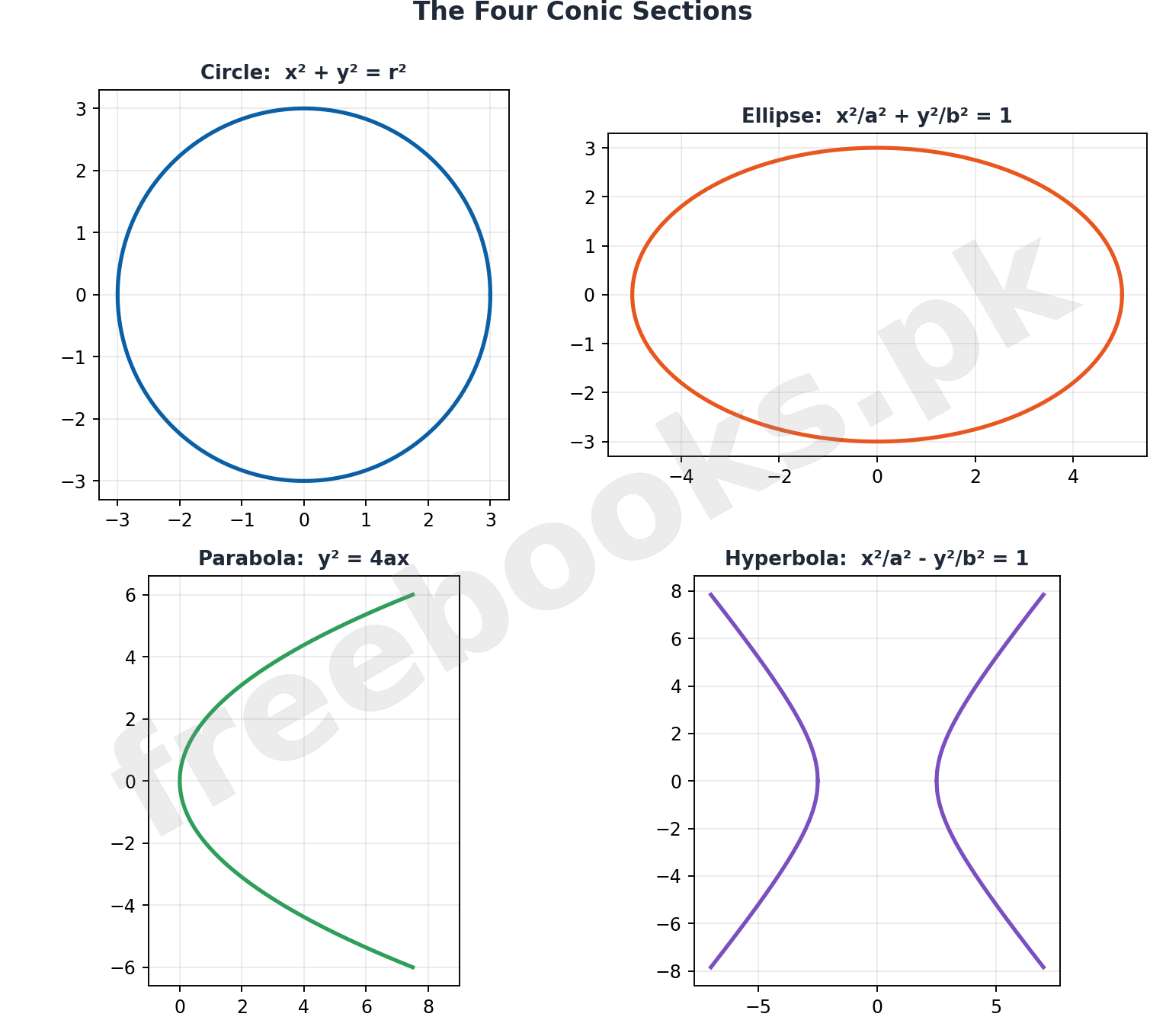
A conic section is the curve obtained when a plane slices through a right circular cone. Depending on the angle of the cutting plane relative to the cone's axis, four distinct curves arise: a circle (plane perpendicular to the axis), an ellipse (plane inclined, cutting one nappe), a parabola (plane parallel to a generator, cutting one nappe), and a hyperbola (plane parallel to the axis, cutting both nappes). First studied geometrically by the Greek mathematicians Apollonius and Pappus, conics are studied here using analytic (coordinate) geometry, giving each curve a clean algebraic equation.
This unit develops each conic in turn: the circle (equation from centre and radius, general form, tangents, normals, and the position of a point relative to a circle), the parabola (standard equation from its focus-directrix definition, vertex, axis, latus rectum, tangents), the ellipse (standard equation from the constant-sum-of-distances definition, foci, eccentricity, tangents), and the hyperbola (standard equation from the constant-difference-of-distances definition, asymptotes, tangents). The unit closes with real-life applications — satellite orbits, suspension bridge cables, parabolic reflectors, and planetary motion — showing why conics matter far beyond the mathematics classroom.
Learning Objectives
- Derive and apply the standard and general equations of a circle, and find its centre and radius
- Find the equation of a circle satisfying given conditions (three points, tangency, diameter endpoints)
- Find equations of tangents and normals to a circle, and determine a point's position relative to a circle
- Derive the standard equation of a parabola from its focus-directrix definition and identify its elements
- Find equations of tangents and normals to a parabola, and the condition for a line to be tangent
- Derive the standard equation of an ellipse and identify its foci, vertices, eccentricity, and directrices
- Derive the standard equation of a hyperbola and identify its foci, vertices, asymptotes, and eccentricity
- Apply conic section concepts to real-life problems in astronomy, architecture, and optics
Key Concepts
6.1 The Circle: Equation, Tangents, and Normals
A circle is the set of points at a fixed distance (the radius r) from a fixed point (the centre). Its standard equation is (x-h)^2+(y-k)^2=r^2 for centre (h,k); expanding gives the general form x^2+y^2+2gx+2fy+c=0, which represents a real circle with centre (-g,-f) and radius sqrt(g^2+f^2-c) whenever g^2+f^2-c>0. Three independent constants (g, f, c) mean a circle is fully determined by three conditions — three non-collinear points, two points plus a line the centre lies on, or points plus a tangency condition.
The tangent to x^2+y^2+2gx+2fy+c=0 at a point (x_1,y_1) on the circle is xx_1+yy_1+g(x+x_1)+f(y+y_1)+c=0, obtained by a simple substitution rule (x^2 to xx_1, x to (x+x_1)/2, and so on) from the circle's own equation. A point lies outside, on, or inside a circle according as substituting its coordinates into the circle's general-form expression gives a value greater than, equal to, or less than zero; the length of the tangent from an external point is the square root of that same substituted value.
6.2 The Parabola: Standard Equation and Elements
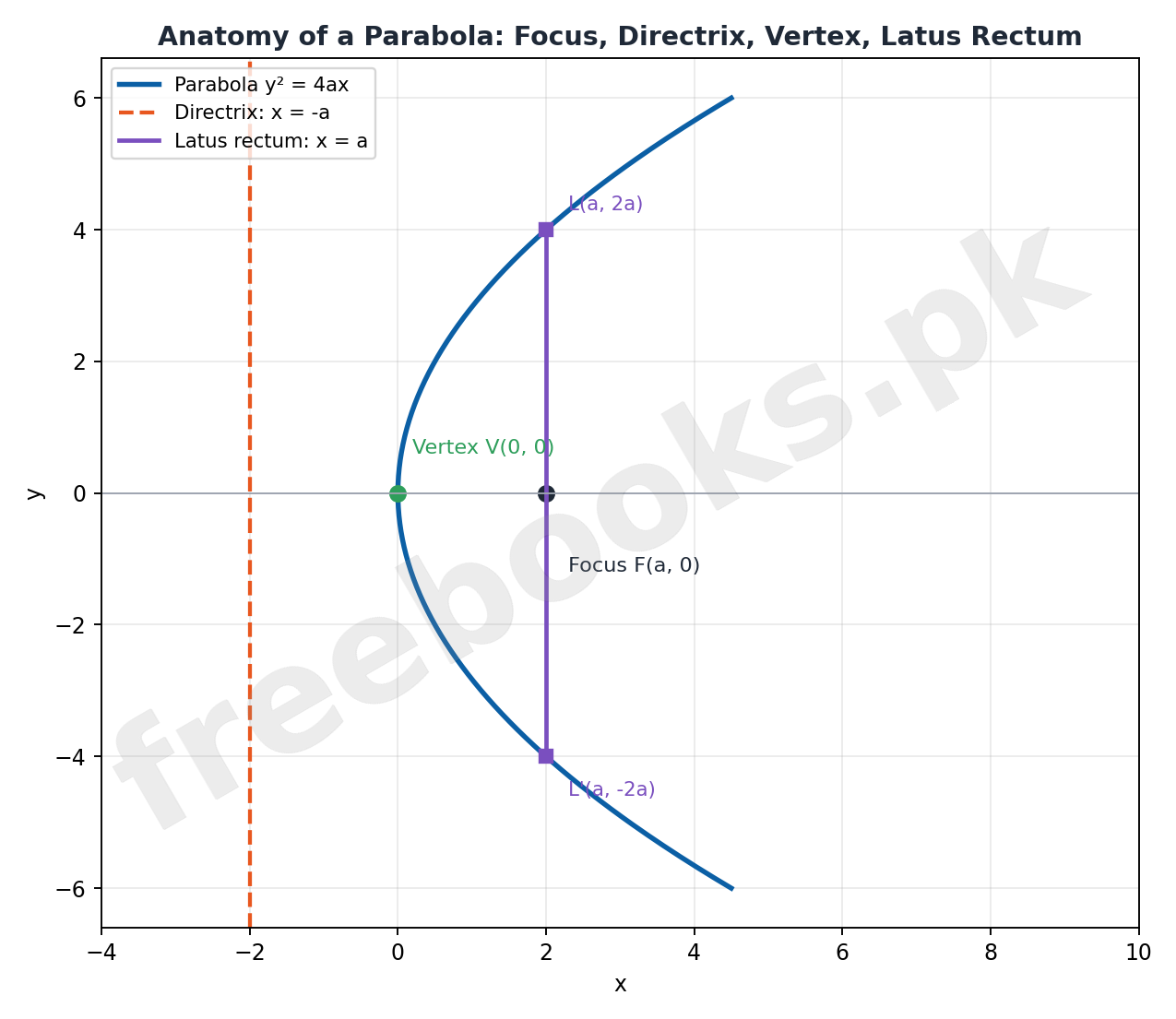
A parabola is the locus of points equidistant from a fixed point (the focus) and a fixed line (the directrix). Placing the vertex at the origin with the focus at (a,0) and directrix x=-a gives the standard equation y^2=4ax; taking the directrix on the other side or perpendicular gives three more standard forms (y^2=-4ax, x^2=4ay, x^2=-4ay), each with focus, vertex, directrix, axis, and latus rectum (length 4a) determined by the same pattern.
The tangent to y^2=4ax at (x_1,y_1) is yy_1=2a(x+x_1), found by implicit differentiation; a line y=mx+c is tangent to the parabola exactly when c=a/m. The same substitution technique used for circles (x^2 to xx_1, 2x to x+x_1, etc.) extends to writing tangents for any conic once the general pattern is understood.
6.3 The Ellipse: Standard Equation and Key Features
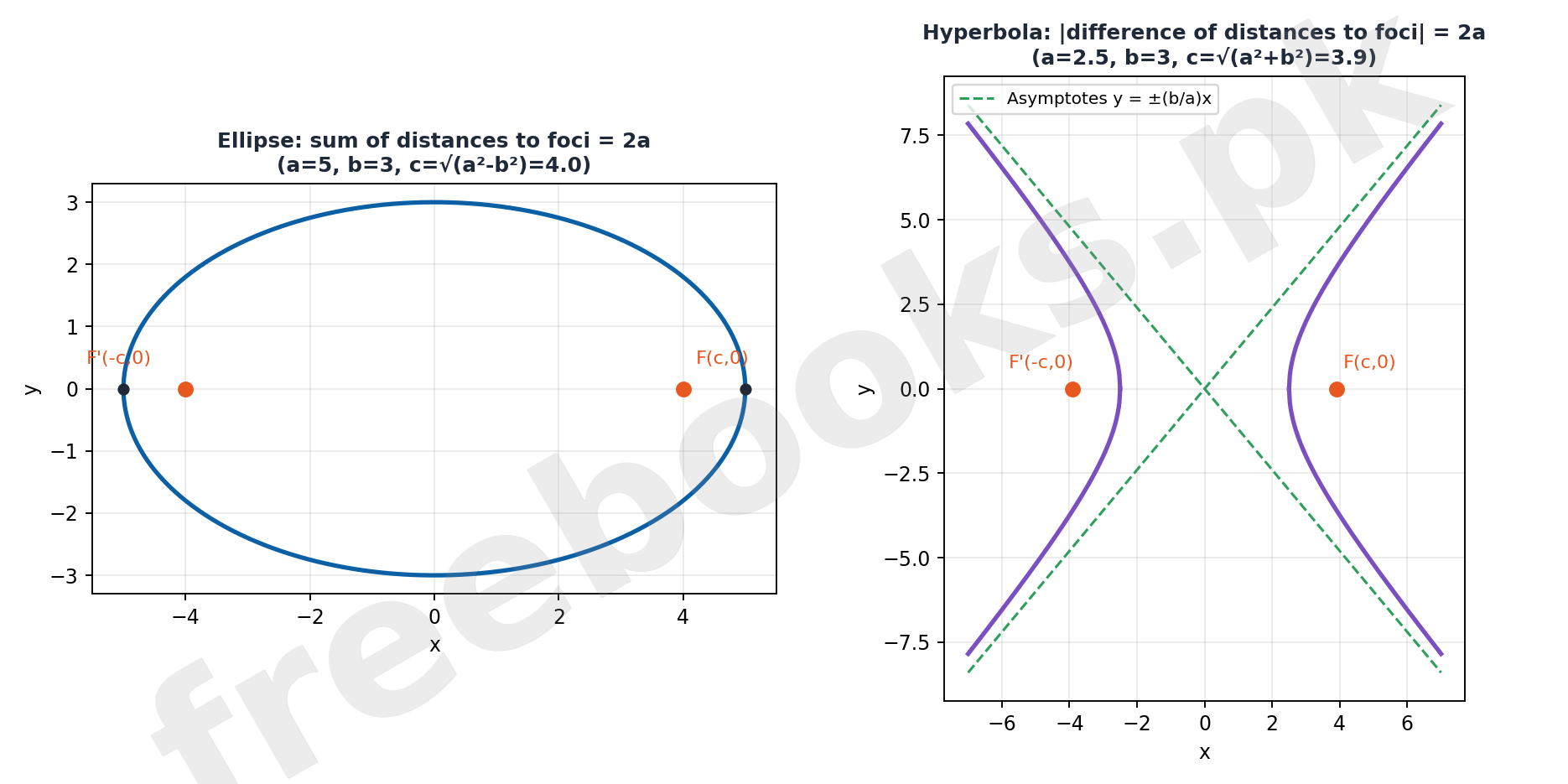
An ellipse is the locus of points whose distances to two fixed foci sum to a constant 2a. Placing the foci on the x-axis at (+-c,0) gives the standard equation x^2/a^2+y^2/b^2=1, where b^2=a^2-c^2 and a>b; the major axis (length 2a) lies along the foci, the minor axis (length 2b) is perpendicular to it, and eccentricity e=c/a satisfies 0<e<1 (e=0 gives a circle).
Key features include vertices (+-a,0), co-vertices (0,+-b), directrices x=+-a/e, and latus rectum length 2b^2/a. The tangent to x^2/a^2+y^2/b^2=1 at (x_1,y_1) is xx_1/a^2+yy_1/b^2=1, and a line y=mx+c is tangent to the ellipse exactly when c^2=a^2m^2+b^2.
6.4 The Hyperbola: Standard Equation and Key Features
A hyperbola is the locus of points whose distances to two fixed foci differ (in absolute value) by a constant 2a. With foci at (+-c,0), the standard equation is x^2/a^2-y^2/b^2=1, where now c^2=a^2+b^2 (so a and b can be in either order); the transverse axis (length 2a) joins the vertices, the conjugate axis (length 2b) is perpendicular, and eccentricity e=c/a>1.
A distinguishing feature not shared by the ellipse is the pair of asymptotes y=+-(b/a)x, straight lines the hyperbola's two branches approach but never touch as x to +-infinity; when a=b the hyperbola is called rectangular and its asymptotes are perpendicular. The tangent to x^2/a^2-y^2/b^2=1 at (x_1,y_1) is xx_1/a^2-yy_1/b^2=1, and a line y=mx+c is tangent exactly when c^2=a^2m^2-b^2.
6.5 Real-Life Applications of Conics
Parabolas describe suspension bridge cables (which hang in a parabolic curve under uniform load) and parabolic reflectors (headlights, satellite dishes, flashlights), which use the reflective property that rays from the focus reflect off the parabola parallel to its axis, and vice versa — this is why bulbs are placed exactly at the focus.
Ellipses describe planetary and satellite orbits (Kepler's first law: planets orbit the sun in ellipses with the sun at one focus), with the apogee (farthest point) and perigee (closest point) related to the semi-major axis a and focal distance c by A=a+c and P=a-c, giving eccentricity e=(A-P)/(A+P). Hyperbolas appear in navigation systems like LORAN, where the constant time-difference between synchronized radio signals from two stations traces a hyperbolic path with the stations as foci.
Important Definitions
What is a conic section?
The curve formed by the intersection of a plane with a right circular cone; depending on the angle of the plane, the result is a circle, ellipse, parabola, or hyperbola.
What is the standard equation of a circle with centre (h,k) and radius r?
(x-h)^2 + (y-k)^2 = r^2.
What is a parabola?
The locus of points equidistant from a fixed point (the focus) and a fixed line (the directrix).
What is the latus rectum of a parabola?
The focal chord perpendicular to the axis; for y^2=4ax it has length 4a and endpoints (a,2a) and (a,-2a).
What is an ellipse?
The locus of points for which the sum of the distances to two fixed points (the foci) is a constant, 2a.
What is the eccentricity of an ellipse?
e = c/a, where c is the distance from the centre to a focus; since a>c>0, we have 0<e<1.
What is a hyperbola?
The locus of points for which the absolute value of the difference of the distances to two fixed points (the foci) is a constant, 2a.
What is an asymptote of a hyperbola?
A straight line that the hyperbola's branches approach arbitrarily closely as x tends to +-infinity, without ever touching it; for x^2/a^2-y^2/b^2=1 the asymptotes are y=+-(b/a)x.
What is a rectangular hyperbola?
A hyperbola in which a=b, so its asymptotes are perpendicular to each other.
What is the tangent to a curve at a point, and the normal?
The tangent is the line touching the curve at exactly that point; the normal is the line through that point perpendicular to the tangent.
Key Facts and Relations
| Topic | Key Fact / Relation |
|---|---|
| Circle: standard & general form | (x-h)^2+(y-k)^2=r^2; x^2+y^2+2gx+2fy+c=0, centre (-g,-f), radius=sqrt(g^2+f^2-c) |
| Tangent to a circle at (x1,y1) | xx_1+yy_1+g(x+x_1)+f(y+y_1)+c=0 (or xx_1+yy_1=r^2 for x^2+y^2=r^2) |
| Parabola standard forms | y^2=4ax (focus (a,0)); y^2=-4ax; x^2=4ay; x^2=-4ay — all with vertex (0,0), latus rectum length 4a |
| Tangent to parabola y^2=4ax | yy_1=2a(x+x_1) at (x_1,y_1); tangency condition for y=mx+c: c=a/m |
| Ellipse standard equation | x^2/a^2+y^2/b^2=1 (a>b), b^2=a^2-c^2, foci (+-c,0), e=c/a<1 |
| Ellipse tangent & tangency condition | xx_1/a^2+yy_1/b^2=1 at (x_1,y_1); y=mx+c tangent iff c^2=a^2m^2+b^2 |
| Hyperbola standard equation | x^2/a^2-y^2/b^2=1, c^2=a^2+b^2, foci (+-c,0), e=c/a>1 |
| Hyperbola asymptotes & tangent | y=+-(b/a)x; tangent at (x_1,y_1): xx_1/a^2-yy_1/b^2=1; y=mx+c tangent iff c^2=a^2m^2-b^2 |
| Latus rectum lengths | Parabola: 4a; Ellipse and hyperbola: 2b^2/a |
| Directrices | Ellipse & hyperbola (foci on x-axis): x = +-a/e |
Diagrams
The Four Conic Sections: Circle, ellipse, parabola, and hyperbola shown together with their standard equations, illustrating how all four curves arise from slicing a cone at different angles
Anatomy of a Parabola: The parabola y²=4ax with its focus F(a,0), directrix x=-a, vertex V(0,0), and latus rectum endpoints L(a,2a) and L'(a,-2a) all labeled
Ellipse and Hyperbola: Foci and Asymptotes: Side-by-side comparison of an ellipse (sum of focal distances constant) and a hyperbola with its asymptotes (difference of focal distances constant), showing the parallel structure of their definitions
Solved Examples
Example 1: Equation of a Circle from Centre and Radius
Problem: Write an equation of the circle with centre (-2,1) and radius 5.
- Use the standard form (x-h)^2+(y-k)^2=r^2 with h=-2, k=1, r=5.
- Substitute: (x-(-2))^2+(y-1)^2=5^2, i.e. (x+2)^2+(y-1)^2=25.
- Expand: x^2+4x+4+y^2-2y+1=25.
- Simplify: x^2+y^2+4x-2y-20=0.
- Final answer: x² + y² + 4x – 2y – 20 = 0.
Example 2: Centre and Radius from General Form
Problem: Equation 5x²+5y²+20x+25y+10=0 represents a circle. Find its centre and radius.
- Divide through by 5 to make the coefficients of x² and y² equal to 1: x²+y²+4x+5y+2=0.
- Compare with x²+y²+2gx+2fy+c=0: 2g=4 so g=2; 2f=5 so f=5/2; c=2.
- Find the centre: (-g,-f) = (-2, -5/2).
- Find the radius: r = sqrt(g²+f²-c) = sqrt(4+25/4-2) = sqrt(33/4).
- Final answer: centre (-2, -5/2), radius = sqrt(33)/2.
Example 3: Tangent and Normal to a Circle
Problem: Find the equation of the tangent to the circle x²+y²-4x+6y+12=0 at the point on the circle whose ordinate (y-value) is -2.
- Substitute y=-2 into the circle's equation to find x: x²+4-4x-12+12=0, giving x²-4x+4=0.
- Factor: (x-2)²=0, so x=2. The point of contact is (2,-2).
- Use the tangent rule xx_1+yy_1+g(x+x_1)+f(y+y_1)+c=0 with g=-2, f=3, c=12, x_1=2, y_1=-2: 2x-2y-2(x+2)+3(y-2)+12=0.
- Expand and simplify: 2x-2y-2x-4+3y-6+12=0, which reduces to y+2=0.
- Final answer: the tangent is y = -2 (a horizontal line), and by the perpendicularity of tangent and normal, the normal is x = 2.
Example 4: Elements of a Parabola from a General Equation
Problem: Analyze the parabola x²-4x-4y-2=0: find its vertex, focus, and directrix.
- Rewrite by completing the square in x: x²-4x=4y+2, so x²-4x+4=4y+6, giving (x-2)²=4(y+3/2).
- Let X=x-2 and Y=y+3/2, so the equation becomes X²=4Y, a standard parabola opening upward with 4a=4, i.e. a=1.
- The vertex is where X=0, Y=0, i.e. x=2, y=-3/2.
- The focus is where X=0, Y=a=1, i.e. x=2, y=-3/2+1=-1/2.
- Final answer: vertex (2, -3/2), focus (2, -1/2), and directrix Y=-1 i.e. y = -3/2-1 = -5/2.
Example 5: Tangent to a Parabola Using the Tangency Condition
Problem: Find the equation of the tangent to the parabola y²=12x which is parallel to the line 3x-y+4=0.
- Find the slope of the given line: 3x-y+4=0 rearranges to y=3x+4, so its slope is m=3.
- Since the required tangent is parallel, it has the same slope m=3. Compare y²=12x with y²=4ax to find a: 4a=12, so a=3.
- Apply the tangency condition c=a/m: c = 3/3 = 1.
- Write the tangent line: y = mx+c = 3x+1.
- Final answer: the tangent is y = 3x + 1, or equivalently 3x – y + 1 = 0.
Example 6: Equation of an Ellipse from Foci and Major Axis
Problem: Find an equation of the ellipse with foci (2,1) and (2,7), and major axis of length 10.
- Since both foci share the x-coordinate 2, the major axis is vertical. Major axis length 2a=10, so a=5.
- Find the centre as the midpoint of the foci: ((2+2)/2, (1+7)/2) = (2,4).
- Find c as the distance from centre to a focus: c=|4-1|=3.
- Use b²=a²-c²: b² = 25-9 = 16.
- Final answer: with vertical major axis, the equation is (x-2)²/16 + (y-4)²/25 = 1.
Example 7: Equation of a Hyperbola from Centre, Axis, and Eccentricity
Problem: A hyperbola has a horizontal transverse axis of length 12, centre at (-2,5), and eccentricity 5/3. Find its equation.
- Since the transverse axis is horizontal, use the form (x-h)²/a² – (y-k)²/b² = 1, with centre (h,k)=(-2,5).
- Find a from the transverse axis length: 2a=12, so a=6.
- Find c using eccentricity e=c/a: c/6 = 5/3, so c=10.
- Find b² using c²=a²+b²: 100 = 36+b², so b²=64.
- Final answer: (x+2)²/36 – (y-5)²/64 = 1.
Example 8: Real-Life Application: Parabolic Suspension Bridge Cable
Problem: A suspension bridge cable is parabolic. The roadway is 10 m below the lowest point of the cable, the span is 200 m, and the tops of the piers are 50 m above the roadway. Find the equation of the parabola, taking the vertex as the origin.
- Take the vertex (lowest point of the cable) as the origin, with the parabola opening upward: x² = 4ay.
- Half the span is 100 m, and the height of the pier top above the vertex is 50-10 = 40 m, so the point (100, 40) lies on the parabola.
- Substitute into x²=4ay: (100)² = 4a(40), giving 10000 = 160a.
- Solve for 4a: 4a = 10000/40 = 250.
- Final answer: the equation of the parabola is x² = 250y.
Short Questions & Answers
What condition on g, f, c makes x²+y²+2gx+2fy+c=0 a real circle?
g² + f² – c > 0 (if it equals zero, the equation represents a single point; if negative, no real locus).
What are the coordinates of the vertex of the parabola y²=4ax?
(0, 0), the origin, which is the midpoint of the perpendicular from the focus to the directrix.
For an ellipse x²/a²+y²/b²=1 with a>b, what is the relationship between a, b, and c?
b² = a² – c², i.e. c = sqrt(a²-b²).
Why can eccentricity of a hyperbola never be less than 1?
Because c²=a²+b² makes c always greater than a (since b²>0), so e=c/a is always greater than 1.
What happens to an ellipse's equation when its two foci coincide (c=0)?
It becomes a circle: a=b and the equation reduces to x²+y²=a², with eccentricity e=0.
What is the reflective property of a parabola used for?
Rays from the focus reflect off the parabola parallel to its axis (or vice versa) — used in flashlights, headlights, and satellite dishes to place the bulb/receiver exactly at the focus.
How is the length of the tangent from an external point P(x1,y1) to a circle found?
Substitute (x1,y1) into the circle's general-form left-hand side (with right side zero) and take the square root of the result.
Long Questions & Answers
Explain how the standard equations of the ellipse and hyperbola are derived from their focus-based definitions, and how their key features compare.
How is the ellipse's definition turned into an equation?
Starting from |PF'|+|PF|=2a with foci at (±c,0), the distance formula gives two square-root terms; isolating and squaring twice (to eliminate both radicals) leads to (a²-c²)x²+a²y²=a²(a²-c²), which becomes x²/a²+y²/b²=1 after substituting b²=a²-c² and dividing through by a²b².
How does the hyperbola's derivation differ?
The hyperbola uses the same distance-formula and double-squaring approach, but starts from ||PF'|-|PF||=2a instead of a sum; the key sign difference is that a<c for a hyperbola (rather than a>c for an ellipse), so the constant is defined as -b²=a²-c² instead of b²=a²-c², flipping a sign and producing x²/a²-y²/b²=1 with c²=a²+b² instead of c²=a²-b².
How do their eccentricities compare?
For an ellipse, a>c always, so e=c/a is between 0 and 1; for a hyperbola, c>a always (since c²=a²+b²>a²), so e=c/a is always greater than 1 — this single number instantly tells you which conic you're looking at.
What feature does the hyperbola have that the ellipse does not?
Asymptotes: straight lines y=±(b/a)x that the hyperbola's branches approach but never touch as x→±∞; an ellipse is a bounded, closed curve with no such lines, since both x and y stay within finite ranges (|x|≤a, |y|≤b).
Explain the general method for finding the tangent to a conic at a given point, and how it applies across the circle, parabola, ellipse, and hyperbola.
What is the general strategy for finding a tangent equation?
Differentiate the conic's equation implicitly with respect to x to find dy/dx as the slope of the tangent at any point, evaluate this slope at the given point (x_1,y_1), then use the point-slope form of a line and simplify using the fact that (x_1,y_1) satisfies the original conic's equation.
What is the substitution shortcut, and why does it work?
Once the tangent formula is derived once for a conic (e.g. xx_1+yy_1=r^2 for a circle x^2+y^2=r^2), the same result can be obtained directly from the conic's equation by substituting x^2→xx_1, y^2→yy_1, x→(x+x_1)/2, y→(y+y_1)/2, and leaving constants unchanged; this shortcut works because it exactly reproduces the algebra of the differentiation-based derivation.
How does the tangent equation differ between the ellipse and hyperbola?
Because the ellipse's equation has a plus sign between the x²/a² and y²/b² terms while the hyperbola's has a minus sign, their tangent equations mirror this: xx_1/a²+yy_1/b²=1 for the ellipse versus xx_1/a²-yy_1/b²=1 for the hyperbola — the same substitution pattern, just preserving the sign structure of the original equation.
What is the tangency condition for a general line y=mx+c, and how does it differ across conics?
It comes from requiring the quadratic formed by substituting the line into the conic's equation to have equal roots (discriminant zero); this gives c=a/m for the parabola y²=4ax, c²=a²m²+b² for the ellipse, and c²=a²m²-b² for the hyperbola — again the sign pattern of each conic's own equation carries through into its tangency condition.
Multiple Choice Questions (MCQs)
The general equation x²+y²+2gx+2fy+c=0 represents a real circle when: (A) g²+f²-c<0 (B) g²+f²-c=0 (C) g²+f²-c>0 (D) g=f=0
Correct answer: (C) g²+f²-c>0. A real circle (with positive radius) requires g²+f²-c to be strictly positive, since the radius is sqrt(g²+f²-c).
The tangent to the circle x²+y²=r² at (x1,y1) is: (A) xx1+yy1=r (B) xx1+yy1=r² (C) x+y=r² (D) xy1+yx1=r²
Correct answer: (B) xx1+yy1=r². The standard tangent formula for a circle centred at the origin is xx1+yy1=r².
The standard equation of a parabola with vertex at the origin and focus (a,0) is: (A) x²=4ay (B) y²=4ax (C) x²/a²+y²/b²=1 (D) x²-y²=a²
Correct answer: (B) y²=4ax. This is the standard first form of the parabola, with axis along the x-axis and directrix x=-a.
The length of the latus rectum of the parabola y²=4ax is: (A) a (B) 2a (C) 4a (D) a²
Correct answer: (C) 4a. The latus rectum, the focal chord perpendicular to the axis, has length 4a for this standard form.
For the ellipse x²/a²+y²/b²=1 with a>b, the relationship between a, b, and c is: (A) c²=a²+b² (B) c²=a²-b² (C) c²=b²-a² (D) c=ab
Correct answer: (B) c²=a²-b². For an ellipse, c²=a²-b² (equivalently b²=a²-c²), reflecting that a>c always.
The eccentricity of an ellipse always satisfies: (A) e=0 (B) e=1 (C) 0<e<1 (D) e>1
Correct answer: (C) 0<e<1. Since a>c>0 for an ellipse, eccentricity e=c/a is strictly between 0 and 1.
For the hyperbola x²/a²-y²/b²=1, the relationship between a, b, and c is: (A) c²=a²-b² (B) c²=a²+b² (C) c=a-b (D) c²=ab
Correct answer: (B) c²=a²+b². Unlike the ellipse, a hyperbola satisfies c²=a²+b², making c always greater than a.
The asymptotes of the hyperbola x²/a²-y²/b²=1 are: (A) y=±(a/b)x (B) y=±(b/a)x (C) y=±ab x (D) x=±(b/a)y
Correct answer: (B) y=±(b/a)x. The hyperbola's branches approach the lines y=±(b/a)x as x→±∞.
A hyperbola with a=b is called: (A) A parabola (B) A degenerate conic (C) A rectangular hyperbola (D) An ellipse
Correct answer: (C) A rectangular hyperbola. When a=b, the hyperbola x²-y²=a² is called rectangular, and its asymptotes are perpendicular.
A point P(x1,y1) lies inside the circle x²+y²+2gx+2fy+c=0 when substituting its coordinates into the left side gives a value that is: (A) Positive (B) Zero (C) Negative (D) Undefined
Correct answer: (C) Negative. A negative value on substitution means the point is inside the circle (closer to the centre than the radius).
Quick Revision Summary
- Conic sections: circle, ellipse, parabola, hyperbola — all arise from slicing a right circular cone at different angles
- Circle: (x-h)²+(y-k)²=r²; general form x²+y²+2gx+2fy+c=0, centre (-g,-f), radius sqrt(g²+f²-c)
- Circle tangent at (x1,y1): xx1+yy1+g(x+x1)+f(y+y1)+c=0 (substitution rule from the circle's own equation)
- Parabola y²=4ax: focus (a,0), directrix x=-a, vertex (0,0), latus rectum length 4a; tangent condition c=a/m
- Ellipse x²/a²+y²/b²=1 (a>b): foci (±c,0), b²=a²-c², eccentricity e=c/a, 0<e<1; tangent condition c²=a²m²+b²
- Hyperbola x²/a²-y²/b²=1: foci (±c,0), c²=a²+b², eccentricity e=c/a>1; asymptotes y=±(b/a)x; tangent condition c²=a²m²-b²
- Rectangular hyperbola: a=b, asymptotes perpendicular
- Real-life applications: parabolic reflectors and bridge cables, elliptical planetary/satellite orbits, hyperbolic LORAN navigation
- Apogee/perigee of an elliptical orbit: A=a+c, P=a-c, giving eccentricity e=(A-P)/(A+P)
- General tangent-finding method: implicit differentiation for dy/dx, or the substitution shortcut (x²→xx1, x→(x+x1)/2, etc.) applied directly to the conic's own equation
Exam Tips
- Before applying any formula, always identify which conic you're dealing with and whether its axis/foci are horizontal or vertical — this determines whether a² or b² sits under the x² or y² term
- For circles, always divide through first so the coefficients of x² and y² are exactly 1 before reading off g, f, c — skipping this step is the most common source of centre/radius errors
- Remember the sign difference between ellipse (b²=a²-c², e<1) and hyperbola (c²=a²+b², e>1) — confusing these two relationships is the most common mistake between the two curves
- When completing the square to find a parabola/ellipse/hyperbola's centre or vertex from a general equation, work through the x-terms and y-terms as two completely separate completions before combining constants
- For tangency conditions (c=a/m for parabola, c²=a²m²±b² for ellipse/hyperbola), double check which conic's condition you're using — the ellipse uses a plus sign, the hyperbola a minus sign
- In real-life application problems, always set up a clear coordinate system first (where is the origin, which way do the axes point) before translating the word problem into an equation — most errors come from an unclear or inconsistent coordinate setup