
Integration is the reverse process of differentiation: given a function's derivative, integration recovers the family of functions it could have come from. This unit builds a complete toolkit for evaluating integrals — the basic power/sum rules, the method of substitution (reversing the chain rule), trigonometric substitution for radicals, integration by parts (reversing the product rule), and partial fractions for rational functions — then introduces the definite integral, the Fundamental Theorem of Calculus, and a rich set of properties that make definite integrals easy to evaluate using symmetry.
The unit closes with real applications: finding the area under a curve and between two curves (including consumer and producer surplus in economics), finding volumes of solids of revolution using the disk and cross-sectional methods, and computing the moment of inertia of physical bodies — showing integration as the natural tool for accumulation, area, and volume problems across mathematics, physics, and economics.
Learning Objectives
- Define the antiderivative and indefinite integral, and apply the basic rules and standard integration formulas
- Evaluate integrals using the method of substitution (change of variable)
- Evaluate integrals involving radicals using trigonometric substitution
- Evaluate integrals using integration by parts, including reduction and repeated applications
- Evaluate integrals of rational functions using partial fractions (all four standard cases)
- Define the definite integral, state the Fundamental Theorem of Calculus, and apply the properties of definite integrals
- Find the area under a curve, the area between two curves, and consumer/producer surplus using definite integrals
- Find the volume of a solid of revolution using the disk and cross-sectional methods, and compute the moment of inertia of simple bodies
Key Concepts
3.1 Antiderivatives, Basic Rules, and Substitution
A function F is an antiderivative of f if F'(x)=f(x); the indefinite integral integral f(x)dx = F(x)+c collects every antiderivative of f, differing only by a constant c. The basic rules are: integral kf(x)dx = k integral f(x)dx, integral[f(x)+-g(x)]dx = integral f(x)dx +- integral g(x)dx, the power rule integral x^n dx = x^(n+1)/(n+1)+c (n<>-1), and integral f'(x)/f(x) dx = ln|f(x)|+c.
The method of substitution reverses the chain rule: setting u=g(x) so du=g'(x)dx converts integral f(g(x))g'(x)dx into the simpler integral f(u)du = F(u)+c, then substituting back u=g(x). Recognizing a composite structure — an 'inner function' whose derivative also appears in the integrand — is the key skill for choosing a good substitution.
3.2 Trigonometric Substitution and Integration by Parts
Integrals containing sqrt(a^2-x^2), sqrt(a^2+x^2), or sqrt(x^2-a^2) can be simplified by substituting x=a sin(theta), x=a tan(theta), or x=a sec(theta) respectively, using the Pythagorean identities to eliminate the radical; this yields standard results such as integral dx/sqrt(a^2-x^2) = sin^-1(x/a)+c and integral dx/sqrt(x^2+a^2) = ln|x+sqrt(x^2+a^2)|+c.
Integration by parts reverses the product rule: integral f(x)g(x)dx = f(x)(integral g(x)dx) – integral[(integral g(x)dx)f'(x)]dx, often summarized as 'first function times integral of second, minus integral of derivative of first times integral of second.' Choosing which factor to differentiate and which to integrate (commonly guided by the order algebraic-logarithmic-trigonometric-exponential) is the central skill, and some integrals (like integral e^(ax) sin(bx) dx) require applying the rule twice and solving algebraically for the original integral.
3.3 Integration Using Partial Fractions
When P(x)/Q(x) is a proper rational function and Q(x) factors into linear and irreducible quadratic pieces, the fraction can be split into simpler pieces that are each easy to integrate. Four cases arise: non-repeated linear factors (A/(x-a) terms), repeated linear factors (A/(x-a) + B/(x-a)^2 + … terms), non-repeated irreducible quadratic factors ((Ax+B)/(x^2+px+q) terms), and repeated irreducible quadratic factors.
In every case, the unknown constants are found by clearing denominators to get a polynomial identity, then either substituting convenient values of x (roots of the linear factors) or comparing coefficients of matching powers of x; once split, each piece integrates using the power rule, the ln|f(x)| rule, or a standard arctan/arcsin form.
3.4 The Definite Integral and Its Properties
The definite integral integral from a to b of f(x)dx = F(b)-F(a), where F'=f, is a real number (not a family of functions) — this is the Second Fundamental Theorem of Calculus. The First Fundamental Theorem states that if F(x)=integral from a to x of f(t)dt, then F'(x)=f(x): differentiating an integral with variable upper limit just recovers the integrand.
A rich set of properties makes definite integrals easier to evaluate: reversing limits flips the sign (property II), an integral splits over subintervals (property III), integral from a to b of f(x)dx = integral from a to b of f(a+b-x)dx (property IV, very useful for symmetry tricks), even/odd functions on [-a,a] simplify to 2*integral from 0 to a or 0 respectively (property V), and linearity holds for sums of functions (property IX).
3.5 Applications: Area Under and Between Curves
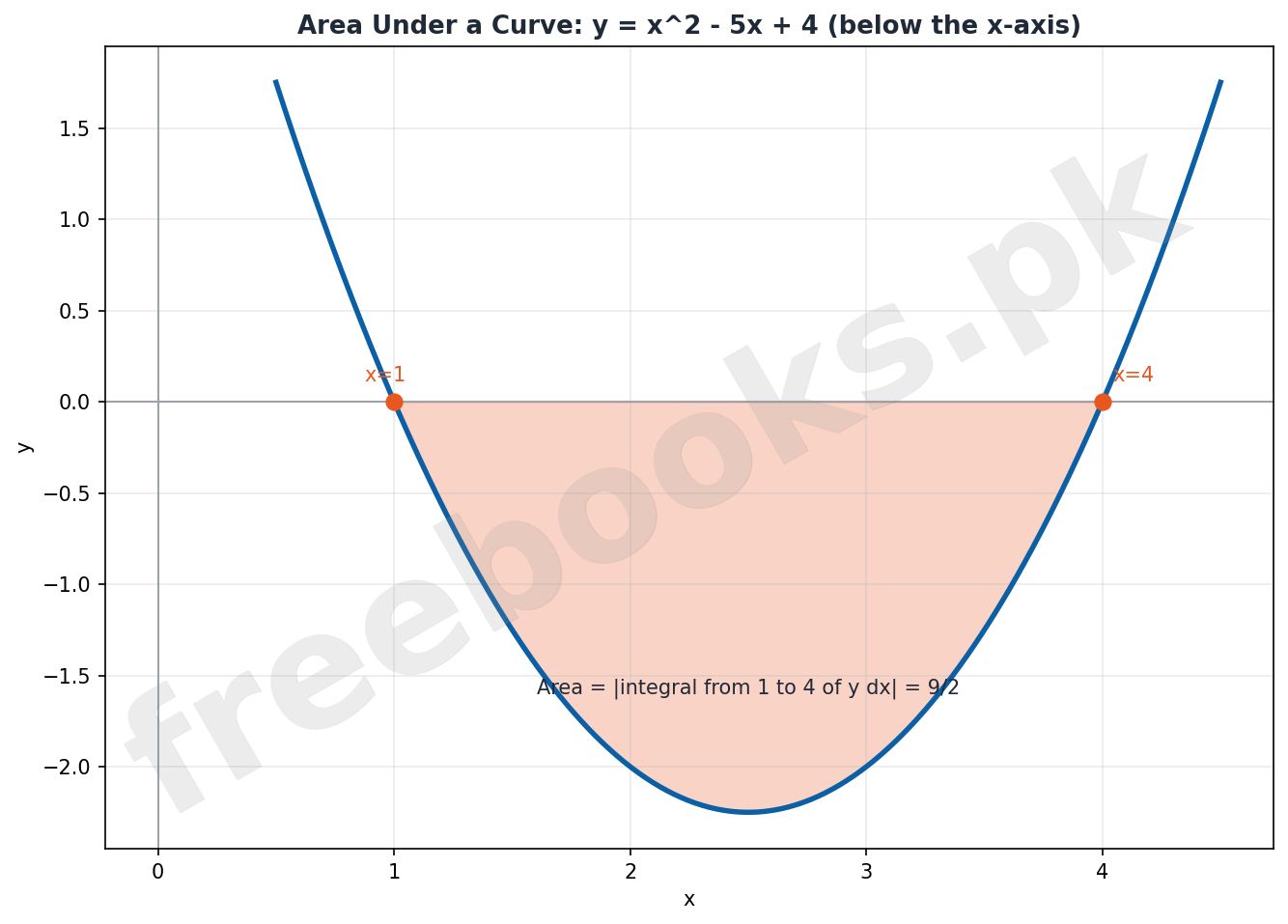
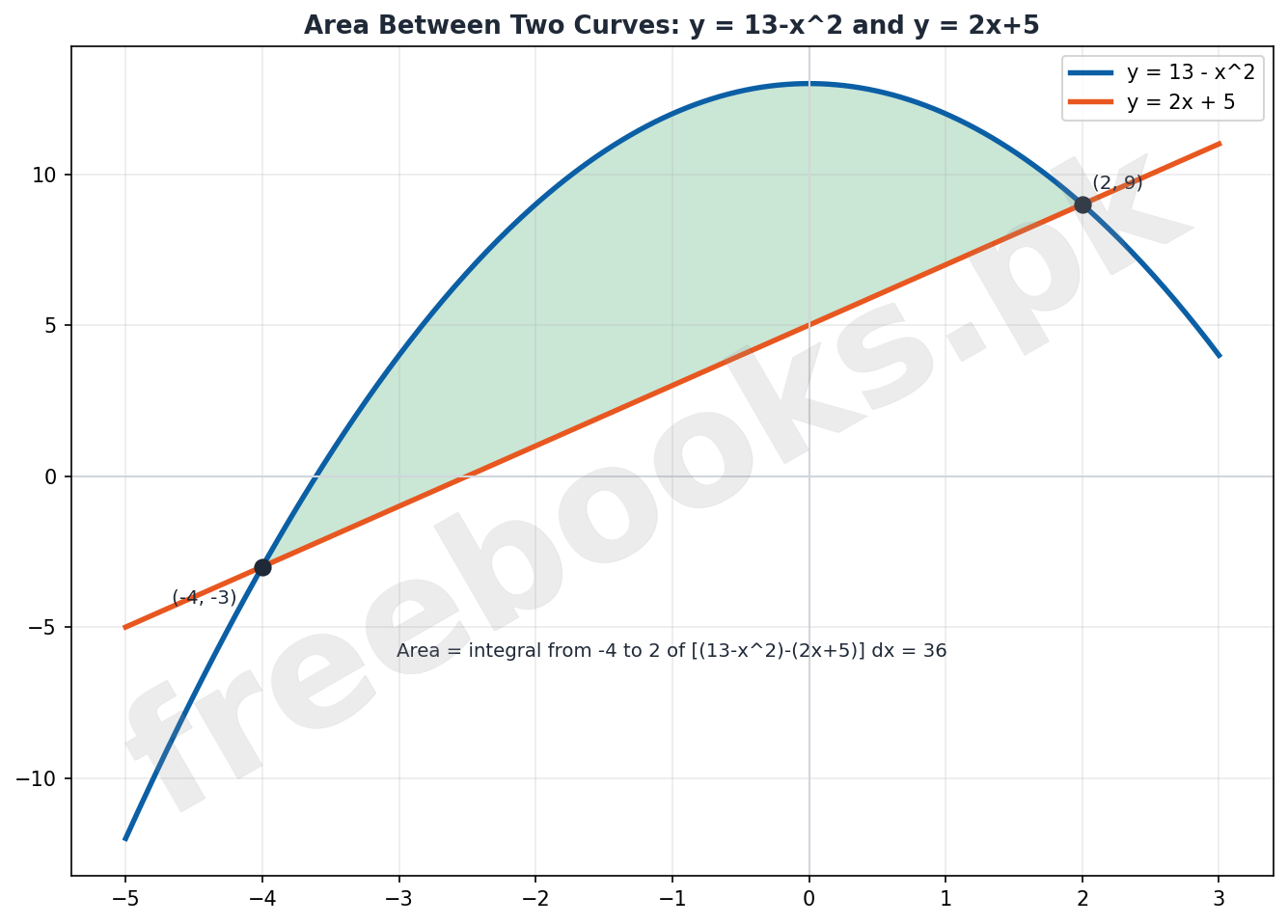
If f(x)>=0 on [a,b], the area under y=f(x) from a to b is simply integral from a to b of f(x)dx; if f(x)<=0, the area is the absolute value of that same integral, since the definite integral there is negative (a 'signed area'). Where f changes sign, the total area is the sum of the absolute values of the integral over each sub-region between consecutive roots. For two curves with f(x)>=g(x) on [a,b], the area between them is integral from a to b of [f(x)-g(x)]dx, found after locating their intersection points.
In economics, the same idea gives consumer surplus CS = integral from 0 to x_e of [D(x)-p_e]dx (the area between the demand curve and the equilibrium price line) and producer surplus PS = integral from 0 to x_e of [p_e-S(x)]dx (the area between the equilibrium price line and the supply curve), where (x_e,p_e) is the market equilibrium point where demand meets supply.
3.6 Applications: Volumes of Revolution and Moment of Inertia
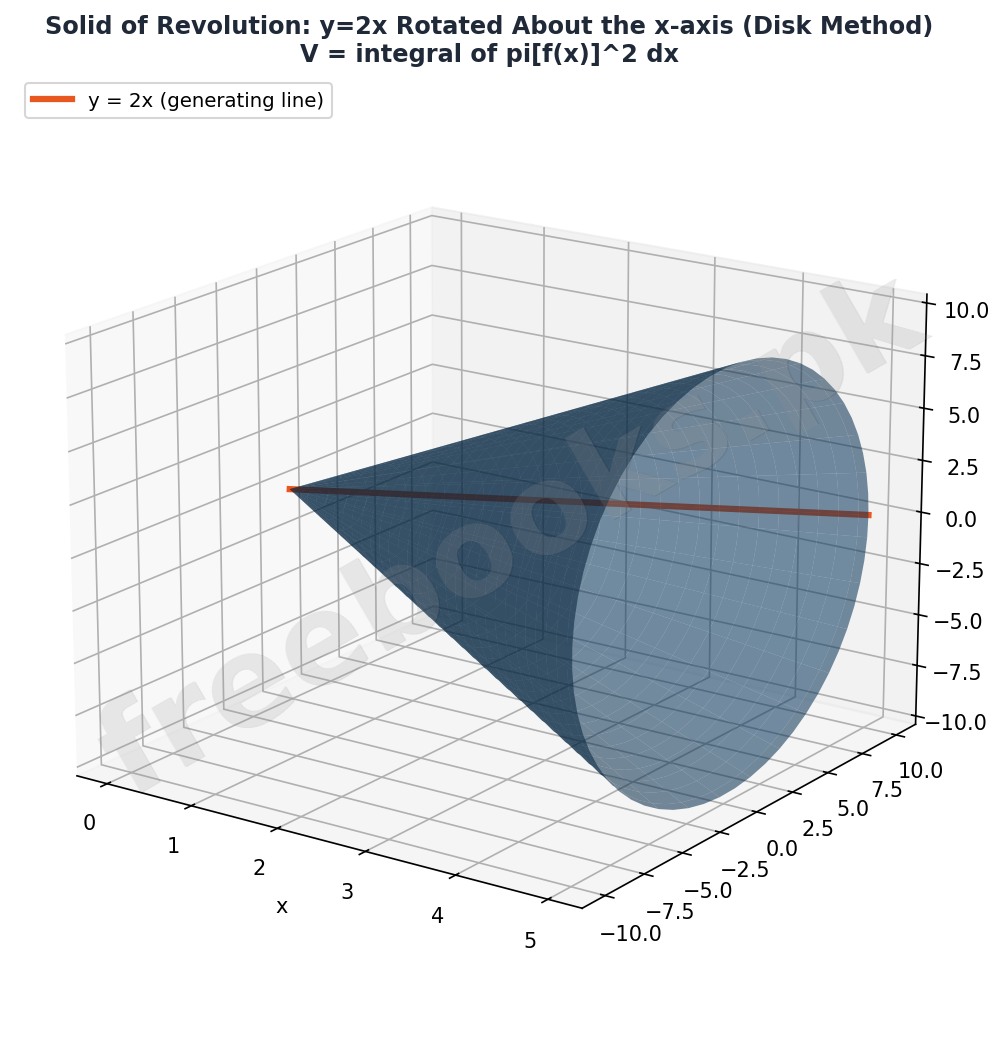
Revolving the region under y=f(x) (f>=0) on [a,b] about the x-axis generates a solid whose volume is V = integral from a to b of pi[f(x)]^2 dx (the disk method); revolving a region bounded by x=g(y) about the y-axis similarly gives V = integral from c to d of pi[g(y)]^2 dy. More generally, if a solid has cross-sectional area A(x) at each point x between a and b, its volume is V = integral from a to b of A(x)dx (the cross-sectional method), which reduces to the disk method when every cross-section is a circle.
The moment of inertia of a particle of mass m at distance r from an axis is mr^2; for a continuous body it becomes the integral I = integral r^2 dm taken over the whole body, found by expressing an element of mass dm in terms of its distance x from the axis (using the body's mass-per-unit-length or mass-per-unit-area) and integrating — this same accumulation idea also appears in problems involving population growth, drug dosage, and other real-world total-change quantities.
Important Definitions
What is an antiderivative of f(x)?
A function F(x) such that F'(x)=f(x) for all x in the interval considered.
What is the indefinite integral of f(x)?
integral f(x)dx = F(x)+c, the family of all antiderivatives of f, where F is any one antiderivative and c is an arbitrary constant.
What is the method of substitution used for?
To simplify an integral by replacing x with a new variable u=g(x) (and dx with du), reversing the chain rule — useful when the integrand contains a composite function.
When is trigonometric substitution useful?
When the integrand contains sqrt(a^2-x^2), sqrt(a^2+x^2), or sqrt(x^2-a^2); substituting x=a sin(theta), a tan(theta), or a sec(theta) respectively eliminates the radical.
What is the formula for integration by parts?
integral f(x)g(x)dx = f(x)(integral g(x)dx) – integral[(integral g(x)dx) f'(x)]dx.
What is a definite integral?
integral from a to b of f(x)dx = F(b)-F(a), where F'=f; it is a real number, the net signed area between the curve and the x-axis from a to b.
What does the First Fundamental Theorem of Calculus state?
If F(x)=integral from a to x of f(t)dt, then F'(x)=f(x) — differentiating an integral with respect to its upper limit recovers the original function.
What is consumer surplus?
The total benefit consumers gain from paying the equilibrium price rather than the higher price they were willing to pay; geometrically, the area between the demand curve and the equilibrium price line.
What is the disk method for volume of revolution?
V = integral from a to b of pi[f(x)]^2 dx, the volume of the solid formed by revolving the region under y=f(x) about the x-axis.
What is the moment of inertia of a continuous body about an axis?
I = integral r^2 dm, taken over the whole body, where r is the distance from each mass element dm to the axis.
Key Facts and Relations
| Topic | Key Fact / Relation |
|---|---|
| Basic integration rules | integral kf(x)dx=k integral f(x)dx; integral x^n dx = x^(n+1)/(n+1)+c (n<>-1); integral f'(x)/f(x) dx = ln|f(x)|+c |
| Standard integrals | integral e^x dx=e^x+c; integral a^x dx=a^x/ln a+c; integral sec^2 x dx=tan x+c; integral dx/sqrt(1-x^2)=sin^-1 x+c |
| Substitution rule | u=g(x), du=g'(x)dx => integral f(g(x))g'(x)dx = integral f(u)du = F(u)+c |
| Trigonometric substitution cases | sqrt(a^2-x^2): x=a sin(theta); sqrt(a^2+x^2): x=a tan(theta); sqrt(x^2-a^2): x=a sec(theta) |
| Integration by parts | integral f g dx = f(integral g dx) – integral[(integral g dx) f'] dx |
| Definite integral / FTC | integral from a to b of f(x)dx = F(b)-F(a); d/dx[integral from a to x of f(t)dt] = f(x) |
| Key properties of definite integrals | integral from a to b = -integral from b to a; integral from a to b of f(x)dx = integral from a to b of f(a+b-x)dx; even f: integral from -a to a = 2 integral from 0 to a; odd f: integral from -a to a = 0 |
| Area formulas | Under curve: integral from a to b of f(x)dx (or its absolute value if f<=0); Between curves: integral from a to b of [f(x)-g(x)]dx, f>=g |
| Consumer / Producer surplus | CS = integral from 0 to x_e of [D(x)-p_e]dx; PS = integral from 0 to x_e of [p_e-S(x)]dx |
| Volume of revolution (disk method) | V = integral from a to b of pi[f(x)]^2 dx (about x-axis); V = integral from c to d of pi[g(y)]^2 dy (about y-axis) |
Diagrams
Area Under a Curve (Signed Area): The graph of y=x^2-5x+4, shaded between x=1 and x=4 where the curve lies below the x-axis, illustrating that the area equals the absolute value of the definite integral there
Area Between Two Curves: The graphs of y=13-x^2 and y=2x+5 with the shaded region between their intersection points at x=-4 and x=2, illustrating area = integral of (upper – lower) dx
Solid of Revolution (Disk Method): The line y=2x revolved about the x-axis from x=0 to x=5, generating a cone whose volume is found via V = integral of pi[f(x)]^2 dx
Solved Examples
Example 1: Basic Integration Using the Power Rule
Problem: Evaluate integral of (8x^7 – 6x^5 + 4x^3 – 2x – 3) dx.
- Split the integral term by term using the sum/difference rule: integral 8x^7 dx – integral 6x^5 dx + integral 4x^3 dx – integral 2x dx – integral 3 dx.
- Pull out constants using the constant multiple rule: 8 integral x^7 dx – 6 integral x^5 dx + 4 integral x^3 dx – 2 integral x dx – 3 integral 1 dx.
- Apply the power rule to each term: 8(x^8/8) – 6(x^6/6) + 4(x^4/4) – 2(x^2/2) – 3x + c.
- Simplify each coefficient: x^8 – x^6 + x^4 – x^2 – 3x + c.
- Final answer: integral (8x^7-6x^5+4x^3-2x-3)dx = x^8 – x^6 + x^4 – x^2 – 3x + c.
Example 2: Integration by Substitution
Problem: Evaluate integral of (5x^5+5)^3 x^4 dx.
- Notice the composite structure: let u = 5x^5+5, so du = 25x^4 dx.
- Rewrite the integral to introduce the factor 25: integral (5x^5+5)^3 x^4 dx = (1/25) integral (5x^5+5)^3 (25x^4) dx.
- Substitute u and du: (1/25) integral u^3 du.
- Integrate using the power rule: (1/25)(u^4/4) + c = u^4/100 + c.
- Substitute back u=5x^5+5: final answer = (1/100)(5x^5+5)^4 + c.
Example 3: Integration by Parts
Problem: Evaluate integral of x e^(ax) dx.
- Apply integration by parts with 'first function' x (differentiate) and 'second function' e^(ax) (integrate): integral x e^(ax) dx = x(e^(ax)/a) – integral (e^(ax)/a)(1)dx.
- Simplify the remaining integral: = x e^(ax)/a – (1/a) integral e^(ax) dx.
- Integrate e^(ax): (1/a) integral e^(ax)dx = (1/a)(e^(ax)/a) = e^(ax)/a^2.
- Combine terms: x e^(ax)/a – e^(ax)/a^2 + c = e^(ax)(x/a – 1/a^2) + c.
- Final answer: integral x e^(ax) dx = e^(ax)[(ax-1)/a^2] + c.
Example 4: Integration Using Partial Fractions (Non-Repeated Linear Factors)
Problem: Evaluate integral of (3x-2)/[x(x-1)(x-2)] dx.
- Write the partial fraction decomposition: (3x-2)/[x(x-1)(x-2)] = A/x + B/(x-1) + C/(x-2).
- Clear denominators: 3x-2 = A(x-1)(x-2) + Bx(x-2) + Cx(x-1).
- Substitute x=0: -2 = A(-1)(-2) = 2A, so A=-1. Substitute x=1: 1 = B(1)(-1) = -B, so B=-1. Substitute x=2: 4 = C(2)(1) = 2C, so C=2.
- Rewrite and integrate each simple term: integral[-1/x – 1/(x-1) + 2/(x-2)]dx = -ln|x| – ln|x-1| + 2ln|x-2| + c.
- Final answer: integral (3x-2)/[x(x-1)(x-2)] dx = -ln|x| – ln|x-1| + 2ln|x-2| + c.
Example 5: Evaluating a Definite Integral
Problem: Evaluate integral from 0 to sqrt(7) of x/sqrt(x^2+9) dx.
- Recognize the substitution: let f(x)=x^2+9, so f'(x)=2x appears (up to a constant) in the numerator.
- Rewrite with the needed factor of 2: (1/2) integral from 0 to sqrt(7) of (x^2+9)^(-1/2) (2x) dx.
- Integrate using the power rule (or recognizing the antiderivative sqrt(x^2+9)): this equals [sqrt(x^2+9)] evaluated from 0 to sqrt(7).
- Substitute the limits: sqrt(7+9) – sqrt(0+9) = sqrt(16) – sqrt(9) = 4 – 3.
- Final answer: integral from 0 to sqrt(7) of x/sqrt(x^2+9) dx = 1.
Example 6: Area Bounded by a Curve and the x-axis
Problem: Find the area bounded by the parabola y = x^2 – 5x + 4 and the x-axis.
- Find the x-intercepts: x^2-5x+4=0 factors as (x-1)(x-4)=0, giving x=1 and x=4.
- Since the parabola opens upward and its roots are 1 and 4, the curve lies below the x-axis between x=1 and x=4.
- Because y<=0 on [1,4], the area is the absolute value: Area = integral from 1 to 4 of -(x^2-5x+4)dx = integral from 1 to 4 of (-x^2+5x-4)dx.
- Integrate: [-x^3/3 + 5x^2/2 – 4x] evaluated from 1 to 4.
- Evaluate: at x=4 this is -64/3+40-16=8/3; at x=1 this is -1/3+5/2-4=-11/6. Subtracting: 8/3-(-11/6)=27/6=9/2. Final answer: Area = 9/2 square units.
Example 7: Area Between Two Curves
Problem: Find the area bounded by the curves y = 13 – x^2 and y = 2x + 5.
- Find the intersection points by setting the curves equal: 13-x^2 = 2x+5, which rearranges to x^2+2x-8=0, i.e. (x-2)(x+4)=0, giving x=-4 and x=2.
- Determine which curve is on top by testing x=0: y=13-0=13 for the parabola, y=2(0)+5=5 for the line — so the parabola is above the line on [-4,2].
- Set up the area integral: Area = integral from -4 to 2 of [(13-x^2)-(2x+5)]dx = integral from -4 to 2 of (8-x^2-2x)dx.
- Integrate: [8x – x^3/3 – x^2] evaluated from -4 to 2.
- Evaluate: at x=2 this is 16-8/3-4=28/3; at x=-4 this is -32+64/3-16=-80/3. Subtracting: 28/3-(-80/3)=108/3=36. Final answer: Area = 36 square units.
Example 8: Volume of a Solid of Revolution
Problem: A cone is formed by rotating the line y=2x about the x-axis from x=0 to x=5 cm. Find the volume of the cone.
- Apply the disk method formula: V = integral from a to b of pi[f(x)]^2 dx, with f(x)=2x, a=0, b=5.
- Substitute: V = pi integral from 0 to 5 of (2x)^2 dx = pi integral from 0 to 5 of 4x^2 dx = 4pi integral from 0 to 5 of x^2 dx.
- Integrate: 4pi[x^3/3] evaluated from 0 to 5.
- Evaluate: 4pi(125/3 – 0) = 500pi/3.
- Final answer: V = 500pi/3 is approximately 523.6 cubic centimetres.
Short Questions & Answers
What does the power rule for integration state?
integral x^n dx = x^(n+1)/(n+1) + c, for n not equal to -1.
What is integral 1/x dx?
ln|x| + c.
What idea does the substitution method reverse?
The chain rule for differentiation.
What idea does integration by parts reverse?
The product rule for differentiation.
What is the value of integral from a to a of f(x)dx?
0, since the interval has zero width.
If f is an odd function, what is integral from -a to a of f(x)dx?
0, because the positive and negative contributions exactly cancel.
What does the area between two curves f(x)>=g(x) on [a,b] equal?
integral from a to b of [f(x)-g(x)]dx.
Long Questions & Answers
Explain the four cases of partial fraction decomposition and how the unknown constants are found in each case.
What is Case I, non-repeated linear factors, and how are constants found?
Each linear factor (x-a) gets a term A/(x-a); after clearing denominators, substituting x=a directly isolates A (since every other term vanishes at x=a).
What is Case II, repeated linear factors?
A factor (x-a)^n contributes n terms: A1/(x-a) + A2/(x-a)^2 + … + An/(x-a)^n; the highest-power constant can be found by substitution, while the rest typically require comparing coefficients.
What is Case III, non-repeated irreducible quadratic factors?
An irreducible quadratic factor (x^2+px+q) contributes a term (Bx+C)/(x^2+px+q); after clearing denominators, comparing coefficients of matching powers of x (and using any linear-factor substitutions first) solves for B and C.
What is Case IV, repeated irreducible quadratic factors, and why is it hardest?
A repeated quadratic factor (x^2+px+q)^n contributes multiple terms with rising powers of the quadratic in the denominator; solving typically requires a mix of substitution, coefficient comparison, and further trigonometric substitution (x=a tan(theta)) to integrate the highest-power term.
Explain how definite integrals are used to find the area under a curve, the area between two curves, and consumer/producer surplus.
How is the area under a single curve found when f(x)>=0?
Directly as integral from a to b of f(x)dx; if f(x)<=0 instead, the definite integral is negative, so the actual area is its absolute value.
How is the area between two curves found?
By identifying which curve is on top on the interval of interest (often by testing a point), then integrating (upper function – lower function) over that interval, after first finding the intersection points to determine the limits.
How is consumer surplus defined and computed?
As the benefit to consumers from paying the equilibrium price rather than a higher price; geometrically the area between the demand curve and the equilibrium price line, computed as CS = integral from 0 to x_e of [D(x)-p_e]dx.
How is producer surplus defined and computed?
As the benefit to producers from receiving the equilibrium price rather than a lower price; geometrically the area between the equilibrium price line and the supply curve, computed as PS = integral from 0 to x_e of [p_e-S(x)]dx.
Multiple Choice Questions (MCQs)
integral x^n dx equals (for n not equal to -1): (A) nx^(n-1)+c (B) x^(n+1)/(n+1)+c (C) x^n/n+c (D) x^(n-1)+c
Correct answer: (B) x^(n+1)/(n+1)+c. The power rule for integration is integral x^n dx = x^(n+1)/(n+1)+c, valid whenever n is not -1.
The method of substitution reverses which differentiation rule? (A) Product rule (B) Quotient rule (C) Chain rule (D) Power rule
Correct answer: (C) Chain rule. Substitution undoes the chain rule, replacing a composite integrand with a simpler one in terms of u=g(x).
Integration by parts reverses which differentiation rule? (A) Chain rule (B) Product rule (C) Quotient rule (D) Power rule
Correct answer: (B) Product rule. Integration by parts is derived directly from the product rule for derivatives.
For sqrt(a^2-x^2) in an integrand, the standard trigonometric substitution is: (A) x=a tan(theta) (B) x=a sec(theta) (C) x=a sin(theta) (D) x=a cos(theta)
Correct answer: (C) x=a sin(theta). x=a sin(theta) makes a^2-x^2 = a^2 cos^2(theta), eliminating the radical using the Pythagorean identity.
A rational function P(x)/Q(x) can be split using partial fractions when: (A) P(x) is always zero (B) Q(x) factors into linear and/or irreducible quadratic factors (C) P(x) has a higher degree than Q(x) always (D) Q(x) is never zero
Correct answer: (B) Q(x) factors into linear and/or irreducible quadratic factors. Partial fractions requires Q(x) to factor into linear and/or irreducible quadratic pieces, over which the original fraction is decomposed.
The Second Fundamental Theorem of Calculus states that integral from a to b of f(x)dx equals: (A) F(a)-F(b) (B) F(b)-F(a) (C) F(a)+F(b) (D) f(b)-f(a)
Correct answer: (B) F(b)-F(a). Where F is any antiderivative of f, the definite integral equals F(b)-F(a).
If f is an even function, integral from -a to a of f(x)dx equals: (A) 0 (B) 2 integral from 0 to a of f(x)dx (C) integral from 0 to a of f(x)dx (D) -2 integral from 0 to a of f(x)dx
Correct answer: (B) 2 integral from 0 to a of f(x)dx. Even symmetry lets the integral over [-a,a] be replaced by twice the integral over [0,a].
The area between two curves f(x)>=g(x) on [a,b] is given by: (A) integral from a to b of f(x)dx (B) integral from a to b of g(x)dx (C) integral from a to b of [f(x)-g(x)]dx (D) integral from a to b of [f(x)+g(x)]dx
Correct answer: (C) integral from a to b of [f(x)-g(x)]dx. The area between two curves is the integral of the difference (upper minus lower function) over the interval.
The disk method for a solid revolved about the x-axis gives volume: (A) integral pi f(x) dx (B) integral pi [f(x)]^2 dx (C) integral 2 pi f(x) dx (D) integral [f(x)]^2 dx
Correct answer: (B) integral pi [f(x)]^2 dx. Each disk has radius f(x) and area pi[f(x)]^2, so the volume is the integral of pi[f(x)]^2 over the interval.
The moment of inertia of a continuous body about an axis is given by: (A) integral r dm (B) integral m dr (C) integral r^2 dm (D) integral dm
Correct answer: (C) integral r^2 dm. The moment of inertia sums (distance)^2 x (mass element) over the whole body, i.e. I = integral r^2 dm.
Quick Revision Summary
- Antiderivative: F'(x)=f(x); indefinite integral integral f(x)dx = F(x)+c
- Basic rules: constant multiple, sum/difference, power rule x^(n+1)/(n+1)+c, and integral f'(x)/f(x)dx=ln|f(x)|+c
- Substitution: u=g(x), du=g'(x)dx, reduces integral f(g(x))g'(x)dx to integral f(u)du
- Trig substitution: sqrt(a^2-x^2) uses x=a sin(theta); sqrt(a^2+x^2) uses x=a tan(theta); sqrt(x^2-a^2) uses x=a sec(theta)
- Integration by parts: integral fg dx = f(integral g dx) – integral[(integral g dx)f']dx
- Partial fractions: four cases based on linear/quadratic, repeated/non-repeated factors of the denominator
- Definite integral: integral from a to b of f(x)dx=F(b)-F(a) (FTC); key properties include reversal, splitting, and even/odd symmetry
- Area under a curve: integral f(x)dx (or its absolute value if f<=0); area between curves: integral of (upper-lower)dx
- Consumer/producer surplus: areas between demand/supply curves and the equilibrium price line
- Volume of revolution (disk method): V=integral pi[f(x)]^2 dx; moment of inertia: I=integral r^2 dm
Exam Tips
- Always try the simplest technique first: check if the integral matches a basic formula before reaching for substitution or parts
- For substitution, look for a function and its derivative (up to a constant) both appearing in the integrand — that's the signal to set u equal to that function
- For integration by parts, choose the 'first function' (to differentiate) using the rough priority: inverse trig/log, then algebraic, then trig, then exponential — whichever simplifies fastest when differentiated
- For partial fractions, always check the degree of the numerator is less than the denominator first; if not, divide before decomposing
- When finding area between curves, always test a point between the intersection limits to confirm which curve is really on top before setting up the integral
- For solids of revolution, sketch the region and the axis of revolution first — confusing revolution about the x-axis with the y-axis is the most common setup mistake