Analytical geometry, also called coordinate geometry, combines algebra and geometry to study shapes and lines using a coordinate system. First developed by Rene Descartes in the 17th century, it lets us describe geometric figures with equations and calculate distances, midpoints, slopes and intersections algebraically instead of purely by drawing. This unit reviews the standard forms of a straight line's equation, then develops the special lines associated with a triangle — medians, altitudes, and right bisectors — and proves that each of these three families is always concurrent.
The unit continues with the condition for three lines to be concurrent, the family of lines through the intersection of two given lines, the angle between two intersecting lines, and the area of a triangular region from its vertices. It closes with homogeneous second-degree equations, which represent a pair of straight lines through the origin, the angle between such a pair, and real-life applications of analytical geometry in aviation and astronomy.
Learning Objectives
- Write the equation of a straight line in general, slope-intercept, point-slope, two-point, intercept, and normal form
- Transform a general linear equation ax+by+c=0 into each of the standard forms
- Find the equations of medians, altitudes, and right bisectors of a triangle, and prove each family is concurrent
- Apply the determinant condition for three lines to be concurrent
- Find the family of lines through the intersection of two given lines, and select a member satisfying an extra condition
- Find the angle between two intersecting lines using their slopes, including the parallel and perpendicular special cases
- Find the area of a triangular region given its vertices, and use it to test collinearity
- Recognize a homogeneous second-degree equation as a pair of lines through the origin, and find the angle between them
- Apply analytical geometry to real-life problems such as distances between locations and flight paths
Key Concepts
5.1 Equation of a Straight Line: Standard Forms
A straight line can be written in several equivalent forms depending on the information given: general form ax+by+c=0; slope-intercept form y=mx+c (slope m, y-intercept c); point-slope form y-y_1=m(x-x_1) (through a known point with known slope); two-point form through two known points; intercept form x/a+y/b=1 (x-intercept a, y-intercept b); and normal form x cos(theta)+y sin(theta)=p (p the perpendicular distance from the origin, theta the angle the perpendicular makes with the positive x-axis).
Any general equation ax+by+c=0 can be transformed into every standard form: dividing by b gives slope-intercept form with m=-a/b; the point (-c/a, 0) lying on the line combined with the slope gives point-slope form; two convenient points (-c/a,0) and (0,-c/c) give two-point and intercept form; and dividing by +-sqrt(a^2+b^2), choosing the sign so the right side is positive, gives normal form.
5.2 Medians, Altitudes, and Right Bisectors of a Triangle
A median joins a vertex of a triangle to the midpoint of the opposite side; an altitude is drawn from a vertex perpendicular to the opposite side; a right (perpendicular) bisector is perpendicular to a side and passes through that side's midpoint. Each is found using the midpoint formula together with either the two-point form (medians) or the point-slope form with the negative-reciprocal slope rule m_1m_2=-1 (altitudes and right bisectors).
Three key theorems establish that these three special families of lines are always concurrent: the medians of any triangle meet at a single point (the centroid), the altitudes meet at a single point (the orthocenter), and the right bisectors meet at a single point (the circumcenter) — each proved using the determinant condition for concurrency and a row-reduction argument that forces the determinant to zero.
5.3 Concurrency and Families of Lines
Three non-parallel lines a_1x+b_1y+c_1=0, a_2x+b_2y+c_2=0, a_3x+b_3y+c_3=0 are concurrent (pass through one common point) if and only if the 3×3 determinant of their coefficients equals zero. If concurrent, the common point can be found as the intersection of any two of the three lines.
For a non-zero real k, the equation a_1x+b_1y+c_1+k(a_2x+b_2y+c_2)=0 represents a family of lines all passing through the intersection point of lines l_1 and l_2, without needing to compute that intersection point directly. Choosing k to satisfy an extra condition (parallel to a given line, perpendicular to a given line, etc.) picks out one specific member of the family.
5.4 Angle Between Two Lines and Area of a Triangle
If m_1 and m_2 are the slopes of two non-vertical, non-perpendicular lines, the angle theta measured from the first line to the second satisfies tan(theta) = (m_2-m_1)/(1+m_1m_2). Two important special cases follow directly: the lines are parallel iff m_1=m_2 (theta=0), and perpendicular iff 1+m_1m_2=0 (theta=90 degrees, undefined tangent).
The area of a triangular region with vertices (x_1,y_1), (x_2,y_2), (x_3,y_3) is Delta = (1/2)|x_1(y_2-y_3)+x_2(y_3-y_1)+x_3(y_1-y_2)|, equivalently the absolute value of half a 3×3 determinant with a column of 1s; if the three points are collinear, this determinant (and hence the area) equals zero, giving a quick collinearity test.
5.5 Homogeneous Second-Degree Equations and Applications
Multiplying two linear equations a_1x+b_1y+c_1=0 and a_2x+b_2y+c_2=0 gives a joint second-degree equation representing both lines together. A homogeneous second-degree equation ax^2+2hxy+by^2=0 (with a, h, b not all zero) always represents a pair of straight lines through the origin: real and distinct if h^2>ab, real and coincident if h^2=ab, and imaginary (but still meeting at the real point (0,0)) if h^2<ab.
The angle between the pair of lines represented by ax^2+2hxy+by^2=0 is given by tan(theta) = 2sqrt(h^2-ab)/(a+b); the lines are coincident when h^2=ab, and perpendicular exactly when a+b=0 (the coefficients of x^2 and y^2 sum to zero). Analytical geometry techniques like these have direct real-life applications — computing distances between objects (e.g. planets, using coordinates in astronomical units) and finding the slope and length of a flight path between two locations.
Important Definitions
What is the general form of a straight line's equation?
ax+by+c=0, where a, b, c are real numbers and a and b are not both zero.
What is a median of a triangle?
A line segment joining a vertex of a triangle to the midpoint of the opposite side.
What is an altitude of a triangle?
A line drawn from a vertex of a triangle perpendicular to the opposite side.
What is a right (perpendicular) bisector of a triangle's side?
A line perpendicular to that side which passes through its midpoint.
What does it mean for three lines to be concurrent?
All three lines pass through one single common point.
What is the condition for three lines a_ix+b_iy+c_i=0 (i=1,2,3) to be concurrent?
The determinant of their coefficients, |a_i b_i c_i| (3×3), must equal zero.
What is a family of lines through the intersection of two lines?
The set of lines a_1x+b_1y+c_1+k(a_2x+b_2y+c_2)=0 for varying real k, all passing through the common intersection point of the two original lines.
What is the formula for the angle from a line with slope m_1 to a line with slope m_2?
tan(theta) = (m_2-m_1)/(1+m_1m_2).
What is a homogeneous equation of degree n?
An equation f(x,y)=0 such that f(kx,ky) = k^n f(x,y) for any real number k.
What does a homogeneous second-degree equation ax^2+2hxy+by^2=0 represent geometrically?
A pair of straight lines passing through the origin.
Key Facts and Relations
| Topic | Key Fact / Relation |
|---|---|
| Standard line forms | General: ax+by+c=0; Slope-intercept: y=mx+c; Point-slope: y-y_1=m(x-x_1); Intercept: x/a+y/b=1; Normal: x cos(theta)+y sin(theta)=p |
| Two-point form | (y-y_1)/(y_1-y_2) = (x-x_1)/(x_1-x_2) |
| Perpendicular slope condition | If m_1, m_2 are slopes of perpendicular lines, then m_1 m_2 = -1 |
| Concurrency of three lines | Lines a_ix+b_iy+c_i=0 (i=1,2,3) are concurrent iff the 3×3 determinant of coefficients [a_i, b_i, c_i] equals 0 |
| Family of lines through an intersection | a_1x+b_1y+c_1 + k(a_2x+b_2y+c_2) = 0, for real k, non-zero |
| Angle between two lines (slopes) | tan(theta) = (m_2-m_1)/(1+m_1m_2) |
| Parallel / perpendicular conditions | Parallel: m_1=m_2 (theta=0); Perpendicular: 1+m_1m_2=0 (theta=90°) |
| Area of a triangle from vertices | Delta = (1/2)|x_1(y_2-y_3)+x_2(y_3-y_1)+x_3(y_1-y_2)|; collinear iff Delta=0 |
| Homogeneous 2nd-degree equation (pair of lines through origin) | ax^2+2hxy+by^2=0; real & distinct if h^2>ab; coincident if h^2=ab; imaginary if h^2<ab |
| Angle between the pair of lines from ax^2+2hxy+by^2=0 | tan(theta) = 2 sqrt(h^2-ab) / (a+b); perpendicular iff a+b=0 |
Diagrams
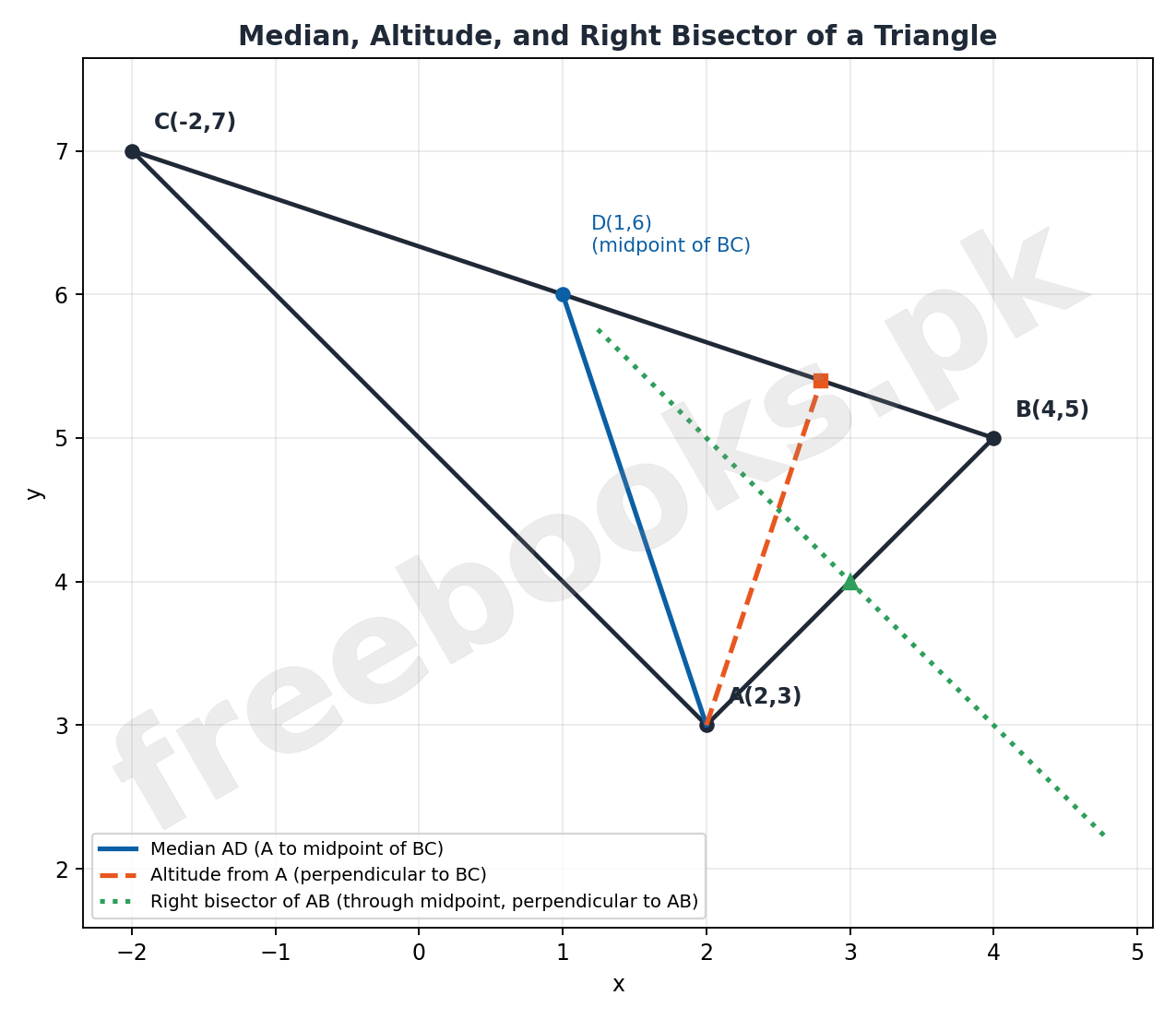
Median, Altitude, and Right Bisector of a Triangle: Triangle A(2,3), B(4,5), C(-2,7) with its median AD, altitude from A perpendicular to BC, and right bisector of side AB all drawn together to show how the three special lines differ
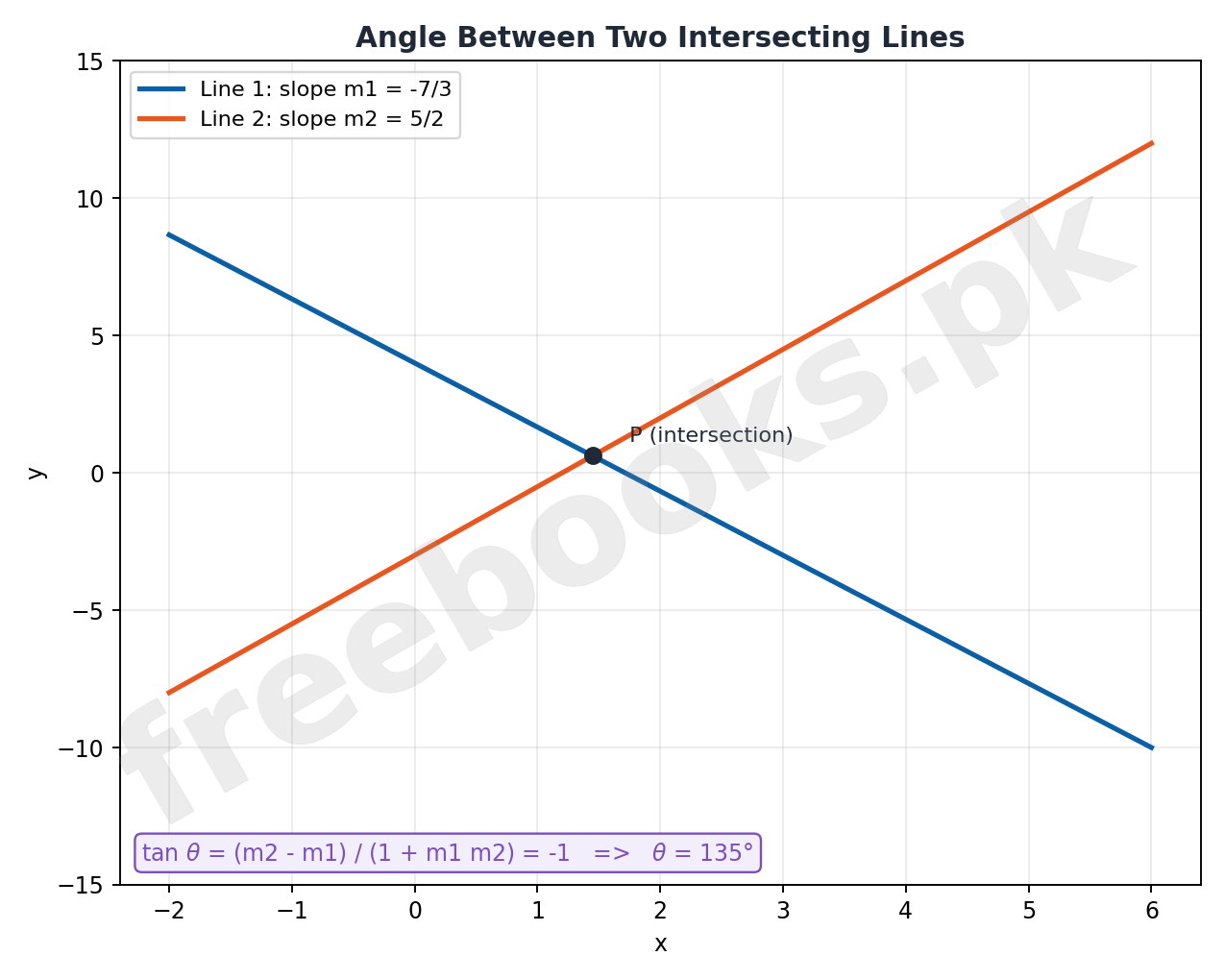
Angle Between Two Intersecting Lines: Two lines with slopes m1=-7/3 and m2=5/2 crossing at a point P, illustrating the angle theta from line 1 to line 2 given by tan(theta)=(m2-m1)/(1+m1m2), here giving theta=135°
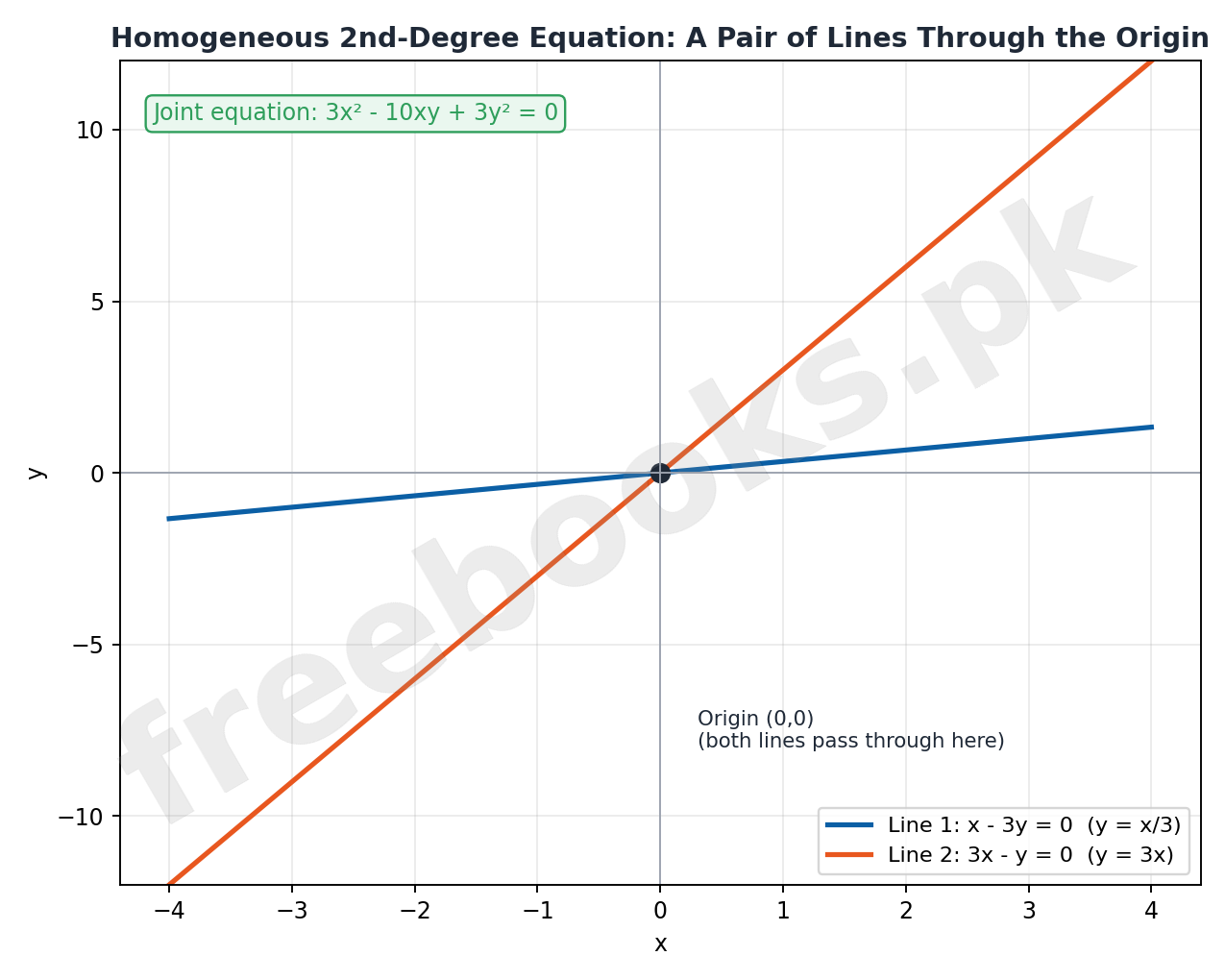
Homogeneous 2nd-Degree Equation: A Pair of Lines Through the Origin: The joint equation 3x²-10xy+3y²=0 factoring into two lines x-3y=0 and 3x-y=0, both passing through the origin, illustrating how a homogeneous second-degree equation represents a pair of straight lines
Solved Examples
Example 1: Equation of a Line in Two-Point Form
Problem: Find an equation of the straight line passing through the points (-3,-2) and (5,4).
- Apply the two-point form: (y-(-2))/(4-(-2)) = (x-(-3))/(5-(-3)).
- Simplify the fractions: (y+2)/6 = (x+3)/8.
- Cross-multiply: 8(y+2) = 6(x+3), giving 8y+16 = 6x+18.
- Rearrange into general form: 6x-8y+2=0, which simplifies by dividing by 2 to 3x-4y+1=0.
- Final answer: 3x – 4y + 1 = 0.
Example 2: Equations of the Medians of a Triangle
Problem: Triangle ABC has vertices A(2,3), B(4,5), C(-2,7). Find the equation of the median AD (from A to the midpoint of BC).
- Find D, the midpoint of BC: D = ((4+(-2))/2, (5+7)/2) = (1, 6).
- Use the two-point form through A(2,3) and D(1,6): (y-3)/(3-6) = (x-2)/(2-1).
- Simplify: (y-3)/(-3) = (x-2)/1, so y-3 = -3(x-2).
- Expand: y-3 = -3x+6.
- Final answer: 3x + y – 9 = 0, the equation of median AD.
Example 3: Checking Concurrency of Three Lines
Problem: Check whether the lines 3x-2y-2=0, x+y-4=0, 2x-y-2=0 are concurrent, and if so find the point of concurrency.
- Set up the 3×3 determinant of coefficients: |3 -2 -2; 1 1 -4; 2 -1 -2|.
- Expand along the first row: 3(1(-2)-(-4)(-1)) – (-2)(1(-2)-(-4)(2)) + (-2)(1(-1)-1(2)) = 3(-6)+2(6)-2(-3).
- Compute: 3(-6) = -18, 2(6) = 12, -2(-3) = 6, so the determinant is -18+12+6 = 0.
- Since the determinant is zero, the three lines are concurrent. Find the point using any two lines: from x+y-4=0 and 2x-y-2=0, adding gives 3x-6=0, so x=2, then y=4-2=2.
- Final answer: the lines are concurrent at the point (2, 2).
Example 4: Family of Lines Through an Intersection
Problem: Find the family of lines through the intersection of 2x-3y-14=0 and 2x+y-10=0, then find the member parallel to a line with slope -1/2.
- Write the family: 2x-3y-14 + k(2x+y-10) = 0, which simplifies to (2+2k)x + (k-3)y + (-14-10k) = 0.
- Find the slope of a general member: m = -(2+2k)/(k-3).
- Set this equal to the required slope -1/2 and solve for k: -(2+2k)/(k-3) = -1/2 gives 4+4k = k-3, so 3k=-7, k=-7/3.
- Substitute k=-7/3 back into the family equation and simplify: (2-14/3)x + (-7/3-3)y + (-14+70/3) = 0 becomes -8x-16y+28=0 after clearing fractions.
- Final answer: dividing by -4, the required line is 2x + 4y – 7 = 0.
Example 5: Angle Between Two Lines
Problem: Find the angle from the line with slope -7/3 to the line with slope 5/2.
- Identify m_1=-7/3 (first line) and m_2=5/2 (second line).
- Apply the angle formula: tan(theta) = (m_2-m_1)/(1+m_1m_2) = (5/2-(-7/3))/(1+(5/2)(-7/3)).
- Compute the numerator: 5/2+7/3 = 15/6+14/6 = 29/6. Compute the denominator: 1-35/6 = 6/6-35/6 = -29/6.
- Divide: tan(theta) = (29/6)/(-29/6) = -1.
- Final answer: tan(theta) = -1, so theta = 135°.
Example 6: Area of a Triangle and Collinearity Test
Problem: Find the area of the region bounded by the triangle with vertices A(1,2), B(3,6), C(5,10).
- Set up the determinant formula: Delta = (1/2)|1 2 1; 3 6 1; 5 10 1|.
- Simplify using row operations R2-R1 and R3-R1: this gives |1 2 1; 2 4 0; 4 8 0|.
- Expand along the third column (only the first row has a non-zero entry there): Delta = (1/2)[1 x (2×8-4×4)] = (1/2)[16-16].
- Compute: (1/2)(0) = 0.
- Final answer: the area is 0, so the three points A, B, C are collinear (they lie on the same straight line).
Example 7: Finding Lines from a Homogeneous Second-Degree Equation
Problem: Find the equations of the lines represented by 3x²-10xy+3y²=0, and the angle between them.
- Factor the homogeneous equation by splitting the middle term: 3x²-9xy-xy+3y²=0.
- Group and factor: 3x(x-3y) – y(x-3y) = 0, giving (x-3y)(3x-y)=0.
- So the two lines are x-3y=0 (i.e. y=x/3) and 3x-y=0 (i.e. y=3x), both passing through the origin.
- Find the angle using a=3, h=-5, b=3: tan(theta) = 2sqrt(h²-ab)/(a+b) = 2sqrt(25-9)/6 = 2sqrt(16)/6 = 8/6 = 4/3.
- Final answer: the lines are x-3y=0 and 3x-y=0, and the angle between them satisfies tan(theta)=4/3, so theta is approximately 53.13°.
Example 8: Real-Life Application: Distance Between Two Locations
Problem: An aircraft flies from A(100,200) km to B(500,800) km. Find the slope of the track and the straight-line distance.
- Find the slope using the two given points: m = (800-200)/(500-100) = 600/400 = 1.5.
- Set up the distance formula between A and B: Distance = sqrt((500-100)² + (800-200)²).
- Compute each term: (400)² = 160000 and (600)² = 360000, so the sum under the root is 520000.
- Take the square root: sqrt(520000) is approximately 721.11.
- Final answer: the slope of the flight track is 1.5, and the straight-line distance is approximately 721.11 km.
Short Questions & Answers
What is the slope-intercept form of a line's equation?
y = mx + c, where m is the slope and c is the y-intercept.
If two lines are parallel, what is true of their slopes?
Their slopes are equal: m_1 = m_2.
If two lines are perpendicular, what condition holds between their slopes?
The product of their slopes equals -1: m_1m_2 = -1.
What point always lies on the family of lines a_1x+b_1y+c_1+k(a_2x+b_2y+c_2)=0?
The point of intersection of the two original lines l_1 and l_2, for every value of k.
How do you test whether three given points are collinear?
Compute the area of the triangle they form using the determinant formula; if the area is zero, the points are collinear.
What condition on a and b makes ax²+2hxy+by²=0 represent perpendicular lines?
a + b = 0, i.e. the coefficients of x² and y² sum to zero.
When does ax²+2hxy+by²=0 represent coincident (identical) lines?
When h² = ab.
Long Questions & Answers
Explain how the medians, altitudes, and right bisectors of a triangle are found, and why each family is always concurrent.
How is the equation of a median found?
The midpoint of the side opposite a vertex is found using the midpoint formula, and then the two-point form of a line's equation is applied through that vertex and the midpoint.
How is the equation of an altitude found?
The slope of the side opposite the vertex is computed, its negative reciprocal gives the altitude's slope (since altitude and side are perpendicular, m_1m_2=-1), and the point-slope form is applied through the vertex with that slope.
How is the equation of a right bisector found?
The midpoint of a side is found, the negative reciprocal of that side's slope gives the right bisector's slope, and the point-slope form is applied through the midpoint with that slope.
Why is each family (medians, altitudes, right bisectors) always concurrent?
In each case, writing the three line equations symbolically in terms of the triangle's vertices and forming the 3×3 determinant of their coefficients, adding the second and third rows to the first row always produces a row of zeros — which forces the determinant to equal zero, proving concurrency regardless of the specific triangle.
Explain how a homogeneous second-degree equation represents a pair of lines through the origin, including how to find the lines and the angle between them.
What makes an equation 'homogeneous of degree 2'?
An equation f(x,y)=0 is homogeneous of degree n if f(kx,ky)=k^n f(x,y) for any real k; a general second-degree homogeneous equation has the form ax²+2hxy+by²=0.
Why does ax²+2hxy+by²=0 always represent two lines through the origin?
Multiplying by b and completing the square in y gives (by+hx)²-x²(h²-ab)=0, which factors as a difference of squares into two linear factors, each representing a line; since x=0,y=0 satisfies both factors, both lines pass through the origin.
How do you determine whether the two lines are real, coincident, or imaginary?
The discriminant-like quantity h²-ab determines this: the lines are real and distinct if h²>ab, real and coincident if h²=ab, and imaginary (though they still meet at the real point (0,0)) if h²<ab.
How is the angle between the pair of lines found?
Using the slopes derived from the two linear factors, the angle satisfies tan(theta) = 2sqrt(h²-ab)/(a+b); the lines are perpendicular exactly when a+b=0, and coincident when h²=ab (giving theta=0).
Multiple Choice Questions (MCQs)
The point-slope form of a line's equation is: (A) y=mx+c (B) y-y_1=m(x-x_1) (C) x/a+y/b=1 (D) ax+by+c=0
Correct answer: (B) y-y_1=m(x-x_1). The point-slope form uses a known point (x_1,y_1) and slope m: y-y_1=m(x-x_1).
A median of a triangle joins a vertex to: (A) The opposite vertex (B) The midpoint of the opposite side (C) The foot of the altitude (D) The circumcenter
Correct answer: (B) The midpoint of the opposite side. By definition, a median connects a vertex to the midpoint of the side opposite that vertex.
Three lines are concurrent if and only if: (A) Their slopes are all equal (B) The determinant of their coefficients is zero (C) They are all parallel (D) Their y-intercepts are equal
Correct answer: (B) The determinant of their coefficients is zero. Concurrency of three lines is characterized by their coefficient determinant being equal to zero.
The family of lines a_1x+b_1y+c_1+k(a_2x+b_2y+c_2)=0 always passes through: (A) The origin (B) The intersection point of the two given lines (C) The midpoint of the two lines (D) A fixed point on the x-axis
Correct answer: (B) The intersection point of the two given lines. Every member of this family passes through the common intersection point of the two original lines, regardless of k.
If m_1 and m_2 are slopes of two perpendicular lines, then: (A) m_1=m_2 (B) m_1+m_2=0 (C) m_1 m_2=-1 (D) m_1 m_2=1
Correct answer: (C) m_1 m_2=-1. Perpendicular lines satisfy the condition that the product of their slopes equals -1.
The area of a triangle with vertices (x1,y1), (x2,y2), (x3,y3) equals zero when: (A) The triangle is equilateral (B) The three points are collinear (C) The triangle is right-angled (D) The vertices are all positive
Correct answer: (B) The three points are collinear. A zero area indicates the three points do not form a proper triangle — they lie on a single straight line.
A homogeneous second-degree equation ax²+2hxy+by²=0 represents: (A) A parabola (B) A pair of straight lines through the origin (C) A circle (D) A single line not through the origin
Correct answer: (B) A pair of straight lines through the origin. This is the defining geometric interpretation of a homogeneous second-degree equation in two variables.
The lines represented by ax²+2hxy+by²=0 are real and coincident when: (A) h²>ab (B) h²=ab (C) h²<ab (D) a+b=0
Correct answer: (B) h²=ab. Coincidence of the pair of lines occurs exactly when h² equals ab.
The lines represented by ax²+2hxy+by²=0 are perpendicular when: (A) h=0 (B) a=b (C) a+b=0 (D) h²=ab
Correct answer: (C) a+b=0. Perpendicularity of the pair of lines requires the sum of the coefficients of x² and y² to be zero.
The angle theta from a line with slope m1 to a line with slope m2 satisfies: (A) tan(theta)=m1+m2 (B) tan(theta)=(m2-m1)/(1+m1m2) (C) tan(theta)=m1m2 (D) tan(theta)=(m1-m2)/(1-m1m2)
Correct answer: (B) tan(theta)=(m2-m1)/(1+m1m2). This is the standard formula for the angle measured from the first line to the second, derived from the tangent subtraction identity.
Quick Revision Summary
- Standard line forms: general ax+by+c=0; slope-intercept y=mx+c; point-slope; two-point; intercept x/a+y/b=1; normal x cos(theta)+y sin(theta)=p
- Median: vertex to midpoint of opposite side; Altitude: vertex perpendicular to opposite side; Right bisector: perpendicular through a side's midpoint
- Medians, altitudes, and right bisectors of any triangle are each always concurrent (centroid, orthocenter, circumcenter)
- Three lines are concurrent iff the 3×3 determinant of their coefficients equals zero
- Family of lines through an intersection: a_1x+b_1y+c_1+k(a_2x+b_2y+c_2)=0, passes through the common point for every k
- Angle between two lines: tan(theta)=(m_2-m_1)/(1+m_1m_2); parallel iff m_1=m_2; perpendicular iff m_1m_2=-1
- Area of a triangle from vertices: Delta=(1/2)|x_1(y_2-y_3)+x_2(y_3-y_1)+x_3(y_1-y_2)|; zero area means collinear points
- Homogeneous 2nd-degree equation ax^2+2hxy+by^2=0 represents a pair of lines through the origin
- Pair of lines: real & distinct if h^2>ab; coincident if h^2=ab; imaginary if h^2<ab; perpendicular iff a+b=0
- Angle between the pair of lines from a homogeneous equation: tan(theta)=2sqrt(h^2-ab)/(a+b)
Exam Tips
- When a problem gives two points, default to the two-point form rather than trying to compute slope and intercept separately — it is faster and less error-prone
- For altitude and right-bisector problems, always find the relevant side's slope first, then take its negative reciprocal — writing this step out explicitly avoids sign errors
- To check concurrency, compute the 3×3 determinant carefully by expanding along the row or column with the most convenient (smallest/zero) entries
- For family-of-lines problems, always simplify the family equation into ax+by+c=0 form (collecting x, y, and constant terms) before applying the parallel/perpendicular slope condition
- Remember the angle formula is direction-sensitive: tan(theta)=(m2-m1)/(1+m1m2) measures the angle FROM line 1 TO line 2, so keep track of which slope is m1 and which is m2
- For homogeneous second-degree equations, always try factoring by splitting the middle term first before reaching for the general h, a, b formulas — it's often faster and confirms the factorization is correct