Kinematics is the branch of mechanics that describes how objects move without asking what causes that motion. This unit studies rectilinear motion — motion of a particle along a straight line — through the key quantities displacement, velocity, and acceleration, distinguishing scalar quantities (distance, speed) that have magnitude only from vector quantities (displacement, velocity, acceleration) that also have direction. Displacement-time and velocity-time graphs give a visual language for motion: the slope of a displacement-time graph is velocity, the slope of a velocity-time graph is acceleration, and the area under a velocity-time graph is displacement.
Using differentiation and integration with respect to time, this unit derives the three equations of motion for constant acceleration — v=u+at, x=ut+(1/2)at^2, and 2ax=v^2-u^2 — which are the primary tools for solving motion problems. The unit closes by applying these ideas to vertical motion under gravity (free fall and upward projectiles, using a=g or a=-g), and to problems where acceleration itself varies with time, solved by direct integration.
Learning Objectives
- Distinguish between scalar quantities (distance, speed) and vector quantities (displacement, velocity, acceleration)
- Calculate average velocity, average speed, instantaneous velocity, and instantaneous speed
- Find velocity and acceleration from a displacement function using differentiation
- Interpret displacement-time graphs: identify rest, uniform forward motion, and uniform backward motion from slope
- Interpret velocity-time graphs: find acceleration from slope and displacement from area under the graph
- Derive and apply the three equations of motion for constant acceleration
- Solve free-fall and vertical projectile motion problems using the equations of motion with a=g or a=-g
- Find velocity and displacement by integrating a variable (time-dependent) acceleration function
Key Concepts
7.1 Scalars, Vectors, and Rectilinear Motion
Rectilinear motion is motion of a particle along a straight line. Scalar quantities (distance, speed) are described by magnitude alone; vector quantities (displacement, velocity, acceleration) require both magnitude and direction, though in rectilinear motion direction is simplified to a plus or minus sign rather than a full vector arrow, with one direction along the line chosen as positive and the opposite as negative.
Average velocity is total displacement divided by total time (v_avg=Delta x/Delta t), while average speed is total distance divided by total time — these can differ significantly, as when a body returns to its starting point (displacement zero, but distance and average speed nonzero). Instantaneous velocity is v(t)=dx/dt, the derivative of displacement with respect to time, and instantaneous speed is its absolute value |v(t)|.
7.2 Acceleration and Displacement-Time Graphs
Acceleration is the rate of change of velocity with respect to time: a(t)=dv/dt=d^2x/dt^2. When velocity is known as a function of displacement rather than time, the chain rule gives the useful alternate form a=v(dv/dx).
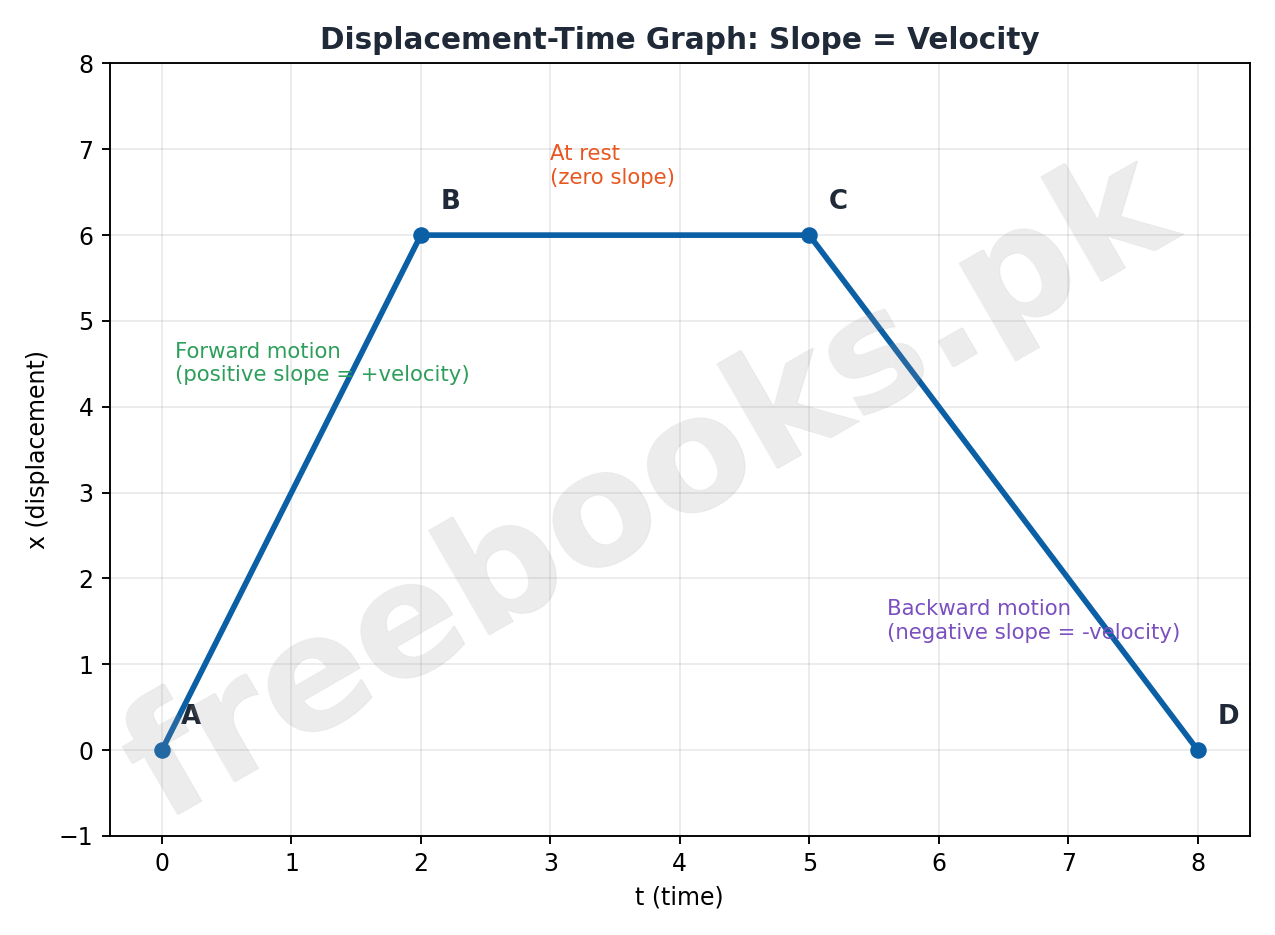
On a displacement-time graph (x on the vertical axis, t on the horizontal), the slope dx/dt gives velocity at each instant: a horizontal segment (zero slope) means the particle is at rest, a rising straight segment (constant positive slope) means uniform forward motion, and a falling straight segment (constant negative slope) means uniform backward motion.
7.3 Velocity-Time Graphs
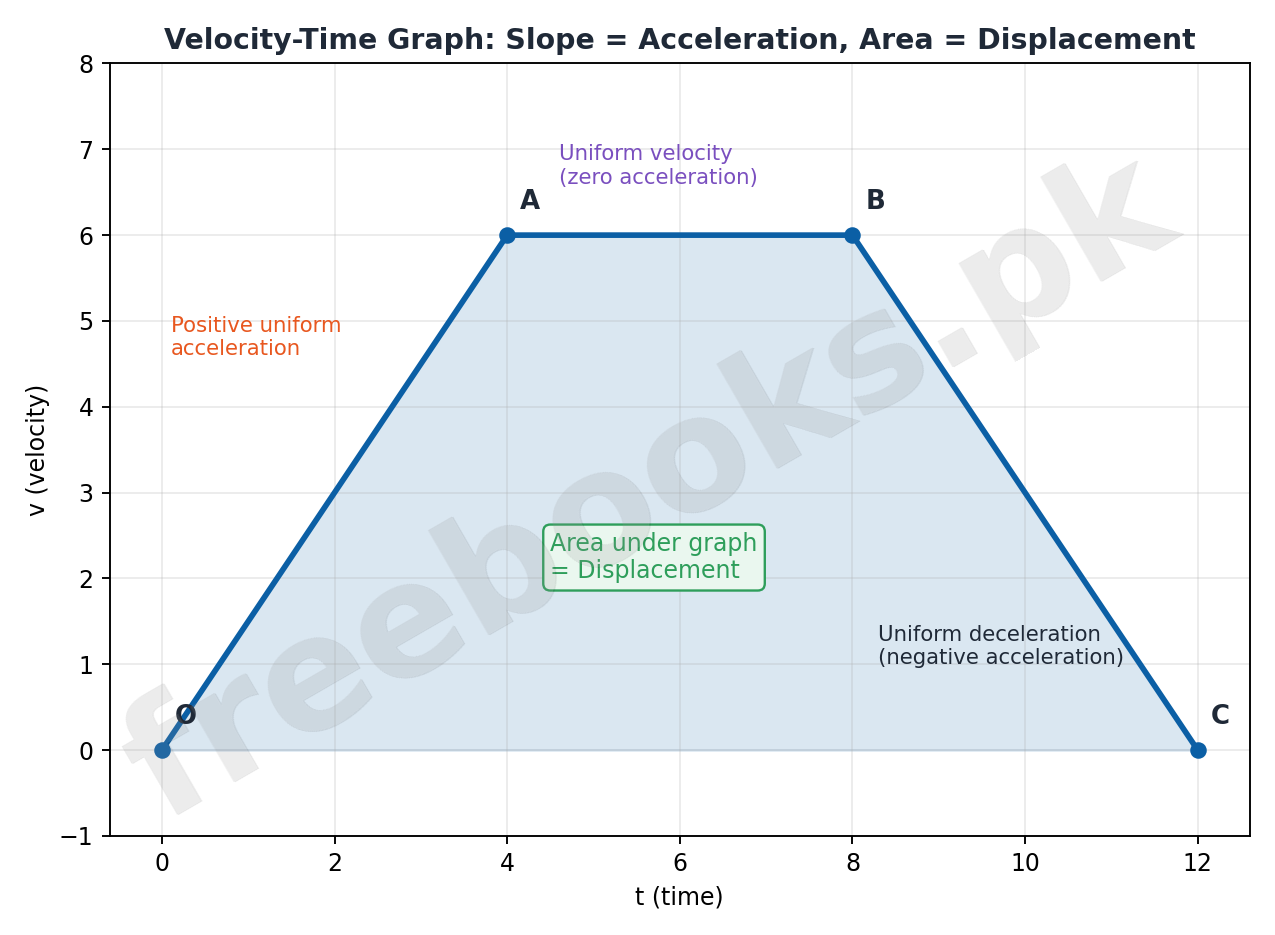
On a velocity-time graph (v on the vertical axis, t on the horizontal), the slope dv/dt gives acceleration at each instant: a horizontal segment means uniform (constant) velocity with zero acceleration, a rising straight segment means uniform positive acceleration, and a falling straight segment means uniform negative acceleration (retardation/deceleration). A curved (non-straight) velocity-time graph indicates variable acceleration.
The area under a velocity-time graph between t=t_1 and t=t_2, above the time axis, equals the displacement over that interval, since integral from t1 to t2 of v(t)dt = integral from t1 to t2 of (dx/dt)dt = x(t2)-x(t1). If the graph dips below the time axis, the area above the axis (A1) and the area below (A2) combine differently for displacement (A1-A2) and total distance (A1+A2), since distance always adds magnitudes regardless of direction.
7.4 Equations of Motion for Constant Acceleration
Starting from a constant acceleration a=dv/dt, integrating once with the initial condition v=u at t=0 gives v=u+at; integrating v=dx/dt with x=0 at t=0 gives x=ut+(1/2)at^2. Eliminating t between these two (by substituting t=(v-u)/a) gives the third equation, 2ax=v^2-u^2, useful whenever time is not given or not needed.
These three equations of motion — v=u+at, x=ut+(1/2)at^2, 2ax=v^2-u^2 — are the standard toolkit for any constant-acceleration problem: given any three of the five quantities (u, v, a, t, x), the equations solve for the remaining two.
7.5 Vertical Motion Under Gravity and Variable Acceleration
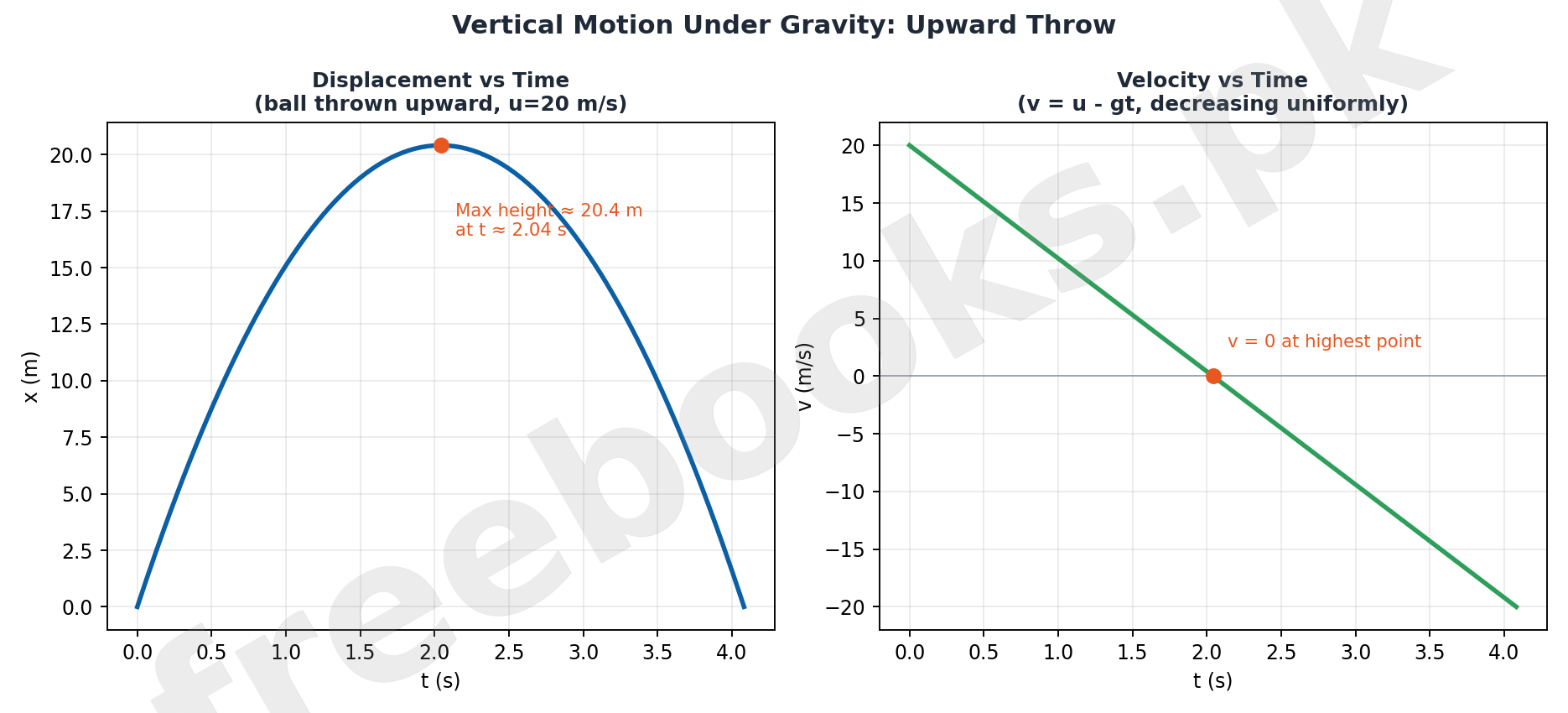
Free fall and vertical projectile motion are constant-acceleration motion with a replaced by g (approximately 9.8 m/s^2) for downward motion, or -g for upward motion, since gravity always decelerates an object thrown upward until its velocity becomes zero at the highest point, then accelerates it back downward. The same three equations of motion apply directly, simply substituting g or -g for a.
When acceleration is not constant but given as a function of time, a(t), the equations of motion no longer apply directly; instead, velocity and displacement are found by direct integration: v(t) = integral a(t)dt (using the initial velocity to find the constant of integration), then x(t) = integral v(t)dt (using the initial position to find the next constant).
Important Definitions
What is rectilinear motion?
The motion of a particle along a straight line.
What is the difference between a scalar and a vector quantity?
A scalar has magnitude only (e.g. distance, speed); a vector has both magnitude and direction (e.g. displacement, velocity, acceleration).
What is average velocity?
Total displacement divided by total time taken: v_avg = Delta x / Delta t.
What is instantaneous velocity?
The rate of change of displacement with respect to time at a specific instant: v(t) = dx/dt.
What is acceleration?
The rate of change of velocity with respect to time: a(t) = dv/dt = d²x/dt².
What does the slope of a displacement-time graph represent?
The velocity of the particle at that instant.
What does the slope of a velocity-time graph represent?
The acceleration of the particle at that instant.
What does the area under a velocity-time graph represent?
The displacement of the particle over that time interval.
What are the three equations of motion for constant acceleration?
v=u+at; x=ut+(1/2)at²; 2ax=v²-u², where u is initial velocity, v is final velocity, a is acceleration, t is time, and x is displacement.
What is free fall?
Motion of a particle under the influence of gravity alone (air resistance neglected), with acceleration g ≈ 9.8 m/s² directed downward.
Key Facts and Relations
| Topic | Key Fact / Relation |
|---|---|
| Average velocity & speed | v_avg = Total displacement / Total time; Average speed = Total distance / Total time |
| Instantaneous velocity & speed | v(t) = dx/dt; Speed = |v(t)| |
| Acceleration | a(t) = dv/dt = d²x/dt²; also a = v(dv/dx) when v is a function of x |
| Displacement-time graph | Slope = dx/dt = velocity |
| Velocity-time graph | Slope = dv/dt = acceleration; Area under graph (t1 to t2) = displacement = x(t2)-x(t1) |
| Distance vs displacement from a v-t graph | If A1 = area above time axis, A2 = area below: Displacement = A1-A2; Distance = A1+A2 |
| Equations of motion (constant acceleration) | v = u + at; x = ut + (1/2)at²; 2ax = v² – u² |
| Vertical motion under gravity | Use a=g (downward motion) or a=-g (upward motion), g ≈ 9.8 m/s², in the same equations of motion |
| Variable acceleration a(t) | v(t) = integral a(t)dt + C (find C from initial velocity); x(t) = integral v(t)dt + C1 (find C1 from initial position) |
| Area of a trapezium (for v-t graph displacement) | Area = (1/2)(a+b)h, where a, b are the parallel sides and h is the distance between them |
Diagrams
Displacement-Time Graph: Slope = Velocity: A displacement-time graph with four labeled points A, B, C, D showing forward motion (positive slope), rest (zero slope), and backward motion (negative slope) as three distinct straight-line segments
Velocity-Time Graph: Slope = Acceleration, Area = Displacement: A trapezoidal velocity-time graph showing uniform positive acceleration, uniform velocity (zero acceleration), and uniform deceleration, with the shaded area under the graph representing total displacement
Vertical Motion Under Gravity: Upward Throw: Side-by-side displacement-vs-time and velocity-vs-time graphs for a ball thrown upward at 20 m/s, showing the parabolic displacement curve reaching maximum height where velocity crosses zero
Solved Examples
Example 1: Average Speed and Velocity
Problem: A man walks 100 meters east in 2 minutes, then turns around and walks 60 meters west in 1 minute. Find his average speed and average velocity.
- Find total distance travelled: 100+60 = 160 meters (distance always adds, regardless of direction).
- Find total time: 2+1 = 3 minutes.
- Compute average speed: Total distance/Total time = 160/3 ≈ 53.3 meters/min.
- Taking east as positive and west as negative, find total displacement: 100+(-60) = 40 meters (eastward).
- Compute average velocity: Total displacement/Total time = 40/3 ≈ 13.33 meters/min, eastward.
Example 2: Velocity and Speed from a Displacement Function
Problem: Let x(t) = t³-6t² be the position of a particle (x in meters, t in seconds). Find the velocity and speed at any time t, and at t=1 second.
- Differentiate x(t) with respect to t to find velocity: v(t) = dx/dt = 3t²-12t.
- Write the speed as the absolute value of velocity: Speed = |v(t)| = |3t²-12t|.
- Substitute t=1 into the velocity formula: v(1) = 3(1)²-12(1) = 3-12 = -9 m/s.
- Substitute t=1 into the speed formula: Speed = |v(1)| = |-9| = 9 m/s.
- Final answer: at t=1 second, velocity is -9 m/s (moving in the negative direction) and speed is 9 m/s.
Example 3: Displacement from a Velocity-Time Graph (Trapezium Area)
Problem: A cyclist's velocity-time graph is a trapezium OABC where OC=12 minutes, AB=8 minutes (upper parallel side), and the vertical distance between OC and AB is 6 m/min. Find the total displacement over the 12 minutes.
- Recognize that displacement equals the area under the velocity-time graph, and the graph forms a trapezium with parallel sides a=OC=12 and b=AB=8, height h=6.
- Apply the trapezium area formula: Area = (1/2)(a+b)h.
- Substitute the values: Area = (1/2)(12+8)(6).
- Compute: (1/2)(20)(6) = 60.
- Final answer: the total displacement is 60 meters.
Example 4: Distance Using an Equation of Motion
Problem: A car accelerates from 10 m/s to 30 m/s in 4 seconds. Find the distance covered during this time.
- First find the acceleration using v=u+at: 30 = 10 + a(4).
- Solve for a: 4a = 20, so a = 5 m/s².
- Use the equation 2ax = v²-u² to find distance x, since time is no longer needed: 2(5)x = 30²-10².
- Compute the right side: 900-100 = 800, so 10x = 800.
- Final answer: x = 80 meters.
Example 5: Velocity and Position from a Time-Dependent Acceleration
Problem: A particle starts from rest at t=0 and has acceleration a(t)=t²+cos(t). Find its velocity and position at any time t.
- Integrate acceleration to find velocity: v(t) = integral (t²+cos t)dt = (1/3)t³+sin t+C.
- Apply the initial condition v=0 at t=0: 0 = 0+0+C, so C=0, giving v(t) = (1/3)t³+sin t.
- Integrate velocity to find position: x(t) = integral [(1/3)t³+sin t]dt = (1/12)t⁴-cos t+C1.
- Apply the initial condition x=0 at t=0: 0 = 0-1+C1, so C1=1.
- Final answer: v(t) = (1/3)t³+sin t, and x(t) = (1/12)t⁴-cos t+1.
Example 6: Free Fall from a Height
Problem: A stone is dropped from the top of a tower 45 m high. Find the time taken to reach the ground and the final velocity on impact.
- Identify the known values: u=0 (dropped, not thrown), x=45 m, a=g=9.8 m/s².
- Use x=ut+(1/2)gt² to find time: 45 = 0+(1/2)(9.8)t².
- Solve for t: t² = 90/9.8, so t = sqrt(90/9.8) ≈ 3.03 s.
- Use v=u+gt to find the final velocity: v = 0+9.8(3.03).
- Final answer: time to reach the ground is approximately 3.03 seconds, and the final velocity on impact is approximately 29.7 m/s.
Example 7: Maximum Height of a Vertical Throw
Problem: A ball is thrown vertically upward with a speed of 20 m/s. Find the maximum height attained and the time to reach it.
- Identify the known values at the highest point: u=20 m/s, v=0 m/s (velocity is zero at the top), a=g=-9.8 m/s² (deceleration while rising).
- Use v=u+gt to find the time to reach maximum height: 0 = 20+(-9.8)t.
- Solve for t: t = 20/9.8 ≈ 2.04 s.
- Use x=ut+(1/2)gt² to find maximum height: x = 20(2.04)+(1/2)(-9.8)(2.04)².
- Final answer: the time to reach maximum height is approximately 2.04 seconds, and the maximum height is approximately 20.4 meters.
Example 8: Constant Uniform Acceleration from Rest
Problem: A car starts from rest and accelerates uniformly at 3 m/s². Find the velocity of the car after 5 seconds.
- Identify the known values: u=0 (starts from rest), a=3 m/s², t=5 s.
- Apply the equation of motion v=u+at.
- Substitute the values: v = 0+3(5).
- Compute: v = 15.
- Final answer: the velocity of the car after 5 seconds is 15 m/s.
Short Questions & Answers
What is the difference between distance and displacement?
Distance is the total length of the path travelled (a scalar); displacement is the change in position from start to end, including direction (a vector).
What is the difference between speed and velocity?
Speed is the rate of covering distance regardless of direction (a scalar); velocity is the rate of change of displacement in a specified direction (a vector).
If a body goes and returns to its starting position, what are its displacement and distance?
Displacement is zero, but distance travelled is nonzero (equal to the total path length covered).
What does a horizontal segment on a displacement-time graph indicate?
The particle is at rest (zero velocity, since the slope is zero).
What does a horizontal segment on a velocity-time graph indicate?
The particle is moving with uniform (constant) velocity, since acceleration (the slope) is zero.
Write the equation of motion that does not involve time.
2ax = v² – u².
For an object thrown vertically upward, what is its velocity at the highest point?
Zero — the velocity decreases uniformly under gravity until it momentarily reaches zero at the top before falling back down.
Long Questions & Answers
Derive the three equations of motion for constant acceleration, explaining the role of integration and initial conditions at each step.
How is the first equation, v=u+at, derived?
Starting from acceleration a=dv/dt (constant), rewrite as dv=a dt and integrate both sides: v=at+c; applying the initial condition v=u at t=0 gives c=u, so v=u+at.
How is the second equation, x=ut+(1/2)at², derived?
Since v=dx/dt, substitute v=u+at to get dx/dt=u+at, or dx=(u+at)dt; integrating gives x=ut+(1/2)at²+c1, and applying the initial condition x=0 at t=0 gives c1=0, so x=ut+(1/2)at².
How is the third equation, 2ax=v²-u², derived?
From v=u+at, solve for t: t=(v-u)/a; substituting this into x=ut+(1/2)at² and simplifying algebraically eliminates t entirely, leaving the relation 2ax=v²-u².
Why are three equations needed instead of just one?
Each equation relates a different subset of the five motion quantities (u, v, a, t, x); having all three lets you solve any constant-acceleration problem regardless of which quantity is missing — particularly useful when time is not given, since 2ax=v²-u² skips it entirely.
Explain how displacement-time and velocity-time graphs are used to analyze motion, including what their slopes and areas represent.
What does the slope of a displacement-time graph tell you?
The slope dx/dt equals velocity at that instant; a positive slope means forward motion, a negative slope means backward motion, and a zero slope (horizontal segment) means the particle is at rest.
What does the slope of a velocity-time graph tell you?
The slope dv/dt equals acceleration at that instant; a positive slope means increasing velocity (accelerating), a negative slope means decreasing velocity (decelerating/retarding), and a zero slope means constant velocity.
What does the area under a velocity-time graph represent, and why?
The area between the graph and the time axis over an interval equals the displacement during that interval, because integral of v(t)dt = integral of (dx/dt)dt = x(t2)-x(t1) by the fundamental theorem of calculus — area under a rate-of-change graph gives total change.
How do you find total distance (rather than displacement) from a velocity-time graph that dips below the axis?
Split the area into the portion above the time axis (A1) and the portion below (A2); displacement is the signed difference A1-A2 (since velocity below the axis represents motion in the negative direction), while total distance is the sum A1+A2, since distance always accumulates regardless of direction.
Multiple Choice Questions (MCQs)
Which of the following is a scalar quantity? (A) Displacement (B) Velocity (C) Distance (D) Acceleration
Correct answer: (C) Distance. Distance is described by magnitude only, with no associated direction, making it a scalar quantity.
Instantaneous velocity is defined as: (A) Total displacement/Total time (B) dx/dt (C) d²x/dt² (D) |dx/dt|
Correct answer: (B) dx/dt. Instantaneous velocity is the derivative of displacement with respect to time, v(t)=dx/dt.
The slope of a displacement-time graph represents: (A) Acceleration (B) Velocity (C) Distance (D) Speed
Correct answer: (B) Velocity. Since slope = dx/dt, and velocity is defined as dx/dt, the slope of a displacement-time graph gives velocity.
The slope of a velocity-time graph represents: (A) Displacement (B) Distance (C) Acceleration (D) Speed
Correct answer: (C) Acceleration. Since slope = dv/dt, and acceleration is defined as dv/dt, the slope of a velocity-time graph gives acceleration.
The area under a velocity-time graph (above the time axis) represents: (A) Acceleration (B) Displacement (C) Speed (D) Time
Correct answer: (B) Displacement. By the fundamental theorem of calculus, integral of v dt over an interval equals the displacement during that interval.
Which equation of motion does NOT involve time? (A) v=u+at (B) x=ut+(1/2)at² (C) 2ax=v²-u² (D) a=dv/dt
Correct answer: (C) 2ax=v²-u². 2ax=v²-u² relates displacement, velocities, and acceleration without any explicit time variable.
For a body thrown vertically upward, the acceleration used in the equations of motion is: (A) +g (B) -g (C) 0 (D) 2g
Correct answer: (B) -g. Gravity decelerates an object moving upward, so acceleration is taken as -g in the equations of motion.
If a particle returns to its starting point after some motion, its total displacement is: (A) Equal to total distance (B) Zero (C) Negative of total distance (D) Undefined
Correct answer: (B) Zero. Displacement depends only on start and end position; if they coincide, displacement is zero regardless of the path taken.
For a particle with acceleration a(t) that varies with time, velocity is found by: (A) Differentiating a(t) (B) Integrating a(t) with respect to t (C) Multiplying a(t) by t (D) Taking the square root of a(t)
Correct answer: (B) Integrating a(t) with respect to t. Since a(t)=dv/dt, integrating a(t) with respect to time (and applying the initial velocity condition) gives v(t).
A horizontal segment on a velocity-time graph indicates: (A) The particle is at rest (B) The particle has zero displacement (C) The particle moves with constant velocity (D) The particle has infinite acceleration
Correct answer: (C) The particle moves with constant velocity. A horizontal (zero-slope) segment on a v-t graph means acceleration is zero, so the particle moves at constant velocity (not necessarily zero).
Quick Revision Summary
- Scalars (distance, speed) have magnitude only; vectors (displacement, velocity, acceleration) have magnitude and direction
- Average velocity = displacement/time; average speed = distance/time; these can differ, especially for round trips
- Instantaneous velocity v(t)=dx/dt; instantaneous speed = |v(t)|
- Acceleration a(t)=dv/dt=d²x/dt²; also a=v(dv/dx) when v is given as a function of x
- Displacement-time graph: slope = velocity (zero slope = rest, positive = forward, negative = backward)
- Velocity-time graph: slope = acceleration; area under graph = displacement over that interval
- Equations of motion (constant a): v=u+at; x=ut+(1/2)at²; 2ax=v²-u²
- Vertical motion under gravity: use a=g (downward) or a=-g (upward) in the same equations of motion, g≈9.8 m/s²
- Variable acceleration a(t): integrate once (with initial velocity) to find v(t), integrate again (with initial position) to find x(t)
- Distance = A1+A2 (sum of areas above and below time axis); Displacement = A1-A2 (signed sum)
Exam Tips
- Always write down which of the five motion quantities (u, v, a, t, x) are known and which is required before picking an equation of motion — this instantly tells you which of the three equations to use
- Use 2ax=v²-u² whenever time isn't given or isn't needed — it saves an extra step of finding time first
- For vertical motion, carefully choose your positive direction at the start (usually 'upward positive') and stay consistent — this determines whether g is +9.8 or -9.8 throughout the problem
- On a displacement-time or velocity-time graph, always read off the slope as (change in y)/(change in x) between two clearly marked points rather than estimating visually
- When a velocity-time graph is a trapezium, split it into the standard formula (1/2)(a+b)h rather than manually breaking it into a rectangle and triangle — it's faster and less error-prone
- For variable acceleration problems, always apply the initial condition immediately after each integration step (find C right after integrating for v, then C1 right after integrating for x) rather than saving both for the end