A trigonometric equation involves one or more trigonometric functions (or their inverses) of an unknown angle, such as sin x=1/√2 or 2cos²θ-5cosθ+1=0. Because trigonometric functions are periodic, these equations have infinitely many solutions — the solutions lying within one period, usually [0,2π], are called the principal solutions, and adding integer multiples of the period to a principal solution generates the full general solution.
This unit develops the algebraic technique for finding principal and general solutions using quadrant analysis and reference angles, including equations that require squaring both sides (and therefore checking for extraneous roots). It then introduces the graphical method for equations too complex to solve algebraically, by plotting both sides of the equation and reading off intersection points, and closes with real-life applications in engineering and architecture — subtended-angle problems, projectile range, and angle-of-elevation problems — solved using inverse trigonometric functions.
Learning Objectives
- Define a trigonometric equation, and distinguish between a principal solution and a general solution
- Use quadrant analysis and reference angles to find all principal solutions of sinθ=k, cosθ=k, or tanθ=k in [0,2π]
- Write the general solution of a trigonometric equation using the function's period
- Solve trigonometric equations that require squaring both sides, and correctly identify and discard extraneous roots
- Solve a trigonometric equation graphically by plotting both sides and reading off intersection points
- Apply general and graphical solution methods to real-life problems involving subtended angles, projectile motion, and angles of elevation/depression
Key Concepts
10.1 Trigonometric Equations, Principal and General Solutions
A trigonometric equation is an equation involving trigonometric functions (sine, cosine, tangent, etc.) or their inverses, such as sinx=1/√2 or 2tan⁻¹x=π/2. An unknown angle satisfying the equation is called a solution; solutions lying in [0,2π] are the principal solutions.
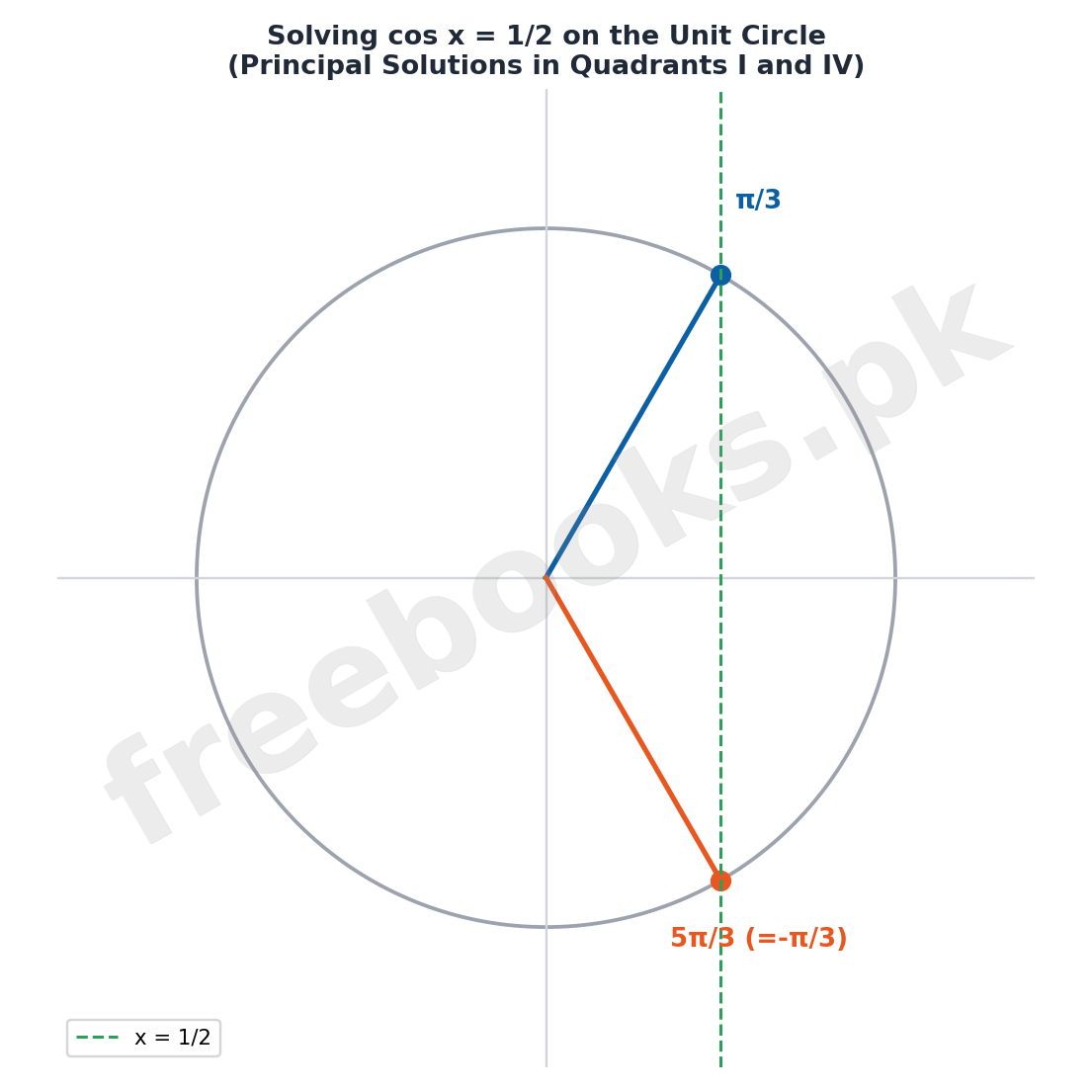
Because trigonometric functions repeat every period (2π for sin/cos, π for tan), once a principal solution is found, adding or subtracting integer multiples n of the period generates every other solution — this full solution set is the general solution, e.g. for cosx=1/2, the general solution is x={π/3+2nπ}∪{5π/3+2nπ}, n∈ℤ.
10.2 Quadrant Analysis and Reference Angles
To solve sinθ=k, cosθ=k, or tanθ=k algebraically, first determine which quadrants give the correct sign for the function (positive/negative), then use the reference angle (the related acute angle) to write both principal solutions in [0,2π] — e.g. for cosx=√3/2 (positive), x lies in quadrants I and IV with reference angle π/6, giving x=π/6 and x=2π-π/6=11π/6.
More complex equations are first reduced to this basic form using algebraic manipulation (factoring, using identities to write everything in terms of one function) before quadrant analysis is applied — e.g. 2sec²x-8/3=0 reduces to cosx=±√3/2, each case then solved separately by quadrant analysis.
10.3 Squaring and Extraneous Roots
Some equations, such as √3cotx-cscx-1=0, cannot be solved by direct quadrant analysis and instead require isolating a term and squaring both sides to eliminate a reciprocal or radical function. Squaring can introduce extraneous roots — values that satisfy the squared equation but not the original one — because squaring can make a true statement out of what was originally a false one (e.g. it discards sign information).
Every candidate solution obtained after squaring must therefore be substituted back into the ORIGINAL (unsquared) equation to verify it actually satisfies it; any candidate that fails this check is discarded as extraneous, and only the verified solutions are reported in the final general solution.
10.4 Graphical Solution of Trigonometric Equations
When an equation f(x)=g(x) is too complex for algebraic methods (e.g. sinx=x/2 or cosx=x/8), the graphical method plots y=f(x) and y=g(x) on the same axes over a given interval; each point where the two curves intersect gives an x-value that is a solution of the equation.
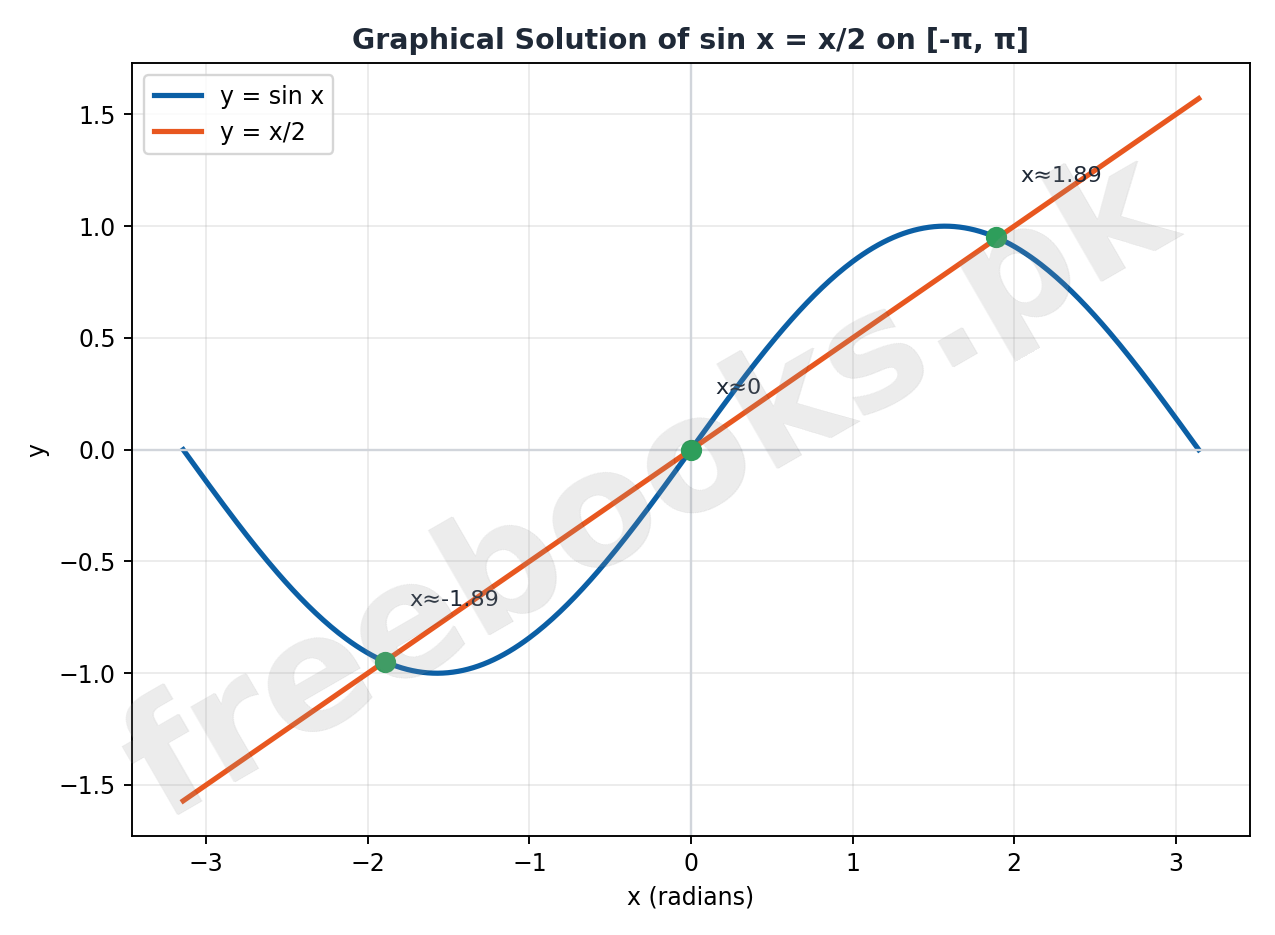
This method does not give exact values but provides accurate decimal approximations and also reveals the total number of solutions in the interval at a glance — e.g. sinx=x/2 on [-π,π] has exactly three intersection points, giving solutions x≈-1.89, 0, and 1.89 radians.
10.5 Real-Life Applications
Subtended-angle problems (e.g. a lighthouse lantern viewed from a ship) use the difference formula for tan⁻¹ to relate two angles of elevation measured from the same observation point to different heights on a structure, solving the resulting equation for an unknown height.
Projectile range problems use R=(v₀²/g)sin2θ to relate launch angle to horizontal range, solved using sin⁻¹ and the identity sinθ=sin(180°-θ) to find both possible launch angles for a given target distance, while the maximum range is found by recognizing sin2θ is maximized (equal to 1) when 2θ=90°, i.e. θ=45°.
Important Definitions
What is a trigonometric equation?
An equation involving one or more trigonometric functions (or their inverses) of an unknown angle, such as sinx=1/√2.
What is a principal solution?
A solution of a trigonometric equation that lies within the interval [0,2π].
What is a general solution?
The complete set of all solutions of a trigonometric equation, obtained by adding integer multiples of the function's period to each principal solution.
What is a reference angle?
The acute angle between the terminal side of an angle and the x-axis, used to find related angles with the same trigonometric ratio magnitude in other quadrants.
What is an extraneous root?
A value obtained while solving an equation (often after squaring both sides) that satisfies the transformed equation but does NOT satisfy the original equation.
What is the period of sinx and cosx?
2π.
What is the period of tanx?
π.
What is the graphical method for solving a trigonometric equation?
Plotting y=f(x) and y=g(x) for an equation f(x)=g(x) and reading off the x-coordinates of their points of intersection as the solutions.
At what launch angle is projectile range R=(v₀²/g)sin2θ maximized?
θ=45°, since sin2θ reaches its maximum value of 1 when 2θ=90°.
Why must candidate roots be checked after squaring a trigonometric equation?
Because squaring can introduce extraneous roots that satisfy the squared equation but not the original one, so each candidate must be substituted back into the original equation to confirm validity.
Key Facts and Relations
| Topic | Key Fact / Relation |
|---|---|
| General solution of cosx=k | x = {θ_r + 2nπ} ∪ {-θ_r + 2nπ}, n∈ℤ, θ_r = reference angle |
| General solution of sinx=k | x = {θ_r + 2nπ} ∪ {(π-θ_r) + 2nπ}, n∈ℤ |
| General solution of tanx=k | x = θ_r + nπ, n∈ℤ (period π) |
| Reference-angle sign rule | Sign of the trig function determines the quadrant pair; the reference angle gives the acute angle in each |
| Difference formula for tan⁻¹ | tan⁻¹α – tan⁻¹β = tan⁻¹[(α-β)/(1+αβ)] |
| Projectile range formula | R = (v₀²/g) sin2θ |
| Maximum projectile range | R_max = v₀²/g, achieved at θ=45° |
| Sine supplementary-angle identity | sinθ = sin(180°-θ) |
| Pythagorean identity (used after squaring) | sin²x + cos²x = 1 |
| Angle of elevation relation | tanθ = (height)/(horizontal distance) |
Diagrams
Solving cos x = 1/2 on the Unit Circle: The unit circle showing the two principal solutions x=π/3 and x=5π/3 for cosx=1/2, found in quadrants I and IV using the reference angle π/3
Graphical Solution of sin x = x/2: The graphs of y=sinx and y=x/2 plotted together on [-π,π], showing all three intersection points that give the equation's approximate solutions
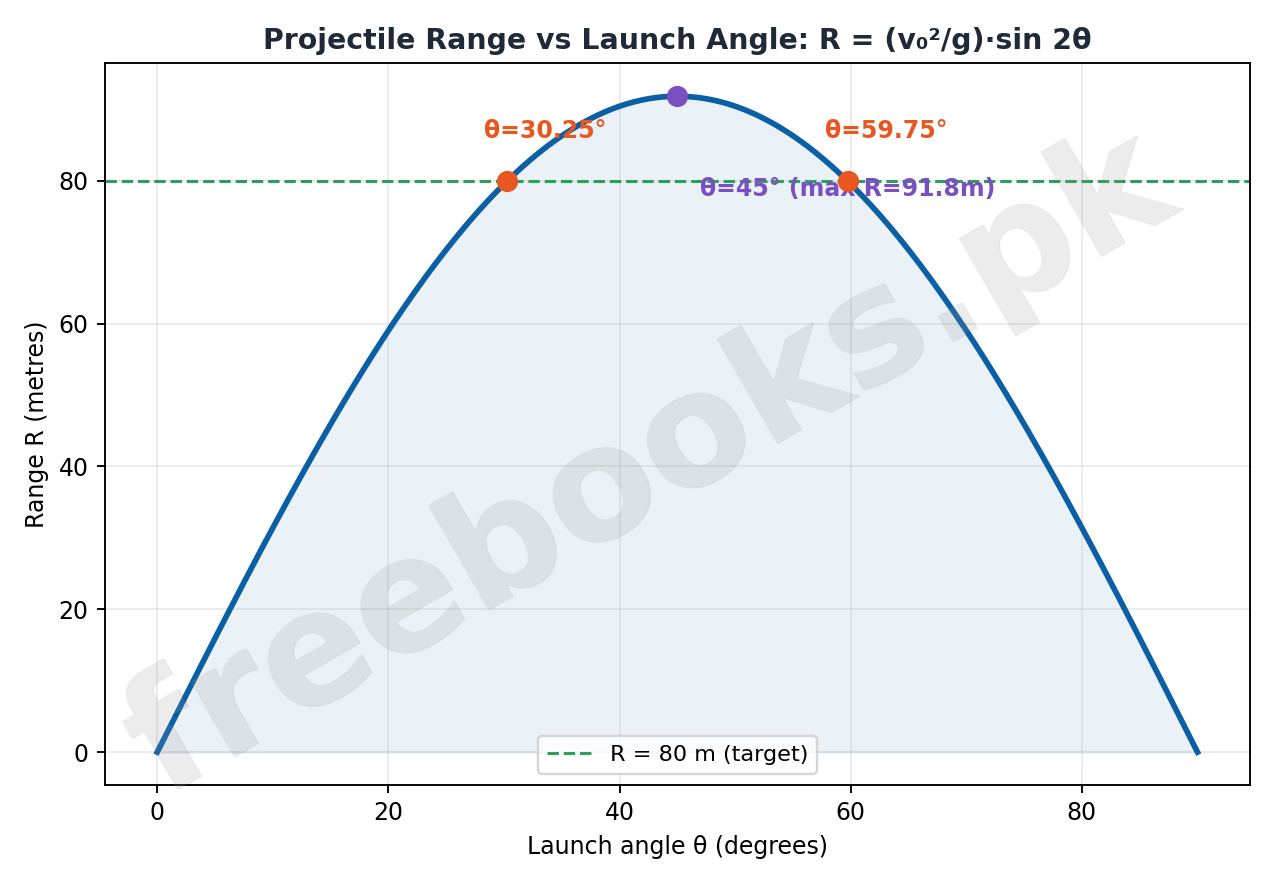
Projectile Range vs Launch Angle: The range R=(v₀²/g)sin2θ plotted against launch angle θ, showing the two angles that give a range of 80m and the single angle (45°) that gives the maximum range
Solved Examples
Example 1: Solving a Basic Sine Equation
Problem: Solve sin x = -√3/2.
- Since sine is negative, x lies in quadrants III and IV, with reference angle π/3 (since sin(π/3)=√3/2).
- Quadrant III solution: x = π + π/3 = 4π/3.
- Quadrant IV solution: x = 2π – π/3 = 5π/3.
- Since 2π is the period of sinx, the general solution adds 2nπ to each principal solution.
- Final answer: general solution = {4π/3 + 2nπ} ∪ {5π/3 + 2nπ}, n∈ℤ.
Example 2: Solving a Squared-Function Equation
Problem: Solve 2sec²x – 8/3 = 0.
- Isolate sec²x: sec²x = 4/3, so secx = ±2/√3, giving cosx = √3/2 or cosx = -√3/2.
- For cosx=√3/2 (positive, quadrants I and IV, reference angle π/6): x=π/6 and x=11π/6.
- For cosx=-√3/2 (negative, quadrants II and III, reference angle π/6): x=5π/6 and x=7π/6.
- Since 2π is the period of cosx, add 2nπ to each of the four principal solutions.
- Final answer: general solution = {π/6+2nπ} ∪ {5π/6+2nπ} ∪ {7π/6+2nπ} ∪ {11π/6+2nπ}, n∈ℤ.
Example 3: Solving an Equation Requiring Squaring, with Extraneous Root Check
Problem: Solve √3 cot x – csc x – 1 = 0.
- Rewrite in terms of sin and cos, isolate the radical-free term: √3cosx – 1 = sinx, then square both sides: (√3cosx-1)² = sin²x.
- Expand and use sin²x=1-cos²x to reduce to 4cos²x – 2√3cosx = 0, which factors as 2cosx(2cosx-√3)=0, giving cosx=0 or cosx=√3/2.
- For cosx=0: candidates x=π/2 and x=3π/2. Checking in the ORIGINAL equation: x=π/2 gives LHS=-2≠0 (extraneous); x=3π/2 gives LHS=0=RHS (valid).
- For cosx=√3/2: candidates x=π/6 and x=11π/6. Checking in the original equation: x=π/6 gives LHS=0=RHS (valid); x=11π/6 gives LHS=-2≠0 (extraneous).
- Final answer: general solution = {3π/2 + 2nπ} ∪ {π/6 + 2nπ}, n∈ℤ (the two extraneous roots are discarded).
Example 4: Graphical Solution of an Equation
Problem: Solve sin x = x/2 graphically over [-π, π].
- Recognize this equation cannot be solved algebraically in closed form since x appears both inside and outside the sine function.
- Plot y=sinx and y=x/2 on the same axes over the interval [-π,π].
- Identify each point where the two curves cross — reading the graph shows three intersection points.
- Read off the approximate x-coordinates of these three intersection points.
- Final answer: x ≈ -1.89, 0, or 1.89 radians.
Example 5: Graphical Solution with a Wider Search Interval
Problem: Solve cos x = x/8 graphically.
- Since -1≤cosx≤1, any solution must satisfy -1≤x/8≤1, i.e. -8≤x≤8, so this is the natural search interval.
- Plot y=cosx and y=x/8 together over [-8,8].
- Count and locate each intersection point of the two curves — the graph shows six intersection points in this interval.
- Read off the approximate x-coordinate of each intersection point.
- Final answer: x ≈ -4.16, -1.8, 0, 1.39, 5.46, and 6.82 radians.
Example 6: Real-Life Application: Subtended Angle of a Lighthouse Lantern
Problem: A 15m lantern sits atop a cliff. From a ship 120m offshore, the lantern subtends the same angle as a 1.5m buoy at the base of the cliff. Find the height of the cliff.
- Let h be the cliff height. From the ship, the angle to the cliff top is θ₁=tan⁻¹(h/120), and the angle to the lantern top is θ=tan⁻¹[(h+15)/120].
- The lantern's subtended angle is θ₂=θ-θ₁ = tan⁻¹[(h+15)/120] – tan⁻¹(h/120). The buoy's subtended angle is θ₃=tan⁻¹(1.5/120).
- Since θ₂=θ₃, apply the tan⁻¹ difference formula to combine the left side into a single inverse tangent, then equate arguments: 15/120 divided by (14400+h²+15h)/14400 = 1.5/120.
- Simplify to the quadratic h² + 15h – 129600 = 0, then solve with the quadratic formula: h = [-15 + √(225+518400)]/2 = [-15+720.2]/2.
- Final answer: the cliff height is h ≈ 352.6 metres.
Example 7: Real-Life Application: Projectile Launch Angle
Problem: A projectile launched at v₀=30 m/s must hit a target 80m away. Find the launch angle θ, using R=(v₀²/g)sin2θ with g=9.8 m/s².
- Substitute the known values: 80 = (30²/9.8)sin2θ = (900/9.8)sin2θ, so sin2θ = 80×9.8/900 = 784/900 ≈ 0.8711.
- Take sin⁻¹ of both sides: 2θ = sin⁻¹(0.8711) ≈ 60.5°, giving θ = 30.25°.
- Since sinθ=sin(180°-θ), a second solution exists: 2θ = 180°-60.5° = 119.5°, giving θ = 59.75°.
- Both angles are valid launch angles that produce the same 80m range (a low, flat trajectory and a high, steep trajectory).
- Final answer: θ ≈ 30.25° or θ ≈ 59.75°.
Example 8: Real-Life Application: Maximum Projectile Range
Problem: For the same projectile (v₀=30 m/s, g=9.8 m/s²), find the launch angle that gives the maximum range, and compute that maximum range.
- The range R=(v₀²/g)sin2θ is maximized when sin2θ is at its maximum possible value.
- Since the maximum value of the sine function is 1, set sin2θ=1, giving 2θ=sin⁻¹(1)=90°.
- Solve for θ: θ = 90°/2 = 45°.
- Substitute θ=45° (or directly use sin2θ=1) into the range formula: R_max = v₀²/g = 900/9.8.
- Final answer: the maximum range occurs at θ=45°, giving R_max ≈ 91.84 metres.
Short Questions & Answers
What distinguishes a principal solution from a general solution?
A principal solution lies only within [0,2π], while the general solution includes every solution obtained by adding integer multiples of the period to each principal solution.
Why does squaring both sides of a trigonometric equation risk introducing extraneous roots?
Because squaring discards sign information, so a value that makes the squared equation true might not actually satisfy the original (unsquared) equation.
How is an extraneous root identified and handled?
By substituting the candidate solution back into the ORIGINAL equation; if it does not satisfy the original equation, it is discarded as extraneous.
What is the main advantage of the graphical method for solving trigonometric equations?
It can find approximate solutions for equations too complex for algebraic methods, and it also reveals the total number of solutions in a given interval at a glance.
In quadrant analysis, what determines which two quadrants contain the solutions?
The sign (positive or negative) of the trigonometric function value in the equation, since each function is positive in two quadrants and negative in the other two.
At what angle is projectile range R=(v₀²/g)sin2θ maximized, and why?
θ=45°, because sin2θ reaches its maximum possible value of 1 when 2θ=90°.
Why can a target range typically be hit at two different launch angles?
Because sinθ=sin(180°-θ), so the equation sin2θ=k generally has two solutions for 2θ in [0°,180°], giving two valid values of θ.
Long Questions & Answers
Explain the complete process for finding the general solution of a trigonometric equation like cos x = k, including how quadrant analysis, reference angles, and the function's period are used.
How is the correct pair of quadrants identified for cosx=k?
The sign of k determines the quadrants: if k is positive, cosx is positive in quadrants I and IV; if k is negative, cosx is negative in quadrants II and III — this narrows the search to exactly two quadrants within [0,2π].
How is the reference angle used to find both principal solutions?
The reference angle θ_r is the acute angle satisfying cos(θ_r)=|k|; the two principal solutions are then obtained by placing θ_r correctly in each of the two identified quadrants, e.g. for quadrant I the solution is simply θ_r, and for quadrant IV it is 2π-θ_r.
How is the period of cosx used to extend the principal solutions to a general solution?
Since cosx repeats every 2π, adding any integer multiple 2nπ (n∈ℤ) to each principal solution produces another valid solution, so the general solution is written as the union of {θ_r+2nπ} and {-θ_r+2nπ} (or equivalently {2π-θ_r+2nπ}), covering every possible solution.
How does this process change for sinx=k or tanx=k?
For sinx=k, the two quadrants are I/II (positive) or III/IV (negative), and the period is also 2π; for tanx=k, the two quadrants are I/III (positive) or II/IV (negative), but since tanx has period π (not 2π), only a single principal solution plus nπ is needed to generate the full general solution.
Explain how the graphical method solves trigonometric equations that resist algebraic methods, and how it was applied to find the launch angles and maximum range of a projectile.
Why is the graphical method needed for an equation like sinx=x/2?
Because x appears both inside the trigonometric function and as a plain algebraic term, there is no algebraic manipulation that isolates x exactly — the equation is transcendental, so no closed-form solution exists, making a visual/numerical approach necessary.
What is the general procedure for solving f(x)=g(x) graphically?
Plot y=f(x) and y=g(x) on the same set of axes over the interval of interest, then identify every point where the two curves cross; the x-coordinate of each crossing point is an approximate solution to the equation, and the total number of crossings gives the number of solutions in that interval.
How does the projectile range formula R=(v₀²/g)sin2θ connect to solving for a launch angle?
Setting R equal to a target distance and rearranging gives sin2θ = (Rg)/v₀², an equation solved not by plotting but by taking sin⁻¹ of both sides directly, since it reduces to the standard form sin(angle)=k; because sinθ=sin(180°-θ), this generally yields two valid launch angles for the same target range.
How is the maximum-range angle found, and why is it unique?
Since sin2θ can never exceed 1, the range is maximized exactly when sin2θ=1, which happens only at 2θ=90°, i.e. θ=45° within the physically meaningful range of launch angles (0° to 90°) — making 45° the single unique angle that achieves the maximum possible range for a given launch speed.
Multiple Choice Questions (MCQs)
Solutions of a trigonometric equation lying within [0,2π] are called: (A) General solutions (B) Principal solutions (C) Extraneous solutions (D) Reference solutions
Correct answer: (B) Principal solutions. Principal solutions are, by definition, the solutions restricted to one full period [0,2π].
The general solution of cosx=1/2 is: (A) x=π/3+nπ (B) x={π/3+2nπ}∪{5π/3+2nπ} (C) x=π/3+2nπ only (D) x=5π/3-nπ
Correct answer: (B) x={π/3+2nπ}∪{5π/3+2nπ}. Both principal solutions π/3 and 5π/3 must be extended by adding 2nπ (the period of cosine) to each.
An extraneous root arises most often from which operation? (A) Adding a constant (B) Squaring both sides of an equation (C) Taking a reciprocal (D) Multiplying by a positive constant
Correct answer: (B) Squaring both sides of an equation. Squaring can turn a false statement into a true one, introducing solutions that don't satisfy the original equation.
How should a suspected extraneous root be checked? (A) Substitute it into the squared equation (B) Substitute it into the original (unsquared) equation (C) Ignore it if it's negative (D) Round it to the nearest integer
Correct answer: (B) Substitute it into the original (unsquared) equation. Only substitution into the ORIGINAL equation correctly confirms or rejects a candidate root.
The graphical method finds solutions of f(x)=g(x) by locating: (A) The maximum of f(x) (B) Points where the two graphs intersect (C) The y-intercepts of both graphs (D) The period of f(x)
Correct answer: (B) Points where the two graphs intersect. Each intersection point's x-coordinate is a solution of f(x)=g(x).
The period of tanx used when writing its general solution is: (A) 2π (B) π (C) π/2 (D) 4π
Correct answer: (B) π. Unlike sine and cosine, tangent repeats every π, so only nπ (not 2nπ) is added to its principal solution.
The projectile range formula R=(v₀²/g)sin2θ is maximized when: (A) θ=0° (B) θ=90° (C) θ=45° (D) θ=60°
Correct answer: (C) θ=45°. sin2θ reaches its maximum value of 1 when 2θ=90°, i.e. θ=45°.
Why can a projectile hit a target at two different launch angles? (A) Because g is not constant (B) Because sinθ=sin(180°-θ) gives two valid angles for the same sin2θ value (C) Because v₀ changes with angle (D) It cannot — only one angle is ever possible
Correct answer: (B) Because sinθ=sin(180°-θ) gives two valid angles for the same sin2θ value. The supplementary-angle sine identity means sin2θ=k has two solutions for 2θ in [0°,180°].
For sinx=k with k negative, the solutions lie in which quadrants? (A) I and II (B) I and IV (C) III and IV (D) II and III
Correct answer: (C) III and IV. Sine is negative in quadrants III and IV.
In the equation √3cotx-cscx-1=0, why is squaring used? (A) To simplify the coefficients (B) To eliminate the reciprocal trig functions and reduce to a solvable polynomial in cosx (C) To find the period (D) Squaring is not used in this example
Correct answer: (B) To eliminate the reciprocal trig functions and reduce to a solvable polynomial in cosx. Squaring both sides after isolating terms converts the equation into a polynomial equation in cosx that can be factored and solved.
Quick Revision Summary
- Trigonometric equation: an equation in one or more trig functions or their inverses; solution = angle satisfying it
- Principal solution: lies in [0,2π] | General solution: principal solution(s) + integer multiples of the period
- Quadrant analysis: sign of k determines the quadrant pair; reference angle gives the acute angle within each
- Periods used in general solutions: sinx and cosx use 2nπ; tanx uses nπ
- Squaring both sides can introduce extraneous roots — always verify every candidate in the ORIGINAL equation
- Graphical method: plot both sides of f(x)=g(x); intersection points' x-coordinates are the approximate solutions
- Subtended-angle problems use the tan⁻¹ difference formula to relate two angles of elevation from one observation point
- Projectile range: R=(v₀²/g)sin2θ; two launch angles usually give the same range (sinθ=sin(180°-θ))
- Maximum projectile range occurs at θ=45°, since sin2θ's maximum value of 1 occurs at 2θ=90°
- Angle of elevation/depression problems use tanθ=(height)/(horizontal distance) as the basic relation
Exam Tips
- Always determine the correct pair of quadrants FIRST (from the sign of k) before computing the reference angle — working in the wrong quadrant pair is the most common error
- When an equation involves squaring, always circle or list every candidate solution before checking, then substitute each one individually into the ORIGINAL equation — do not skip this verification step
- For graphical-method questions, sketch both curves as accurately as possible and count intersection points carefully — missing an intersection near the edge of the given interval is a common mistake
- Remember tanx has period π, not 2π — using 2nπ instead of nπ for a tangent equation's general solution will produce an incomplete or incorrect answer
- For real-life subtended-angle problems, draw a clear diagram labeling every triangle and angle before writing any equation — it prevents mixing up which angle belongs to which triangle
- For projectile problems, remember the supplementary-angle identity sinθ=sin(180°-θ) whenever an inverse-sine step is involved — it is the source of the second (usually higher) launch angle