
A scalar function assigns a single real number to each input, like temperature at a point. A vector-valued function instead assigns a vector — a quantity with both magnitude and direction — making it the natural tool for modelling position, velocity, or force in two or three dimensions. Written as r(t)=f(t)î+g(t)ĵ+h(t)k̂, each component is itself an ordinary scalar function of the parameter t (often time), and together the three components trace out a curve in space as t varies.
This unit defines scalar and vector-valued functions, shows how to construct a vector-valued function from a real-world description, finds the domain and range by intersecting the domains of the individual components, and develops the derivative r'(t) (found by differentiating each component separately) as the key tool for analyzing motion. Building on this, it defines velocity as r'(t), acceleration as r''(t), speed as the magnitude of velocity, and direction of motion as the unit tangent vector, applying these to real-life problems in robotics, drones, projectiles, and orbital motion.
Learning Objectives
- Distinguish between a scalar function and a vector-valued function, with examples of each
- Construct a vector-valued function r(t) from a description of how each coordinate changes with t
- Find the domain of a vector-valued function by intersecting the domains of its component functions
- Find the range of a vector-valued function given its component functions
- Differentiate a vector-valued function by differentiating each component separately
- Define and compute the velocity vector v(t)=r'(t) and acceleration vector a(t)=r''(t) of a moving particle
- Compute the speed of a particle as the magnitude of its velocity vector, and its direction of motion as the unit tangent vector
- Apply vector-valued functions and their derivatives to real-life motion problems in robotics, drones, projectiles, and orbits
Key Concepts
11.1 Scalar Functions and Vector-Valued Functions
A scalar function assigns a single real number to each value of its input variable, e.g. f(t)=3t+2cos t; it is typically denoted by a lowercase letter and describes quantities like temperature or potential energy that have magnitude only, no direction.
A vector-valued function of a single variable takes one input (usually t) and returns a vector, written r(t)=⟨f(t),g(t),h(t)⟩=f(t)î+g(t)ĵ+h(t)k̂, where each component f(t), g(t), h(t) is itself a scalar function. It is typically denoted by a boldface or arrow-topped letter and describes quantities like position, velocity, or force that have both magnitude and direction.
11.2 Constructing a Vector-Valued Function
To build a vector-valued function from a real-world description: first determine how each coordinate (x, y, and if needed z) changes with respect to t; then combine these component functions into a single vector using either angle-bracket notation ⟨f(t),g(t),h(t)⟩ or unit-vector notation f(t)î+g(t)ĵ+h(t)k̂; finally specify the domain of t appropriate to the physical situation (e.g. t≥0 for time-dependent motion starting at t=0).
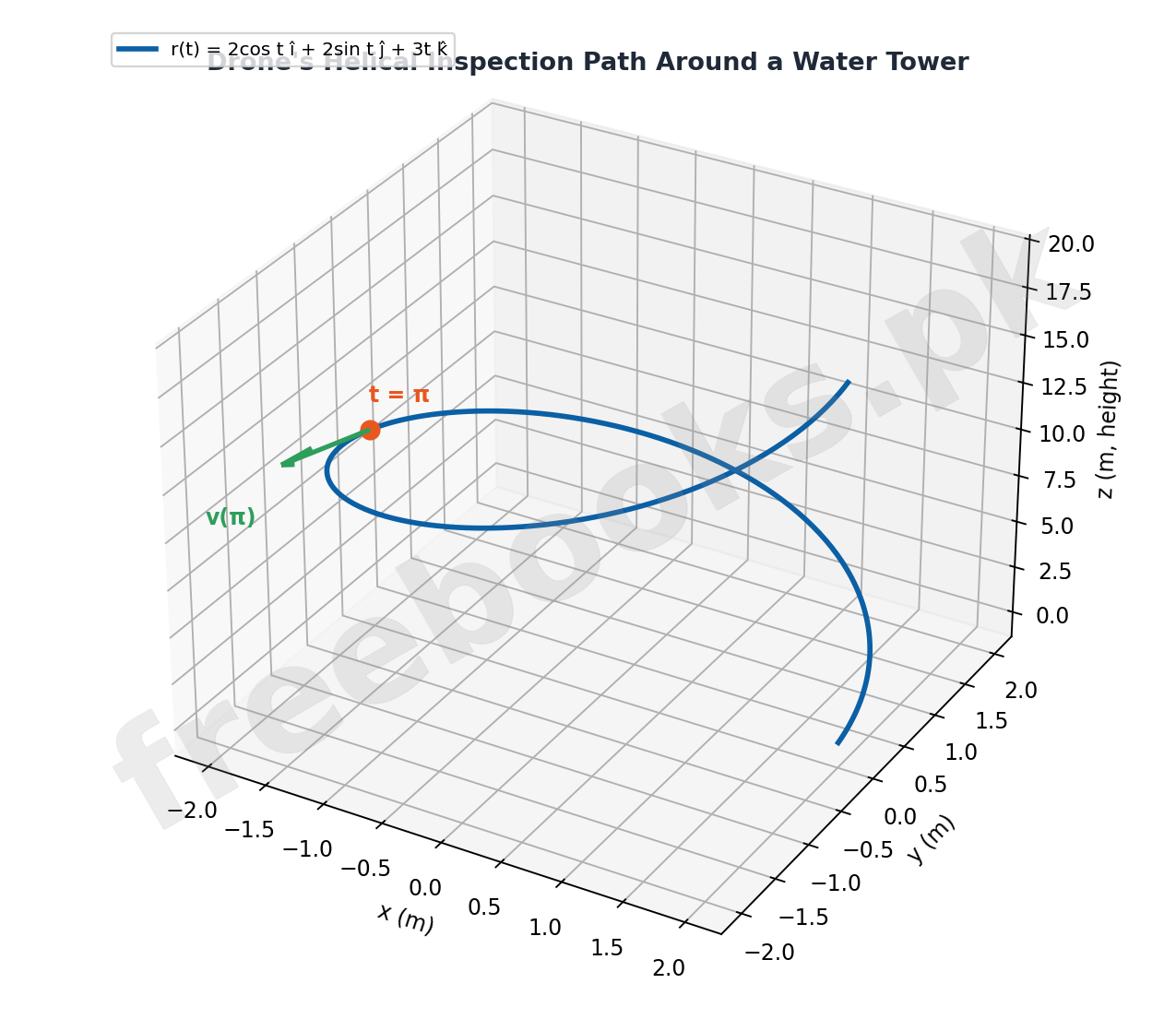
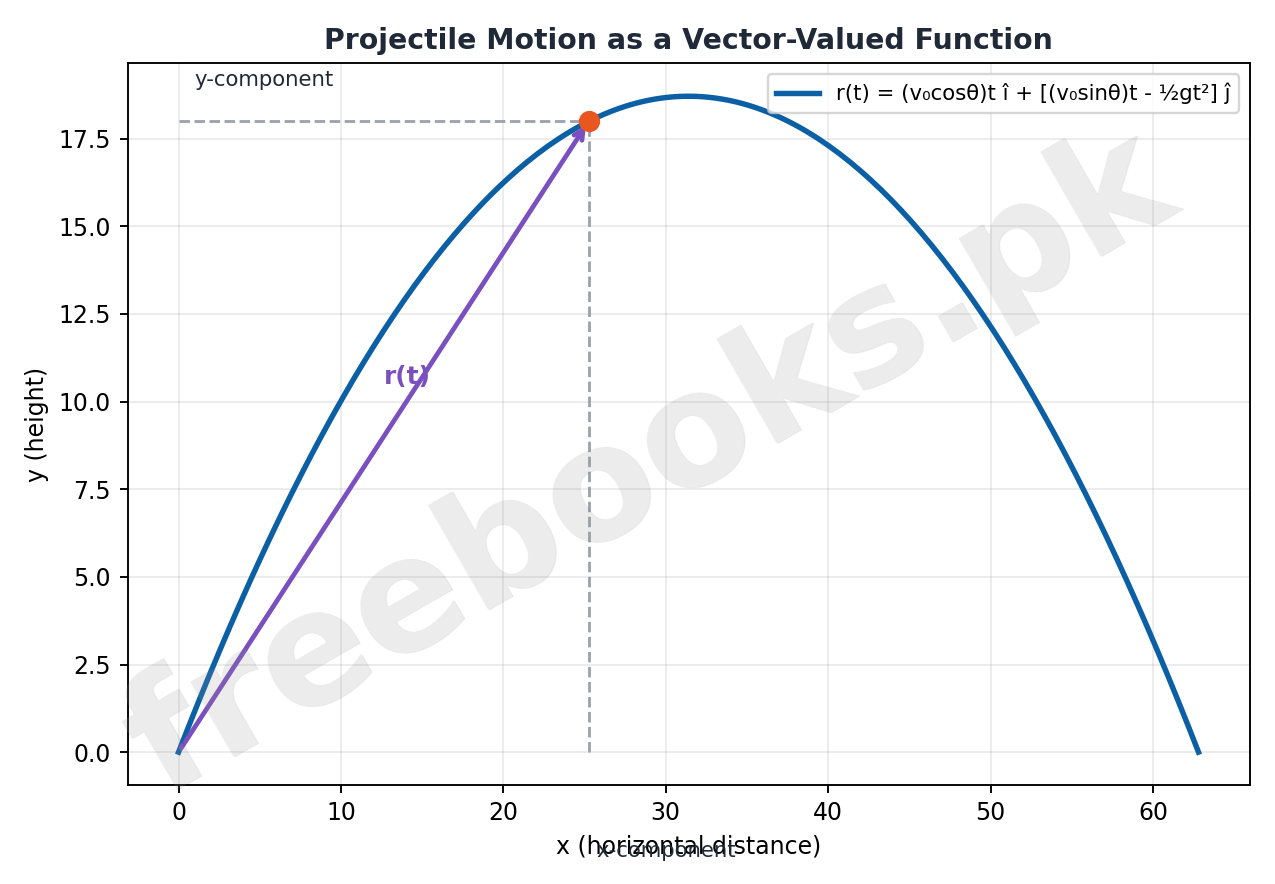
Common physical examples include projectile motion, r(t)=(v₀cosθ)tî+[(v₀sinθ)t-½gt²]ĵ, where the x-component models constant horizontal speed and the y-component models vertical motion under gravity; and helical motion, r(t)=Rcos t î+Rsin t ĵ+ct k̂, where the x,y-components trace a circle of radius R and the z-component models steady linear ascent.
11.3 Domain and Range of a Vector-Valued Function
The domain of r(t)=f(t)î+g(t)ĵ+h(t)k̂ is the set of all t for which every component function is simultaneously defined — found by determining the domain of each component separately, then taking the intersection of all these domains.
The range of r(t) is the set of all possible output vectors as t varies over the domain; it is described component-wise by finding the range of each individual component function (given the domain restriction) and expressing the overall output as an ordered tuple ⟨x,y⟩ or ⟨x,y,z⟩ subject to those component ranges.
11.4 The Derivative of a Vector-Valued Function
The derivative of r(t) is defined by the same limit-of-difference-quotient idea as for scalar functions: r'(t)=lim(Δt→0)[r(t+Δt)-r(t)]/Δt. When this limit exists, it can be computed simply by differentiating each component separately: r'(t)=f₁'(t)î+f₂'(t)ĵ+f₃'(t)k̂.
This componentwise rule means every differentiation technique already known for scalar functions (product rule, chain rule, quotient rule, trig/exponential/log derivatives) applies directly to each component of a vector-valued function — no new differentiation rules are needed, only careful bookkeeping across the components.
11.5 Velocity, Acceleration, Speed, and Direction of Motion
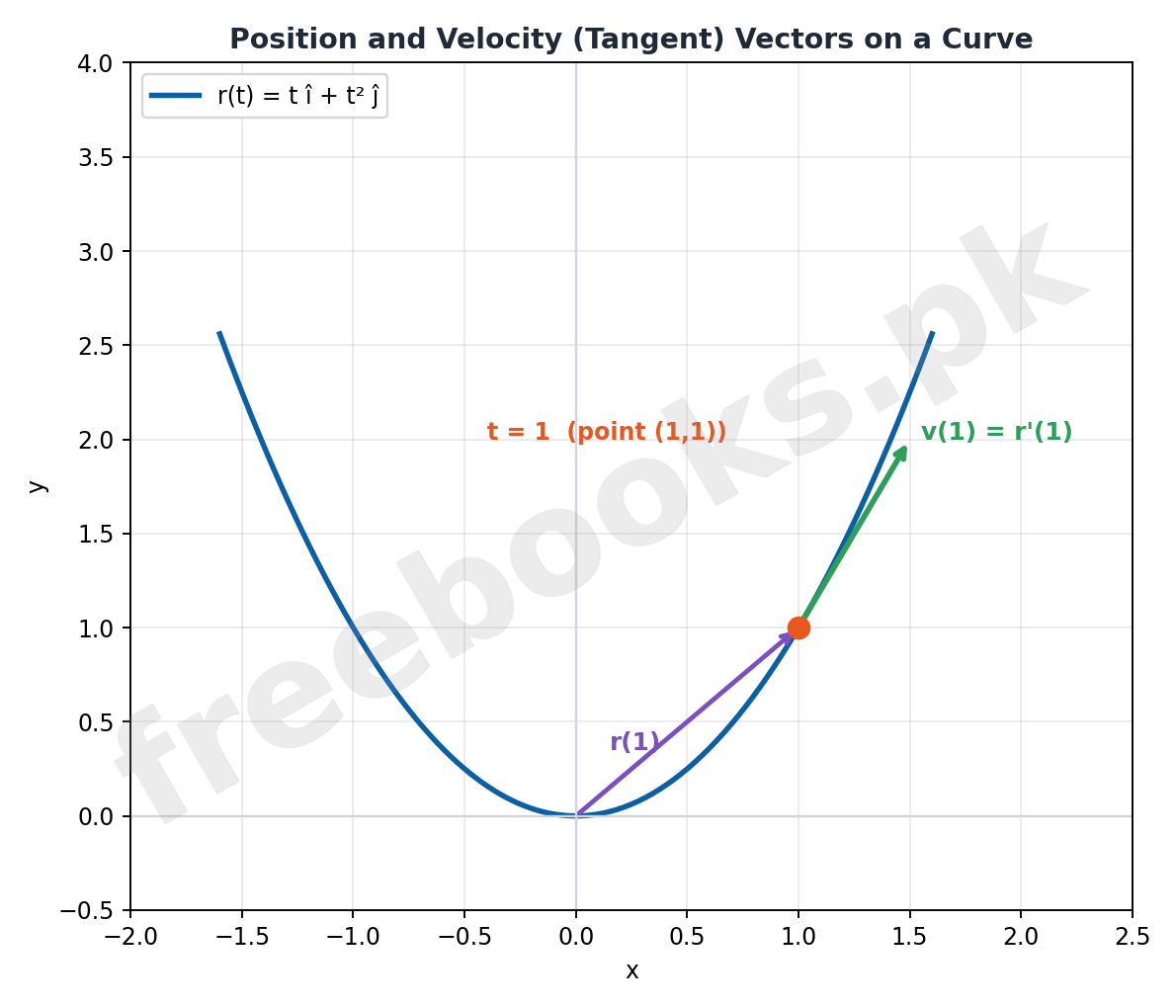
If r(t) is a particle's position vector, its velocity vector is v(t)=r'(t), which is tangent to the path of motion at every point; its acceleration vector is a(t)=v'(t)=r''(t), the second derivative of position. Both are themselves vector-valued functions of t.
The particle's speed at a given instant is the magnitude of its velocity vector, |v(t)|, a scalar; its direction of motion is given by the unit tangent vector v̂(t)=v(t)/|v(t)|, a vector of magnitude 1 pointing in the instantaneous direction of travel. Together these four quantities — velocity, acceleration, speed, and direction — give a complete instantaneous description of a particle's motion along its path.
Important Definitions
What is a scalar function?
A function that assigns a single real number to each value of the input variable, such as f(t)=3t+2cos t.
What is a vector-valued function?
A function of a single variable that returns a vector as output, written r(t)=f(t)î+g(t)ĵ+h(t)k̂, where each component is a scalar function of t.
What is the domain of a vector-valued function r(t)?
The set of all t for which every component function of r(t) is simultaneously defined — the intersection of each component's individual domain.
What is the range of a vector-valued function?
The set of all possible output vectors r(t) as t varies over the domain.
How is the derivative of a vector-valued function computed?
By differentiating each component function separately: r'(t)=f₁'(t)î+f₂'(t)ĵ+f₃'(t)k̂.
What is the velocity vector of a moving particle?
v(t)=r'(t), the derivative of the position vector, tangent to the particle's path of motion.
What is the acceleration vector of a moving particle?
a(t)=v'(t)=r''(t), the derivative of the velocity vector (second derivative of position).
What is the speed of a particle?
The magnitude of its velocity vector, |v(t)|, a scalar quantity.
What is the unit tangent vector, and what does it represent?
v̂(t)=v(t)/|v(t)|, a vector of magnitude 1 that gives the particle's instantaneous direction of motion.
Give an example of a helical vector-valued function.
r(t)=Rcos t î + Rsin t ĵ + ct k̂, which traces a circle of radius R in the xy-plane while climbing steadily along the z-axis at rate c.
Key Facts and Relations
| Topic | Key Fact / Relation |
|---|---|
| Vector-valued function (component form) | r(t) = ⟨f(t), g(t), h(t)⟩ = f(t)î + g(t)ĵ + h(t)k̂ |
| Derivative of a vector-valued function | r'(t) = f₁'(t)î + f₂'(t)ĵ + f₃'(t)k̂ |
| Derivative as a limit | r'(t) = lim(Δt→0) [r(t+Δt) – r(t)] / Δt |
| Velocity vector | v(t) = r'(t) |
| Acceleration vector | a(t) = v'(t) = r''(t) |
| Speed | |v(t)| = √[(f₁'(t))² + (f₂'(t))² + (f₃'(t))²] |
| Unit tangent vector (direction of motion) | v̂(t) = v(t) / |v(t)| |
| Projectile motion position vector | r(t) = (v₀cosθ)t î + [(v₀sinθ)t – ½gt²] ĵ |
| Helical motion position vector | r(t) = Rcos t î + Rsin t ĵ + ct k̂ |
| Domain of a vector-valued function | Domain[r(t)] = Domain[f(t)] ∩ Domain[g(t)] ∩ Domain[h(t)] |
Diagrams
Drone's Helical Inspection Path Around a Water Tower: The 3D helix traced by r(t)=2cos t î+2sin t ĵ+3t k̂, with the velocity vector shown tangent to the path at t=π
Position and Velocity (Tangent) Vectors on a Curve: The curve r(t)=t î+t² ĵ with the position vector r(1) from the origin and the tangent velocity vector v(1)=r'(1) shown at the point (1,1)
Projectile Motion as a Vector-Valued Function: The parabolic trajectory of a projectile with its position vector r(t) shown decomposed into horizontal (x) and vertical (y) components at a point along the path
Solved Examples
Example 1: Constructing and Evaluating a Vector-Valued Function
Problem: For the vector-valued function r(t)=⟨cos t, sin t, t⟩, find r(π/2) and describe the type of curve it traces.
- Substitute t=π/2 into each component: cos(π/2)=0, sin(π/2)=1, and the third component is simply π/2.
- Combine the results: r(π/2) = ⟨0, 1, π/2⟩.
- This vector represents a specific point in 3D space — the drone or particle's location at that instant.
- Since the x,y-components trace a unit circle while the z-component increases linearly and steadily with t, the overall curve spirals upward at a constant rate.
- Final answer: r(π/2)=⟨0,1,π/2⟩, and the function traces a helix (a 3D spiral).
Example 2: Finding the Domain and Range of a Vector-Valued Function
Problem: Find the domain and range of r(t) = √(4-t²) î + 1/(t-1) ĵ.
- For the first component √(4-t²), require 4-t²≥0, i.e. t²≤4, giving t∈[-2,2].
- For the second component 1/(t-1), require the denominator nonzero: t-1≠0, i.e. t≠1.
- Intersect both conditions: domain = [-2,1) ∪ (1,2].
- For the range: since 4-t² ranges over [0,4] on this domain, √(4-t²) ranges over [0,2], so x∈[0,2]; since 1/(t-1) can equal any nonzero real number as t varies (excluding t=1), y can be any real number except 0.
- Final answer: domain = [-2,1)∪(1,2]; range = {⟨x,y⟩ | 0≤x≤2, y∈ℝ, y≠0}.
Example 3: Differentiating a Vector-Valued Function
Problem: Find r'(t) for r(t) = t²î + sin t ĵ + eᵗk̂.
- Differentiate the first component: d/dt(t²) = 2t.
- Differentiate the second component: d/dt(sin t) = cos t.
- Differentiate the third component: d/dt(eᵗ) = eᵗ.
- Combine the three derivatives into a single vector-valued derivative.
- Final answer: r'(t) = 2t î + cos t ĵ + eᵗ k̂.
Example 4: Evaluating a Derivative at a Specific Point
Problem: Find r'(π/4) for r(t) = sec t î + tan t ĵ – cos t k̂.
- Differentiate each component symbolically: d/dt(sec t)=sec t tan t, d/dt(tan t)=sec²t, d/dt(-cos t)=sin t.
- Evaluate the first at t=π/4: sec(π/4)tan(π/4) = √2 × 1 = √2.
- Evaluate the second at t=π/4: sec²(π/4) = (√2)² = 2.
- Evaluate the third at t=π/4: sin(π/4) = 1/√2.
- Final answer: r'(π/4) = √2 î + 2 ĵ + (1/√2) k̂.
Example 5: Velocity, Acceleration, Speed, and Direction on a Conveyor Belt
Problem: A part's position on a vibrating conveyor belt is r(t)=3t²î+2sin t ĵ (metres). Find its velocity, acceleration, speed, and direction of motion at t=π/2.
- Velocity: v(t)=r'(t)=6tî+2cos t ĵ; at t=π/2, v(π/2)=6(π/2)î+2cos(π/2)ĵ = 3πî + 0ĵ.
- Acceleration: a(t)=v'(t)=6î-2sin t ĵ; at t=π/2, a(π/2)=6î-2sin(π/2)ĵ = 6î – 2ĵ.
- Speed: |v(t)|=√(36t²+4cos²t); at t=π/2, |v(π/2)|=√((3π)²+0)=3π ≈ 9.42 m/s.
- Direction: v̂(π/2)=v(π/2)/|v(π/2)| = (3πî+0ĵ)/(3π) = î + 0ĵ.
- Final answer: at t=π/2 the part moves due east at 3π≈9.42 m/s, is accelerating eastward and starting to accelerate southward, though its instantaneous velocity has no north-south component.
Example 6: Velocity, Acceleration, Speed, and Direction for a Drone's Helical Path
Problem: A drone inspecting a water tower follows r(t)=2cos t î+2sin t ĵ+3t k̂. Find its velocity, acceleration, speed, and direction of motion at t=π.
- Velocity: v(t)=r'(t)=-2sin t î+2cos t ĵ+3k̂; at t=π, v(π)=-2sin(π)î+2cos(π)ĵ+3k̂ = 0î – 2ĵ + 3k̂.
- Acceleration: a(t)=v'(t)=-2cos t î-2sin t ĵ; at t=π, a(π)=-2cos(π)î-2sin(π)ĵ = 2î + 0ĵ + 0k̂.
- Speed: |v(t)|=√(4cos²t+4sin²t+9)=√13 (constant for all t, since the trig terms simplify to 4).
- Direction: v̂(π) = (0î-2ĵ+3k̂)/√13 = 0î – (2/√13)ĵ + (3/√13)k̂.
- Final answer: at t=π the drone has no east-west motion, moves south and climbs simultaneously at constant speed √13≈3.61 m/s, with acceleration pointing eastward toward the tower's central axis (centripetal acceleration).
Example 7: Real-Life Application: Cannonball Projectile Motion
Problem: A cannonball is fired at 30° with initial velocity 100 m/s (g=9.8 m/s²). Formulate r(t) and find the velocity vector at t=5 seconds.
- Use the projectile position formula: r(t)=(v₀cosθ)tî+[(v₀sinθ)t-½gt²]ĵ, with v₀=100, θ=30°, g=9.8.
- Substitute: r(t) = (100cos30°)tî + [(100sin30°)t – 4.9t²]ĵ = (86.6t)î + (50t – 4.9t²)ĵ.
- Differentiate to get velocity: v(t) = r'(t) = 86.6î + (50 – 9.8t)ĵ.
- Evaluate at t=5: v(5) = 86.6î + (50 – 9.8×5)ĵ = 86.6î + (50-49)ĵ = 86.6î + 1ĵ.
- Final answer: r(t)=86.6tî+(50t-4.9t²)ĵ, and v(5)≈86.6î+1ĵ (m/s) — the cannonball is nearly at the peak of its trajectory at t=5s, moving almost purely horizontally.
Example 8: Real-Life Application: Comet's Elliptical Orbit
Problem: A comet's position (in AU) is x=2cos t, y=sin t. Write r(t), and find its velocity and speed at t=π/2.
- Combine the components into a vector-valued function: r(t) = 2cos t î + sin t ĵ.
- Differentiate to find velocity: v(t) = r'(t) = -2sin t î + cos t ĵ.
- Evaluate at t=π/2: v(π/2) = -2sin(π/2)î + cos(π/2)ĵ = -2î + 0ĵ.
- Compute speed: |v(π/2)| = √((-2)²+0²) = √4 = 2 AU/year.
- Final answer: r(t)=2cos t î+sin t ĵ; at t=π/2, v(π/2)=-2î (AU/year), speed = 2 AU/year, moving due west (negative x-direction) at that instant.
Short Questions & Answers
What is the key difference between a scalar function and a vector-valued function?
A scalar function outputs a single real number, while a vector-valued function outputs a vector with both magnitude and direction.
How is the derivative of r(t)=f(t)î+g(t)ĵ+h(t)k̂ computed?
By differentiating each component function separately: r'(t)=f'(t)î+g'(t)ĵ+h'(t)k̂.
How is the domain of a vector-valued function found?
By finding the domain of each component function individually, then taking the intersection of all these domains.
What does the velocity vector v(t)=r'(t) represent geometrically?
A vector tangent to the particle's path of motion at each point, pointing in the instantaneous direction of travel.
How is the speed of a particle related to its velocity vector?
Speed is the magnitude (length) of the velocity vector, |v(t)|, a scalar quantity.
How is the direction of motion found from the velocity vector?
By computing the unit tangent vector v̂(t)=v(t)/|v(t)|, which has magnitude 1 and points in the direction of travel.
What real-world quantity does the acceleration vector a(t)=r''(t) represent?
The instantaneous rate of change of velocity — how quickly and in what direction the particle's velocity itself is changing.
Long Questions & Answers
Explain how a vector-valued function is constructed from a real-world description, and how its domain and range are determined, using a concrete example.
What are the three steps for constructing a vector-valued function from a description?
First, determine how each coordinate (x, and y, and z if 3D) changes with respect to the parameter t; second, combine these component functions into a single vector using either angle-bracket notation ⟨f(t),g(t),h(t)⟩ or unit-vector notation f(t)î+g(t)ĵ+h(t)k̂; third, specify the domain of t appropriate to the physical situation, such as t≥0 for motion starting at time zero.
How is the domain of a constructed vector-valued function found?
The domain of each component function is determined separately (e.g. requiring a square root's argument to be non-negative, or a denominator to be nonzero), and then the overall domain of r(t) is the intersection of all these individual component domains, since every component must be defined simultaneously.
How is the range of a vector-valued function described?
The range is described by finding the range of each component function given the domain restriction, then expressing the set of all possible output vectors as an ordered tuple ⟨x,y⟩ or ⟨x,y,z⟩ subject to those individual component ranges and any relationships between them.
How does this process apply to r(t)=√(4-t²)î+1/(t-1)ĵ?
The first component requires 4-t²≥0 giving t∈[-2,2], and the second requires t≠1, so the domain is [-2,1)∪(1,2]; on this domain, √(4-t²) ranges over [0,2] while 1/(t-1) can take any nonzero real value, giving the range {⟨x,y⟩ | 0≤x≤2, y∈ℝ, y≠0}.
Explain how velocity, acceleration, speed, and direction of motion are all derived from a position vector r(t), and how they are interpreted for a particle moving along a curved path.
How is the velocity vector obtained from the position vector, and what does it represent?
The velocity vector is v(t)=r'(t), found by differentiating each component of the position vector; geometrically it is tangent to the particle's path at every point and indicates the instantaneous direction and rate of change of position.
How is the acceleration vector obtained, and what does it represent?
The acceleration vector is a(t)=v'(t)=r''(t), the derivative of velocity (second derivative of position); it captures how the velocity itself — both its magnitude and direction — is changing at each instant, such as speeding up, slowing down, or curving.
How is speed obtained from the velocity vector, and why is it a scalar rather than a vector?
Speed is the magnitude |v(t)| of the velocity vector, computed as the square root of the sum of the squares of its components; it is a scalar because it measures only how fast the particle is moving, discarding all directional information.
How is the direction of motion found, and why is it useful separately from speed?
The direction of motion is the unit tangent vector v̂(t)=v(t)/|v(t)|, obtained by dividing the velocity vector by its own magnitude so the result has length 1; separating direction from speed lets an analyst describe exactly which way a particle is heading independent of how fast it is currently travelling, which is essential in applications like drone navigation or orbital tracking.
Multiple Choice Questions (MCQs)
A vector-valued function differs from a scalar function because it: (A) Always uses time as input (B) Outputs a vector with magnitude and direction, not just a number (C) Cannot be differentiated (D) Has no domain restrictions
Correct answer: (B) Outputs a vector with magnitude and direction, not just a number. The defining feature of a vector-valued function is that its output is a vector, not a single real number.
The derivative of r(t)=f(t)î+g(t)ĵ+h(t)k̂ is found by: (A) Differentiating only f(t) (B) Multiplying all components together then differentiating (C) Differentiating each component separately (D) Taking the magnitude first, then differentiating
Correct answer: (C) Differentiating each component separately. Vector-valued differentiation is done componentwise: r'(t)=f'(t)î+g'(t)ĵ+h'(t)k̂.
The domain of a vector-valued function r(t) is: (A) The union of each component's domain (B) The intersection of each component's domain (C) Always all real numbers (D) The domain of only the first component
Correct answer: (B) The intersection of each component's domain. Every component must be defined simultaneously, so the overall domain is the intersection of the individual component domains.
The velocity vector of a moving particle is defined as: (A) v(t) = r(t) (B) v(t) = r'(t) (C) v(t) = r''(t) (D) v(t) = |r(t)|
Correct answer: (B) v(t) = r'(t). Velocity is the first derivative of the position vector.
The acceleration vector is defined as: (A) a(t) = r(t) (B) a(t) = v(t) (C) a(t) = v'(t) = r''(t) (D) a(t) = |v(t)|
Correct answer: (C) a(t) = v'(t) = r''(t). Acceleration is the derivative of velocity, equivalently the second derivative of position.
Speed is best described as: (A) A vector pointing in the direction of motion (B) The magnitude of the velocity vector (C) The magnitude of the acceleration vector (D) The same thing as velocity
Correct answer: (B) The magnitude of the velocity vector. Speed is a scalar equal to |v(t)|, the length of the velocity vector.
The unit tangent vector v̂(t)=v(t)/|v(t)| represents: (A) The particle's speed (B) The particle's acceleration (C) The particle's direction of motion (D) The particle's position
Correct answer: (C) The particle's direction of motion. Dividing the velocity vector by its own magnitude produces a vector of length 1 pointing in the direction of travel.
For r(t)=Rcos t î+Rsin t ĵ+ct k̂, the motion described is: (A) Purely linear (B) Purely circular (C) A helix (circular motion plus steady linear climb) (D) Random
Correct answer: (C) A helix (circular motion plus steady linear climb). The x,y-components trace a circle of radius R while the z-component climbs steadily, together tracing a helix.
If a particle's velocity has zero y-component at some instant, this means: (A) The particle has stopped moving entirely (B) The particle has no north-south motion at that instant (C) The particle's acceleration is also zero (D) The position vector is undefined
Correct answer: (B) The particle has no north-south motion at that instant. A zero component in the velocity vector means no motion in that particular direction at that instant, not that the particle has stopped altogether.
Every differentiation technique used for scalar functions (product rule, chain rule, etc.) applies to a vector-valued function's components because: (A) Vector-valued functions have their own separate differentiation rules (B) Each component of a vector-valued function is itself an ordinary scalar function of t (C) Only the first component needs to be differentiated (D) Vector-valued functions cannot actually be differentiated
Correct answer: (B) Each component of a vector-valued function is itself an ordinary scalar function of t. Since f(t), g(t), h(t) are each ordinary scalar functions, all standard differentiation rules apply directly to each one.
Quick Revision Summary
- Scalar function: outputs a single real number | Vector-valued function: outputs a vector, r(t)=f(t)î+g(t)ĵ+h(t)k̂
- Constructing r(t): determine each component's dependence on t, combine into vector form, specify domain
- Domain of r(t) = intersection of the domains of f(t), g(t), h(t) | Range described component-wise
- Derivative: r'(t)=f'(t)î+g'(t)ĵ+h'(t)k̂ — differentiate each component separately, using ordinary scalar rules
- Velocity: v(t)=r'(t) | Acceleration: a(t)=v'(t)=r''(t)
- Speed: |v(t)| (scalar, magnitude of velocity) | Direction of motion: v̂(t)=v(t)/|v(t)| (unit vector)
- Projectile motion: r(t)=(v₀cosθ)tî+[(v₀sinθ)t-½gt²]ĵ
- Helical motion: r(t)=Rcos t î+Rsin t ĵ+ct k̂ — circular motion in xy-plane plus steady linear climb along z
- Every scalar differentiation rule (product, chain, quotient, trig/exp/log derivatives) applies componentwise to vector-valued functions
- Applications: robotics (arm trajectories), drones (helical inspection paths), projectiles (cannonballs, footballs), orbits (comets, satellites, Ferris wheels)
Exam Tips
- Always differentiate each component of a vector-valued function completely separately — treat î, ĵ, k̂ as fixed labels, not variables, and never mix terms across components
- When finding the domain of r(t), work out each component's domain restriction on its own first (square roots need non-negative arguments, denominators need to be nonzero, logs need positive arguments), then intersect all of them at the end
- Remember speed is always a non-negative scalar (a magnitude), while velocity is a vector — do not confuse the two when a question asks specifically for one or the other
- For direction-of-motion questions, always divide the velocity vector by its OWN magnitude at that same instant — using a magnitude from a different value of t gives a meaningless result
- For real-life motion problems, first identify what physical quantity each component represents (horizontal, vertical, or height) before differentiating — this makes interpreting the final velocity/acceleration vector far more intuitive
- When acceleration is constant (like -g in projectile motion) but velocity's other components are non-constant, differentiate each term individually rather than assuming the whole acceleration vector is zero or constant without checking