This unit builds a graphical toolkit for functions: sketching a quadratic from its factored form and predicting a quadratic equation from a given graph, classifying functions as algebraic or transcendental, and studying the key transcendental function families — exponential, hyperbolic, and logarithmic — through their domains, ranges, intercepts, monotonicity, and asymptotes.
It then connects these ideas visually: the graph of an inverse function is the reflection of the original graph about the line y=x (which is why y=ln x mirrors y=e^x), and any graph can be moved or resized using horizontal/vertical shifts and horizontal/vertical scaling. The unit closes with solving exponential and logarithmic equations and inequalities, and applying these functions to real-world growth and decay, sound intensity (decibels), and compound interest problems.
Learning Objectives
- Sketch the graph of a quadratic function given in factored form, and predict a quadratic function from its graph
- Classify functions as algebraic or transcendental, and as fundamental or non-fundamental transcendental functions
- State and apply the domain, range, intercepts, monotonicity, and asymptotic behaviour of exponential functions and sketch their graphs
- Define the hyperbolic and inverse hyperbolic functions and derive their logarithmic forms
- State and apply the laws of logarithms and sketch the graph of a logarithmic function as the inverse of an exponential function
- Construct the graph of an inverse function by reflecting the original graph about the line y=x
- Apply horizontal/vertical shifts and horizontal/vertical scaling to transform the graph of a function
- Solve exponential and logarithmic equations and inequalities, and apply these functions to growth/decay, sound intensity, and compound interest problems
Key Concepts
1.1 Sketching and Predicting Quadratic Graphs Using Factors
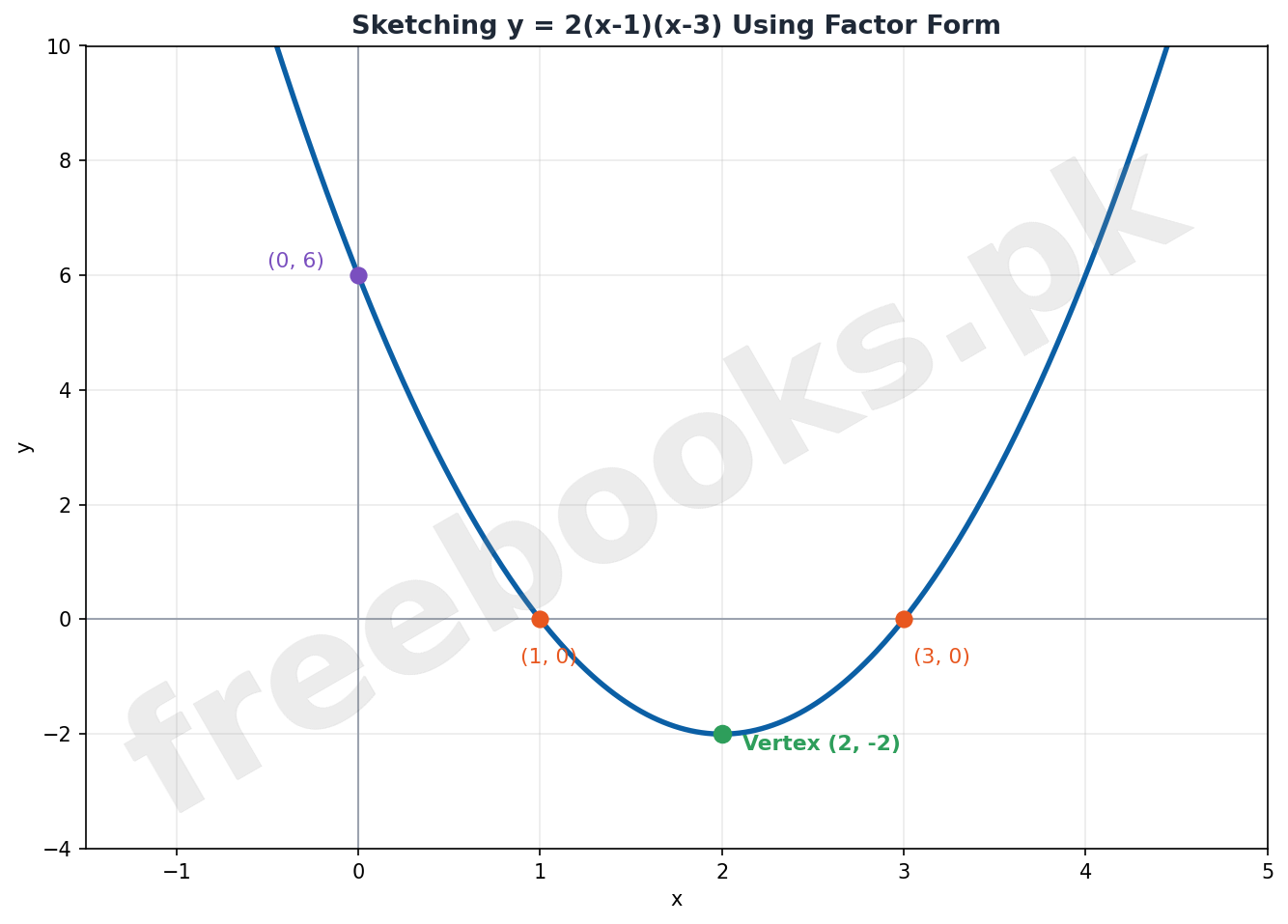
A quadratic y=a(x-h)(x-k) (h<=k) can be sketched directly from its factors: the graph cuts the x-axis at x=h and x=k, its vertex lies at x=(h+k)/2, its end behaviour (y -> +infinity or y -> -infinity as x -> +-infinity) is fixed by the sign of a, and its y-intercept is found by setting x=0 (giving y=ahk). When h=k, the factor (x-h)^2 makes the parabola touch rather than cross the x-axis, with vertex (h,0).
Conversely, if the x-intercepts x=h and x=k of a quadratic graph are known, the function can be written as f(x)=a(x-h)(x-k), and substituting the coordinates of any third point on the curve determines the remaining constant a — letting a full equation be recovered directly from a picture of its graph.
1.2 Algebraic and Transcendental Functions
A function y=f(x) is algebraic if it satisfies a polynomial equation in y with polynomial coefficients in x — equivalently, if it is built from x using finitely many algebraic operations (addition, subtraction, multiplication, division, and nth roots). A function that is not algebraic is called transcendental.
Transcendental functions split further into fundamental transcendental functions — the standard building blocks such as y=a^x, y=ln x, y=sin x, y=sin^-1 x — and non-fundamental transcendental functions, formed by combining these with algebraic functions or with each other through composition (e.g. y=sin x + ln x, y=e^(x^2)).
1.3 Exponential, Hyperbolic, and Inverse Hyperbolic Functions
The exponential function f(x)=a^x (a>0, a<>1) has domain ]-infinity,infinity[, range ]0,infinity[, is continuous and always positive, cuts the y-axis at (0,1), has no x-intercept, and has horizontal asymptote y=0. It is strictly increasing when a>1 and strictly decreasing when 0<a<1, and it is injective in both cases, so every horizontal line meets its graph at most once.
Hyperbolic functions sinh x=(e^x-e^-x)/2, cosh x=(e^x+e^-x)/2, and tanh x=sinh x/cosh x (plus their reciprocals coth, sech, csch) are built from e^x and behave like trigonometric functions but arise from the hyperbola x^2-y^2=1 rather than the circle. Their inverses — such as sinh^-1 x=ln(x+sqrt(x^2+1)) and cosh^-1 x=ln(x+sqrt(x^2-1)) on [1,infinity) — are derived by solving the defining exponential equation for x algebraically using the quadratic formula.
1.4 Logarithmic Functions and Their Graphs
The logarithmic function y=log_a x is defined as the inverse of the exponential function y=a^x, with domain ]0,infinity[ and range ]-infinity,infinity[. It is injective, has vertical asymptote x=0, cuts the x-axis at (1,0), has no y-intercept, and is strictly increasing when a>1 and strictly decreasing when 0<a<1. The product, quotient, and power laws of logarithms, together with the change-of-base formula log_a x=ln x/ln a, are the standard tools for simplifying logarithmic expressions and equations.
The modulus function f(x)=|x| produces a V-shaped graph made of the two lines y=x (for x>=0) and y=-x (for x<0), meeting at the origin.
1.5 Graphs of Inverse Functions and Transformations
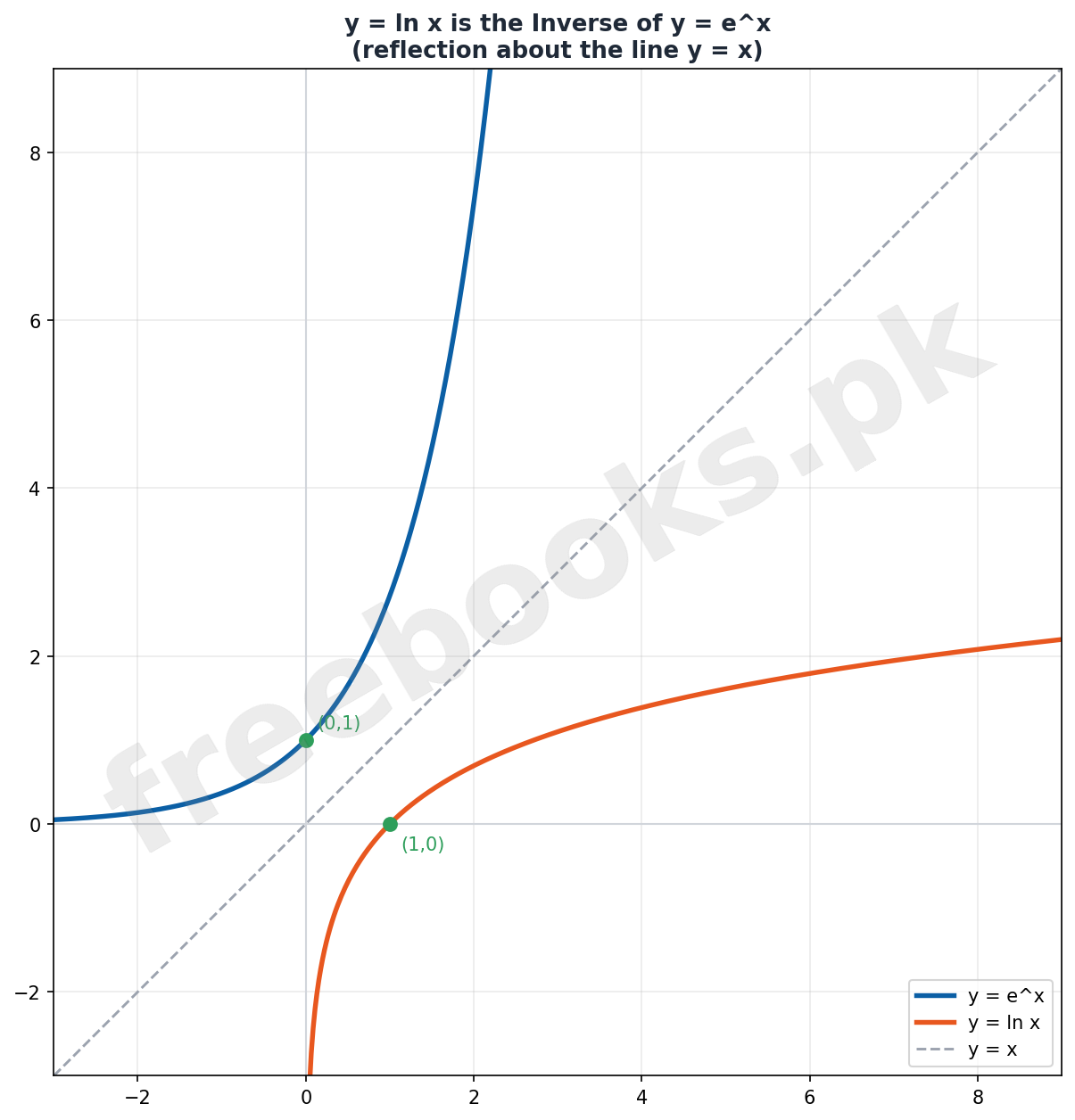
A function has an inverse exactly when it is bijective (one-to-one and onto); its inverse graph is the reflection of the original graph about the line y=x, since interchanging the roles of input and output corresponds exactly to reflecting across the line where input equals output. This is why the graph of y=ln x is the mirror image of y=e^x about y=x.
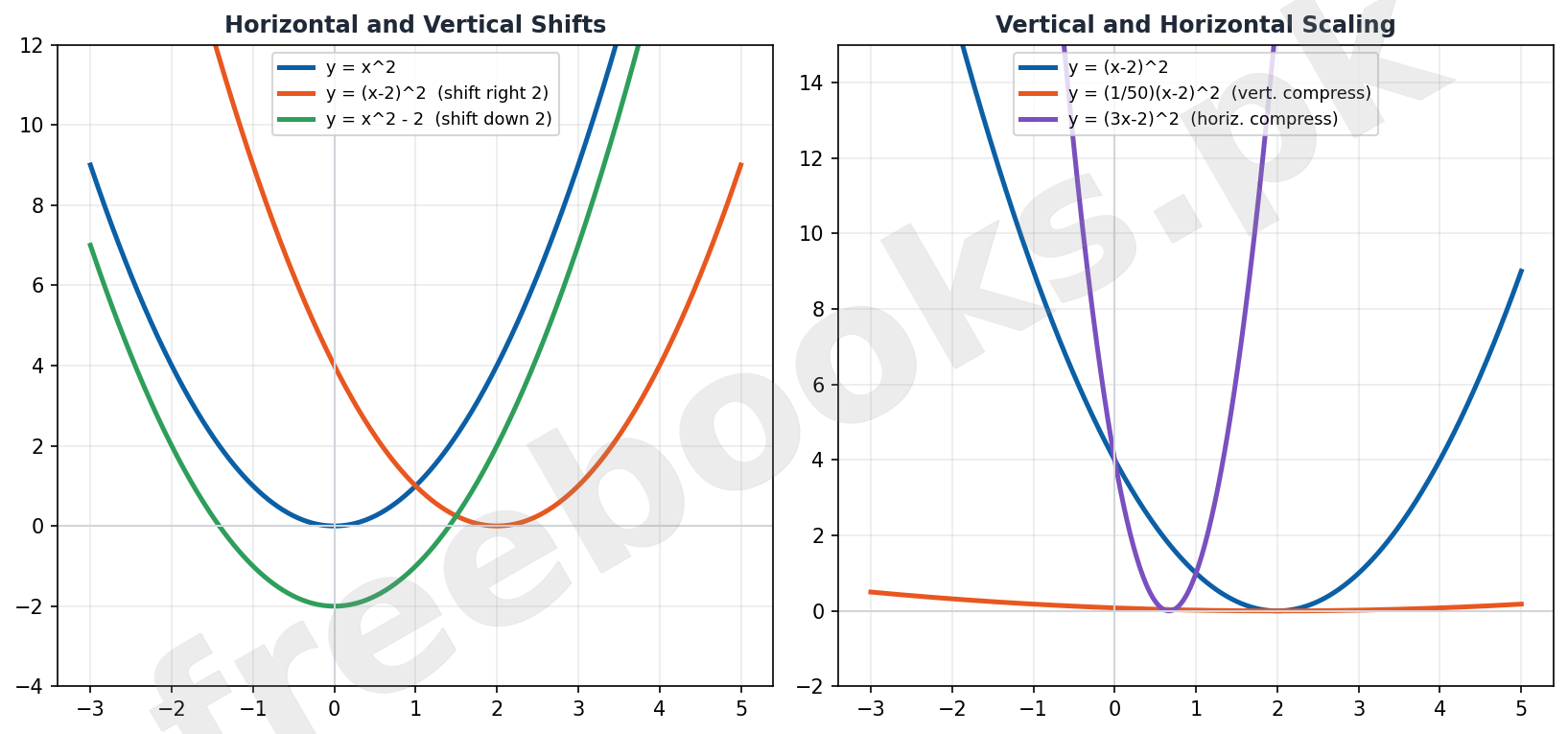
A graph can be transformed by shifting — y=f(x-h)+k moves the graph h units horizontally (right if h>0, left if h<0) and k units vertically (up if k>0, down if k<0) — or by scaling — y=a f(bx) stretches/compresses the graph vertically by a and horizontally by 1/b (for a,b>0), where a>1 stretches vertically and 0<a<1 compresses vertically, while b>1 compresses horizontally and 0<b<1 stretches horizontally.
1.6 Exponential/Logarithmic Equations, Inequalities, and Real-World Applications
Exponential and logarithmic equations are solved by matching bases (using injectivity of a^x or log_a x) or by taking logarithms of both sides; the domain must always be checked first, since logarithmic expressions require positive arguments and positive, non-unit bases. The same injectivity/monotonicity facts convert exponential and logarithmic inequalities into ordinary algebraic inequalities, again subject to the domain restrictions of the original expressions.
These functions model real growth and decay via N=N0 e^(kt) (k>0 for growth, k<0 for decay), sound intensity in decibels via L=10 log(I/I0) with threshold I0=10^-12 W/m^2, and compound interest via the discrete formula A=P(1+r/n)^(nt) or the continuous formula A=Pe^(rt) — each a direct application of solving an exponential or logarithmic equation for the unknown quantity.
Important Definitions
What is an algebraic function?
A function y=f(x) obtained from x using a finite number of algebraic operations (addition, subtraction, multiplication, division, and nth roots), i.e. one satisfying a polynomial equation in y with polynomial coefficients in x.
What is a transcendental function?
A function that is not algebraic, such as y=e^x, y=ln x, y=sin x, or y=sin^-1 x.
What is the natural exponential function?
f(x)=e^x, where e is the number defined by the infinite series sum(1/n!) for n=0 to infinity, with e is approximately 2.71828.
What is a horizontal asymptote?
A horizontal line y=c that a function's graph approaches (but need not touch) as x -> +infinity or x -> -infinity.
What is a vertical asymptote?
A vertical line x=c such that f(x) -> +-infinity as x -> c from the left or right.
What are the hyperbolic functions sinh x and cosh x?
sinh x = (e^x – e^-x)/2 and cosh x = (e^x + e^-x)/2; they satisfy cosh^2 x – sinh^2 x = 1, the hyperbola analogue of sin^2+cos^2=1.
What is a logarithmic function?
y=log_a x (a>0, a<>1, x>0), defined as the inverse of the exponential function y=a^x, i.e. a^y=x.
How is the graph of an inverse function obtained from the original graph?
By reflecting the original graph about the line y=x.
What does the general shift formula y=f(x-h)+k represent?
A horizontal shift of h units (right if h>0, left if h<0) and a vertical shift of k units (up if k>0, down if k<0).
What is the continuous compound interest formula?
A = P e^(rt), where P is the principal, r is the annual interest rate (decimal), and t is time.
Key Facts and Relations
| Topic | Key Fact / Relation |
|---|---|
| Quadratic graph via factors | y = a(x-h)(x-k); x-intercepts x=h,k; vertex at x=(h+k)/2; y-intercept y=ahk |
| Exponential function | y = a^x (a>0, a<>1); domain ]-inf,inf[, range ]0,inf[, y-intercept (0,1), asymptote y=0 |
| Hyperbolic functions | sinh x=(e^x-e^-x)/2, cosh x=(e^x+e^-x)/2, tanh x=sinh x/cosh x; cosh^2 x – sinh^2 x = 1 |
| Inverse hyperbolic sine/cosine | sinh^-1 x = ln(x+sqrt(x^2+1)); cosh^-1 x = ln(x+sqrt(x^2-1)), x>=1 |
| Laws of logarithms | log_a(xy)=log_a x+log_a y; log_a(x/y)=log_a x-log_a y; log_a(x^t)=t log_a x; log_a x = ln x/ln a |
| Logarithmic function | y = log_a x (a>0, a<>1, x>0); domain ]0,inf[, range ]-inf,inf[, x-intercept (1,0), asymptote x=0 |
| General shift of a graph | y = f(x-h) + k (h: horizontal shift, k: vertical shift) |
| General scaling of a graph | y = a f(bx), a>0, b>0 (a: vertical scale factor, 1/b: horizontal scale factor) |
| Growth/decay model | N = N0 e^(kt) (k>0 growth, k<0 decay) |
| Sound level (decibels) / Compound interest | L = 10 log(I/I0), I0=10^-12 W/m^2; A = P(1+r/n)^(nt) (discrete); A = Pe^(rt) (continuous) |
Diagrams
Sketching y = 2(x-1)(x-3) Using Factor Form: A parabola showing the x-intercepts at x=1 and x=3, the vertex at (2,-2), and the y-intercept at (0,6), illustrating the factor-form sketching method
y = ln x is the Inverse of y = e^x: The graphs of y=e^x and y=ln x plotted together with the line y=x, showing that the two curves are reflections of each other about y=x
Horizontal/Vertical Shifts and Scaling of Graphs: Two panels showing y=x^2 transformed by horizontal and vertical shifts (left) and by vertical and horizontal scaling (right)
Solved Examples
Example 1: Sketching a Quadratic Graph Using Factors
Problem: Sketch the graph of y = 2(x-1)(x-3).
- Find the x-intercepts by setting each factor to zero: x-1=0 and x-3=0, giving x=1 and x=3, so the graph meets the x-axis at (1,0) and (3,0).
- Find the vertex by evaluating y at x=(1+3)/2=2: y=2(2-1)(2-3)=-2, so the vertex is (2,-2).
- Determine end behaviour: since a=2>0, y -> +infinity as x -> +-infinity.
- Find the y-intercept by setting x=0: y=2(-1)(-3)=6, so the y-intercept is (0,6).
- Using the intercepts (1,0), (3,0), (0,6) and vertex (2,-2), sketch the upward-opening parabola.
Example 2: Predicting a Quadratic Function from Its Graph
Problem: Find an equation of the graph whose x-intercepts are x=1 and x=2 and which passes through the point (3,4).
- Since the x-intercepts are x=1 and x=2, write the function in factored form: y=a(x-1)(x-2).
- Substitute the known point (3,4): 4=a(3-1)(3-2)=2a.
- Solve for a: a=4/2=2.
- Substitute a=2 back into the factored form: y=2(x-1)(x-2)=2(x^2-3x+2).
- Final answer: y=2x^2-6x+4.
Example 3: Proving a Hyperbolic Identity
Problem: Prove that cosh^2 x – sinh^2 x = 1.
- Write both functions in terms of e^x: cosh x=(e^x+e^-x)/2 and sinh x=(e^x-e^-x)/2.
- Square each: cosh^2 x = (e^2x+e^-2x+2)/4 and sinh^2 x = (e^2x+e^-2x-2)/4.
- Subtract: cosh^2 x – sinh^2 x = [(e^2x+e^-2x+2)-(e^2x+e^-2x-2)]/4.
- Simplify the numerator: (e^2x+e^-2x+2-e^2x-e^-2x+2)/4 = 4/4 = 1.
- Final answer: cosh^2 x – sinh^2 x = 1.
Example 4: Deriving the Logarithmic Form of sinh^-1 x
Problem: Prove that sinh^-1 x = ln(x + sqrt(x^2+1)).
- Let y=sinh^-1 x, so x=sinh y = (e^y-e^-y)/2, giving 2x=e^y-1/e^y.
- Multiply through by e^y: 2x e^y = e^(2y) – 1, i.e. (e^y)^2 – 2x e^y – 1 = 0, a quadratic in e^y.
- Apply the quadratic formula: e^y = [2x +- sqrt(4x^2+4)]/2 = x +- sqrt(x^2+1).
- Since x – sqrt(x^2+1) < 0 for all real x but e^y must be positive, reject the negative sign: e^y = x + sqrt(x^2+1).
- Take the natural log of both sides: y = ln(x+sqrt(x^2+1)). Final answer: sinh^-1 x = ln(x+sqrt(x^2+1)).
Example 5: Solving an Exponential Equation by Matching Bases
Problem: Solve the equation 4^(x-1) = 8.
- Note the domain: 4^(x-1) is defined for all real x, so the domain is ]-infinity,infinity[.
- Write both sides with base 2: 4=2^2 and 8=2^3, so (2^2)^(x-1)=2^3, i.e. 2^(2x-2)=2^3.
- Since the exponential function is one-to-one (injective), the exponents must be equal: 2x-2=3.
- Solve for x: 2x=5, so x=5/2.
- Final answer: solution set = {5/2}.
Example 6: Solving a Logarithmic Inequality
Problem: Solve the inequality log(2x-1) >= log(5-3x).
- Find the domain: 2x-1>0 gives x>1/2, and 5-3x>0 gives x<5/3, so the domain is 1/2 < x < 5/3.
- Since the logarithmic function with base 10 is strictly increasing, the inequality is equivalent to comparing the arguments directly: 2x-1 >= 5-3x.
- Solve the resulting linear inequality: 2x+3x >= 5+1, so 5x >= 6, giving x >= 6/5.
- Combine with the domain restriction 1/2 < x < 5/3: this gives 6/5 <= x < 5/3.
- Final answer: solution set = [6/5, 5/3).
Example 7: Applying Multiple Graph Transformations in Order
Problem: Let f(x) = x/(x+1). Find the function after: (i) vertical stretch by 2, (ii) horizontal stretch by 3, (iii) shift 2 units right, (iv) shift 1 unit down.
- (i) Vertical stretch by 2: y=2f(x)=2x/(x+1). Call this g(x)=2x/(x+1).
- (ii) Horizontal stretch by 3 means y=g(x/3): substituting gives y=2(x/3)/((x/3)+1)=2x/(x+3). Call this s(x)=2x/(x+3).
- (iii) Shift 2 units right means y=s(x-2)=2(x-2)/((x-2)+3)=(2x-4)/(x+1). Call this t(x)=(2x-4)/(x+1).
- (iv) Shift 1 unit down means y=t(x)-1=(2x-4)/(x+1) – 1 = (2x-4-(x+1))/(x+1) = (x-5)/(x+1).
- Final answer: y = (x-5)/(x+1).
Example 8: Real-World Application: Continuous Compound Interest
Problem: A sum of Rs. 1000 is invested at a rate of 5% per year compounded continuously for 3 years. Find the final amount.
- Identify the given values: P=1000, r=5%=0.05, t=3.
- Apply the continuous compounding formula: A = P e^(rt).
- Substitute the values: A = 1000 e^(0.05×3) = 1000 e^0.15.
- Evaluate: e^0.15 is approximately 1.1618, so A is approximately 1000 x 1.1618 = 1161.8.
- Final answer: the final amount after 3 years is approximately Rs. 1161.8.
Short Questions & Answers
What determines whether an exponential function y=a^x is increasing or decreasing?
The base a: strictly increasing if a>1, strictly decreasing if 0<a<1.
What is the horizontal asymptote of every exponential function y=a^x?
y=0, the x-axis.
What is the vertical asymptote of every logarithmic function y=log_a x?
x=0, the y-axis.
Through which point does every exponential function y=a^x pass?
(0,1), since a^0=1.
Through which point does every logarithmic function y=log_a x pass?
(1,0), since log_a 1=0.
How is the graph of an inverse function related to the original graph?
It is the reflection of the original graph about the line y=x.
What is the shape of the graph of the modulus function f(x)=|x|?
A V-shape, made of the lines y=x for x>=0 and y=-x for x<0, meeting at the origin.
Long Questions & Answers
Explain how to sketch and predict the graph of a quadratic function using its factored form, with the roles of intercepts and vertex.
How do the x-intercepts of y=a(x-h)(x-k) relate to its factors?
Setting each factor to zero gives x=h and x=k directly, so the graph crosses the x-axis exactly at these two points (or touches it once at x=h if h=k).
How is the vertex of the parabola located?
The vertex lies midway between the two x-intercepts, at x=(h+k)/2; substituting this x-value back into the function gives the vertex's y-coordinate.
How does the sign of a determine the graph's end behaviour?
If a>0, y -> +infinity as x -> +-infinity (the parabola opens upward); if a<0, y -> -infinity as x -> +-infinity (it opens downward).
How can a quadratic function be predicted from its graph?
If the x-intercepts h and k are known, write f(x)=a(x-h)(x-k), then substitute the coordinates of any third point on the curve to solve for the remaining constant a.
Compare exponential and logarithmic functions: their domains, ranges, monotonic behaviour, and how their graphs relate to each other.
What are the domain and range of y=a^x versus y=log_a x?
The exponential function y=a^x has domain ]-infinity,infinity[ and range ]0,infinity[; the logarithmic function y=log_a x has domain ]0,infinity[ and range ]-infinity,infinity[ — domain and range are exactly swapped, since the two are inverses.
How does the base a affect monotonic behaviour in each case?
For both y=a^x and y=log_a x, the function is strictly increasing when a>1 and strictly decreasing when 0<a<1 — the same base condition governs monotonicity in both families.
What asymptotes do these two graphs have?
y=a^x has horizontal asymptote y=0 (the x-axis); y=log_a x has vertical asymptote x=0 (the y-axis) — again mirror images of each other.
Why is the graph of y=log_a x the reflection of y=a^x about y=x?
Because y=log_a x is defined as the inverse of y=a^x, and the graph of any inverse function is obtained by reflecting the original graph about the line y=x, where input and output roles are interchanged.
Multiple Choice Questions (MCQs)
The graph of y=a(x-h)(x-k) crosses the x-axis at: (A) x=a only (B) x=h and x=k (C) x=(h+k)/2 only (D) It never crosses the x-axis
Correct answer: (B) x=h and x=k. Setting each factor to zero gives the x-intercepts x=h and x=k directly.
A function is called transcendental if it is: (A) Always positive (B) Not algebraic (C) A polynomial (D) Always increasing
Correct answer: (B) Not algebraic. A transcendental function is, by definition, any function that is not algebraic.
The exponential function y=a^x (a>1) is: (A) Strictly decreasing (B) Strictly increasing (C) Constant (D) Undefined for x<0
Correct answer: (B) Strictly increasing. When a>1, y=a^x is strictly increasing on its whole domain.
The horizontal asymptote of every exponential function y=a^x is: (A) x=0 (B) y=1 (C) y=0 (D) y=a
Correct answer: (C) y=0. As x -> -infinity (for a>1) or x -> +infinity (for 0<a<1), a^x -> 0, so y=0 is the horizontal asymptote.
cosh^2 x – sinh^2 x equals: (A) 0 (B) 1 (C) 2x (D) e^x
Correct answer: (B) 1. This is the hyperbolic identity analogous to sin^2+cos^2=1, proved directly from the exponential definitions of sinh and cosh.
The logarithmic function y=log_a x has vertical asymptote: (A) x=0 (B) y=0 (C) x=1 (D) y=1
Correct answer: (A) x=0. As x -> 0+, log_a x -> +-infinity depending on the base, making x=0 the vertical asymptote.
The graph of an inverse function is obtained from the original graph by: (A) Reflecting about the x-axis (B) Reflecting about the line y=x (C) Rotating 90 degrees (D) Shifting up by 1 unit
Correct answer: (B) Reflecting about the line y=x. Interchanging input and output corresponds geometrically to reflecting the graph about the line y=x.
In y=f(x-h)+k, a positive value of h shifts the graph: (A) Left (B) Right (C) Up (D) Down
Correct answer: (B) Right. A positive h shifts the graph h units to the right; the sign is opposite to what might be expected because it replaces x with x-h.
In y=af(bx) with a>1 and b>1, the graph is: (A) Compressed vertically and stretched horizontally (B) Stretched vertically and compressed horizontally (C) Unchanged (D) Reflected about the origin
Correct answer: (B) Stretched vertically and compressed horizontally. a>1 stretches the graph vertically by factor a, while b>1 compresses it horizontally by factor b.
The continuous compound interest formula is: (A) A=P(1+r)^t (B) A=Prt (C) A=Pe^(rt) (D) A=P+rt
Correct answer: (C) A=Pe^(rt). Continuous compounding is modeled by A=Pe^(rt), the limiting case of discrete compounding as the number of periods grows without bound.
Quick Revision Summary
- y=a(x-h)(x-k): x-intercepts x=h,k; vertex at x=(h+k)/2; y-intercept y=ahk; end behaviour set by sign of a
- Algebraic functions use only +,-,x,/,and nth roots of x; transcendental functions are everything else
- Fundamental transcendental functions: a^x, ln x, sin x, sin^-1 x; combinations of these are non-fundamental
- Exponential y=a^x: domain ]-inf,inf[, range ]0,inf[, y-intercept (0,1), asymptote y=0, increasing if a>1, decreasing if 0<a<1
- sinh x=(e^x-e^-x)/2, cosh x=(e^x+e^-x)/2; cosh^2 x – sinh^2 x = 1; sinh^-1 x = ln(x+sqrt(x^2+1))
- Logarithmic y=log_a x: domain ]0,inf[, range ]-inf,inf[, x-intercept (1,0), asymptote x=0, is the inverse of y=a^x
- Laws of logarithms: log_a(xy)=log_a x+log_a y; log_a(x/y)=log_a x-log_a y; log_a(x^t)=t log_a x
- The graph of an inverse function is the reflection of the original graph about the line y=x
- Shift: y=f(x-h)+k moves h units horizontally, k units vertically; Scale: y=af(bx) scales vertically by a, horizontally by 1/b
- Exponential/logarithmic equations: match bases using injectivity, or take logs of both sides; always check the domain first
- Growth/decay: N=N0 e^(kt); Sound level: L=10 log(I/I0); Compound interest: A=P(1+r/n)^(nt) (discrete) or A=Pe^(rt) (continuous)
Exam Tips
- When sketching a quadratic from factors, always find the x-intercepts, vertex, and y-intercept in that order — three points are enough to sketch an accurate parabola
- To classify a function as algebraic or transcendental, check whether it can be built using only +,-,x,/,and roots of x — any exponential, logarithmic, or trigonometric piece makes it transcendental
- Memorize the four exponential/logarithmic facts as a pair: exponential passes through (0,1) with asymptote y=0; logarithmic passes through (1,0) with asymptote x=0
- For hyperbolic identity proofs, always rewrite sinh x and cosh x in terms of e^x and e^-x first, then simplify algebraically
- Before solving any exponential or logarithmic equation/inequality, find the domain first — many 'solutions' get rejected at the end for violating the original domain
- When applying multiple graph transformations in sequence, apply them strictly in the given order, one function substitution at a time — reordering changes the final answer