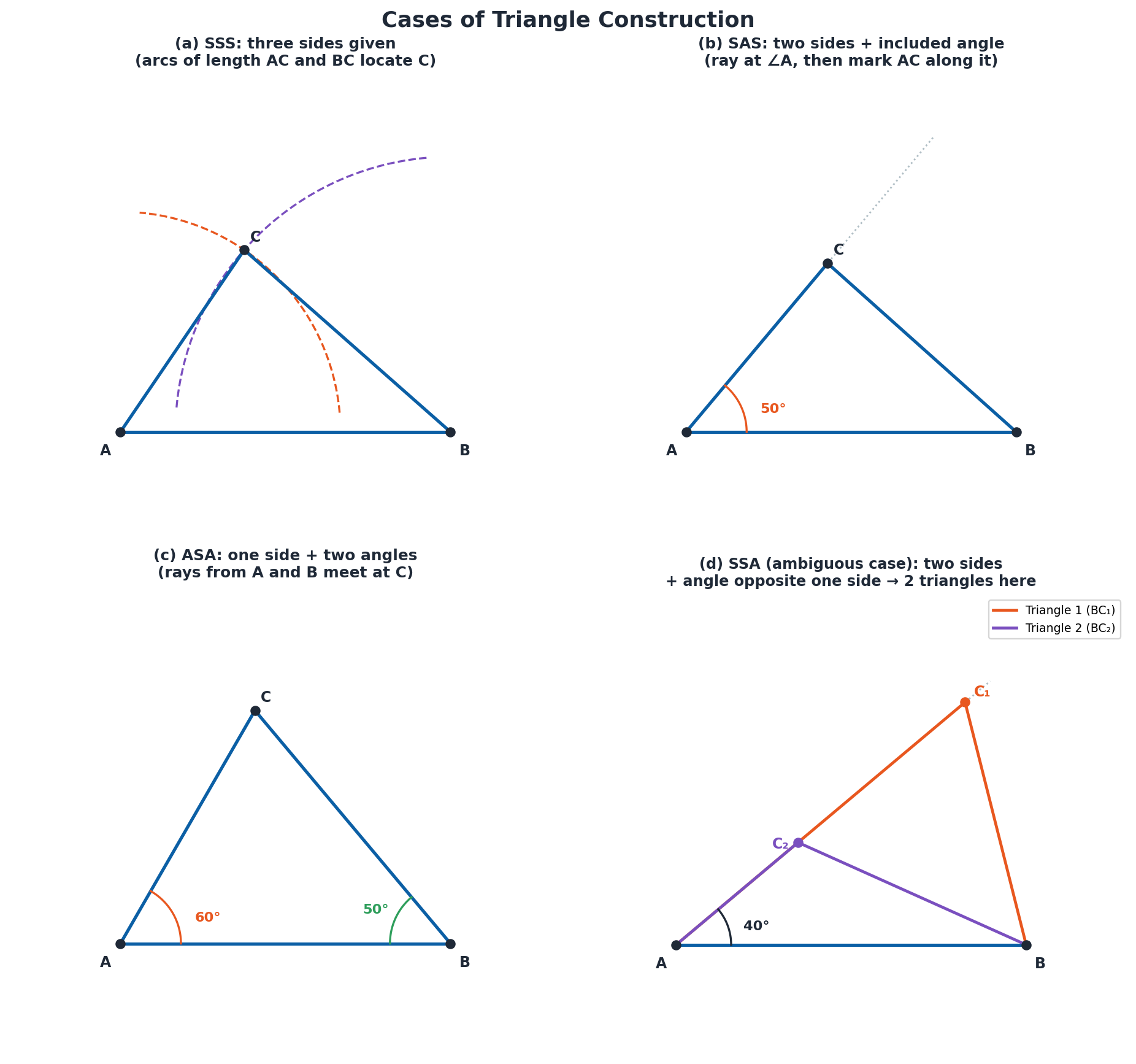
Geometric construction is the practice of drawing accurate figures using only a ruler and compass, without relying on a protractor for measurements that can be produced more precisely by construction. This unit begins with the four classic cases of triangle construction — three sides (SSS), two sides with the included angle (SAS), one side with two angles (ASA), and two sides with an angle opposite one of them (SSA, the famous ambiguous case that can yield two triangles, one triangle, or none at all).
The unit then introduces the special lines of a triangle — perpendicular bisectors, medians, angle bisectors, and altitudes — and shows that each set of three lines meets at a single special point: the circumcentre, centroid, incentre, and orthocentre respectively. Finally, the unit introduces the idea of a locus: the set of all points obeying one geometric rule. The four basic loci in two dimensions (a circle, a pair of parallel lines, a perpendicular bisector, and an angle bisector) are constructed individually and then combined, since real positioning problems — from placing a fire hydrant to designing a robotic arm's safe zone — are usually solved by finding where two or more loci intersect.
Learning Objectives
- Construct a triangle given its three sides (SSS) using ruler and compass.
- Construct a triangle given two sides and the included angle (SAS).
- Construct a triangle given one side and two angles (ASA).
- Construct a triangle given two sides and an angle opposite one of them (SSA), and determine the number of possible triangles in the ambiguous case.
- Apply the Triangle Inequality Theorem to test whether three given lengths can form a triangle.
- Construct the perpendicular bisectors, medians, angle bisectors, and altitudes of a triangle, and identify their points of concurrency: circumcentre, centroid, incentre, and orthocentre.
- Define a locus and construct the four basic loci in two dimensions: a circle, parallel lines, a perpendicular bisector, and an angle bisector.
- Solve construction problems by finding the intersection of two or more loci, and apply loci to real-life positioning problems.
Key Concepts
11.1 Construction of Triangles
A triangle can be constructed accurately with ruler and compass from three independent pieces of information, covering four standard cases. In the SSS case, all three sides are given: one side is drawn first, then arcs of the other two side-lengths, centred at its two endpoints, are drawn to intersect at the third vertex. In the SAS case, two sides and the angle between them are given: one side is drawn, an angle is constructed at one endpoint, and the second given side is marked off along the new ray.
In the ASA case, one side and two angles are given: the side is drawn first, then angles are constructed at both of its endpoints, with the two new rays intersecting at the third vertex. The SSA case — two sides and an angle opposite one of them — is different: it is called the ambiguous case because, depending on the exact measurements, it can produce two distinct triangles, exactly one triangle (when the given opposite side exactly equals the perpendicular distance from the third vertex, giving a right angle at the point of tangency), or no triangle at all (when the given side is too short to reach the required vertex).
Before attempting any construction, the Triangle Inequality Theorem should be checked: the sum of the lengths of any two sides of a triangle must always be greater than the length of the third side, otherwise the three given lengths cannot form a triangle at all. Triangles are further classified by their sides (scalene: all sides different; isosceles: two sides equal; equilateral: all three sides equal) and by their angles (acute: all angles less than 90°; right: one angle exactly 90°; obtuse: one angle greater than 90°).
11.2 Perpendicular Bisectors and Medians of a Triangle
A perpendicular bisector of a triangle's side is a line that crosses that side at its exact midpoint and at a right angle (90°) to it; it is constructed by drawing equal-radius arcs from both endpoints of the side, above and below it, and joining the two points where the arcs cross. A median is a line segment joining a vertex of the triangle directly to the midpoint of the side opposite that vertex.
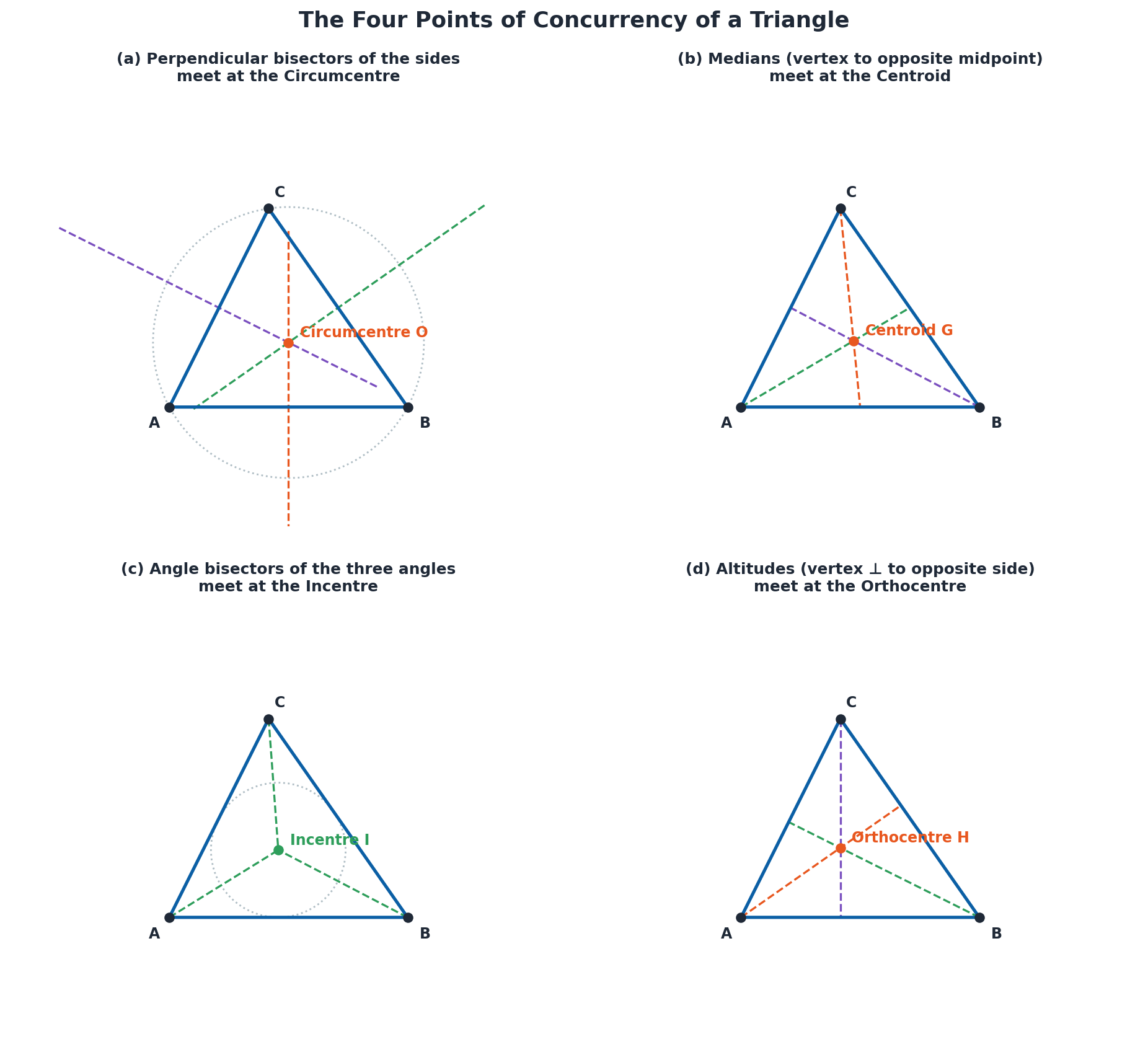
Although a triangle has three perpendicular bisectors (one per side) and three medians (one per vertex), each set of three lines always meets at exactly one shared point — a property called concurrency. The three perpendicular bisectors of a triangle are concurrent at the circumcentre, a point equidistant from all three vertices (and therefore the centre of the triangle's circumscribed circle). The three medians are concurrent at the centroid, the triangle's balance point, which always lies inside the triangle regardless of its shape.
11.3 Angle Bisector of a Triangle
An angle bisector of a triangle is a ray that starts at one vertex and splits that vertex's interior angle into two exactly equal halves; it is constructed by drawing an arc from the vertex that cuts both sides of the angle at equal distances, then drawing two further equal-radius arcs from those two points to find a crossing point inside the angle, which is then joined to the vertex.
The three angle bisectors of a triangle — one from each vertex — are always concurrent at a single point called the incentre. The incentre is equidistant from all three sides of the triangle (not the vertices), which makes it the centre of the triangle's inscribed circle (incircle), the largest circle that fits entirely inside the triangle while touching all three sides.
11.4 Altitudes of a Triangle
An altitude of a triangle is a perpendicular line segment drawn from one vertex to the line containing the side opposite that vertex (extending that side if necessary). Each triangle has three altitudes, one from each vertex, and they are constructed using a set square or a standard perpendicular-line compass construction.
The three altitudes of a triangle are always concurrent at a single point called the orthocentre. The orthocentre's position relative to the triangle depends on the triangle's shape: it lies strictly inside an acute triangle, exactly at the right-angle vertex of a right triangle, and outside an obtuse triangle (requiring the altitudes to be extended beyond the triangle's sides to find the meeting point).
11.5 Loci and Construction
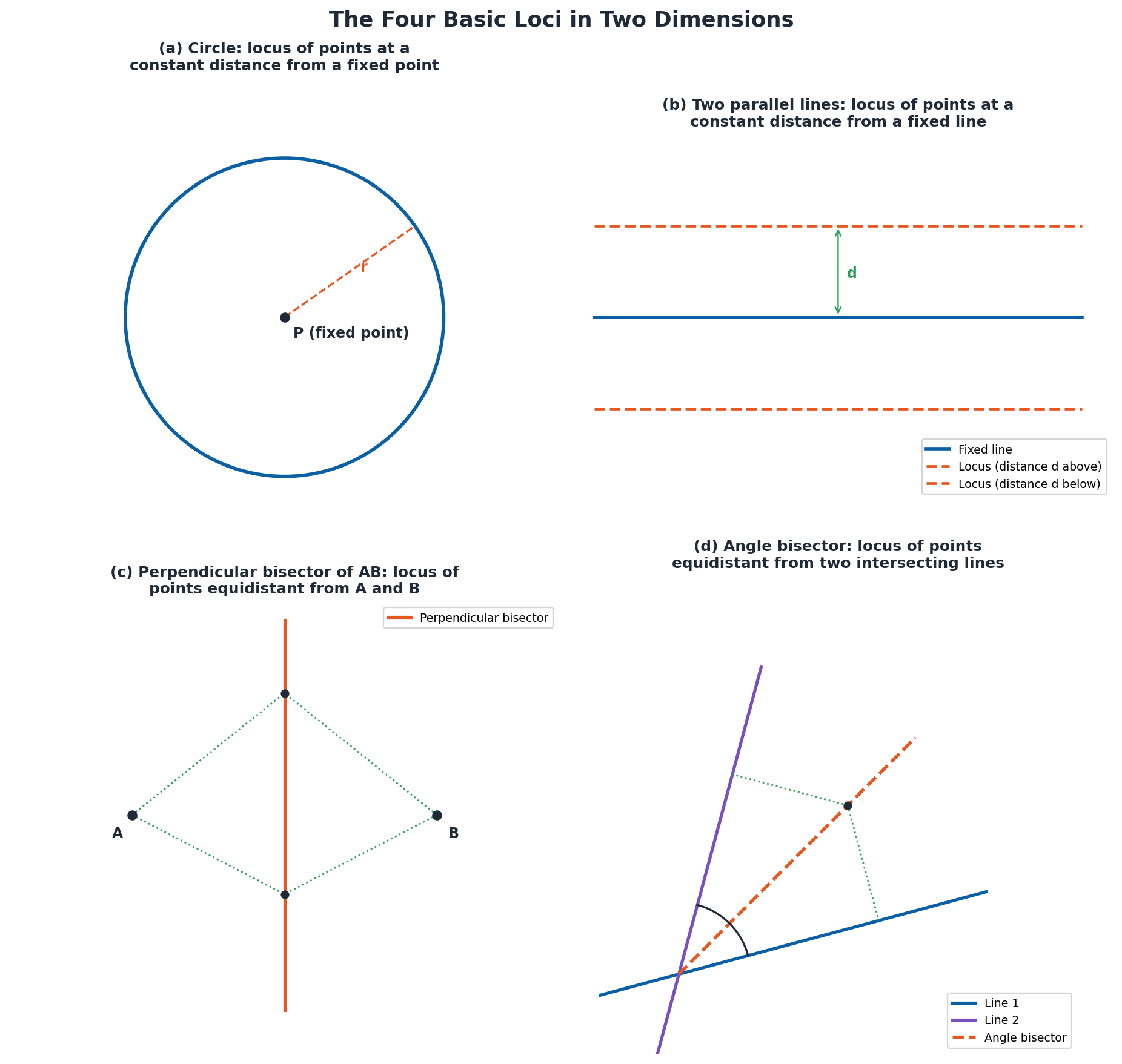
A locus (plural: loci) is the set of all points in a plane that satisfy one specific given geometric condition or rule. Rather than plotting isolated points one at a time, a locus is constructed as a continuous curve, line, or region representing every point that obeys the stated rule. Four basic loci recur throughout geometry: the locus of points at a fixed distance from a fixed point is a circle (centred at that point, with the fixed distance as radius); the locus of points at a fixed distance from a fixed straight line is a pair of straight lines running parallel to it, one on each side; the locus of points equidistant from two fixed points is the perpendicular bisector of the segment joining them; and the locus of points equidistant from two intersecting straight lines is the bisector (or pair of bisectors) of the angles formed where the lines cross.
11.5.2 Intersection of Loci: many practical construction problems involve two conditions at once, not just one. Each condition is drawn as its own locus, and the point(s) that satisfy both conditions simultaneously are exactly the point(s) where the two loci intersect. For example, a point that must be 2 cm from a given vertex and also equidistant from two given sides of a triangle is found by drawing a circle of radius 2 cm about the vertex and the angle bisector between the two sides, then marking where the circle crosses the bisector.
11.6 Real-Life Applications of Loci
Loci are not just an abstract geometric exercise — they model many real positioning problems. A fire hydrant or utility pole placed equidistant from two water sources or supply points uses the perpendicular-bisector locus; a robotic arm's safe working zone is often modelled as a circular (or rectangular-band) locus around its base showing every point it can safely reach; GPS receivers and cell-tower networks use circular loci (based on signal-timing distance) and their intersections to pin down a single physical location.
Similarly, an epidemiologist marking a quarantine zone around an outbreak site uses a circular locus of a chosen radius, and land-surveyors or treasure-hunters solving multi-clue positioning puzzles combine several loci — such as 'equidistant from two landmarks' and 'exactly 50 m from a boundary wall' — and locate the unique answer at the intersection of all the given loci.
Important Definitions
Locus
The set of all points in a plane that satisfy one specific given geometric condition or rule (plural: loci).
Perpendicular Bisector (of a segment)
A line that crosses a line segment at its exact midpoint and at a right angle to it.
Median (of a triangle)
A line segment joining a vertex of a triangle to the midpoint of the side opposite that vertex.
Point of Concurrency
A single point at which three or more lines (such as a triangle's medians or bisectors) all meet.
Circumcentre
The point of concurrency of a triangle's three perpendicular bisectors; it is equidistant from all three vertices.
Centroid
The point of concurrency of a triangle's three medians; it always lies inside the triangle and is its balance point.
Incentre
The point of concurrency of a triangle's three angle bisectors; it is equidistant from all three sides.
Orthocentre
The point of concurrency of a triangle's three altitudes.
Angle Bisector (of a triangle's angle)
A ray from a vertex that divides that vertex's interior angle into two exactly equal parts.
Altitude (of a triangle)
A perpendicular line segment drawn from a vertex to the line containing the side opposite that vertex.
Key Facts and Relations
| Topic | Key Fact / Relation |
|---|---|
| Triangle Inequality Theorem | For any triangle with sides a, b, c: a + b > c, b + c > a, and a + c > b (the sum of any two sides exceeds the third). |
| SSA — two triangles | If the given side opposite the angle is greater than the perpendicular distance from the third vertex to the ray, exactly two triangles are possible. |
| SSA — one triangle (tangent/right-angle case) | If the given side opposite the angle exactly equals the perpendicular distance, exactly one (right-angled) triangle is possible. |
| SSA — no triangle | If the given side opposite the angle is less than the perpendicular distance, no triangle is possible. |
| Perpendicular bisectors → Circumcentre | The three perpendicular bisectors of a triangle's sides are concurrent at the circumcentre, equidistant from all three vertices. |
| Medians → Centroid | The three medians of a triangle are concurrent at the centroid, which always lies inside the triangle. |
| Angle bisectors → Incentre | The three angle bisectors of a triangle are concurrent at the incentre, equidistant from all three sides. |
| Altitudes → Orthocentre | The three altitudes of a triangle are concurrent at the orthocentre. |
| Locus of points equidistant from two intersecting lines | The bisector(s) of the angles formed at the intersection of the two lines. |
Diagrams
Cases of Triangle Construction: A four-panel figure showing the SSS, SAS, ASA, and SSA (ambiguous) cases of triangle construction, with construction arcs, rays, and labelled vertices
The Four Points of Concurrency of a Triangle: A four-panel figure showing, on the same triangle, the perpendicular bisectors meeting at the circumcentre, the medians meeting at the centroid, the angle bisectors meeting at the incentre, and the altitudes meeting at the orthocentre
The Four Basic Loci in Two Dimensions: A four-panel figure showing the circle locus (fixed point), the parallel-lines locus (fixed line), the perpendicular-bisector locus (two fixed points), and the angle-bisector locus (two intersecting lines)
Solved Examples
Example 1: Constructing a Triangle Given Three Sides (SSS)
Problem: Construct triangle ABC in which AB = 6 cm, BC = 5 cm, and CA = 4 cm.
- Draw line segment AB = 6 cm using a ruler.
- Open the compass to a radius equal to CA = 4 cm, place the point at A, and draw an arc above AB.
- Open the compass to a radius equal to BC = 5 cm, place the point at B, and draw a second arc intersecting the first.
- Mark the intersection point of the two arcs as C.
- Join AC and BC with straight lines to complete triangle ABC.
Example 2: Constructing a Triangle Given Two Sides and the Included Angle (SAS)
Problem: Construct triangle PQR in which PQ = 7 cm, angle P = 60°, and PR = 5 cm.
- Draw line segment PQ = 7 cm.
- At P, construct a ray making an angle of 60° with PQ (using a protractor or a compass-based angle construction).
- On this ray, mark off a distance of 5 cm from P and label the point R.
- Join QR with a straight line to complete triangle PQR.
- Check by measurement that angle P is 60° and that PR = 5 cm as required.
Example 3: Investigating the Ambiguous Case (SSA) of Triangle Construction
Problem: In triangle ABC, angle A = 40°, AB = 7 cm, and BC = 5 cm (the side opposite angle A). Determine how many distinct triangles can be constructed, and construct them.
- Draw AB = 7 cm and construct a ray from A making an angle of 40° with AB.
- Calculate the perpendicular distance from B to this ray: BD = AB × sin(40°) ≈ 7 × 0.643 ≈ 4.5 cm.
- Compare the given side BC = 5 cm with this perpendicular distance: since 5 cm > 4.5 cm, an arc of radius 5 cm centred at B crosses the ray at two distinct points.
- Draw an arc of radius 5 cm centred at B; it intersects the ray from A at two points, C₁ and C₂, each giving a valid triangle.
- Conclude that two different triangles, ABC₁ and ABC₂, both satisfy the given SSA data — this is exactly why SSA is called the ambiguous case.
Example 4: Constructing the Perpendicular Bisectors and Medians of a Triangle
Problem: For triangle ABC with AB = 6 cm, BC = 5 cm, and CA = 5.5 cm, construct (a) the three perpendicular bisectors to locate the circumcentre, and (b) the three medians to locate the centroid.
- Construct triangle ABC using the given side lengths by the SSS method.
- For each side, open the compass to more than half that side's length and draw arcs above and below the side from both of its endpoints; join the two arc-intersection points to draw the perpendicular bisector of that side.
- Mark the point where all three perpendicular bisectors meet — this is the circumcentre, equidistant from all three vertices.
- To find the medians, locate the midpoint of each side (already found while bisecting), then join each midpoint to the vertex opposite it.
- Mark the point where all three medians meet — this is the centroid, which always lies inside the triangle.
Example 5: Constructing the Angle Bisectors of a Triangle to Locate the Incentre
Problem: For triangle ABC, construct the bisectors of all three interior angles and locate the incentre.
- At vertex A, draw an arc that cuts both sides AB and AC at equal distances from A.
- From each of these two intersection points, draw arcs of equal radius that cross inside the angle; join A to this crossing point to obtain the bisector of angle A.
- Repeat the same process at vertices B and C to construct the bisectors of angle B and angle C.
- Mark the point where all three angle bisectors meet — this is the incentre, usually labelled I.
- Note that the incentre is equidistant from all three sides of the triangle, making it the centre of the triangle's inscribed circle (incircle).
Example 6: Constructing the Altitudes of a Triangle to Locate the Orthocentre
Problem: For triangle ABC, construct the three altitudes and locate the orthocentre.
- From vertex A, draw a perpendicular line to side BC (extending BC if necessary), meeting it at the foot of the altitude.
- Repeat from vertex B, drawing a perpendicular to side CA.
- Repeat from vertex C, drawing a perpendicular to side AB.
- Mark the point where all three altitudes (or their extensions) meet — this is the orthocentre, usually labelled H.
- Note that in an acute triangle the orthocentre lies inside the triangle, in a right triangle it lies exactly at the right-angled vertex, and in an obtuse triangle it lies outside the triangle.
Example 7: Finding a Point Satisfying Two Loci Conditions
Problem: Point P lies 3 cm from a fixed point O and is also equidistant from two fixed points A and B that are 4 cm apart. Construct the locus of each condition and locate P.
- Draw a circle of radius 3 cm centred at O — this represents the first locus (all points 3 cm from O).
- Mark points A and B, 4 cm apart, then construct the perpendicular bisector of AB — this represents the second locus (all points equidistant from A and B).
- The required point(s) P must lie on both loci simultaneously, so mark where the circle and the perpendicular bisector intersect.
- If the perpendicular bisector passes within 3 cm of O, it crosses the circle at two points, giving two valid positions for P; if it passes exactly 3 cm from O it touches at one point; otherwise there is no solution.
- Label the intersection point(s) as the required position(s) of P, and verify by measurement that each is exactly 3 cm from O and equidistant from A and B.
Example 8: Real-Life Application: Locating a Facility Equidistant from Two Roads and a Fixed Distance from a Landmark
Problem: A new fire hydrant must be placed so that it is equidistant from two straight roads that cross at point O, and exactly 6 m from a landmark point L on one of the roads. Determine the possible location(s) for the hydrant.
- Represent the two roads as two straight lines crossing at O; the locus of points equidistant from both roads is the bisector of the angle they form at O.
- Construct the angle bisector of the angle between the two roads at O (there are two such bisectors, perpendicular to each other, together covering all four angles at the crossing).
- Represent the fixed-distance condition as a circle of radius 6 m centred at the landmark point L.
- Draw the circle of radius 6 m about L, and identify where it crosses the angle-bisector line(s).
- Each intersection point is a valid hydrant location, since it lies simultaneously on the angle bisector (equidistant from both roads) and on the circle (exactly 6 m from L).
Short Questions & Answers
What is the Triangle Inequality Theorem?
The sum of the lengths of any two sides of a triangle must be greater than the length of the third side; otherwise the three lengths cannot form a triangle.
Why is the SSA case of triangle construction called the ambiguous case?
Because, depending on the given measurements, it can produce two different triangles, exactly one triangle, or no triangle at all, unlike SSS, SAS, and ASA, which always give a unique triangle.
What is the difference between a perpendicular bisector and a median of a triangle?
A perpendicular bisector cuts a side at its midpoint at a right angle and does not necessarily pass through the opposite vertex, while a median joins a vertex directly to the midpoint of the opposite side.
What is a locus?
A locus is the set of all points that satisfy one specific given geometric condition or rule; the plural form is loci.
What shape is the locus of points that are a fixed distance from a fixed point?
A circle, with the fixed point as its centre and the fixed distance as its radius.
What shape is the locus of points equidistant from two fixed points?
The perpendicular bisector of the line segment joining the two fixed points.
What is the locus of points equidistant from two intersecting straight lines?
The bisector (or bisectors) of the angles formed at the intersection of the two lines.
How is the intersection of two loci used to solve a construction problem?
Each locus is drawn as a curve or line representing one condition; any point where the two loci cross satisfies both conditions simultaneously, giving the required point(s).
Long Questions & Answers
Explain the different cases of triangle construction, including the ambiguous case.
How is a triangle constructed when three sides (SSS) are given?
One side is drawn first with a ruler to its exact given length. Then, using a compass, an arc equal to the second given side is drawn from one endpoint of that side, and an arc equal to the third given side is drawn from the other endpoint. The point where the two arcs intersect is the third vertex of the triangle, and joining it to both endpoints of the original side completes the triangle. This method always gives exactly one triangle (up to reflection), provided the three lengths satisfy the Triangle Inequality Theorem.
How is a triangle constructed when two sides and the included angle (SAS) are given?
One of the given sides is drawn first as a straight line segment. At one endpoint of this side, a ray is constructed making the given included angle with the drawn side, using a protractor or a compass-based angle construction. The second given side is then marked off along this new ray from the same endpoint, fixing the position of the third vertex. Joining this new vertex to the far endpoint of the original side completes the triangle uniquely.
How is a triangle constructed when one side and two angles (ASA) are given?
The given side is drawn first between its two endpoints. At each endpoint of this side, a ray is constructed making the respective given angle with the side. Because the two angles are measured on the same side of the base and are less than 180° combined, the two rays are not parallel and must eventually cross at a single point, which becomes the third vertex of the triangle. This intersection point, joined to both original endpoints, completes a uniquely determined triangle.
What makes the SSA case different, and how many triangles can result?
In the SSA case, an angle and two sides are given, but the second side is opposite the given angle rather than included between the two given sides, so its far endpoint is only constrained to lie somewhere on a circular arc rather than at one fixed point. Comparing the given opposite side to the perpendicular distance from the third vertex to the ray from the angle determines the outcome: if the side is longer than this distance, the arc crosses the ray twice, giving two distinct triangles; if it exactly equals the distance, the arc is tangent to the ray, giving exactly one right-angled triangle; and if it is shorter than the distance, the arc never reaches the ray, so no triangle exists at all.
Explain the four types of loci in two dimensions and how the four points of concurrency in a triangle are constructed.
What are the four basic loci in two dimensions?
The four basic loci are: a circle, which is the locus of all points at a fixed distance from a fixed point, drawn by setting a compass to the given distance and swinging it fully around the point; a pair of parallel lines, which is the locus of points at a fixed distance from a fixed straight line, with one line on each side of it; the perpendicular bisector of a segment, which is the locus of all points equidistant from its two endpoints; and the angle bisector, which is the locus of all points equidistant from two intersecting straight lines, found at the bisector(s) of the angles they form.
How are the circumcentre and centroid of a triangle constructed?
The circumcentre is found by constructing the perpendicular bisector of each of the triangle's three sides — each one crossing its side at the midpoint at a right angle — and marking the single point where all three meet; this point is equidistant from all three vertices. The centroid is found by joining each vertex to the midpoint of its opposite side to form the three medians, then marking the single point where all three medians cross; this point always lies inside the triangle and represents its geometric balance point.
How are the incentre and orthocentre of a triangle constructed?
The incentre is found by bisecting each of the triangle's three interior angles with a compass-and-arc construction at each vertex, and marking the single point where all three angle bisectors meet; this point is equidistant from all three sides and is the centre of the triangle's inscribed circle. The orthocentre is found by drawing a perpendicular from each vertex to the line containing the opposite side (extending that side if needed), and marking the point where all three altitudes meet; its position shifts inside, on, or outside the triangle depending on whether the triangle is acute, right-angled, or obtuse.
How is the intersection of two loci used in real-life construction problems?
Real positioning problems usually involve more than one condition at once — for example, a facility that must be a fixed distance from a landmark and also equidistant from two roads. Each condition is drawn as its own locus: a circle for the fixed-distance condition and an angle bisector for the equidistant-from-two-roads condition. Because a valid location must satisfy both rules simultaneously, only the point(s) where the two loci actually cross qualify as solutions, which is why construction problems of this kind are solved by carefully drawing both loci accurately and then reading off their intersection point(s).
Multiple Choice Questions (MCQs)
Which of the following sets of side lengths can form a triangle? (A) 3 cm, 4 cm, 8 cm (B) 2 cm, 3 cm, 6 cm (C) 5 cm, 6 cm, 10 cm (D) 1 cm, 2 cm, 3 cm
Correct answer: (C) 5 cm, 6 cm, 10 cm. By the Triangle Inequality Theorem, 5 + 6 = 11 > 10, so this set satisfies the condition; the other sets fail it (e.g., 3+4=7 < 8).
The three angle bisectors of a triangle are always concurrent at a point called the: (A) circumcentre (B) centroid (C) incentre (D) orthocentre
Correct answer: (C) incentre. The point where all three angle bisectors of a triangle meet is called the incentre, equidistant from all three sides.
The locus of points at a constant distance from a fixed point is a: (A) straight line (B) circle (C) pair of parallel lines (D) angle bisector
Correct answer: (B) circle. A circle is defined as the set of all points at a fixed distance (the radius) from a fixed centre point.
The locus of points equidistant from two fixed points A and B is: (A) a circle centred at A (B) a circle centred at B (C) the perpendicular bisector of AB (D) a line parallel to AB
Correct answer: (C) the perpendicular bisector of AB. Every point on the perpendicular bisector of segment AB is exactly equidistant from A and B.
The locus of points at a constant distance from a fixed straight line is: (A) a single line parallel to it (B) two straight lines parallel to it, one on each side (C) a circle (D) an angle bisector
Correct answer: (B) two straight lines parallel to it, one on each side. Points at a fixed distance from a line exist on both sides of it, forming two parallel lines rather than one.
The locus of points equidistant from two intersecting straight lines is: (A) the perpendicular bisector of their point of intersection (B) a circle centred at their intersection (C) the bisector(s) of the angles between the lines (D) a line parallel to one of them
Correct answer: (C) the bisector(s) of the angles between the lines. Points equidistant from two intersecting lines lie on the bisector(s) of the angles formed at the intersection.
A median of a triangle is a line segment joining: (A) a vertex to the midpoint of the opposite side (B) the midpoints of two sides (C) a vertex perpendicular to the opposite side (D) two vertices of the triangle
Correct answer: (A) a vertex to the midpoint of the opposite side. A median always joins one vertex directly to the midpoint of the side opposite that vertex.
The perpendicular bisectors of the three sides of a triangle meet at the: (A) centroid (B) incentre (C) orthocentre (D) circumcentre
Correct answer: (D) circumcentre. The circumcentre is the point of concurrency of a triangle's three perpendicular bisectors, equidistant from all vertices.
In an obtuse triangle, the orthocentre lies: (A) inside the triangle (B) on the triangle (C) outside the triangle (D) at the centroid
Correct answer: (C) outside the triangle. For an obtuse triangle, the altitudes (or their extensions) meet at a point outside the triangle's boundary.
In the SSA case of triangle construction, if the given side opposite the angle is shorter than the perpendicular distance from the third vertex to the ray, then: (A) exactly one triangle is possible (B) exactly two triangles are possible (C) no triangle is possible (D) infinitely many triangles are possible
Correct answer: (C) no triangle is possible. If the given side cannot reach far enough to meet the ray at all, no triangle can be constructed with the given measurements.
Quick Revision Summary
- A triangle can be constructed uniquely from SSS, SAS, or ASA data using ruler-and-compass methods.
- The SSA case is ambiguous: it can yield two triangles, exactly one triangle (the tangent/right-angle case), or no triangle, depending on how the given opposite side compares with the perpendicular distance from the third vertex.
- The Triangle Inequality Theorem requires the sum of any two sides to exceed the third side for a triangle to exist at all.
- A perpendicular bisector of a side passes through its midpoint at 90°; the three perpendicular bisectors of a triangle meet at the circumcentre, equidistant from all vertices.
- A median joins a vertex to the midpoint of the opposite side; the three medians meet at the centroid, which always lies inside the triangle.
- An angle bisector splits a vertex angle into two equal parts; the three angle bisectors meet at the incentre, equidistant from all three sides.
- An altitude is a perpendicular from a vertex to the line containing the opposite side; the three altitudes meet at the orthocentre.
- A locus is the set of all points satisfying a single given rule; the four basic 2D loci are a circle, a pair of parallel lines, a perpendicular bisector, and an angle bisector.
- Where two loci intersect, the intersection point(s) satisfy both governing conditions simultaneously.
- Loci have real-life uses such as siting facilities equidistant from two points or roads, defining safe working radii for machinery, and solving land-surveying or multi-clue positioning problems.
Exam Tips
- Always draw a rough sketch of the triangle before starting the accurate ruler-and-compass construction — it helps you place arcs and rays sensibly.
- In SSA problems, calculate the perpendicular distance first (side × sine of the given angle) and compare it to the given opposite side to know whether to expect 0, 1, or 2 triangles before constructing.
- Keep your compass setting fixed while drawing an arc — do not adjust the radius partway through, or the arc will not be accurate.
- Remember which concurrency point matches which construction: perpendicular bisectors → circumcentre, medians → centroid, angle bisectors → incentre, altitudes → orthocentre.
- When solving locus intersection problems, construct each locus separately and clearly before looking for their intersection — mixing steps causes construction errors.
- Leave all construction arcs visible in your final answer — examiners look for correct compass-arc marks, not just the finished shape, as evidence of proper method.