Two figures are similar when they share the same shape but not necessarily the same size — one is simply a scaled copy of the other. This concept, first formalized by Euclid, is one of the most practically useful ideas in geometry: it underlies map scales, architectural models, photographic enlargements, and countless real-world scaling problems. This unit develops the criteria for identifying similar triangles, quadrilaterals, and solids, then builds the two central formulas of the unit — that the ratio of areas of similar figures equals the square of the ratio of corresponding lengths, and the ratio of volumes of similar solids equals the cube of that same ratio.
The unit closes by applying these ideas to the geometry of regular polygons — their interior angles, exterior angles, diagonals, and symmetry — and to genuinely practical problems: tiling a floor, painting a wall, carpeting a room, and understanding which regular polygons can tessellate a plane without gaps. Throughout, the unifying idea is the scale factor k: lengths scale by k, areas by k², and volumes by k³.
Learning Objectives
- Identify similarity of polygons using the AA, SAS, and SSS similarity criteria for triangles.
- Determine whether quadrilaterals and other polygons are similar by checking corresponding angles and side ratios.
- Apply the relationship between the areas of similar figures (ratio of areas = square of ratio of corresponding lengths).
- Apply the relationship between the volumes of similar solids (ratio of volumes = cube of ratio of corresponding lengths).
- Use the mass-volume proportionality of similar solids to solve real-world scaling problems.
- Calculate the interior angle, exterior angle, and number of diagonals of a regular polygon.
- Understand the geometric properties of triangles and parallelograms, including angle sum and exterior angle relationships.
- Determine which regular polygons can tessellate a plane and solve real-life problems involving tiling, painting, carpeting, and fencing.
Key Concepts
9.1 Similarity of Polygons and Triangles
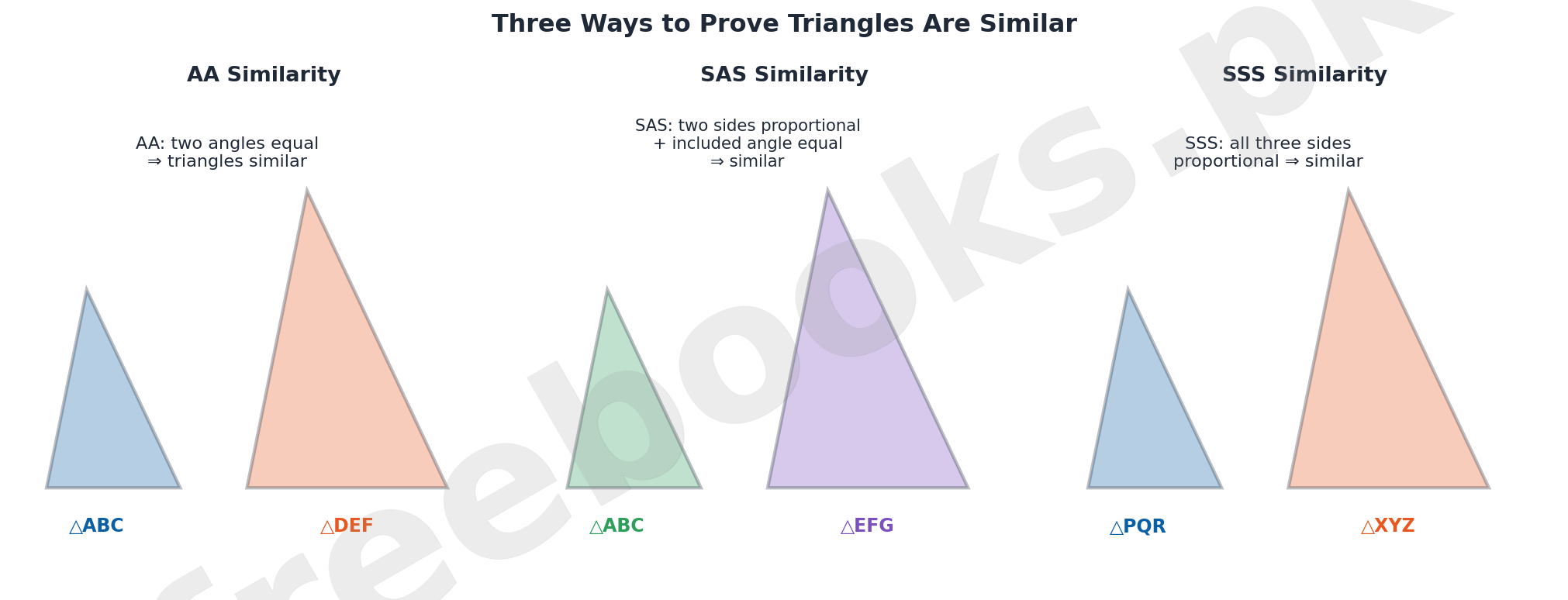
Two polygons are similar if their corresponding angles are equal and their corresponding sides are proportional — one is a scaled version of the other, denoted with the symbol ~. Three criteria identify similar triangles: AA (two pairs of corresponding angles equal, forcing the third pair equal too), SAS (two corresponding sides proportional with their included angle equal), and SSS (all three pairs of corresponding sides proportional).
When one pair of corresponding sides in two triangles is parallel, vertical and alternate angle relationships often show all three angle pairs are equal, proving the triangles similar — a technique used constantly in problems involving intersecting or nested triangles.
9.1.2 Similarity of Quadrilaterals
For quadrilaterals (and other polygons), similarity requires checking both that all corresponding angles are congruent and that all corresponding sides share the same ratio. Missing angles can be found using the fact that a quadrilateral's interior angles sum to 360°, which is often the first step before comparing angle measures.
9.2 Area of Similar Figures
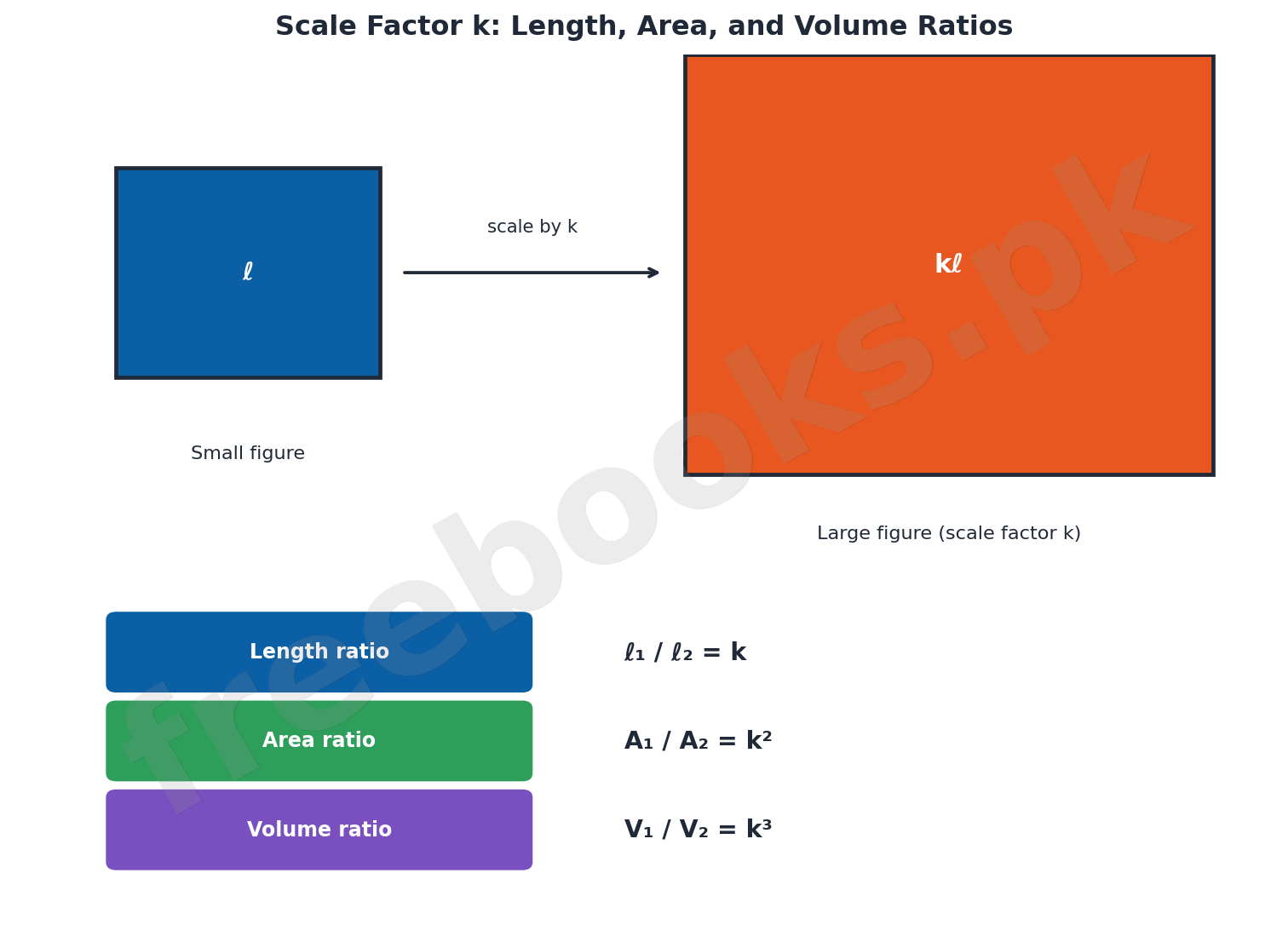
For similar figures with any pair of corresponding lengths ℓ₁ and ℓ₂, the ratio of their areas satisfies A₁/A₂ = (ℓ₁/ℓ₂)². If the scale factor is k = ℓ₁/ℓ₂, then A₁/A₂ = k² — area scales with the square of the length ratio because area is a two-dimensional quantity built from two length measurements.
9.3 Volume of Similar Solids
Similarly, for similar solids, the ratio of volumes satisfies V₁/V₂ = (ℓ₁/ℓ₂)³ = k³ — volume scales with the cube of the length ratio, since volume is a three-dimensional quantity. Because mass is proportional to volume for objects of the same material, the ratio of masses of two similar solids also equals k³: w₁/w₂ = (ℓ₁/ℓ₂)³.
9.4.1 – 9.4.3 Geometrical Properties of Polygons, Triangles, and Parallelograms
For a regular n-sided polygon: the sum of interior angles is (n−2)×180°, each interior angle measures [(n−2)×180°]/n, each exterior angle measures 360°/n, and the total number of diagonals is n(n−3)/2. Interior and exterior angles at any vertex are always supplementary (sum to 180°).
In any triangle, the interior angles sum to 180°, and an exterior angle equals the sum of the two non-adjacent (opposite) interior angles. In a parallelogram, opposite sides and opposite angles are equal, adjacent angles are supplementary, and the diagonals bisect each other (but are not necessarily equal, unless it is also a rectangle).
9.4.4 Tessellations and Real-World Applications
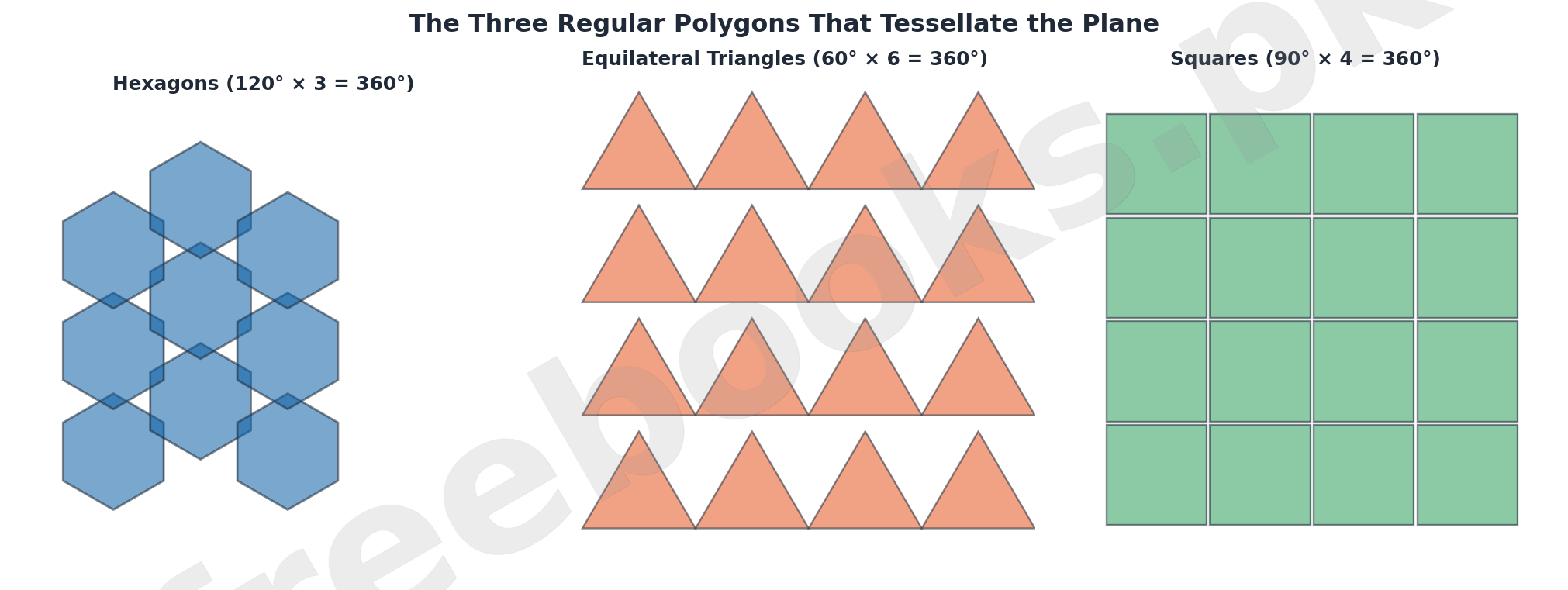
A tessellation is a pattern of shapes fitting together with no gaps or overlaps, covering a plane. A regular polygon can tessellate the plane on its own only if its interior angle divides evenly into 360° — this is true for exactly three regular polygons: equilateral triangles (60°, 6 meet at a vertex), squares (90°, 4 meet), and regular hexagons (120°, 3 meet). Regular pentagons and most other regular polygons cannot tessellate alone because their interior angles do not divide evenly into 360°.
These geometric properties directly solve real-world problems: computing the number of tiles or paint needed for a floor or wall, the carpet rolls needed for a room, or the fencing needed around a polygonal plot — all using basic area formulas alongside the similarity and polygon relationships developed in this unit.
Important Definitions
Similar Figures
Figures that have the same shape but not necessarily the same size — one is a scaled copy of the other, with equal corresponding angles and proportional corresponding sides.
Scale Factor (k)
The constant ratio between corresponding lengths of two similar figures, k = ℓ₁/ℓ₂.
AA, SAS, SSS Similarity
Three sufficient criteria for proving two triangles are similar: two equal angles (AA), two proportional sides with an equal included angle (SAS), or three proportional sides (SSS).
Regular Polygon
A polygon with all sides equal in length and all interior angles equal in measure.
Interior Angle
An angle formed inside a polygon between two adjacent sides; for a regular n-gon, each measures [(n−2)×180°]/n.
Exterior Angle
The angle formed between one side of a polygon and the extension of an adjacent side; for a regular n-gon, each measures 360°/n.
Diagonal
A line segment connecting two non-adjacent vertices of a polygon; an n-sided polygon has n(n−3)/2 diagonals.
Tessellation
A pattern of one or more shapes that fit together perfectly, without gaps or overlaps, to cover a plane.
Similar Solids
Three-dimensional solids with the same shape but possibly different sizes, having proportional corresponding lengths.
Parallelogram
A quadrilateral with both pairs of opposite sides parallel and equal, opposite angles equal, and diagonals that bisect each other.
Key Facts and Relations
| Topic | Key Fact / Relation |
|---|---|
| A₁/A₂ = (ℓ₁/ℓ₂)² = k² | Ratio of areas of similar figures equals the square of the ratio of corresponding lengths. |
| V₁/V₂ = (ℓ₁/ℓ₂)³ = k³ | Ratio of volumes of similar solids equals the cube of the ratio of corresponding lengths. |
| w₁/w₂ = (ℓ₁/ℓ₂)³ | Ratio of masses of similar solids equals the cube of the ratio of corresponding lengths (mass proportional to volume). |
| Sum of interior angles = (n−2) × 180° | Sum of the interior angles of an n-sided polygon. |
| Interior angle = [(n−2)×180°] / n | Measure of each interior angle of a regular n-sided polygon. |
| Exterior angle = 360° / n | Measure of each exterior angle of a regular n-sided polygon. |
| Number of diagonals = n(n−3)/2 | Total number of diagonals in a polygon with n sides. |
| Interior angle + Exterior angle = 180° | Interior and exterior angles at a vertex are always supplementary. |
Diagrams
Three Ways to Prove Triangles Are Similar: Three side-by-side triangle pairs illustrating the AA, SAS, and SSS similarity criteria
Scale Factor k: Length, Area, and Volume Ratios: A small and large similar figure connected by a scale factor k, with the length, area, and volume ratio formulas listed beside them
The Three Regular Polygons That Tessellate the Plane: Three tiling patterns showing hexagons, equilateral triangles, and squares each covering a plane without gaps
Solved Examples
Example 1: Proving Triangles Similar Using the SSS Criterion
Problem: In triangle ABC, the sides are AB = 6 cm, BC = 9 cm, CA = 12 cm. In triangle DEF, the sides are DE = 10.5 cm, EF = 15.75 cm, FD = 21 cm. Prove the triangles are similar.
- Compute the ratio of each pair of corresponding sides: AB/DE = 6/10.5 = 4/7.
- Compute BC/EF = 9/15.75 = 4/7.
- Compute CA/FD = 12/21 = 4/7.
- Since all three ratios are equal (4/7), by the SSS similarity criterion, triangle ABC ~ triangle DEF.
Example 2: Finding an Unknown Area Using the Ratio of Similar Figures
Problem: Two similar triangles have corresponding lengths ℓ₁ = 2.4 cm and ℓ₂ = 1.5 cm, with A₂ = 25 cm². Find A₁.
- Apply the area ratio formula: A₁/A₂ = (ℓ₁/ℓ₂)².
- Substitute the known values: A₁/25 = (2.4/1.5)² = (8/5)².
- Simplify: A₁/25 = 64/25.
- Solve for A₁: A₁ = 64 cm².
Example 3: Finding an Unknown Volume Using the Ratio of Similar Solids
Problem: Two similar solids have corresponding lengths ℓ₁ = 5 cm and ℓ₂ = 7 cm, with V₂ = 686 cm³. Find V₁.
- Apply the volume ratio formula: V₁/V₂ = (ℓ₁/ℓ₂)³.
- Substitute the known values: V₁/686 = (5/7)³ = 125/343.
- Solve for V₁: V₁ = (125/343) × 686.
- Simplify: V₁ = 250 cm³.
Example 4: Solving a Similar-Solids Mass Problem
Problem: A sack of rice with height 60 cm has mass 50 kg. Find the mass of a similar sack with height 90 cm.
- Apply the mass-volume proportionality: w₁/w₂ = (h₁/h₂)³.
- Substitute the known values: 50/w₂ = (60/90)³ = (2/3)³ = 8/27.
- Solve for w₂: w₂ = (27 × 50)/8.
- Simplify: w₂ = 168.75 kg.
Example 5: Finding the Interior and Exterior Angle of a Regular Polygon
Problem: Find the measure of each interior angle and each exterior angle of a regular pentagon.
- Apply the interior angle formula with n = 5: [(5−2)×180°]/5 = 540°/5.
- Simplify: each interior angle is 108°.
- Apply the exterior angle formula: 360°/5 = 72°.
- Verify supplementarity: 108° + 72° = 180°, confirming the relationship holds.
Example 6: Determining Whether Two Regular Polygons Can Tessellate Together
Problem: A tessellation combines regular pentagons and regular decagons. Determine whether they can tessellate together at a shared vertex.
- Find the interior angle of a regular decagon: [(10−2)×180°]/10 = 1440°/10 = 144°.
- Recall the interior angle of a regular pentagon: 108°.
- Sum the two angles at the shared vertex: 144° + 108° = 252°.
- Since 252° ≠ 360°, the two shapes cannot tessellate together without leaving gaps or overlaps.
Example 7: Using Similar Triangles to Solve a Real-World Shadow Problem
Problem: A man 1.8 m tall casts a shadow 0.76 m long. At the same time, a telephone pole casts a shadow 3 m long. Find the height of the pole.
- Recognize that the man and his shadow form a triangle similar to the pole and its shadow, since sunlight rays are parallel.
- Set up the proportion: (man's height)/(man's shadow) = (pole's height)/(pole's shadow).
- Substitute known values: 1.8/0.76 = pole height/3.
- Solve for the pole's height: pole height = (1.8/0.76) × 3 ≈ 7.11 m.
Example 8: Real-World Application: Finding the Number of Carpet Rolls Needed
Problem: A parallelogram-shaped room has a base of 10 m and a height of 8 m. Carpet rolls cover 20 m² each. How many rolls are needed?
- Compute the area of the parallelogram-shaped room: A = base × height = 10 × 8.
- Simplify: A = 80 m².
- Divide the total area by the coverage per roll: 80/20.
- Result: 4 rolls of carpet are needed.
Short Questions & Answers
What condition must be met for two polygons to be similar?
Their corresponding angles must be equal and their corresponding sides must be proportional.
What is the AA similarity criterion for triangles?
If two angles of one triangle are congruent to two corresponding angles of another triangle, the triangles are similar (the third angles must also match automatically).
How does the ratio of areas of similar figures relate to the ratio of their corresponding lengths?
The ratio of areas equals the square of the ratio of corresponding lengths: A₁/A₂ = (ℓ₁/ℓ₂)².
How does the ratio of volumes of similar solids relate to the ratio of their corresponding lengths?
The ratio of volumes equals the cube of the ratio of corresponding lengths: V₁/V₂ = (ℓ₁/ℓ₂)³.
What is the formula for the number of diagonals in an n-sided polygon?
n(n−3)/2.
Why do interior and exterior angles of a polygon sum to 180° at each vertex?
Because the interior angle and its adjacent exterior angle together form a straight line, and angles on a straight line always sum to 180°.
Which three regular polygons can tessellate a plane on their own, and why?
Equilateral triangles, squares, and regular hexagons, because their interior angles (60°, 90°, and 120° respectively) divide evenly into 360°, allowing whole numbers of them to meet at each vertex with no gaps.
Long Questions & Answers
Explain the three criteria for proving triangles similar, and how each is applied in a proof.
What is the AA criterion and why is it sufficient?
If two angles of one triangle equal two corresponding angles of another, the triangles are similar; this is sufficient because the third angle is automatically determined (all triangle angles sum to 180°), so all three angle pairs end up equal.
What is the SAS criterion?
If the ratio of two corresponding sides is equal and the angle included between those two sides is also equal, the triangles are similar — matching sides and the angle between them locks the whole triangle's shape.
What is the SSS criterion?
If the ratios of all three pairs of corresponding sides are equal, the triangles are similar, since matching all three side ratios forces the same shape regardless of angles being checked directly.
How are these criteria typically applied together with parallel-line angle facts?
When one pair of sides is parallel, vertical angles and alternate angles from the parallel lines often establish two or three angle equalities directly, allowing the AA (or full angle) criterion to be applied without measuring sides at all.
Describe how area and volume scale with similar figures, and how this applies to real-world scaling problems.
How does area scale with the length ratio of similar figures?
Area is a two-dimensional quantity, so it scales with the square of the length ratio: A₁/A₂ = (ℓ₁/ℓ₂)² = k², where k is the scale factor.
How does volume scale with the length ratio of similar solids?
Volume is a three-dimensional quantity, so it scales with the cube of the length ratio: V₁/V₂ = (ℓ₁/ℓ₂)³ = k³.
How does mass relate to these ratios for similar solids?
Since mass is proportional to volume for objects of the same material, mass also scales with the cube of the length ratio: w₁/w₂ = (ℓ₁/ℓ₂)³, exactly like volume.
How is this used in a real scaling problem?
Given a known area, volume, or mass at one scale and the ratio of corresponding lengths, the k², or k³ relationship directly gives the corresponding area, volume, or mass at the other scale — as in scaling a sack of rice's mass from a smaller to a larger similar sack using the cube of the height ratio.
Multiple Choice Questions (MCQs)
If two polygons are similar, then: (A) their corresponding angles are equal (B) their areas are equal (C) their volumes are equal (D) their corresponding sides are equal
Correct answer: (A) their corresponding angles are equal. Similar polygons have equal corresponding angles and proportional (not necessarily equal) corresponding sides.
The ratio of the areas of two similar polygons is: (A) equal to the ratio of their perimeters (B) equal to the square of the ratio of their corresponding sides (C) equal to the cube of the ratio of their corresponding sides (D) equal to the sum of their corresponding sides
Correct answer: (B) equal to the square of the ratio of their corresponding sides. Area ratio equals the square of the length ratio, A₁/A₂ = (ℓ₁/ℓ₂)².
If the volumes of two similar solids are 125 cm³ and 27 cm³, the ratio of their corresponding heights is: (A) 3:5 (B) 5:3 (C) 25:9 (D) 9:25
Correct answer: (B) 5:3. Taking the cube root of 125:27 gives 5:3, since (5/3)³ = 125/27.
The exterior angle of a regular pentagon is: (A) 40° (B) 45° (C) 60° (D) 72°
Correct answer: (D) 72°. Exterior angle = 360°/5 = 72°.
A parallelogram has area 64 cm² and a similar parallelogram has area 144 cm². If a side of the smaller parallelogram is 8 cm, the corresponding side of the larger is: (A) 10 cm (B) 12 cm (C) 18 cm (D) 16 cm
Correct answer: (B) 12 cm. Area ratio 64:144 simplifies to 4:9, so length ratio is 2:3; 8 × (3/2) = 12 cm.
The total number of diagonals in a polygon with 9 sides is: (A) 18 (B) 21 (C) 25 (D) 27
Correct answer: (D) 27. Using n(n−3)/2 = 9×6/2 = 27.
Two spheres are similar with radii in ratio 4:5. If the surface area of the larger sphere is 500π cm², the surface area of the smaller sphere is: (A) 256π cm² (B) 320π cm² (C) 400π cm² (D) 405π cm²
Correct answer: (B) 320π cm². Area ratio = (4/5)² = 16/25; smaller area = 500π × 16/25 = 320π cm².
A regular polygon has an exterior angle of 30°. How many sides does it have? (A) 8 (B) 10 (C) 12 (D) 15
Correct answer: (C) 12. Number of sides = 360°/30° = 12.
In a regular hexagon, the ratio of the length of the longest diagonal to the side length is: (A) √3 : 1 (B) 2 : 1 (C) 3 : 2 (D) 2 : 3
Correct answer: (B) 2 : 1. The longest diagonal of a regular hexagon passes through the center and equals twice the side length, giving ratio 2:1.
A regular polygon has an interior angle of 165°. How many sides does it have? (A) 15 (B) 16 (C) 20 (D) 24
Correct answer: (D) 24. Exterior angle = 180°−165° = 15°; number of sides = 360°/15° = 24.
Quick Revision Summary
- Two polygons are similar when corresponding angles are equal and corresponding sides are proportional; triangles specifically can be proved similar via AA, SAS, or SSS.
- Area ratio of similar figures = square of the length ratio (A₁/A₂ = k²); volume ratio of similar solids = cube of the length ratio (V₁/V₂ = k³).
- Mass of similar solids scales the same way as volume, since mass is proportional to volume for the same material.
- Interior angle of a regular n-gon = [(n−2)×180°]/n; exterior angle = 360°/n; number of diagonals = n(n−3)/2.
- Interior and exterior angles at any polygon vertex are always supplementary (sum to 180°).
- Only equilateral triangles, squares, and regular hexagons can tessellate a plane alone, because their interior angles divide evenly into 360°.
Exam Tips
- When proving triangle similarity, look first for parallel lines — they usually hand you two angle equalities immediately via alternate or vertical angles.
- Always double-check which ratio (ℓ₁/ℓ₂ or ℓ₂/ℓ₁) matches which area/volume in the formula before substituting — flipping it is a common error.
- Remember: lengths scale by k, areas by k², volumes by k³ — write this out before starting any similar-figures word problem.
- For polygon-angle problems, always compute n from the given angle first (via 360°/exterior angle) before answering further sub-questions.
- To test if two regular polygons can tessellate together, always check whether their interior angles sum to exactly 360° at the shared vertex.
- In real-world area/tiling problems, compute the area of the room or wall first, then divide by the coverage of a single tile, roll, or gallon — do the division last.