Logic is the systematic study of reasoning — it gives mathematics a precise language for deciding whether a statement is true, combining statements into new ones, and building airtight chains of argument from accepted facts to new conclusions. This unit introduces the mathematical statement as the basic unit of logic, then builds up the five standard logical operators (negation, conjunction, disjunction, conditional, and biconditional) along with the truth tables that define exactly when each combined statement is true or false.
From there, the unit explores the deep relationships between a conditional and its converse, inverse, and contrapositive, and introduces the vocabulary mathematicians use to classify claims: axioms (accepted without proof), theorems (proved true), and conjectures (believed true but unproven). The unit closes by teaching the practical skill of writing a deductive proof — a step-by-step algebraic argument showing that one side of an equation equals the other, justifying every step with a known law or property.
Learning Objectives
- Understand what a mathematical statement is and what it means for a statement to be true or false.
- Differentiate between an axiom, a conjecture, and a theorem, with examples of each.
- Use the logical operators negation, conjunction, disjunction, conditional, and biconditional, and construct their truth tables.
- Form the converse, inverse, and contrapositive of a given conditional statement and understand the equivalences between them.
- Understand the difference between inductive and deductive reasoning.
- Formulate simple deductive proofs, including algebraic proofs that show the left-hand side of an equation equals the right-hand side.
Key Concepts
8.1 Mathematical Statements
A statement is a sentence or mathematical expression that is either true or false, but not both. Statements are the fundamental building blocks of logic — for example, 'x^m · x^n = x^(m+n)' and 'the sum of two odd integers is an even integer' are both true mathematical statements, while '3 + 4 = 8' is a false one.
Inductive reasoning draws general conclusions from repeated observations or experiments (common in natural sciences), while deductive reasoning draws conclusions from premises already accepted as true, guaranteeing the conclusion is true if the premises are true. Mathematics relies primarily on deductive reasoning to build reliable, provable knowledge.
8.1.1 – 8.1.2 Logical Operators and Truth Tables
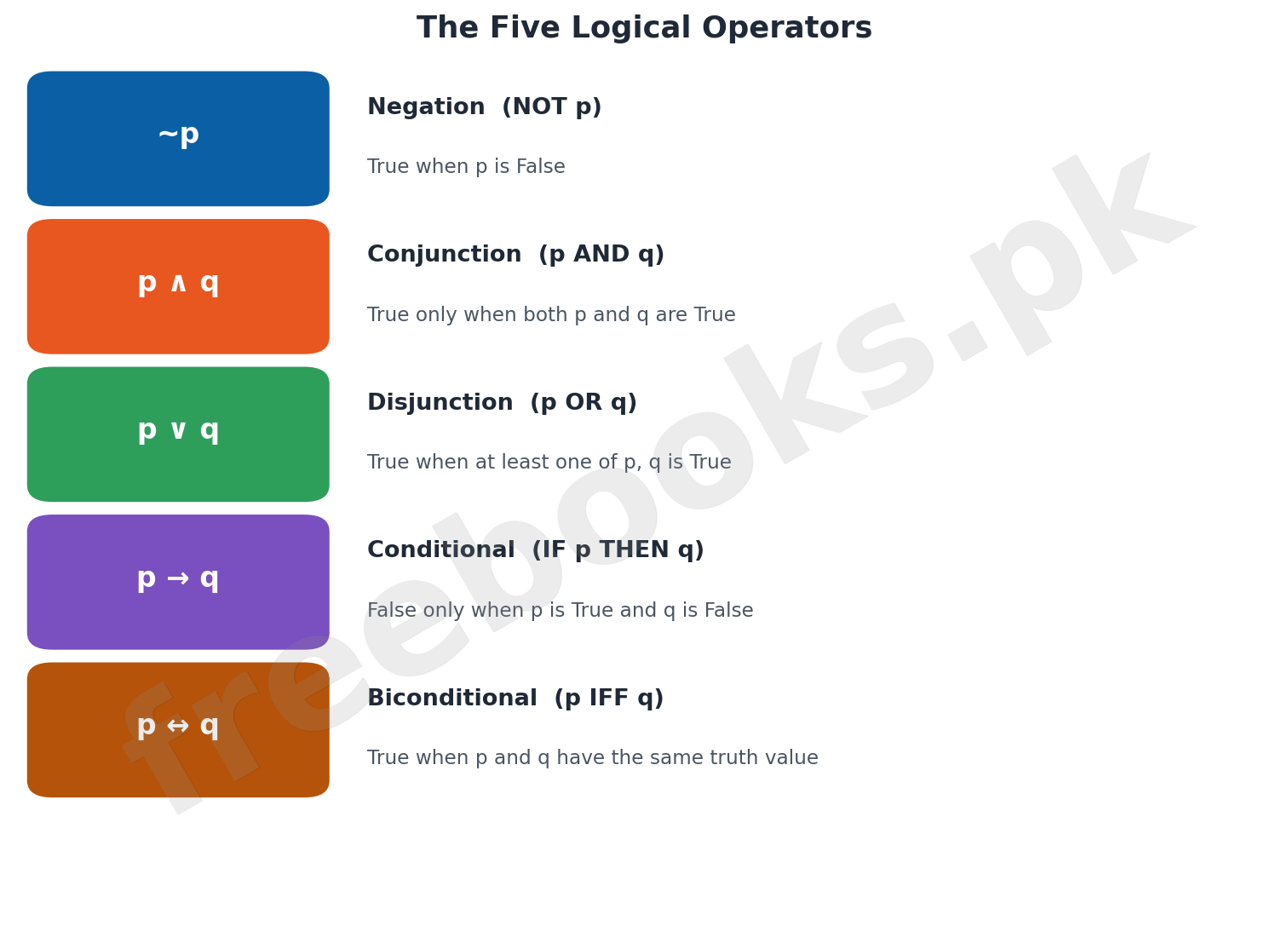
Negation (~p, 'not p') reverses a statement's truth value. Conjunction (p ∧ q, 'p and q') is true only when both p and q are true. Disjunction (p ∨ q, 'p or q') is true when at least one of p, q is true, and false only when both are false.
The conditional (p → q, 'if p then q') is false only in the single case where p is true and q is false — in every other combination it is considered true. The biconditional (p ↔ q, 'p if and only if q') is true exactly when p and q share the same truth value, whether both true or both false.
Converse, Inverse, and Contrapositive
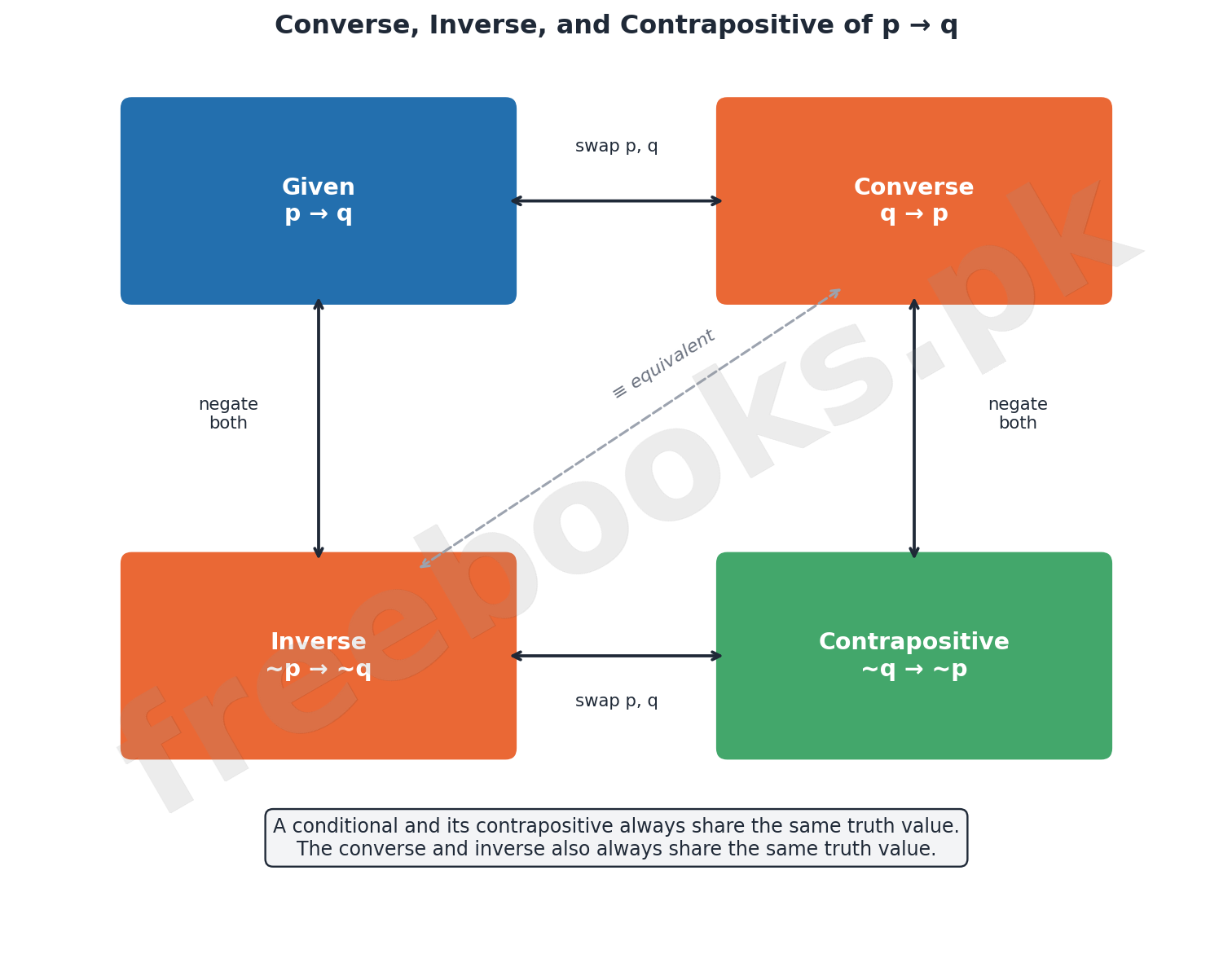
For a given conditional p → q: the converse is q → p (swapping the two statements), the inverse is ~p → ~q (negating both statements), and the contrapositive is ~q → ~p (negating both statements and swapping their order). A conditional and its contrapositive always share the same truth value (they are logically equivalent), and likewise the converse and the inverse are always equivalent to each other — this is why a theorem can sometimes be proved more easily by proving its contrapositive instead.
8.1.3 Mathematical Proof
A mathematical proof is a logical sequence of steps, each justified by a known fact, definition, or previously proven result, that establishes a statement is true beyond doubt. Proofs are the mathematical equivalent of the evidence a court or a warranty claim requires — a claim is only accepted once solid justification is presented, not merely asserted.
8.1.4 Theorem, Conjecture, and Axiom
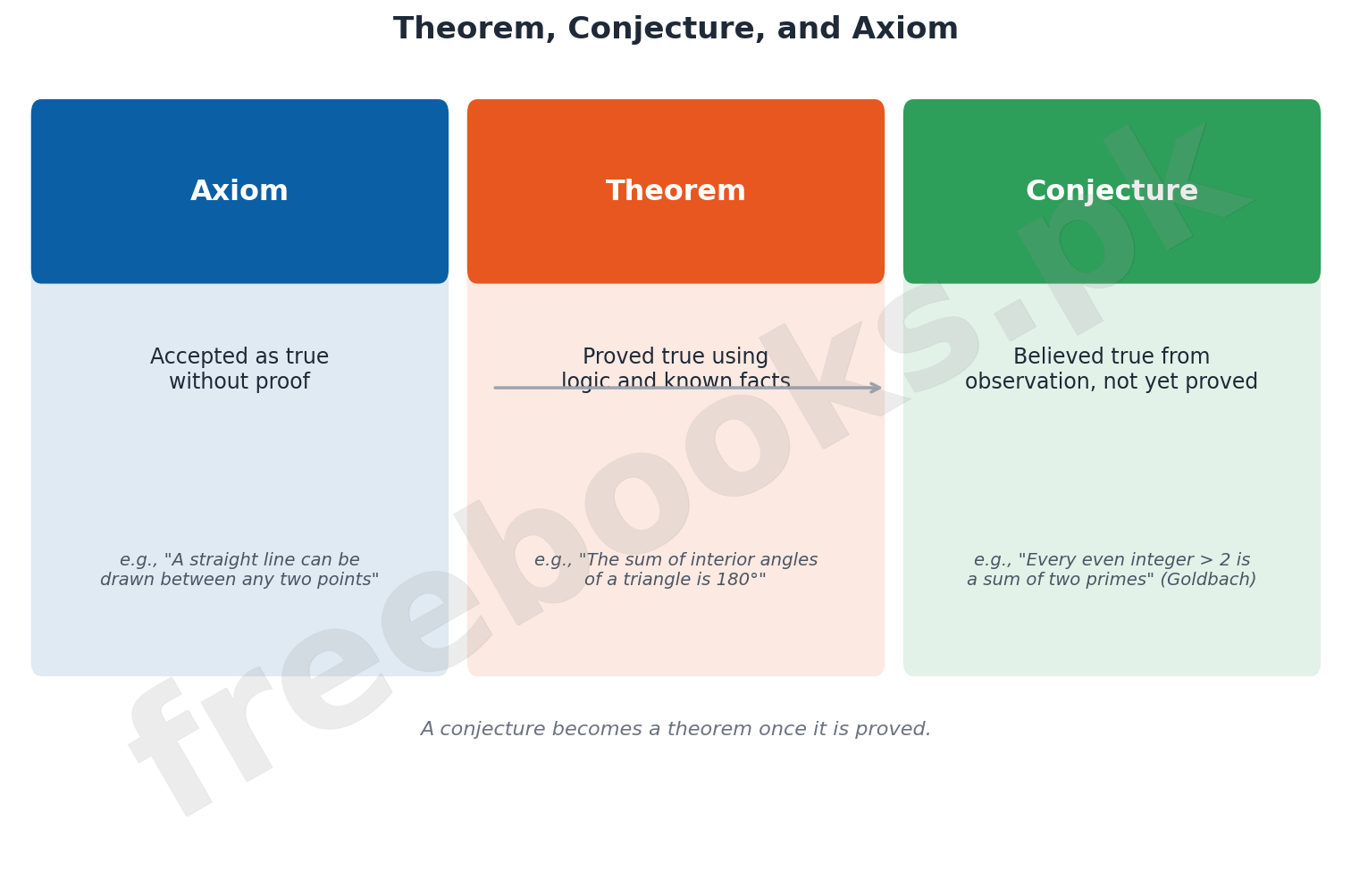
A theorem is a mathematical statement that has been proved true using logical reasoning from previously known facts — for example, that the interior angles of a quadrilateral sum to 360°. A conjecture is a statement believed to be true based on observation but not yet proved, such as the still-unproven Goldbach Conjecture that every even integer greater than 2 is the sum of two primes; if a conjecture is later proved, it becomes a theorem.
An axiom (or postulate, when specifically in geometry) is a statement accepted as true without requiring proof, serving as a foundational starting point for building further mathematical arguments — for example, that a straight line can be drawn between any two points.
8.1.5 Deductive (Algebraic) Proof
A deductive algebraic proof shows that a given equation's left-hand side (LHS) equals its right-hand side (RHS) through a sequence of algebraically valid steps, each one justified explicitly by a law such as the distributive property, commutative law, multiplicative identity, or multiplicative inverse. This is the standard technique for proving algebraic identities like (x+1)² + 7 = x² + 2x + 8.
Important Definitions
Statement
A sentence or mathematical expression that is either true or false, but not both.
Negation (~p)
The logical operator that reverses the truth value of a statement p; true when p is false, and false when p is true.
Conjunction (p ∧ q)
A compound statement 'p and q' that is true only when both p and q are true.
Disjunction (p ∨ q)
A compound statement 'p or q' that is true when at least one of p or q is true, and false only when both are false.
Conditional (p → q)
An 'if p then q' statement, false only when p (the antecedent) is true and q (the consequent) is false.
Biconditional (p ↔ q)
A 'p if and only if q' statement, true exactly when p and q have the same truth value.
Converse, Inverse, Contrapositive
For p → q: the converse is q → p, the inverse is ~p → ~q, and the contrapositive is ~q → ~p.
Axiom (Postulate)
A statement accepted as true without requiring proof, used as a starting point for further reasoning; called a postulate specifically in geometry.
Theorem
A mathematical statement that has been proved true using logical reasoning from previously known facts or axioms.
Conjecture
A mathematical statement believed to be true based on observation but not yet proved; becomes a theorem if proved.
Key Facts and Relations
| Topic | Key Fact / Relation |
|---|---|
| ~p is true iff p is false | Definition of negation. |
| p ∧ q is true iff both p and q are true | Definition of conjunction. |
| p ∨ q is true iff at least one of p, q is true | Definition of disjunction. |
| p → q is false iff p is true and q is false | Definition of the conditional. |
| p ↔ q is true iff p and q share the same truth value | Definition of the biconditional. |
| Converse of p → q is q → p | Formed by swapping the antecedent and consequent. |
| Inverse of p → q is ~p → ~q | Formed by negating both the antecedent and consequent. |
| Contrapositive of p → q is ~q → ~p | Formed by negating and swapping both parts; always equivalent to p → q. |
Diagrams
The Five Logical Operators: A summary panel listing negation, conjunction, disjunction, conditional, and biconditional with their symbols, readings, and truth rules
Converse, Inverse, and Contrapositive of a Conditional: A diagram of four related conditional statements connected by arrows showing how each is derived, with the equivalence between a conditional and its contrapositive highlighted
Theorem, Conjecture, and Axiom: A three-panel comparison of axioms, theorems, and conjectures with definitions and examples, showing how a conjecture becomes a theorem once proved
Solved Examples
Example 1: Determining the Truth Value of Conjunctions
Problem: Determine whether each conjunction is true or false: (i) Lahore is the capital of Punjab and Quetta is the capital of Balochistan. (ii) 4 < 5 ∧ 8 < 10. (iii) 2+2=3 ∧ 6+6=10.
- Recall that a conjunction p ∧ q is true only when both p and q are individually true.
- For (i): both statements are factually true, so the conjunction is true.
- For (ii): both 4<5 and 8<10 are true, so the conjunction is true.
- For (iii): both 2+2=3 and 6+6=10 are false statements, so the conjunction is false.
Example 2: Constructing a Truth Table for a Compound Statement
Problem: Construct the truth table of [(p → q) ∧ p] → q.
- List all four combinations of truth values for p and q: TT, TF, FT, FF.
- Compute p → q for each row using its definition (false only when p is T and q is F).
- Compute (p → q) ∧ p for each row by taking the conjunction of the previous column with p.
- Compute the final column [(p → q) ∧ p] → q; the result is true in all four rows, showing this compound statement is a logical law (tautology).
Example 3: Finding the Converse, Inverse, and Contrapositive
Problem: Given the conditional p → q, find its converse, inverse, and contrapositive, and state which pairs are logically equivalent.
- Form the converse by swapping the statements: q → p.
- Form the inverse by negating both statements: ~p → ~q.
- Form the contrapositive by negating and swapping: ~q → ~p.
- Recall from the truth table that a conditional and its contrapositive always share the same truth value, and the converse and inverse always share the same truth value with each other.
Example 4: Proving a Statement About Odd Integers
Problem: Prove that if x is an odd integer, then x² is also an odd integer.
- Express x using the definition of an odd integer: x = 2k + 1 for some integer k.
- Square both sides: x² = (2k+1)² = 4k² + 4k + 1.
- Factor to isolate a multiple of 2: x² = 2(2k²+2k) + 1.
- Let m = 2k²+2k, an integer, so x² = 2m + 1, which matches the definition of an odd integer — hence x² is odd.
Example 5: Proving a Set Identity Using Logical Steps
Problem: Prove that for any two non-empty sets A and B, (A ∪ B)' = A' ∩ B'.
- Let x ∈ (A ∪ B)'; by definition, x ∉ (A ∪ B), meaning x ∉ A and x ∉ B.
- This means x ∈ A' and x ∈ B', so x ∈ A' ∩ B', showing (A ∪ B)' ⊆ A' ∩ B'.
- Conversely, let y ∈ A' ∩ B'; then y ∉ A and y ∉ B, so y ∉ (A ∪ B), meaning y ∈ (A ∪ B)'.
- This shows A' ∩ B' ⊆ (A ∪ B)'; combining both inclusions gives (A ∪ B)' = A' ∩ B'.
Example 6: Classifying a Statement as Axiom, Theorem, or Conjecture
Problem: Classify each statement: (i) There is exactly one straight line through any two points. (ii) Every even number greater than 2 can be written as the sum of two primes. (iii) The sum of the angles in a triangle is 180°.
- For (i): this is accepted as a basic geometric fact without proof, so it is an axiom (postulate).
- For (ii): this is the Goldbach Conjecture — believed true from extensive observation but never proved, so it is a conjecture.
- For (iii): this has been logically proved from more basic geometric facts, so it is a theorem.
Example 7: Formulating a Deductive Algebraic Proof
Problem: Prove that (x + 1)² + 7 = x² + 2x + 8, justifying each step.
- Start from the left-hand side: (x+1)² + 7 = (x+1)(x+1) + 7.
- Apply the distributive law: x(x+1) + 1(x+1) + 7 = x²+x+x+1+7.
- Combine like terms using the commutative law: x² + 2x + 8.
- Since this matches the right-hand side exactly, LHS = RHS, so the identity is proved.
Example 8: Proving a Rational Expression Identity
Problem: Prove that (45x + 15)/15 = 3x + 1, justifying each step.
- Rewrite the left-hand side using division as multiplication: (1/15) × (45x + 15).
- Factor 15 out of the bracket: (1/15) × 15(3x + 1), using the distributive law in reverse.
- Apply the associative law: [(1/15) × 15] × (3x + 1) = 1 × (3x + 1), using the multiplicative inverse.
- Apply the multiplicative identity: 1 × (3x+1) = 3x + 1, matching the right-hand side, so the identity is proved.
Short Questions & Answers
What makes a sentence a mathematical statement?
It must be either true or false, but not both — this true-or-false property is what distinguishes a statement from other kinds of sentences.
What is the difference between inductive and deductive reasoning?
Inductive reasoning draws general conclusions from repeated observations, while deductive reasoning draws conclusions from premises already accepted as true, guaranteeing the conclusion follows logically.
When is a conditional p → q considered false?
Only when the antecedent p is true and the consequent q is false; in every other case it is considered true.
What is the contrapositive of p → q, and why is it useful?
The contrapositive is ~q → ~p; it is useful because it is always logically equivalent to the original conditional, so a theorem can sometimes be proved more easily by proving its contrapositive instead.
What is the key difference between a theorem and a conjecture?
A theorem has been proved true using logical reasoning from known facts, while a conjecture is only believed true from observation and has not yet been proved.
Why are axioms accepted without proof?
Axioms are basic, self-evident facts that serve as the starting point for building further mathematical arguments; there is nothing more fundamental to prove them from.
What is a deductive algebraic proof used for?
It is used to show that the left-hand side of an equation equals the right-hand side by justifying each algebraic step with a known law, such as the distributive or commutative law.
Long Questions & Answers
Explain the five logical operators and how their truth tables are constructed.
What is negation and how is its truth table built?
Negation ~p reverses the truth value of p: when p is true, ~p is false, and when p is false, ~p is true — a simple two-row truth table.
What are conjunction and disjunction, and how do their truth values differ?
Conjunction p∧q requires both p and q to be true to be true overall, while disjunction p∨q only requires at least one of them to be true — disjunction is false only when both are false.
What is the conditional and why is its truth table often confusing?
The conditional p→q is false only when p is true and q is false; in the other three combinations (including when p is false) it is considered true, which can seem counterintuitive but reflects that a false hypothesis makes no claim that can be contradicted.
What is the biconditional, and when is it true?
The biconditional p↔q, meaning p→q and q→p together, is true exactly when p and q share the same truth value — both true, or both false.
Describe how theorems, conjectures, and axioms differ, and how a deductive proof is constructed to establish a theorem.
How do axioms, theorems, and conjectures differ in their basis?
Axioms are accepted as true without proof as foundational starting points; theorems are proved true through logical reasoning from axioms and known facts; conjectures are only believed true from observation and evidence, without proof.
What happens to a conjecture once it is proved?
A proved conjecture becomes a theorem — the Fermat's Last Theorem case shows this transition can take centuries, having remained an unproven conjecture for over 350 years before Andrew Wiles's proof in 1993.
What is the general structure of a deductive algebraic proof?
The proof starts from one side of the equation (typically the LHS), applies a sequence of algebraically valid transformations, each explicitly justified by a named law or property, until it matches the other side (RHS) exactly.
How does justifying each step matter in a deductive proof?
Without explicit justification (e.g., citing the distributive law or multiplicative identity), a proof is just an unverified sequence of algebra; naming the law used at each step is what makes the proof logically rigorous rather than merely suggestive.
Multiple Choice Questions (MCQs)
Which of the following is often associated with inductive reasoning? (A) based on repeated experiments (B) if and only if statements (C) statement proven by a theorem (D) based on general principles
Correct answer: (A) based on repeated experiments. Inductive reasoning draws general conclusions from repeated observations or experiments.
Which sentence best describes deductive reasoning? (A) general conclusions from limited observations (B) based on repeated experiments (C) based on units of accurate information (D) draw conclusions from well-known facts
Correct answer: (D) draw conclusions from well-known facts. Deductive reasoning draws conclusions from premises already accepted or known to be true.
Which of the following statements is true? (A) The set of integers is finite (B) The sum of interior angles of any quadrilateral is always 180° (C) 22/7 ∉ Q' (D) All isosceles triangles are equilateral triangles
Correct answer: (C) 22/7 ∉ Q'. 22/7 is a rational number, so it is correctly stated as not belonging to the set of irrational numbers Q'.
The conjunction of two statements p and q is true when: (A) both p and q are false (B) both p and q are true (C) only q is true (D) only p is true
Correct answer: (B) both p and q are true. A conjunction p∧q requires both statements to be true simultaneously.
A conditional is regarded as false only when: (A) antecedent is true and consequent is false (B) consequent is true and antecedent is false (C) antecedent is true only (D) consequent is false only
Correct answer: (A) antecedent is true and consequent is false. This is the sole case in which a conditional p→q is considered false.
The contrapositive of q → p is: (A) q → ~p (B) ~q → p (C) ~p → ~q (D) ~p → ~q reversed correctly as ~p → ~q
Correct answer: (C) ~p → ~q. The contrapositive of q→p is formed by negating and swapping both parts, giving ~p → ~q.
The statement 'Every even integer greater than 2 is a sum of two prime numbers' is a: (A) theorem (B) conjecture (C) axiom (D) postulate
Correct answer: (B) conjecture. This is the Goldbach Conjecture — widely believed true but never proved, making it a conjecture.
The statement 'A straight line can be drawn between any two points' is a(n): (A) theorem (B) conjecture (C) axiom (D) logic
Correct answer: (C) axiom. This is one of Euclid's foundational axioms, accepted without proof.
The statement 'The sum of the interior angles of a triangle is 180°' is a: (A) converse (B) theorem (C) axiom (D) conditional
Correct answer: (B) theorem. This has been logically proved from more basic geometric facts, making it a theorem.
Which best represents the negation of 'The stove is burning'? (A) The stove is not burning (B) The stove is dim (C) The stove is turned to low heat (D) It is both burning and not burning
Correct answer: (A) The stove is not burning. Negation simply reverses the truth value of the original statement without adding new claims.
Quick Revision Summary
- A statement must be either true or false, never both — this is the foundation of all logical reasoning in mathematics.
- Negation, conjunction, disjunction, conditional, and biconditional each have a precise truth table that defines exactly when the compound statement is true.
- A conditional p→q is false only when p is true and q is false — this single exception trips up many students.
- A conditional and its contrapositive are always logically equivalent; the converse and inverse are also always equivalent to each other.
- Axioms are accepted without proof, theorems are proved true, and conjectures are believed true but unproven — a conjecture becomes a theorem once proved.
- A deductive algebraic proof must justify every single step with a named law (distributive, commutative, associative, multiplicative identity/inverse) — an unjustified step is not a valid proof.
Exam Tips
- When building a truth table, always list the T/F combinations for p and q in the same consistent order (TT, TF, FT, FF) to avoid errors.
- Remember the conditional's one false case by heart: true antecedent, false consequent — everything else defaults to true.
- To prove a theorem indirectly, try proving its contrapositive instead; since they're equivalent, this sometimes makes the argument far simpler.
- Always define odd/even integers algebraically (x = 2k+1 or x = 2k) before starting a proof involving them — this is the standard entry point.
- In a deductive algebraic proof, write the specific law used in parentheses next to every step — a proof without justification is incomplete.
- Distinguish carefully between an axiom (no proof needed) and a conjecture (no proof exists yet) — the difference is whether proof is required at all, not just whether one currently exists.