A set is a well-defined collection of distinct objects, described in descriptive, tabular (roster), or set-builder form. Building on this foundation, this unit reviews the key set types (singleton, empty, equal, equivalent, subset, universal, power set) and the operations performed on sets — union, intersection, difference, and complement — all visualized using Venn diagrams, developed by John Venn. It extends these ideas to three sets, covering the associative, distributive, and De Morgan's laws, and applies the inclusion-exclusion principle to solve real-world classification problems in demographics, surveys, and product categorization.
The unit then introduces binary relations (subsets of a Cartesian product A×B) and functions — a special type of relation where every element of the domain maps to exactly one element of the range. Relations and functions can be represented as tables, ordered pairs, or graphs. The unit classifies functions into into, one-one (injective), onto (surjective), and bijective types using mapping diagrams, and covers function notation, evaluation, and linear/quadratic function forms.
Learning Objectives
- Identify sets and apply union, intersection, and complement operations on two and three sets using Venn diagrams
- Verify the commutative, associative, distributive, and De Morgan's laws for union and intersection
- Apply the inclusion-exclusion principle to solve real-world classification and survey problems
- Explain the Cartesian product, binary relations, and their domain and range
- Represent a relation as a table, a set of ordered pairs, and a graph
- Determine the value, domain, and range of a function using function notation
- Identify into, one-one (injective), onto (surjective), and bijective functions using Venn/mapping diagrams
Key Concepts
3.1 Sets: Definitions and Representation
A set is a well-defined collection of distinct objects; capital letters name sets, lowercase letters name elements, and ∈ denotes membership. A set can be described descriptively (in words), in tabular/roster form (listing elements), or by set-builder notation (e.g. A={x | x is a vowel of the English alphabet}).
Key set types: a singleton set has exactly one element; an empty (null/void) set ∅ has no elements; equal sets have exactly the same elements; equivalent sets have the same number of elements (written A~B); A is a subset of B (A⊆B) if every element of A is in B, a proper subset (A⊂B) if B also has an element not in A; the universal set U contains all elements under consideration; the power set P(S) contains all subsets of S, with n(P(S))=2^m for a set of m elements.
3.2 Operations on Sets and Venn Diagrams
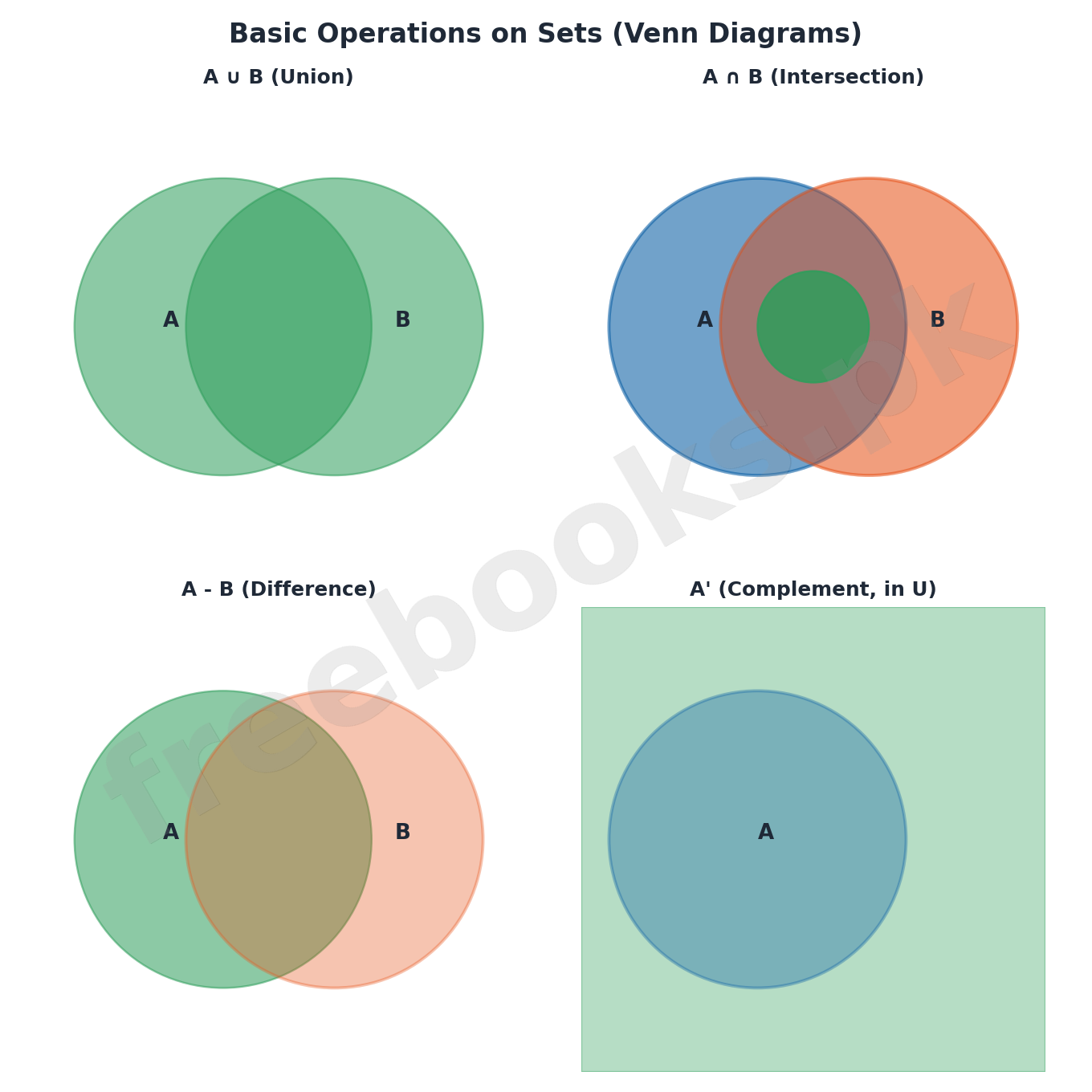
Union A∪B={x | x∈A ∨ x∈B}; Intersection A∩B={x | x∈A ∧ x∈B}; sets are disjoint if A∩B=∅, and overlapping if A∩B≠∅ but neither is a subset of the other. Difference A-B={x | x∈A ∧ x∉B}; Complement A'=U-A={x | x∈U ∧ x∉A}. Venn diagrams (rectangle=U, circles=sets) visualize all these operations.
For three sets, the key properties are: commutative (A∪B=B∪A, A∩B=B∩A), associative (A∪(B∪C)=(A∪B)∪C), distributive (A∪(B∩C)=(A∪B)∩(A∪C) and its dual), and De Morgan's Laws ((A∪B)'=A'∩B' and (A∩B)'=A'∪B') — each verifiable both analytically (by listing elements) and visually (by shading Venn diagram regions).
3.2.1 The Inclusion-Exclusion Principle
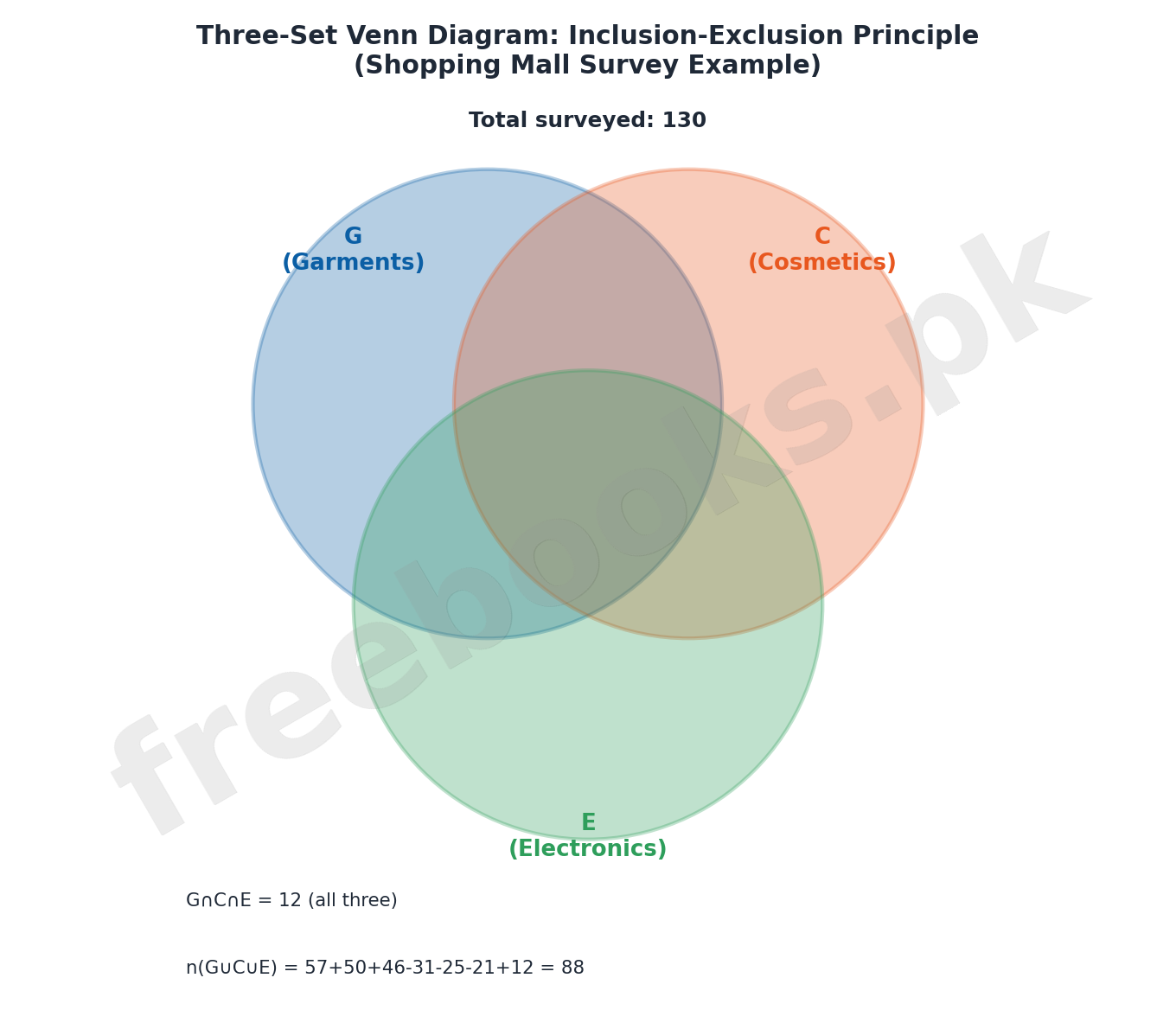
The cardinality n(A) of a set is its number of elements. For two sets, n(A∪B)=n(A)+n(B)-n(A∩B); for three sets, n(A∪B∪C)=n(A)+n(B)+n(C)-n(A∩B)-n(A∩C)-n(B∩C)+n(A∩B∩C). These formulas solve real-world classification problems: surveys, demographic overlaps, and product categorization, letting unknown overlap counts be found from known totals.
3.3 Binary Relations
For non-empty sets A and B, the Cartesian product A×B={(x,y) | x∈A, y∈B} is the set of all ordered pairs. Any subset of A×B is called a binary relation (or simply relation) from A to B, usually denoted r. The domain of r is the set of first elements of its ordered pairs; the range is the set of second elements. A relation can be represented as a table, a set of ordered pairs, or a graph (plotting each ordered pair as a point).
3.3.2 Functions: Definition, Notation, and Domain/Range
A function f from A to B is a relation (subset of A×B) where the domain of f equals A, and no two ordered pairs share the same first element — written f:A→B. If (x,y)∈f, we write y=f(x), calling y the value/image of x under f. The domain is the input set, the codomain is B, and the range (⊆codomain) is the set of actual output values.
Function evaluation substitutes a specific input into the function's rule to compute the output, e.g. for f(x)=2x-1, f(3)=2(3)-1=5. A linear function has the form {(x,y) | y=mx+c} (graph is a straight line); a quadratic function has the form {(x,y) | y=ax²+bx+c}.
3.3.2 Types of Functions
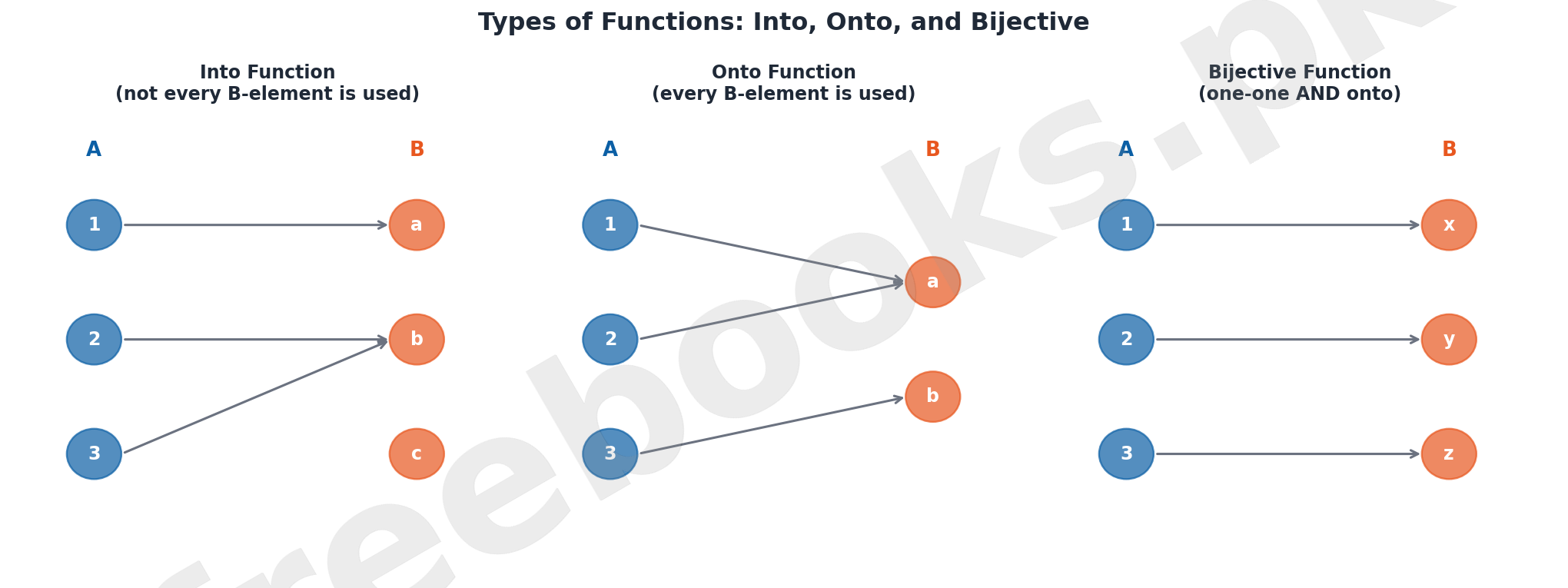
An into function f:A→B has Range(f)⊂B (not every element of B is used). A one-one (injective) function has no two ordered pairs sharing the same second element. An onto (surjective) function has Range(f)=B (every element of B is used). A bijective function is both one-one and onto, giving a (1-1) correspondence between A and B — these types are identified visually using mapping/Venn diagrams.
Important Definitions
What is a set?
A well-defined collection of distinct objects, numbers, or elements.
What is a singleton set?
A set with exactly one element, e.g. {3}.
What is a subset?
A⊆B if every element of A is also an element of B.
What is the power set of a set S?
P(S), the set of all possible subsets of S; if n(S)=m, then n(P(S))=2^m.
What is the union of two sets A and B?
A∪B={x | x∈A ∨ x∈B}, the set of all elements in A or B (or both).
What is the intersection of two sets A and B?
A∩B={x | x∈A ∧ x∈B}, the set of all elements in both A and B.
What is the Cartesian product A×B?
The set of all ordered pairs (x,y) such that x∈A and y∈B.
What is a binary relation from A to B?
Any subset of the Cartesian product A×B.
What is a function f:A→B?
A relation from A to B where the domain equals A and no two ordered pairs share the same first element.
What is a bijective function?
A function that is both one-one (injective) and onto (surjective), giving a (1-1) correspondence between the two sets.
Key Facts and Relations
| Topic | Key Fact / Relation |
|---|---|
| Union of two sets | A ∪ B = {x | x∈A ∨ x∈B} |
| Intersection of two sets | A ∩ B = {x | x∈A ∧ x∈B} |
| Complement of a set | A' = U – A = {x | x∈U ∧ x∉A} |
| De Morgan's Laws | (A∪B)' = A'∩B'; (A∩B)' = A'∪B' |
| Inclusion-exclusion, two sets | n(A∪B) = n(A) + n(B) – n(A∩B) |
| Inclusion-exclusion, three sets | n(A∪B∪C) = n(A)+n(B)+n(C) -n(A∩B)-n(A∩C)-n(B∩C) +n(A∩B∩C) |
| Cartesian product | A × B = {(x,y) | x∈A, y∈B} |
| Power set size | n(P(S)) = 2^m, where n(S)=m |
| Linear function | {(x,y) | y = mx + c} |
| Quadratic function | {(x,y) | y = ax² + bx + c} |
Diagrams
Basic Operations on Sets (Venn Diagrams): Four Venn diagrams showing union, intersection, difference, and complement of sets A and B relative to a universal set U
Three-Set Venn Diagram: Inclusion-Exclusion Principle: A three-circle Venn diagram illustrating the shopping-mall survey example, showing how the inclusion-exclusion formula combines individual, pairwise, and triple-overlap counts
Types of Functions: Into, Onto, and Bijective: Three mapping diagrams comparing an into function, an onto function, and a bijective function between sets A and B
Solved Examples
Example 1: Finding Union, Intersection, and Difference from a Venn Diagram
Problem: Given A={1,2,3,4,5,6,8} and B={5,6,7,8,9,10,12}, find A∩B, B-A, and A∪B.
- Find A∩B: the elements common to both sets are {5,6,8}.
- Find B-A: the elements in B but not in A are {7,9,10,12}.
- Find A∪B: combine all elements from both sets without repetition.
- List all elements from A and B together: {1,2,3,4,5,6,7,8,9,10,12}.
- Final answer: A∩B={5,6,8}, B-A={7,9,10,12}, A∪B={1,2,3,4,5,6,7,8,9,10,12}.
Example 2: Verifying De Morgan's Law
Problem: For A={1,2,3}, B={2,3,4,5}, and U={1,2,…,10}, verify (A∪B)'=A'∩B'.
- Compute A∪B: {1,2,3}∪{2,3,4,5} = {1,2,3,4,5}.
- Compute (A∪B)': U-(A∪B) = {6,7,8,9,10}.
- Compute A' and B' separately: A'={4,5,6,7,8,9,10}, B'={1,6,7,8,9,10}.
- Compute A'∩B': the common elements of A' and B' are {6,7,8,9,10}.
- Final answer: (A∪B)'={6,7,8,9,10} = A'∩B'={6,7,8,9,10}, so De Morgan's Law is verified.
Example 3: Applying Inclusion-Exclusion for Two Sets
Problem: 98 students are in a sports club; 58 join swimming, 50 join tug-of-war. Find how many joined both.
- Let A=swimming students, B=tug-of-war students; given n(A∪B)=98, n(A)=58, n(B)=50.
- We need n(A∩B), the number who joined both clubs.
- Rearrange the inclusion-exclusion formula: n(A∩B) = n(A) + n(B) – n(A∪B).
- Substitute: n(A∩B) = 58 + 50 – 98.
- Final answer: n(A∩B) = 10 students joined both clubs.
Example 4: Applying Inclusion-Exclusion for Three Sets
Problem: 45 teachers teach math, physics, or chemistry: 18 math, 12 physics, 8 chemistry, 6 both math&physics, 4 both physics&chemistry, 2 both math&chemistry. Find how many teach all three.
- Let M, P, C be the sets of teachers for each subject; given n(M∪P∪C)=45, n(M)=18, n(P)=12, n(C)=8, n(M∩P)=6, n(P∩C)=4, n(M∩C)=2.
- We need n(M∩P∩C), using the three-set inclusion-exclusion formula.
- Rearrange: n(M∩P∩C) = n(M∪P∪C) – n(M) – n(P) – n(C) + n(M∩P) + n(P∩C) + n(M∩C).
- Substitute: n(M∩P∩C) = 45 – 18 – 12 – 8 + 6 + 4 + 2.
- Final answer: n(M∩P∩C) = 19 teachers teach all three subjects.
Example 5: Finding a Relation's Domain and Range
Problem: Let A={1,2,3}. Determine the relation r such that x r y iff x<y, and find its domain and range.
- List all ordered pairs in A×A: (1,1),(1,2),(1,3),(2,1),(2,2),(2,3),(3,1),(3,2),(3,3).
- Apply the condition x<y to select only pairs where the first element is less than the second.
- The qualifying pairs are: (1,2), (1,3), (2,3).
- Extract the domain (first elements) and range (second elements) from these pairs.
- Final answer: r={(1,2),(1,3),(2,3)}, Dom(r)={1,2}, Range(r)={2,3}.
Example 6: Evaluating a Function and Identifying Its Domain, Codomain, and Range
Problem: If A={0,1,2,3,4}, B={3,5,7,9,11}, and f:A→B defined by f={(x,y) | y=2x+3}, find f, Dom(f), codomain, and Range(f).
- Substitute each value of x in A into y=2x+3 to generate ordered pairs.
- For x=0,1,2,3,4: y=3,5,7,9,11 respectively.
- Collect the ordered pairs: f={(0,3),(1,5),(2,7),(3,9),(4,11)}.
- Identify Dom(f) as the set of first elements (equal to A), and the codomain as B.
- Final answer: Dom(f)={0,1,2,3,4}=A, Codomain(f)=B, Range(f)={3,5,7,9,11}⊆B.
Example 7: Solving for Unknown Constants in a Linear Function
Problem: Given f(x)=ax+b+3, if f(1)=4 and f(5)=9, find a and b.
- Substitute x=1 into f(x)=ax+b+3=4: a+b+3=4, giving a+b=1 …(i).
- Substitute x=5 into f(x)=ax+b+3=9: 5a+b+3=9, giving 5a+b=6 …(ii).
- Subtract equation (i) from (ii): (5a+b)-(a+b)=6-1, giving 4a=5, so a=5/4.
- Substitute a=5/4 back into equation (i): 5/4+b=1, so b=1-5/4=-1/4.
- Final answer: a=5/4 and b=-1/4.
Example 8: Real-Life Application: Three-Set Survey Analysis
Problem: 130 shopping mall customers: 57 garments, 50 cosmetics, 46 electronics, 31 garments&cosmetics, 25 garments&electronics, 21 cosmetics&electronics, 12 all three. Find how many bought at least one product.
- Let G, C, E represent garments, cosmetics, and electronics buyers respectively.
- Apply the three-set inclusion-exclusion formula: n(G∪C∪E) = n(G)+n(C)+n(E) -n(G∩C)-n(G∩E)-n(C∩E) +n(G∩C∩E).
- Substitute the given values: n(G∪C∪E) = 57+50+46 -31-25-21 +12.
- Compute step by step: 57+50+46=153; 153-31-25-21=76; 76+12=88.
- Final answer: 88 customers bought at least one of the three products.
Short Questions & Answers
What are the three ways to describe a set?
Descriptive form (in words), tabular/roster form (listing elements), and set-builder notation.
What is the difference between a subset and a proper subset?
A subset (A⊆B) allows A=B; a proper subset (A⊂B) requires B to have at least one element not in A.
When are two sets called disjoint?
When their intersection is the empty set, A∩B=∅.
What is the cardinality of a set?
The total number of elements in the set, denoted n(A) for a set A.
How is the domain of a relation defined?
The set of first elements of all the ordered pairs forming the relation.
What distinguishes a function from a general relation?
In a function, the domain equals the starting set A, and no two ordered pairs share the same first element (each input maps to exactly one output).
What condition makes a function onto (surjective)?
Range(f) = B, meaning every element of the codomain B is the image of some element of A.
Long Questions & Answers
Explain the fundamental operations on sets (union, intersection, difference, complement) and how the properties of union and intersection are verified for three sets.
How are union, intersection, difference, and complement defined for two sets?
Union A∪B contains elements in A or B (or both); intersection A∩B contains elements in both A and B; difference A-B contains elements in A but not B; complement A' (relative to universal set U) contains elements of U not in A — each captures a different way of combining or contrasting two sets.
What are the commutative and associative properties of union and intersection?
Commutative: A∪B=B∪A and A∩B=B∩A (order doesn't matter); Associative: A∪(B∪C)=(A∪B)∪C and A∩(B∩C)=(A∩B)∩C (grouping doesn't matter) — both can be verified either by listing out elements of each side or by shading the corresponding Venn diagram regions and comparing them.
What do the distributive properties state, and how are they verified?
A∪(B∩C)=(A∪B)∩(A∪C) and its dual A∩(B∪C)=(A∩B)∪(A∩C); verification proceeds by computing both sides independently (either analytically with actual set elements, or visually by shading the described region in a Venn diagram) and confirming the resulting sets match exactly.
What do De Morgan's Laws state, and why are they useful?
(A∪B)'=A'∩B' and (A∩B)'=A'∪B' — they let the complement of a combined set be rewritten in terms of the complements of the individual sets, which is essential for simplifying set expressions and solving classification problems where working with complements directly would be more complex.
Explain what a function is, how its domain, codomain, and range are identified, and how the four main types of functions (into, one-one, onto, bijective) are distinguished.
What conditions must a relation satisfy to be called a function?
A relation f from A to B is a function if its domain equals A (every element of A appears as a first element) and no two ordered pairs share the same first element — meaning each input in A maps to exactly one output, written f:A→B.
How are the domain, codomain, and range of a function identified?
The domain is the set of all first elements (equal to A by definition); the codomain is the target set B as stated in f:A→B; the range is the actual set of second elements produced, which may be equal to or a proper subset of the codomain.
What distinguishes an into function from a one-one (injective) function?
An into function has Range(f)⊂B, meaning not every element of B is used as an output; a one-one (injective) function instead requires that no two ordered pairs share the same second element, meaning distinct inputs always produce distinct outputs — these are independent properties describing different aspects of the mapping.
What distinguishes an onto (surjective) function from a bijective function?
An onto (surjective) function has Range(f)=B, meaning every element of B is used as an output by at least one input; a bijective function satisfies both the one-one and onto conditions simultaneously, giving a perfect (1-1) correspondence where every element of A maps to a unique element of B and every element of B is used exactly once.
Multiple Choice Questions (MCQs)
If A={}, then P(A) is: (A) {} (B) {1} (C) {{}} (D) ∅
Correct answer: (C) {{}}. The power set of the empty set contains exactly one element: the empty set itself, so P(∅)={∅}, written {{}}.
If U={1,2,3,4,5}, A={1,2,3}, B={3,4,5}, then U-(A∩B) is: (A) {1,2,4,5} (B) {2,3} (C) {1,3,4,5} (D) {1,2,3}
Correct answer: (A) {1,2,4,5}. A∩B={3}, so U-(A∩B)=U-{3}={1,2,4,5}.
If A and B are overlapping sets, then n(A∩B) is: (A) Always 0 (B) Always equal to n(A) (C) Always positive but not equal to n(A) or n(B) (D) Undefined
Correct answer: (C) Always positive but not equal to n(A) or n(B). Overlapping sets have a non-empty intersection, but neither is a subset of the other, so n(A∩B) is positive but strictly less than both n(A) and n(B).
If n(A∪B)=50, n(A)=30, n(B)=35, then n(A∩B) equals: (A) 23 (B) 15 (C) 9 (D) 40
Correct answer: (B) 15. n(A∩B) = n(A)+n(B)-n(A∪B) = 30+35-50 = 15.
If A={1,2,3,4} and B={x,y,z}, then A×B contains exactly: (A) 13 elements (B) 12 elements (C) 10 elements (D) 6 elements
Correct answer: (B) 12 elements. The Cartesian product has n(A)×n(B) = 4×3 = 12 ordered pairs.
Given f(x)=3x+1, if f(x)=28, then x equals: (A) 9 (B) 27 (C) 3 (D) 18
Correct answer: (A) 9. Solving 3x+1=28 gives 3x=27, so x=9.
Let A={1,2,3}, B={a,b} and f={(1,a),(2,b),(3,b)}. This function is: (A) Injective (B) Surjective (onto) (C) Bijective (D) Into only
Correct answer: (B) Surjective (onto). Since Range(f)={a,b}=B, every element of B is used, making f onto (surjective); it is not injective since 2 and 3 both map to b.
The set of all subsets of a set S is called its: (A) Universal set (B) Complement (C) Power set (D) Cartesian product
Correct answer: (C) Power set. The power set P(S) contains every possible subset of S, including ∅ and S itself.
A relation f:A→B is a function only if: (A) Range(f)=B (B) Domain(f)=A and no two pairs share a first element (C) A and B have the same number of elements (D) f is a subset of B×A
Correct answer: (B) Domain(f)=A and no two pairs share a first element. The defining conditions of a function are that its domain equals A and each input maps to exactly one output.
A function that is both one-one and onto is called: (A) Into (B) Injective only (C) Surjective only (D) Bijective
Correct answer: (D) Bijective. A bijective function satisfies both the injective (one-one) and surjective (onto) conditions simultaneously.
Quick Revision Summary
- A set is a well-defined collection of distinct objects; described descriptively, in tabular form, or by set-builder notation
- Subset A⊆B: every element of A is in B; Power set P(S) has 2^m elements for n(S)=m
- Union A∪B, Intersection A∩B, Difference A-B, Complement A'=U-A — all visualized with Venn diagrams
- Properties: commutative, associative, distributive laws, and De Morgan's Laws (A∪B)'=A'∩B', (A∩B)'=A'∪B'
- Inclusion-exclusion (2 sets): n(A∪B)=n(A)+n(B)-n(A∩B) | (3 sets): add all three, subtract pairwise, add back the triple overlap
- Cartesian product A×B = all ordered pairs (x,y), x∈A, y∈B; a binary relation is any subset of A×B
- Domain = first elements of a relation's ordered pairs; Range = second elements
- A function f:A→B has domain=A and no two pairs sharing a first element; y=f(x) is the image of x
- Types of functions: into (Range⊂B), one-one/injective (distinct inputs→distinct outputs), onto/surjective (Range=B), bijective (both one-one and onto)
- Linear function: y=mx+c (straight line) | Quadratic function: y=ax²+bx+c
Exam Tips
- When verifying set properties (commutative, associative, distributive, De Morgan's), always compute BOTH sides completely and independently before comparing — don't assume equality partway through
- For inclusion-exclusion word problems, carefully identify which given number is the TOTAL (union), which are individual set sizes, and which are pairwise/triple overlaps before substituting into the formula
- Remember A-B and B-A are generally different sets (unless A and B are disjoint or one contains all of the other's non-shared elements) — never assume set difference is symmetric
- When identifying a relation's domain and range, always double-check whether you're listing UNIQUE first/second elements, not just copying the ordered pairs directly
- To classify a function's type, check one-one and onto SEPARATELY — a function can be one without being the other, and only functions satisfying both are bijective
- When solving for unknown constants in a linear function like f(x)=ax+b+c, substitute each given condition to form a system of two equations, then solve by elimination or substitution just as with any two-variable linear system