
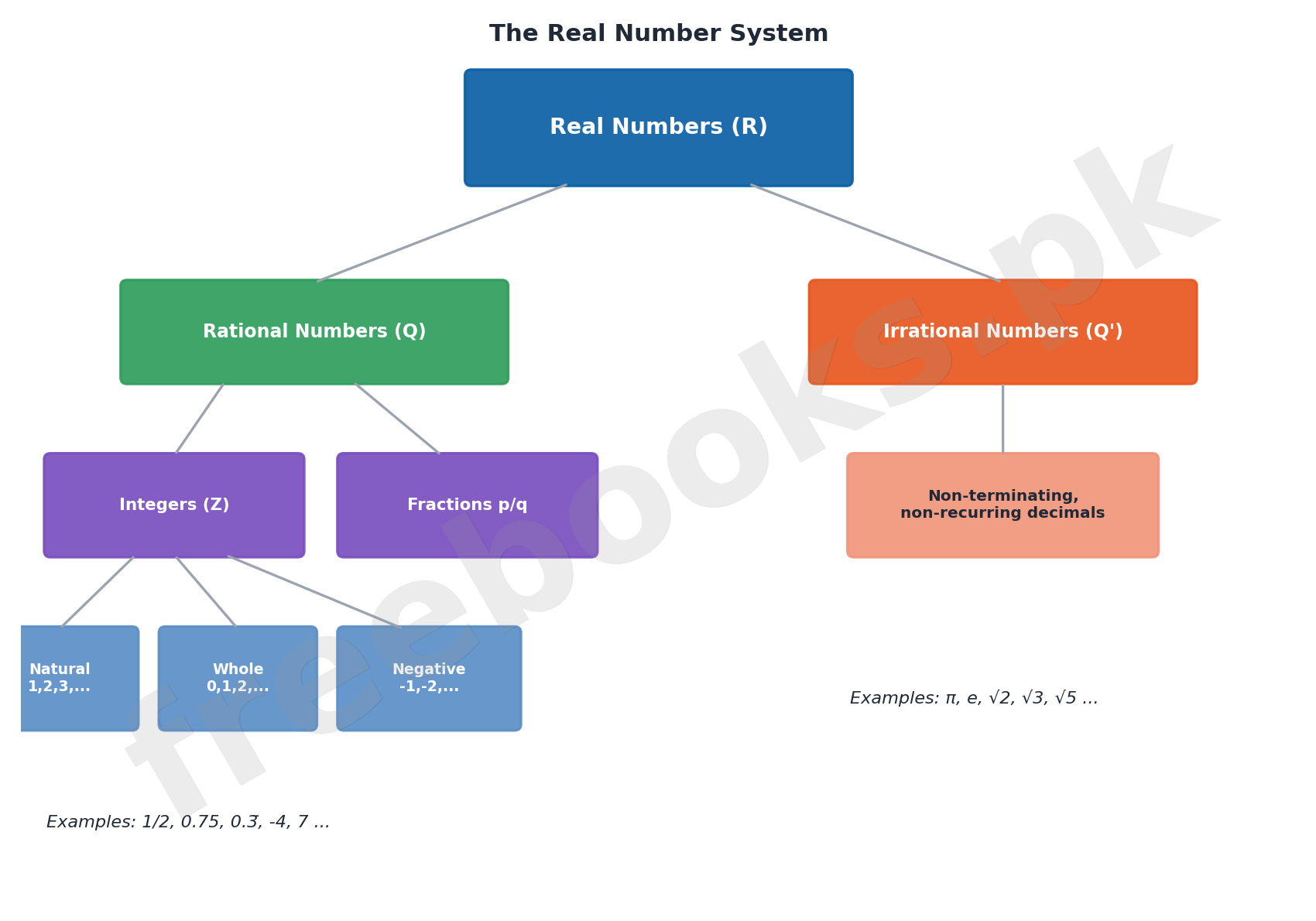
Numbers developed over thousands of years, from the Sumerian base-60 system through Egyptian, Roman, and Indian numerals to the modern Arabic decimal system used worldwide today. The set of real numbers R is defined as the union of two disjoint sets: the rational numbers Q (which can be written as p/q with integers p, q and q≠0) and the irrational numbers Q' (which cannot). Every real number has a decimal representation that is either terminating, non-terminating and recurring (both rational), or non-terminating and non-recurring (irrational) — this decimal test is the fastest way to classify any given number.
This unit covers the real number system and its properties (closure, commutative, associative, identity, inverse, distributive, equality, and order properties), representing irrational numbers geometrically on a number line, the laws of radicals and indices, surds and rationalizing denominators, and practical applications of real numbers in daily life including temperature conversion between Celsius, Fahrenheit, and Kelvin, and profit/loss calculations in business.
Learning Objectives
- Describe the set of real numbers as the union of rational and irrational numbers
- Classify a decimal number as rational or irrational using its terminating/recurring pattern
- Represent irrational numbers on a number line using geometric construction (Pythagoras theorem)
- State and apply the additive, multiplicative, distributive, equality, and order properties of real numbers
- Apply the laws of radicals and indices to simplify radical and exponential expressions
- Identify surds, classify them as monomial or binomial, and rationalize denominators using conjugates
- Apply real number concepts to real-life problems: temperature conversion, profit and loss, ratio division
Key Concepts
1.1 The Real Number System
The set of rational numbers is Q={p/q : p,q∈Z, q≠0}, and the set of irrational numbers Q' contains every real number that cannot be written this way. The set of real numbers is their union: R=Q∪Q'. Every rational number's decimal expansion either terminates (e.g. 1/4=0.25) or is non-terminating but recurring (e.g. 1/3=0.333…=0.3̄); every irrational number's decimal expansion is non-terminating and non-recurring (e.g. π=3.14159265…).
This decimal-pattern test is the standard way to classify any given decimal number: check whether it stops, repeats a fixed block forever, or never repeats — the three cases correspond exactly to terminating rational, recurring rational, and irrational respectively.
1.2 Representing Irrational Numbers on a Number Line
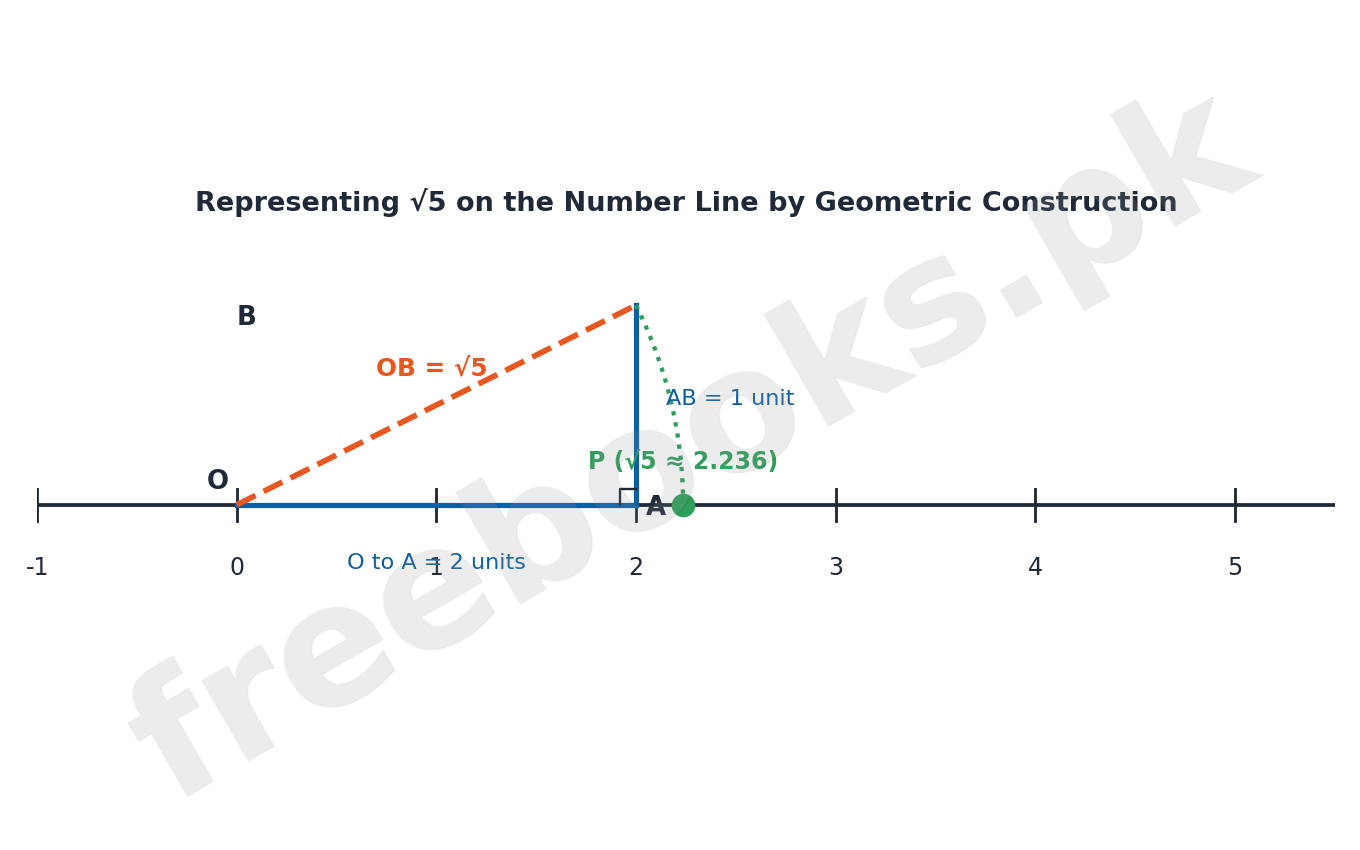
An irrational number like √5 can be placed exactly on a number line using geometric construction based on the Pythagoras theorem. Draw OA=2 units along the number line, then AB=1 unit perpendicular to OA at A; the hypotenuse OB of right triangle OAB satisfies OB²=OA²+AB²=4+1=5, so OB=√5. Swinging an arc of this radius from O back onto the number line marks the exact point representing √5.
This method generalizes to any √n: choose OA and AB so that OA²+AB²=n, construct the right triangle, then transfer the hypotenuse length to the number line with a compass arc.
1.3 Properties of Real Numbers
Real numbers satisfy additive and multiplicative closure, commutative, associative, identity (0 for addition, 1 for multiplication), and inverse properties (except 0 has no multiplicative inverse), plus the distributive properties linking addition/subtraction and multiplication: a(b+c)=ab+ac and (a+b)c=ac+bc, in both left and right forms.
Real numbers also satisfy properties of equality (reflexive, symmetric, transitive, additive, multiplicative, and cancellation) and properties of order (trichotomy, transitive, additive, multiplicative, division, and reciprocal) — these order properties are essential for solving and justifying steps in inequalities.
1.4 Radicals, Indices, Surds, and Rationalization
For a positive integer n>1 and real number a, x=ⁿ√a is the nth root of a, with exponential form x=a^(1/n). The laws of radicals (ⁿ√(ab)=ⁿ√a·ⁿ√b, ⁿ√(a/b)=ⁿ√a/ⁿ√b, etc.) mirror the laws of indices (aᵐ·aⁿ=aᵐ⁺ⁿ, (aᵐ)ⁿ=aᵐⁿ, etc.) and are used together to simplify radical expressions into exponential form and back.
A surd is an irrational radical with a rational radicand, e.g. √5 (but not √9, which simplifies to the whole number 3). A monomial surd has one term (√5); a binomial surd is the sum of two monomial surds (√3+√5); √a+√b and √a-√b are conjugate surds, and their product is always rational — this is the key fact used to rationalize a denominator of the form a+b√x by multiplying numerator and denominator by its conjugate.
1.5 Applications: Temperature Conversion
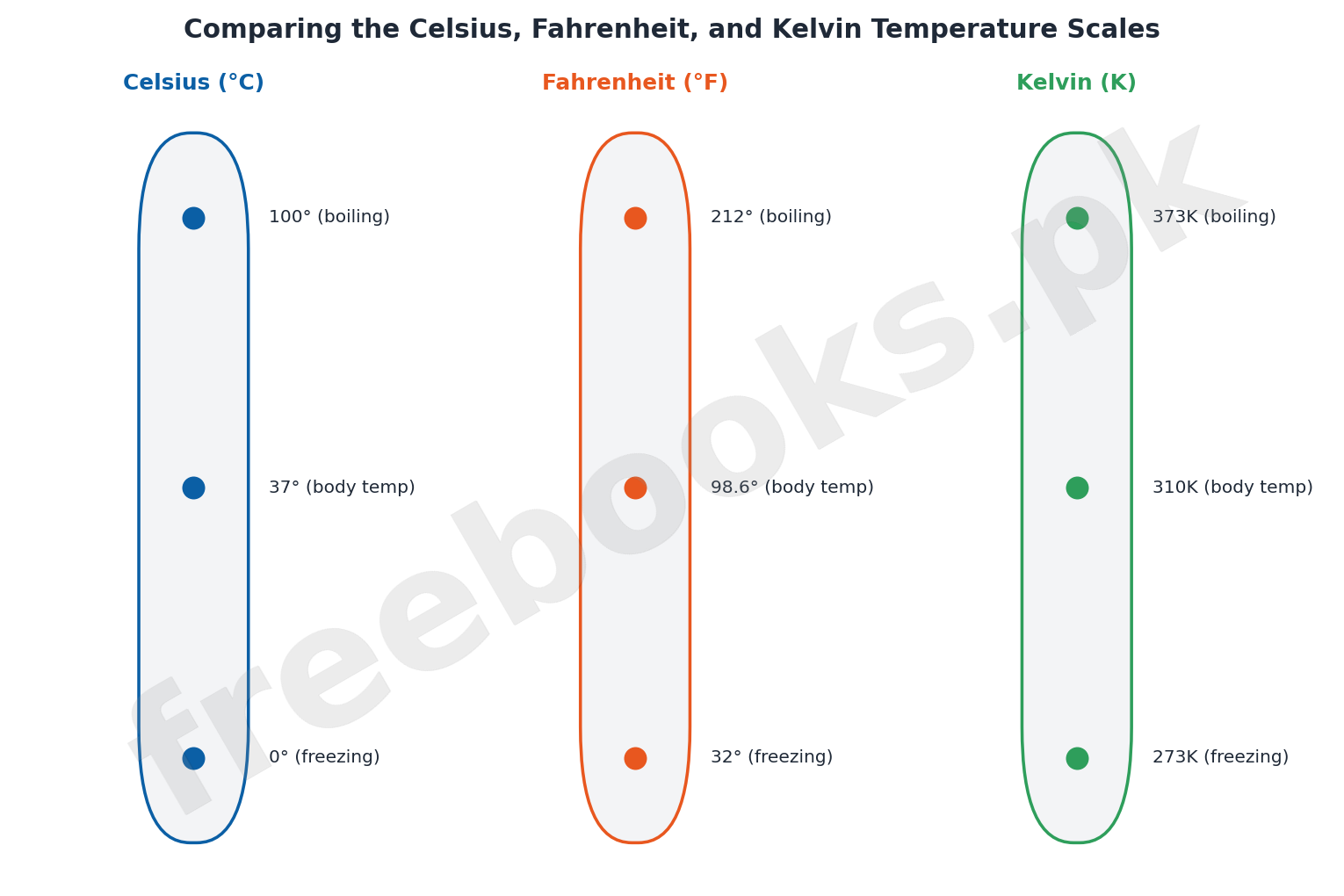
Real numbers model everyday quantities like temperature, which is measured on three related scales: Kelvin (K=°C+273), Celsius (°C=5/9(F-32)), and Fahrenheit (°F=9°C/5+32). These formulas let any temperature reading be converted between scales, which is essential in science, engineering, and everyday weather reporting.
1.6 Applications: Profit, Loss, and Ratios
Business calculations rely on real number arithmetic: Profit=Selling Price-Cost Price (with Profit%=(profit/CP)×100%), and Loss=Cost Price-Selling Price (with Loss%=(loss/CP)×100%). When a profit or investment must be split among partners in a given ratio, each share is found by multiplying the total by that partner's fraction of the sum of the ratio terms.
Important Definitions
What is the set of rational numbers Q?
Q={p/q : p,q∈Z, q≠0} — all numbers expressible as a ratio of two integers with nonzero denominator.
What is the set of irrational numbers Q'?
The set of real numbers that cannot be expressed as a quotient of two integers.
How is the set of real numbers R defined?
R=Q∪Q', the union of the rational and irrational numbers.
What is a terminating decimal number?
A decimal number with a finite number of digits after the decimal point, e.g. 1/4=0.25.
What is a non-terminating, recurring decimal number?
A decimal with an infinitely repeating pattern of digits after the decimal point, e.g. 1/3=0.3̄; such numbers are rational.
What is a surd?
An irrational radical with a rational radicand, e.g. √5 (√9 is not a surd since it simplifies to the rational number 3).
What are conjugate surds?
√a+√b and √a-√b, whose product is always a rational number: (√a+√b)(√a-√b)=a-b.
What is the radical form x=ⁿ√a, and its exponential form?
x=ⁿ√a means x is the nth root of a; its exponential form is x=a^(1/n).
What is the trichotomy property of order?
For all a,b∈R, exactly one of a=b, a>b, or a<b holds.
What formula converts Celsius to Fahrenheit?
°F = (9°C/5) + 32.
Key Facts and Relations
| Topic | Key Fact / Relation |
|---|---|
| Real numbers as a union | R = Q ∪ Q' |
| Terminating decimal example | 1/4 = 0.25 |
| Recurring decimal example | 1/3 = 0.3̄ = 0.333… |
| Radical to exponential form | ⁿ√a = a^(1/n) |
| Product of conjugate surds | (√a+√b)(√a-√b) = a – b |
| Distributive property (left) | a(b+c) = ab + ac |
| Kelvin from Celsius | K = °C + 273 |
| Celsius from Fahrenheit | °C = (5/9)(F – 32) |
| Fahrenheit from Celsius | °F = (9°C/5) + 32 |
| Profit and loss percentage | Profit% = (Profit/CP)×100%, Loss% = (Loss/CP)×100% |
Diagrams
The Real Number System: A tree diagram showing R as the union of Rational and Irrational numbers, with rational numbers further branching into integers and fractions, and integers into natural, whole, and negative numbers
Representing √5 on the Number Line by Geometric Construction: The right-triangle construction OAB with OA=2, AB=1, giving hypotenuse OB=√5 by the Pythagoras theorem, then transferred to the number line with a compass arc to mark the exact point P=√5
Comparing the Celsius, Fahrenheit, and Kelvin Temperature Scales: Three parallel scales showing the freezing point, human body temperature, and boiling point of water on each of the Celsius, Fahrenheit, and Kelvin scales
Solved Examples
Example 1: Classifying Decimal Numbers as Rational or Irrational
Problem: Identify the following as rational or irrational: (i) 0.35 (ii) 0.444… (iii) 3.36788542…
- 0.35 has a finite number of digits after the decimal point, so it is a terminating decimal — therefore rational.
- 0.444… repeats the digit 4 forever in a fixed pattern, so it is a non-terminating, recurring decimal — therefore rational.
- 3.36788542… shows no repeating pattern and continues indefinitely, so it is non-terminating and non-recurring — therefore irrational.
- Compare each case against the decimal-pattern test: terminates → rational; repeats a block forever → rational; never repeats → irrational.
- Final answer: 0.35 is rational, 0.444… is rational, 3.36788542… is irrational.
Example 2: Representing √5 on a Number Line
Problem: Represent √5 on a number line using geometric construction.
- Draw OA=2 units along the number line from the origin O.
- At point A, draw AB=1 unit perpendicular to OA, forming right triangle OAB.
- Apply the Pythagoras theorem: (OB)²=(OA)²+(AB)²=2²+1²=4+1=5, so OB=√5.
- With centre O and radius OB=√5, draw an arc that meets the number line at point P.
- Final answer: point P represents √5 on the number line, since |OP|=OB=√5.
Example 3: Expressing a Recurring Decimal as p/q
Problem: Express 0.9̄3̄ (i.e. 0.939393…) as a rational number p/q.
- Let x=0.939393…, so 100x=93.939393… (multiplying by 100 since the repeating block has 2 digits).
- Subtract the original equation from the multiplied one: 100x-x=93.939393…-0.939393…
- This gives 99x=93.
- Solve for x: x=93/99.
- Final answer: 0.9̄3̄=93/99, expressed in the form p/q with integers p and q.
Example 4: Simplifying a Radical Expression
Problem: Simplify ⁿ√(16x⁴y⁸) for n=4, i.e. the 4th root of 16x⁴y⁸.
- Rewrite the radical in exponential form: (16x⁴y⁸)^(1/4), using ⁿ√a=a^(1/n).
- Apply the power-of-a-product law: =(16)^(1/4)(x⁴)^(1/4)(y⁸)^(1/4).
- Simplify each factor: 16^(1/4)=2^(4×1/4)=2; (x⁴)^(1/4)=x^(4×1/4)=x; (y⁸)^(1/4)=y^(8×1/4)=y².
- Combine the simplified factors together.
- Final answer: ⁴√(16x⁴y⁸) = 2xy².
Example 5: Rationalizing a Denominator
Problem: Rationalize the denominator of 3/(√5+√2).
- Multiply numerator and denominator by the conjugate of the denominator, √5-√2.
- This gives 3(√5-√2) / [(√5+√2)(√5-√2)].
- Simplify the denominator using the conjugate product rule: (√5)²-(√2)²=5-2=3.
- The expression becomes 3(√5-√2)/3.
- Final answer: the 3's cancel, leaving √5-√2 as the rationalized form.
Example 6: Verifying the Distributive Property
Problem: If a=2/3, b=3/2, c=5/3, verify the left distributive property a(b+c)=ab+ac.
- Compute the LHS: a(b+c) = (2/3)(3/2+5/3) = (2/3)(9/6+10/6) = (2/3)(19/6) = 19/9.
- Compute ab: (2/3)(3/2) = 1.
- Compute ac: (2/3)(5/3) = 10/9.
- Add ab+ac: 1 + 10/9 = 9/9 + 10/9 = 19/9.
- Final answer: LHS=RHS=19/9, so a(b+c)=ab+ac is verified.
Example 7: Applying Temperature Conversion
Problem: Normal human body temperature is 98.6°F. Convert it into Celsius and Kelvin.
- Convert Fahrenheit to Celsius using °C=(5/9)(F-32): °C=(5/9)(98.6-32)=(5/9)(66.6).
- Compute: (5/9)(66.6) = 37.
- So the Celsius reading is 37°C.
- Convert Celsius to Kelvin using K=°C+273: K=37+273=310.
- Final answer: 98.6°F = 37°C = 310 K.
Example 8: Applying Profit Percentage
Problem: Hamail purchased a bicycle for Rs. 6590 and sold it for Rs. 6850. Find the profit percentage.
- Identify CP=Rs. 6590 and SP=Rs. 6850.
- Compute profit: Profit = SP – CP = 6850 – 6590 = Rs. 260.
- Apply the profit percentage formula: Profit% = (Profit/CP) × 100%.
- Substitute: (260/6590) × 100% ≈ 3.94%.
- Final answer: the profit percentage is approximately 4%.
Short Questions & Answers
How is the set of real numbers R related to Q and Q'?
R is the union of the rational numbers Q and the irrational numbers Q': R=Q∪Q'.
How can you tell if a decimal number is rational or irrational just by looking at its digits?
If it terminates or repeats a fixed block of digits forever, it is rational; if it never terminates and never repeats, it is irrational.
What theorem is used to represent an irrational number like √5 on a number line?
The Pythagoras theorem, applied to a right triangle whose hypotenuse has the required irrational length.
What makes √9 not a surd, even though it involves a radical sign?
Because √9 simplifies to the rational number 3, and a surd must be irrational; only radicals that stay irrational after simplification count as surds.
Why does rationalizing a denominator with a conjugate always work?
Because the product of conjugate surds (√a+√b)(√a-√b)=a-b is always rational, eliminating the radical from the denominator.
Which real number has no multiplicative inverse, and why?
0, because there is no real number x such that 0×x=1.
What is the formula for converting Celsius to Kelvin?
K = °C + 273.
Long Questions & Answers
Explain how a decimal number's pattern is used to classify it as rational or irrational, and describe how an irrational number can be represented exactly on a number line.
What are the three possible decimal patterns a real number can have?
A real number's decimal expansion either terminates after finitely many digits, repeats a fixed block of digits forever (non-terminating but recurring), or continues forever without ever repeating a fixed block (non-terminating and non-recurring).
Which of these patterns correspond to rational numbers, and which to irrational?
Terminating decimals and non-terminating recurring decimals are both rational, since both can be converted into the form p/q with integers p and q; non-terminating, non-recurring decimals are irrational, since no such fraction exists for them.
How is an irrational number like √5 placed exactly on a number line?
By geometric construction: build a right triangle with legs chosen so their squares sum to 5 (e.g. OA=2, AB=1), apply the Pythagoras theorem to get hypotenuse OB=√5, then draw a compass arc of that radius from O to mark the exact point on the number line.
Why can't this construction method be replaced by just estimating the decimal value and marking that point?
Because a decimal estimate like 2.236 is only an approximation of √5, not the exact value; the geometric construction places the point at the true, exact irrational distance from the origin, using the guaranteed exactness of the Pythagoras theorem rather than a rounded decimal guess.
Explain the laws of radicals and indices, what a surd is, and how the denominator of a fraction containing a surd is rationalized.
What is the relationship between radical form and exponential form?
The radical x=ⁿ√a is equivalent to the exponential form x=a^(1/n); this equivalence lets every law of radicals (like ⁿ√(ab)=ⁿ√a·ⁿ√b) be matched to a corresponding law of indices (like (ab)ⁿ=aⁿbⁿ), so radical expressions can be simplified by converting to exponents and applying index laws.
What distinguishes a surd from any other irrational radical?
A surd is specifically an irrational radical with a RATIONAL radicand — so √5 is a surd because 5 is rational and √5 is irrational, but √π is not a surd even though it is irrational, because π itself is not rational.
What are conjugate surds, and what special property do they have?
√a+√b and √a-√b are conjugate surds of each other; their product (√a+√b)(√a-√b)=a-b is always a rational number, since the radical terms cancel out through the difference-of-squares pattern.
How is this conjugate property used to rationalize a denominator like 3/(√5+√2)?
Multiply both the numerator and denominator by the conjugate of the denominator, √5-√2; the denominator becomes (√5+√2)(√5-√2)=5-2=3, a rational number, while the numerator becomes 3(√5-√2), so the fraction simplifies to √5-√2 with no radical left in the denominator.
Multiple Choice Questions (MCQs)
√7 is: (A) An integer (B) A rational number (C) An irrational number (D) A natural number
Correct answer: (C) An irrational number. 7 is not a perfect square, so √7 has a non-terminating, non-recurring decimal expansion, making it irrational.
The set of real numbers R is defined as: (A) Q only (B) Q' only (C) Q ∪ Q' (D) Q ∩ Q'
Correct answer: (C) Q ∪ Q'. R is the union of the rational numbers Q and the irrational numbers Q'.
A terminating decimal number is always: (A) Irrational (B) Rational (C) A surd (D) Undefined
Correct answer: (B) Rational. Terminating decimals can always be written as p/q, so they are rational.
Which of these is NOT a surd? (A) √5 (B) √7 (C) √9 (D) √11
Correct answer: (C) √9. √9 simplifies to the rational number 3, so it fails the requirement that a surd be irrational.
The product of the conjugate surds (√a+√b) and (√a-√b) is: (A) Always irrational (B) Always negative (C) Always rational (a-b) (D) Always zero
Correct answer: (C) Always rational (a-b). By the difference-of-squares pattern, (√a+√b)(√a-√b)=a-b, which is rational whenever a and b are rational.
0 has no multiplicative inverse because: (A) 0 is not a real number (B) No real number x satisfies 0×x=1 (C) 0 is irrational (D) Multiplication is not defined for 0
Correct answer: (B) No real number x satisfies 0×x=1. There is no real x with 0×x=1, so 0 has no multiplicative inverse, unlike every other real number.
The formula to convert Celsius to Fahrenheit is: (A) °F = °C + 32 (B) °F = (9°C/5) + 32 (C) °F = (5°C/9) – 32 (D) °F = °C × 32
Correct answer: (B) °F = (9°C/5) + 32. The correct conversion formula is °F = (9°C/5) + 32.
If Profit = SP – CP, then Profit% is calculated as: (A) (Profit/SP)×100% (B) (Profit/CP)×100% (C) (CP/Profit)×100% (D) (SP/CP)×100%
Correct answer: (B) (Profit/CP)×100%. Profit percentage is always calculated relative to the Cost Price: (Profit/CP)×100%.
The trichotomy property states that for any a,b∈R: (A) a=b always (B) Exactly one of a=b, a>b, or a<b holds (C) a>b always (D) a and b must be equal or irrational
Correct answer: (B) Exactly one of a=b, a>b, or a<b holds. Trichotomy guarantees exactly one of the three relations (=, >, <) holds between any two real numbers.
Which right-triangle construction is used to represent √5 on a number line? (A) Legs of 1 and 1 (B) Legs of 2 and 1 (C) Legs of 3 and 1 (D) Legs of 5 and 0
Correct answer: (B) Legs of 2 and 1. With legs OA=2 and AB=1, the Pythagoras theorem gives hypotenuse OB=√(4+1)=√5.
Quick Revision Summary
- Real numbers: R = Q ∪ Q' (rational numbers union irrational numbers)
- Terminating or recurring decimals = rational; non-terminating non-recurring decimals = irrational
- Irrational numbers are placed exactly on a number line using Pythagoras-theorem geometric construction
- Real number properties: closure, commutative, associative, identity, inverse (additive & multiplicative), distributive
- Properties of equality: reflexive, symmetric, transitive, additive, multiplicative, cancellation
- Properties of order: trichotomy, transitive, additive, multiplicative, division, reciprocal
- Radical form ⁿ√a = exponential form a^(1/n); laws of radicals mirror laws of indices
- Surd = irrational radical with rational radicand; conjugate surds' product (√a+√b)(√a-√b)=a-b is always rational
- Rationalize a denominator by multiplying numerator and denominator by the denominator's conjugate
- Applications: K=°C+273, °C=(5/9)(F-32), °F=(9°C/5)+32; Profit%=(Profit/CP)×100%, Loss%=(Loss/CP)×100%
Exam Tips
- When classifying a decimal as rational or irrational, look specifically for a REPEATING BLOCK of digits, not just any decimal digits — 0.121121112… looks repetitive but never repeats a fixed block, so it is irrational
- For number-line construction problems, always identify the two leg lengths whose squares sum to the target number under the radical before drawing anything
- Memorize which properties apply to equality (=) versus order (< , >) separately — multiplying an inequality by a negative number flips the direction, but this never happens with equalities
- When simplifying radicals, convert to exponential form first (ⁿ√a=a^(1/n)) — it's much easier to apply index laws than to juggle radical notation directly
- Always double-check which surd is the correct conjugate: it's the SAME two terms with only the middle sign flipped, e.g. the conjugate of √5-√3 is √5+√3, not -√5-√3
- For profit/loss and ratio-division word problems, write out exactly what is given (CP, SP, ratio, total) before choosing a formula — misreading which value is the total versus a part is the most common error