This final unit extends vector ideas from the plane into three-dimensional space. Using the rectangular coordinate system in space and the right-hand rule, a point P(a,b,c) is described by its position vector OP, and vectors are written in component form using the standard unit vectors i, j, and k. From here the unit develops the magnitude of a vector, unit vectors, the distance between two points in space, and direction angles and direction cosines, culminating in the identity cos^2(alpha)+cos^2(beta)+cos^2(gamma)=1.
The unit then introduces the two major vector products. The dot (scalar) product u.v = |u||v| cos(theta), computed equally from components as u1 v1+u2 v2+u3 v3, gives projections, angles between vectors, orthogonality tests, and work done by a constant force. The cross (vector) product u x v, a vector perpendicular to both u and v found via the determinant formula, gives the area of a parallelogram or triangle and the moment (torque) of a force. Finally, the scalar triple product u.(v x w) combines both products to compute the volume of a parallelepiped or tetrahedron and to test whether three vectors are coplanar — with real-world applications spanning engineering, physics, and business.
Learning Objectives
- Describe the rectangular coordinate system in space and locate a point using the right-hand rule
- Write a vector in space in component form using the unit vectors i, j, and k
- Find the magnitude of a vector in space and construct a unit vector in a given direction
- Find the distance between two points in space and the direction angles/direction cosines of a vector
- Compute the dot product of two vectors both geometrically and from components, and use it to find projections, angles, and orthogonality
- Apply the dot product to compute the work done by a constant force
- Compute the cross product of two vectors using the determinant formula and use it to find areas and the moment of a force
- Compute the scalar triple product of three vectors and use it to find volumes and test for coplanarity
Key Concepts
14.1 Rectangular Coordinate System in Space and Vectors
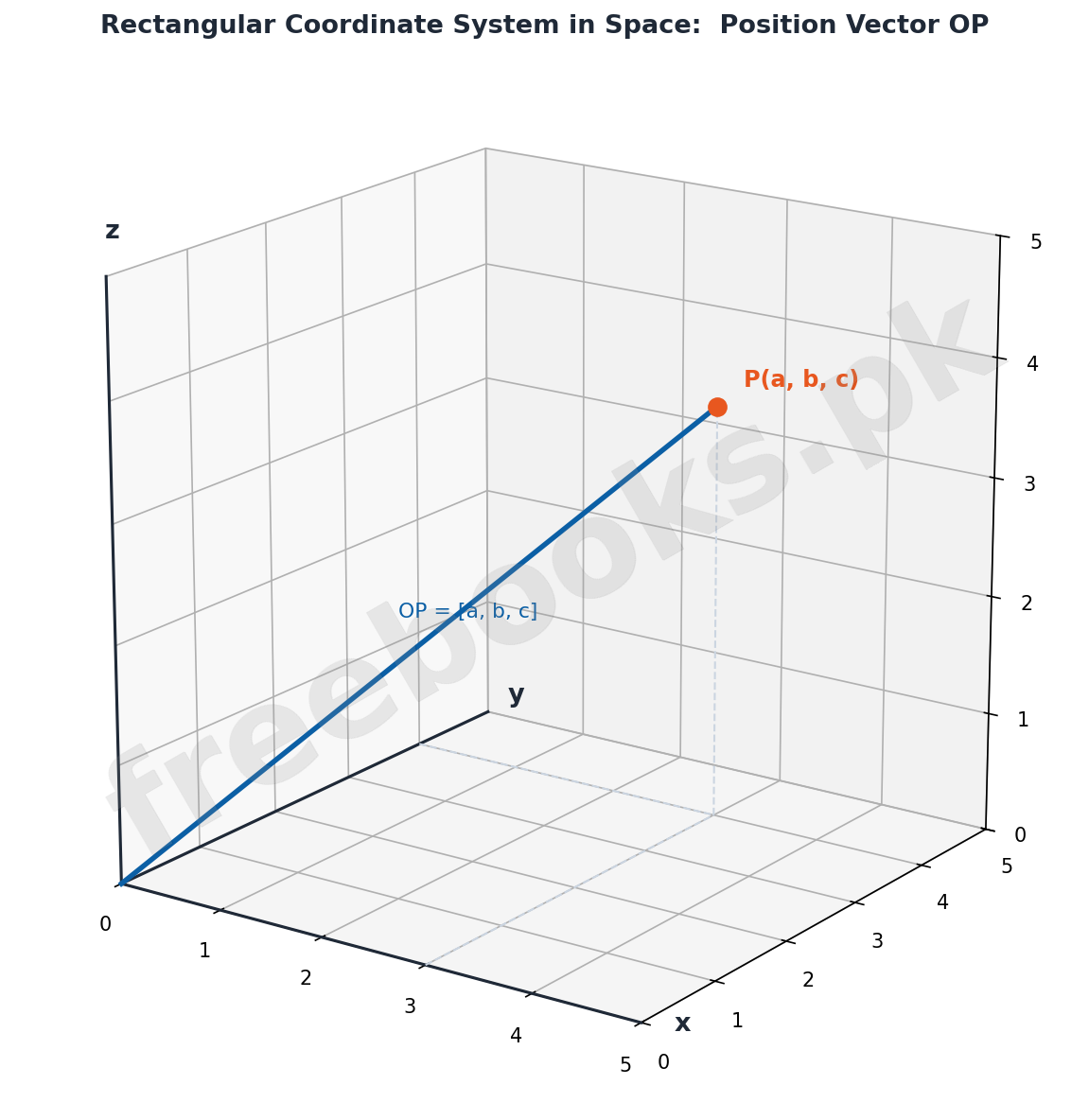
Space is described using three mutually perpendicular axes (x, y, z) meeting at the origin O, oriented according to the right-hand rule: if the fingers of the right hand curl from the positive x-axis toward the positive y-axis, the thumb points along the positive z-axis. Any point P in space is located by an ordered triple (a,b,c), and the position vector OP = [a,b,c] is the vector from the origin to P.
A vector in space is written in component form as u = [u1,u2,u3] or, using the standard unit vectors i=[1,0,0], j=[0,1,0], k=[0,0,1], as u = u1 i + u2 j + u3 k. The fundamental operations — addition, scalar multiplication, the negative of a vector, the difference of two vectors, and the zero vector — extend from the plane to space by simply applying the operation to each of the three components in turn.
14.2 Magnitude, Unit Vectors, and Distance in Space
The magnitude (length) of u = [u1,u2,u3] is |u| = sqrt(u1^2+u2^2+u3^2), a direct extension of the Pythagorean theorem into three dimensions. A unit vector has magnitude 1; the unit vector in the direction of any nonzero vector u is found by scaling: u-hat = u/|u|. Two vectors are parallel exactly when one is a nonzero scalar multiple of the other.
The distance between two points P1(x1,y1,z1) and P2(x2,y2,z2) in space is the magnitude of the vector between them: d = sqrt[(x2-x1)^2+(y2-y1)^2+(z2-z1)^2]. This same formula underlies problems phrased as physical displacement — the straight-line distance between a start point and an end point in three-dimensional space.
14.3 Direction Angles and Direction Cosines
For a nonzero vector u, the direction angles alpha, beta, and gamma are the angles u makes with the positive x-, y-, and z-axes respectively, and the direction cosines are cos(alpha), cos(beta), and cos(gamma) — each equal to the corresponding component of u divided by |u|. These three cosines always satisfy the identity cos^2(alpha)+cos^2(beta)+cos^2(gamma) = 1, which follows directly from the magnitude formula.
Direction cosines give a compact, coordinate-independent way to describe the orientation of a vector in space, and the unit vector in the direction of u can always be written as u-hat = [cos(alpha), cos(beta), cos(gamma)].
14.4 The Dot (Scalar) Product
The dot product of two nonzero vectors u and v is defined geometrically as u.v = |u||v| cos(theta), where theta is the angle between them, and equivalently in component form as u.v = u1 v1+u2 v2+u3 v3 — the two definitions can be shown equivalent using the Law of Cosines. Because the dot product of two vectors is always a scalar (not a vector), it is also called the scalar product.
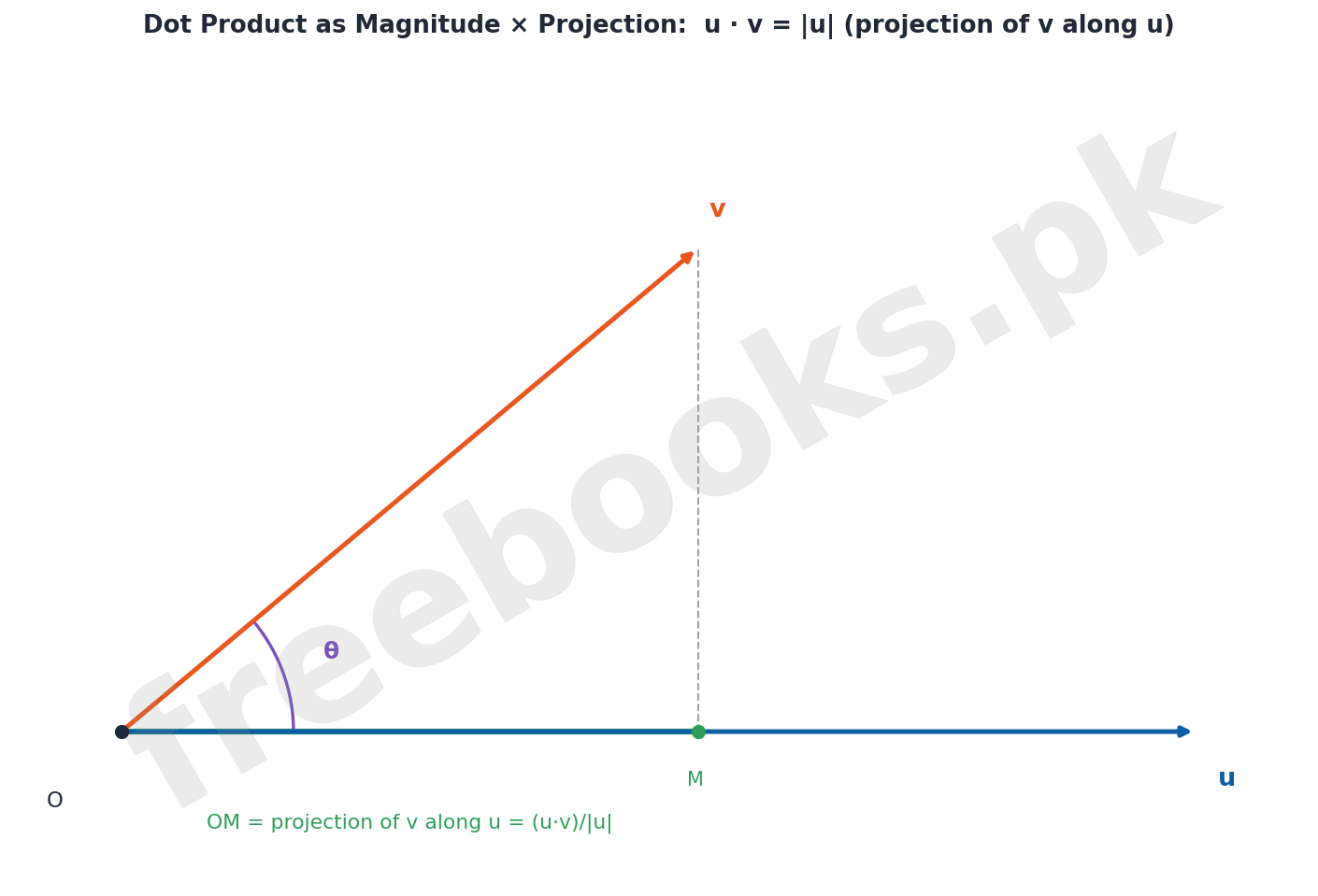
The dot product gives the projection of one vector along another: the (scalar) projection of v along u is (u.v)/|u|. Two nonzero vectors are orthogonal (perpendicular) exactly when their dot product is zero, and the angle between any two nonzero vectors can be recovered as theta = cos^-1[(u.v)/(|u||v|)]. A key physical application is the work done by a constant force F moving an object through a displacement d: W = F.d.
14.5 The Cross (Vector) Product
The cross product of two nonzero, non-parallel vectors u and v is the vector u x v = (|u||v| sin(theta)) n, where n is the unit vector perpendicular to both u and v with direction fixed by the right-hand rule; because the result is itself a vector, it is also called the vector product. In component form, u x v is computed as a 3×3 determinant with i, j, k in the first row, the components of u in the second row, and the components of v in the third row. Two nonzero vectors are parallel exactly when their cross product is the zero vector.
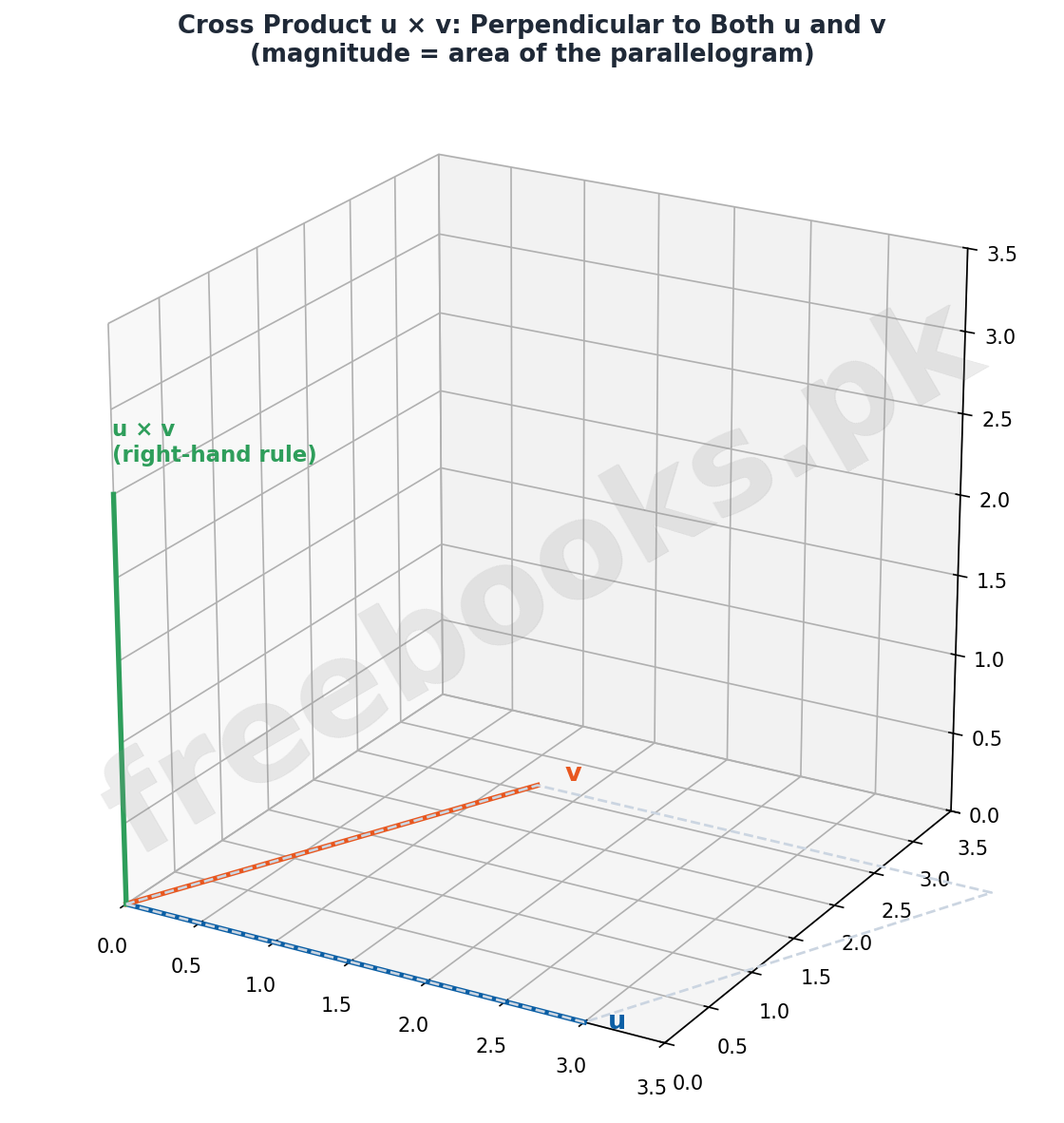
The magnitude |u x v| equals |u||v| sin(theta), which is exactly the area of the parallelogram with u and v as adjacent sides; half of this, (1/2)|u x v|, gives the area of the triangle with u and v as two sides. In mechanics, the moment (torque) of a force F applied at a point with position vector r (relative to the pivot) is the vector M = r x F, whose magnitude measures the turning effect of the force.
14.6 The Scalar Triple Product: Volume and Coplanarity
The scalar triple product of three vectors u, v, w is the scalar u.(v x w), often written [u v w], and computed directly as a 3×3 determinant of the components of u, v, w. It is cyclic — u.(v x w) = v.(w x u) = w.(u x v) — and its absolute value gives the volume of the parallelepiped with u, v, w as edges from a common vertex; one-sixth of that same absolute value gives the volume of the tetrahedron with the same three edges.
Three vectors are coplanar (lie in the same plane, or are linearly dependent) exactly when their scalar triple product is zero — a direct volume-based test, since three coplanar edges enclose zero volume. This same combination of dot and cross product underlies real-world torque, force-magnitude, and even revenue calculations, wherever a single scalar summary of several vector quantities is needed.
Important Definitions
What is the position vector of a point P(a,b,c) in space?
The vector OP = [a,b,c] from the origin O to the point P.
What is a unit vector, and how is it constructed from a nonzero vector u?
A vector of magnitude 1; the unit vector in the direction of u is u-hat = u/|u|.
What is the magnitude of u = [u1,u2,u3]?
|u| = sqrt(u1^2+u2^2+u3^2).
What are the direction cosines of a vector u?
The cosines of the angles u makes with the positive x-, y-, and z-axes, equal to the corresponding components of u divided by |u|; they satisfy cos^2(alpha)+cos^2(beta)+cos^2(gamma)=1.
How is the dot product of two vectors defined?
u.v = |u||v| cos(theta) geometrically, or u1 v1+u2 v2+u3 v3 in component form; the result is always a scalar.
When are two vectors orthogonal?
When their dot product is zero, i.e. u.v=0.
What is the scalar projection of v along u?
(u.v)/|u|.
How is the cross product of two vectors defined?
u x v = (|u||v| sin(theta)) n, a vector perpendicular to both u and v with direction given by the right-hand rule; computed from components using a 3×3 determinant.
What does the scalar triple product u.(v x w) measure?
Its absolute value equals the volume of the parallelepiped with u, v, w as edges from a common vertex; it equals zero exactly when u, v, w are coplanar.
What is the moment (torque) of a force F applied at position r relative to a pivot?
M = r x F, a vector whose magnitude measures the turning effect of the force about the pivot.
Key Facts and Relations
| Topic | Key Fact / Relation |
|---|---|
| Magnitude of a vector in space | |u| = sqrt(u1^2+u2^2+u3^2) |
| Unit vector in the direction of u | u-hat = u / |u| |
| Distance between two points in space | d = sqrt[(x2-x1)^2+(y2-y1)^2+(z2-z1)^2] |
| Direction cosine identity | cos^2(alpha) + cos^2(beta) + cos^2(gamma) = 1 |
| Dot product (geometric and component form) | u.v = |u||v| cos(theta) = u1 v1 + u2 v2 + u3 v3 |
| Angle between two vectors | theta = cos^-1[ (u.v) / (|u||v|) ] |
| Work done by a constant force | W = F . d |
| Cross product magnitude / area of parallelogram | |u x v| = |u||v| sin(theta) = Area of parallelogram with sides u, v |
| Moment of a force | M = r x F |
| Scalar triple product / volume of parallelepiped | u.(v x w) = [u v w]; Volume = |u.(v x w)|; Volume of tetrahedron = (1/6)|u.(v x w)| |
Diagrams
Rectangular Coordinate System in Space: Position Vector OP: A 3D diagram of the x-, y-, z-axes meeting at the origin, with a point P(a,b,c) and its position vector OP shown, illustrating the right-hand rule orientation
Dot Product as Magnitude times Projection: A 2D diagram showing two vectors u and v with the angle theta between them, and the projection of v along u (segment OM) shaded, illustrating u.v = |u| times the projection of v along u
Cross Product and the Right-Hand Rule: A 3D diagram showing vectors u and v with their cross product u x v drawn perpendicular to both, following the right-hand rule, with the parallelogram spanned by u and v outlined to show that |u x v| is its area
Solved Examples
Example 1: Vector Arithmetic in Space
Problem: If u = [2,-1,3] and w = [1,4,-2], find (a) u+w, (b) 3w, and (c) |u|.
- (a) Add corresponding components: u+w = [2+1, -1+4, 3+(-2)] = [3,3,1].
- (b) Multiply every component of w by the scalar 3: 3w = [3(1), 3(4), 3(-2)] = [3,12,-6].
- (c) Apply the magnitude formula: |u| = sqrt(2^2+(-1)^2+3^2) = sqrt(4+1+9) = sqrt(14).
- Final answers: u+w = [3,3,1]; 3w = [3,12,-6]; |u| = sqrt(14).
Example 2: Finding a Unit Vector
Problem: Find the unit vector in the direction of v = [3,-4,12].
- Compute the magnitude: |v| = sqrt(3^2+(-4)^2+12^2) = sqrt(9+16+144) = sqrt(169) = 13.
- Divide each component of v by |v|: v-hat = v/|v| = [3/13, -4/13, 12/13].
- Check the result has magnitude 1: (3/13)^2+(-4/13)^2+(12/13)^2 = (9+16+144)/169 = 169/169 = 1. Correct.
- Final answer: v-hat = [3/13, -4/13, 12/13].
Example 3: Distance Between Two Points in Space
Problem: A drone flies in a straight line from point A(1,2,5) to point B(7,-2,9), measured in kilometres. Find the straight-line distance it travels.
- Apply the distance formula with (x1,y1,z1)=(1,2,5) and (x2,y2,z2)=(7,-2,9): d = sqrt[(7-1)^2+(-2-2)^2+(9-5)^2].
- Compute each square: (7-1)^2=36, (-2-2)^2=16, (9-5)^2=16.
- Add and take the square root: d = sqrt(36+16+16) = sqrt(68) = 2 sqrt(17).
- Final answer: the drone travels 2 sqrt(17) is approximately 8.25 kilometres in a straight line.
Example 4: Dot Product and the Angle Between Two Vectors
Problem: Find the angle between u = [1,1,0] and v = [0,1,1].
- Compute the dot product: u.v = (1)(0)+(1)(1)+(0)(1) = 0+1+0 = 1.
- Compute the magnitudes: |u| = sqrt(1+1+0) = sqrt(2); |v| = sqrt(0+1+1) = sqrt(2).
- Apply theta = cos^-1[(u.v)/(|u||v|)] = cos^-1[1/(sqrt(2).sqrt(2))] = cos^-1(1/2).
- Solve: cos^-1(1/2) = 60 degrees.
- Final answer: the angle between u and v is 60 degrees.
Example 5: Work Done by a Constant Force
Problem: A constant force F = [4,3,0] Newtons moves an object along a displacement d = [5,2,0] metres. Find the work done.
- Work done by a constant force is the dot product of force and displacement: W = F.d.
- Compute the dot product: F.d = (4)(5)+(3)(2)+(0)(0) = 20+6+0 = 26.
- Units: since F is in Newtons and d is in metres, W is in Newton-metres (Joules).
- Final answer: W = 26 Joules.
Example 6: Cross Product and Area of a Triangle
Problem: Find the area of the triangle with vertices A(0,0,0), B(2,0,0), and C(0,3,0), using u=AB and v=AC.
- Form the vectors: u = AB = [2,0,0] and v = AC = [0,3,0].
- Compute the cross product using the determinant formula: u x v = [ (0)(0)-(0)(3), (0)(0)-(2)(0), (2)(3)-(0)(0) ] = [0,0,6].
- Find the magnitude: |u x v| = sqrt(0^2+0^2+6^2) = 6.
- Area of triangle = (1/2)|u x v| = (1/2)(6) = 3.
- Final answer: the area of triangle ABC is 3 square units.
Example 7: Moment of a Force (Torque)
Problem: A wrench applies a force F = [0,-20,0] Newtons at a point with position vector r = [0.3,0,0] metres from the bolt (the pivot). Find the moment of the force about the bolt.
- The moment of a force is M = r x F, with r=[0.3,0,0] and F=[0,-20,0].
- Compute using the determinant formula: M = [ (0)(0)-(0)(-20), (0)(0)-(0.3)(0), (0.3)(-20)-(0)(0) ] = [0,0,-6].
- So M = -6k Newton-metres — a vector along the negative z-axis with magnitude 6.
- Final answer: the moment of the force about the bolt is 6 N.m in magnitude, directed along -k (a clockwise turning effect when viewed from the +z direction).
Example 8: Scalar Triple Product: Volume of a Parallelepiped
Problem: Find the volume of the parallelepiped with edges u = [1,0,0], v = [0,2,0], and w = [0,0,3] from a common vertex.
- Compute the scalar triple product u.(v x w) as the determinant of the three vectors' components (rows u, v, w).
- First find v x w = [ (2)(3)-(0)(0), (0)(0)-(0)(3), (0)(0)-(2)(0) ] = [6,0,0].
- Then dot with u: u.(v x w) = (1)(6)+(0)(0)+(0)(0) = 6.
- Volume = |u.(v x w)| = |6| = 6.
- Final answer: the volume of the parallelepiped is 6 cubic units (matching 1x2x3, since these edges are mutually perpendicular).
Short Questions & Answers
What rule fixes the orientation of the x-, y-, and z-axes in space?
The right-hand rule: curling the fingers of the right hand from the positive x-axis to the positive y-axis, the thumb points along the positive z-axis.
How is the magnitude of u = [u1,u2,u3] computed?
|u| = sqrt(u1^2+u2^2+u3^2).
What condition makes two vectors parallel?
One vector is a nonzero scalar multiple of the other.
What identity do direction cosines always satisfy?
cos^2(alpha)+cos^2(beta)+cos^2(gamma) = 1.
What does a dot product of zero indicate about two nonzero vectors?
That the vectors are orthogonal (perpendicular).
What type of quantity does the cross product of two vectors produce?
A vector, perpendicular to both original vectors, with direction given by the right-hand rule.
What does a scalar triple product of zero indicate about three vectors?
That the three vectors are coplanar (lie in the same plane).
Long Questions & Answers
Explain how a vector in space is described using coordinates and unit vectors, and how its magnitude, unit vector, and direction cosines are found.
How is a point located in the rectangular coordinate system in space?
By an ordered triple (a,b,c) relative to three mutually perpendicular axes meeting at the origin, oriented by the right-hand rule; the position vector OP = [a,b,c] runs from the origin to the point.
How is a vector written using the unit vectors i, j, and k?
As u = u1 i + u2 j + u3 k, where i=[1,0,0], j=[0,1,0], k=[0,0,1] are the standard unit vectors along the three axes and u1, u2, u3 are the components of u.
How are the magnitude and unit vector of u found?
The magnitude is |u| = sqrt(u1^2+u2^2+u3^2), the three-dimensional Pythagorean theorem; the unit vector in the same direction is u-hat = u/|u|, obtained by dividing each component by the magnitude.
What are direction cosines, and what identity do they satisfy?
The cosines of the angles a vector makes with the positive x-, y-, and z-axes; each equals the corresponding component divided by the magnitude, and they always satisfy cos^2(alpha)+cos^2(beta)+cos^2(gamma) = 1.
Compare the dot product and the cross product of two vectors: how each is defined, computed, and applied.
How is the dot product defined and computed?
Geometrically as u.v = |u||v| cos(theta); in components as u1 v1+u2 v2+u3 v3. The result is always a scalar, so the dot product is also called the scalar product.
How is the cross product defined and computed?
As the vector u x v = (|u||v| sin(theta)) n, where n is a unit vector perpendicular to both u and v fixed by the right-hand rule; in components it is computed via a 3×3 determinant with i, j, k in the first row. The result is always a vector, so it is also called the vector product.
What real-world quantity does each product naturally compute?
The dot product computes work done by a constant force, W=F.d, and gives projections and angles between vectors. The cross product computes the area of a parallelogram or triangle, |u x v| or (1/2)|u x v|, and the moment (torque) of a force, M=r x F.
How does each product test a special geometric relationship?
Two nonzero vectors are orthogonal exactly when their dot product is zero; two nonzero vectors are parallel exactly when their cross product is the zero vector — each product vanishes under the opposite geometric extreme from the one it naturally measures.
Multiple Choice Questions (MCQs)
The position vector of the point P(a,b,c) is: (A) [a,b] (B) [a,b,c] (C) a+b+c (D) sqrt(a^2+b^2+c^2)
Correct answer: (B) [a,b,c]. The position vector OP of a point P(a,b,c) in space is the vector [a,b,c] from the origin to P.
The magnitude of u = [u1,u2,u3] is: (A) u1+u2+u3 (B) sqrt(u1^2+u2^2+u3^2) (C) u1 u2 u3 (D) u1^2+u2^2+u3^2
Correct answer: (B) sqrt(u1^2+u2^2+u3^2). The magnitude extends the Pythagorean theorem to three dimensions: |u| = sqrt(u1^2+u2^2+u3^2).
Direction cosines of a vector always satisfy: (A) cos(alpha)+cos(beta)+cos(gamma)=1 (B) cos^2(alpha)+cos^2(beta)+cos^2(gamma)=1 (C) cos(alpha)cos(beta)cos(gamma)=1 (D) cos^2(alpha)-cos^2(beta)=1
Correct answer: (B) cos^2(alpha)+cos^2(beta)+cos^2(gamma)=1. The direction cosine identity is cos^2(alpha)+cos^2(beta)+cos^2(gamma) = 1.
The dot product of two vectors is: (A) Always a vector (B) Always a scalar (C) Sometimes a scalar, sometimes a vector (D) Undefined in space
Correct answer: (B) Always a scalar. The dot product u.v is always a scalar, which is why it is also called the scalar product.
Two nonzero vectors u and v are orthogonal exactly when: (A) u x v = 0 (B) u.v = 0 (C) |u| = |v| (D) u = v
Correct answer: (B) u.v = 0. Orthogonality (perpendicularity) of two nonzero vectors is equivalent to their dot product being zero.
The cross product u x v is: (A) Always a scalar (B) Always a vector perpendicular to both u and v (C) Always parallel to u (D) Always equal to u.v
Correct answer: (B) Always a vector perpendicular to both u and v. The cross product produces a vector perpendicular to both u and v, with direction fixed by the right-hand rule.
The magnitude |u x v| equals: (A) The volume of a parallelepiped (B) The area of the parallelogram with sides u and v (C) The dot product u.v (D) Zero always
Correct answer: (B) The area of the parallelogram with sides u and v. |u x v| = |u||v| sin(theta), which is exactly the area of the parallelogram spanned by u and v.
The moment of a force F applied at position r about a pivot is: (A) r.F (B) r x F (C) F/r (D) r+F
Correct answer: (B) r x F. The moment (torque) of a force is the cross product M = r x F.
Three vectors u, v, w are coplanar exactly when: (A) u.(v x w) = 0 (B) u.(v x w) = 1 (C) u x v = w (D) u+v+w = 0
Correct answer: (A) u.(v x w) = 0. A scalar triple product of zero means the three vectors enclose zero volume, i.e. they are coplanar.
The volume of a tetrahedron with edges u, v, w from a common vertex is: (A) |u.(v x w)| (B) (1/2)|u.(v x w)| (C) (1/6)|u.(v x w)| (D) (1/3)|u.(v x w)|
Correct answer: (C) (1/6)|u.(v x w)|. The tetrahedron's volume is one-sixth of the parallelepiped's volume: (1/6)|u.(v x w)|.
Quick Revision Summary
- A point P(a,b,c) in space has position vector OP=[a,b,c]; axes are oriented by the right-hand rule
- Magnitude: |u| = sqrt(u1^2+u2^2+u3^2); unit vector: u-hat = u/|u|
- Distance between two points: d = sqrt[(x2-x1)^2+(y2-y1)^2+(z2-z1)^2]
- Direction cosines satisfy cos^2(alpha)+cos^2(beta)+cos^2(gamma) = 1
- Dot product: u.v = |u||v| cos(theta) = u1 v1+u2 v2+u3 v3 — always a scalar
- Two vectors are orthogonal exactly when u.v = 0; angle between vectors: theta = cos^-1[(u.v)/(|u||v|)]
- Work done by a constant force: W = F.d
- Cross product u x v is a vector perpendicular to both u and v, computed via a 3×3 determinant; |u x v| = |u||v| sin(theta)
- |u x v| gives the area of the parallelogram with sides u,v; (1/2)|u x v| gives the area of the triangle
- Moment of a force: M = r x F
- Scalar triple product u.(v x w) is cyclic; its absolute value gives the volume of the parallelepiped with edges u,v,w
- Three vectors are coplanar exactly when their scalar triple product is zero; tetrahedron volume is (1/6) of the parallelepiped's volume
Exam Tips
- Always sketch or at least mentally place the right-hand rule before assigning axis directions — sign errors in 3D problems are the most common mistake
- When finding a unit vector, always compute the magnitude first, then divide every component by it — and check the result really has magnitude 1
- Remember: dot product answers 'how much' (a scalar — projection, angle, work), cross product answers 'perpendicular to what' (a vector — area, torque)
- Set up the cross product determinant carefully with i, j, k in the first row and the two vectors' components in the next two rows — a transposed row is the most common cross-product error
- To test orthogonality, parallelism, or coplanarity, compute the dot product, cross product, or scalar triple product respectively and check whether it equals zero
- For real-world force/torque problems, first identify which vector is the force and which is the position vector relative to the pivot before applying M = r x F