
This unit introduces mathematical induction, a powerful proof technique for statements involving natural numbers, and the binomial theorem, a formula for expanding a binomial raised to any power. Since a formula cannot be checked against infinitely many natural numbers one at a time, mathematical induction proves it true for all of them using just two finite steps: a base case, and a step showing the statement always carries forward from one integer to the next.
The unit then develops the binomial theorem for a positive integral index, including the general term, the middle term, and useful deductions like the sum of the binomial coefficients, along with Pascal's triangle as a quick way to find those coefficients. It closes with the binomial theorem for a negative or fractional index (an infinite series valid only for small x), and real-life applications: approximating roots, finding remainders and last digits, testing divisibility, comparing large numbers, and forecasting compound interest.
Learning Objectives
- State the principle of mathematical induction and use it to prove a formula true for all positive integers
- Apply the principle of extended mathematical induction to prove statements true for all integers n greater than or equal to some starting value i
- State and apply the binomial theorem to expand (a+b)^n for a positive integer index n
- Find a specified term, the general term, and the middle term(s) in a binomial expansion
- Derive and apply key deductions from the binomial expansion, including the sum of the binomial coefficients
- Use Pascal's triangle to find binomial coefficients and expand a binomial
- State and apply the binomial theorem when the index is a negative integer or a fraction
- Apply the binomial theorem to find approximate values, remainders, last digits, and to compare large numbers and solve compound interest problems
Key Concepts
8.1 The Principle of Mathematical Induction
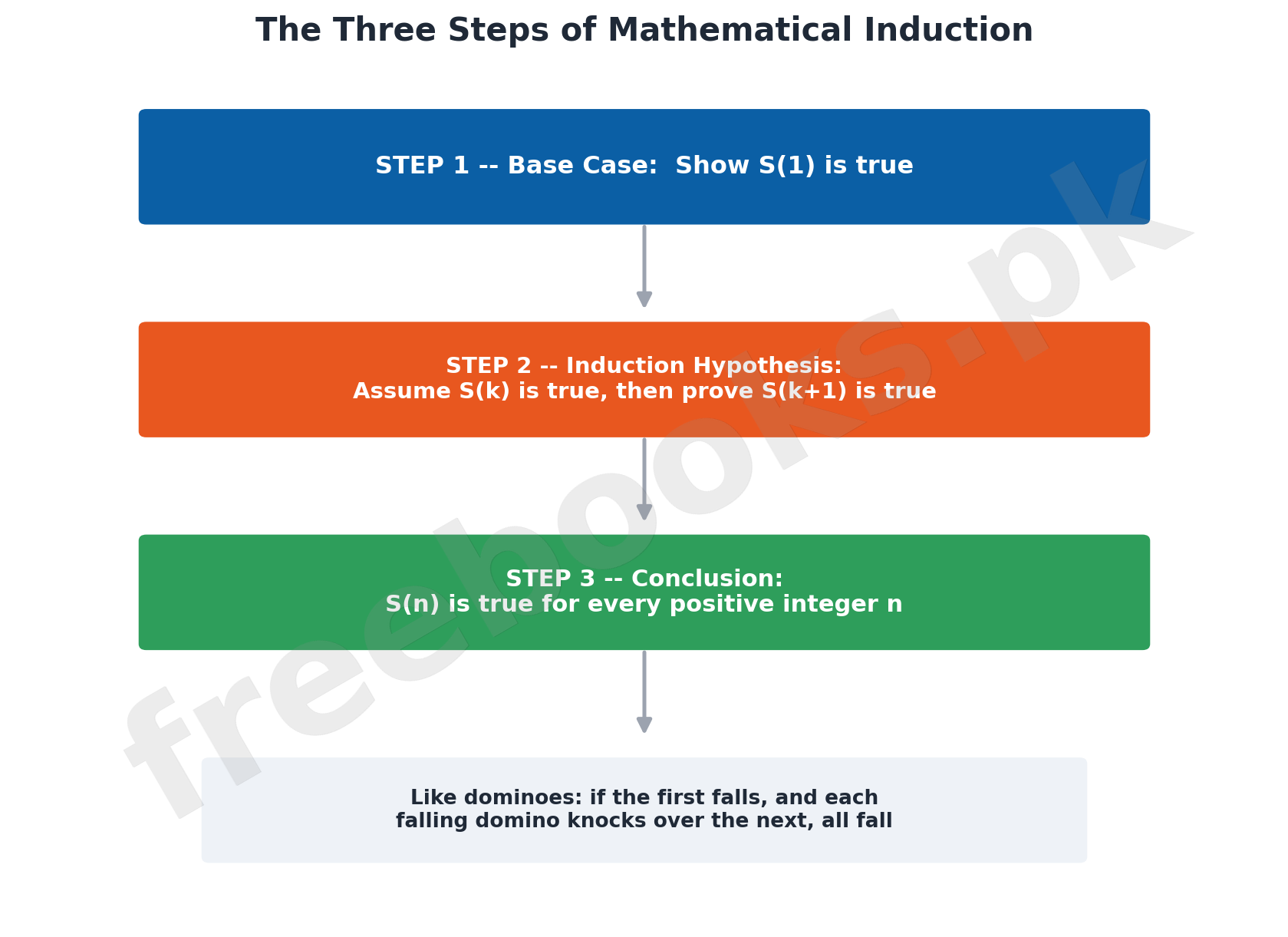
Since a formula cannot be checked for every one of infinitely many natural numbers directly, the principle of mathematical induction proves it in two finite steps: verify the base case S(1) is true, then show that whenever S(k) is true for some positive integer k, S(k+1) must also be true (the induction of hypothesis). If both steps hold, S(n) is concluded true for every positive integer n.
A single case that fails a formula, called a counterexample, is enough to disprove it entirely — which is exactly why observing a pattern in the first several cases is never a substitute for a real proof; the classic example is S(n)=n^2-n+41, which is prime for n=1 through 40 but fails at n=41.
8.2 The Principle of Extended Mathematical Induction
Some statements are not true starting from n=1 but from some other integer i (which may even be 0 or negative); the extended principle proves such statements by verifying the base case at S(i) instead of S(1), then showing S(k+1) follows from S(k) for every integer k >= i, concluding S(n) true for all integers n >= i.
The same two-method approach used in ordinary induction — proving S(k+1) either by direct algebraic manipulation of S(k) or by adding/multiplying an extra term onto both sides of S(k) — applies equally to extended induction; only the starting point of the base case changes.
8.3 The Binomial Theorem for a Positive Integral Index
For any positive integer n, (a+b)^n expands as the sum from r=0 to n of C(n,r) a^(n-r) b^r, where the C(n,r) values are called the binomial coefficients; this can itself be proved using mathematical induction (assuming it holds for n=k, then showing it holds for n=k+1 using Pascal's identity C(k,r)+C(k,r-1)=C(k+1,r)).
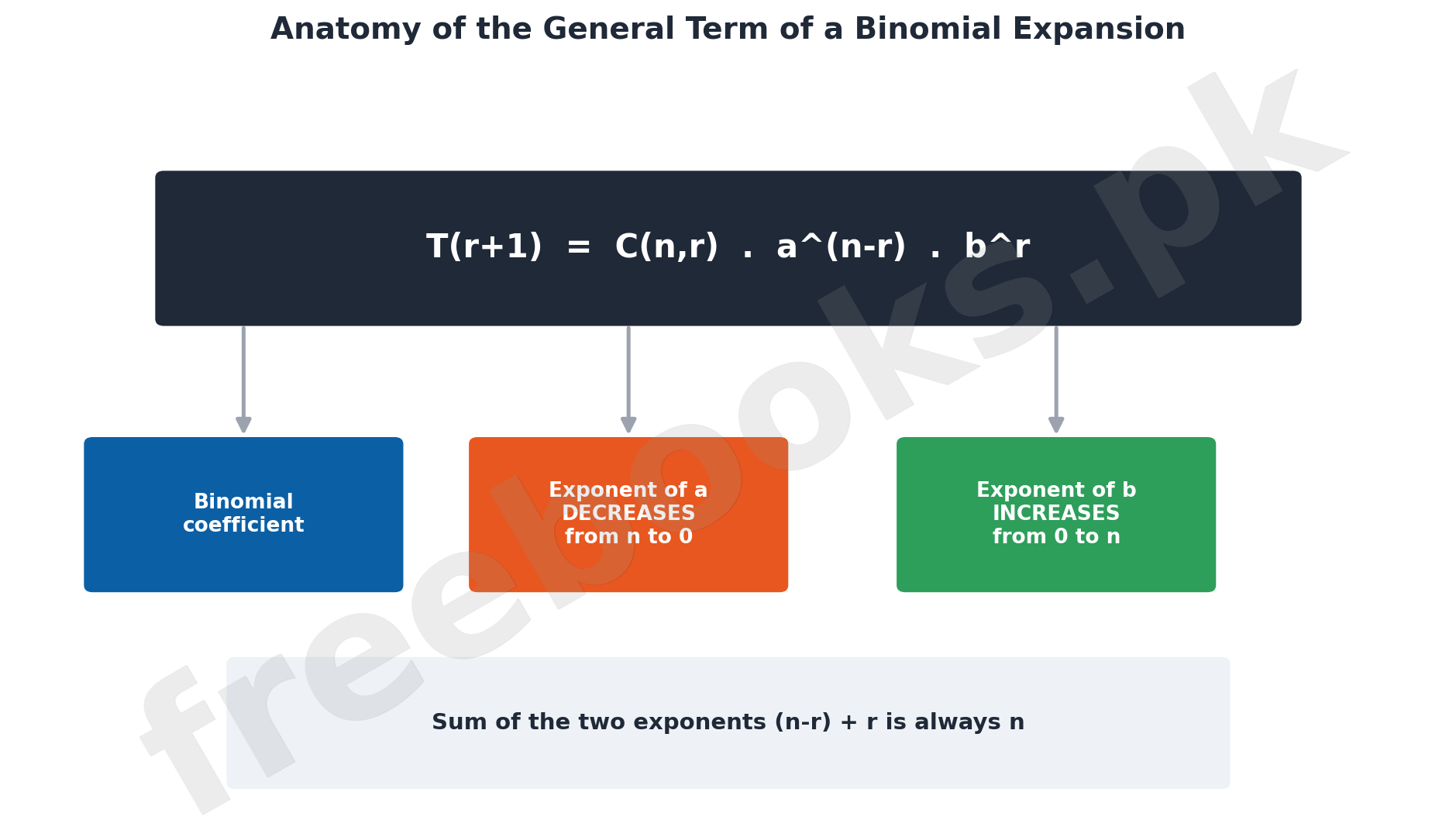
Several patterns hold in every binomial expansion: it has n+1 terms; the exponent of a decreases from n to 0 while the exponent of b increases from 0 to n (their sum is always n); and coefficients equidistant from the two ends are equal, since C(n,r)=C(n,n-r). The (r+1)th term, T(r+1) = C(n,r) a^(n-r) b^r, is called the general term, since every term of the expansion can be generated from it.
8.4 The Middle Term and Deductions from the Binomial Expansion
A binomial expansion has n+1 terms; if n is even, there is exactly one middle term, the (n/2 + 1)th term, while if n is odd, there are two middle terms, the ((n+1)/2)th and ((n+3)/2)th terms.
Substituting particular values for a and b in the general expansion yields useful identities: setting a=1 gives the expansion of (1+b)^n directly in terms of the binomial coefficients; setting a=b=1 shows the sum of all the binomial coefficients equals 2^n; and setting a=1, b=-1 shows the sum of the coefficients at odd positions equals the sum of the coefficients at even positions.
8.5 Pascal's Triangle
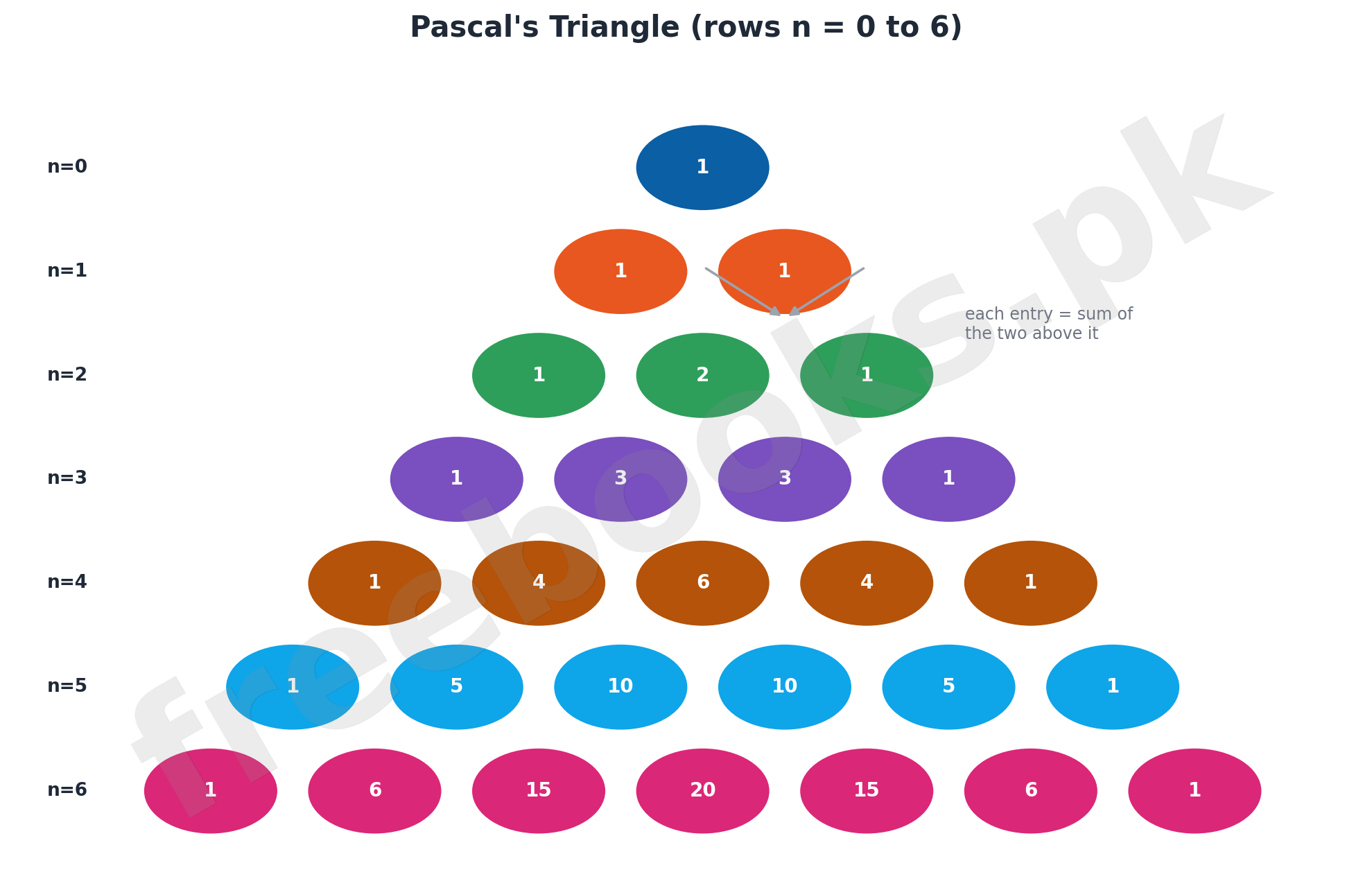
Pascal's triangle is a triangular arrangement of the binomial coefficients where the first row (n=0) is a single 1, every row begins and ends with 1, and every other interior entry is the sum of the two entries diagonally above it in the previous row — this rule is expressed algebraically as Pascal's Rule, C(n,k) = C(n-1,k-1) + C(n-1,k).
The entries in the nth row of Pascal's triangle are exactly the binomial coefficients C(n,0), C(n,1), …, C(n,n) needed to expand (a+b)^n, giving a quick way to find them without computing factorials directly, especially useful for smaller values of n.
8.6 The Binomial Theorem for a Negative or Fractional Index
When n is a negative integer or a fraction, (1+x)^n no longer terminates after n+1 terms; instead it becomes an infinite series, valid only when |x|<1, given by 1 + nx + [n(n-1)/2!]x^2 + [n(n-1)(n-2)/3!]x^3 + …, called the binomial series. In this case the symbols C(n,0), C(n,1), etc. are not meaningful, since n is not a non-negative integer, so the coefficients must be written out using the general pattern of the numerator product instead.
Since |x|<1 means each successive power of x is numerically smaller than the one before it, the terms of the series shrink in size, which is what allows just the first few terms to give a good approximation of the expansion's true value — the basis for every approximation and infinite-series-summation application in this unit.
8.7 Applications of the Binomial Theorem
Because the terms of a valid binomial series shrink rapidly, keeping only the first few terms gives an accurate approximate value for expressions like cube roots or square roots of numbers close to a perfect power (e.g. finding the cube root of 30 by writing it as 27(1+3/27) and expanding (1+1/9)^(1/3)).
Rewriting a large power as (1+k)^n (or (k-1)^n) and expanding via the binomial theorem is a powerful tool for finding remainders after division, the last digits of a large number, proving divisibility, comparing the size of two large numbers, and forecasting compound-interest growth — since every term of the expansion after the first one or two is typically a clean multiple of some convenient number, isolating exactly the piece of the expansion that matters for the question being asked.
Important Definitions
What is a counterexample?
A single case that fails a mathematical statement, proving it false.
What is the principle of mathematical induction?
A two-step method to prove a statement true for all positive integers: verify the base case S(1), then show S(k+1) is true whenever S(k) is true.
What is the base case in a mathematical induction proof?
The first step, showing the statement is true for the starting value of n (usually n=1).
What is the induction of hypothesis?
Assuming the statement is true for n=k, then proving it must also be true for n=k+1.
What is the extended principle of mathematical induction used for?
Proving a statement true for all integers n greater than or equal to some starting integer i, not necessarily 1.
What is the binomial theorem?
A formula for expanding (a+b)^n as a sum of terms involving binomial coefficients C(n,r).
What is the general term of a binomial expansion?
T(r+1) = C(n,r) a^(n-r) b^r, from which every term of the expansion can be generated.
What are binomial coefficients?
The numbers C(n,0), C(n,1), …, C(n,n) that appear in the expansion of (a+b)^n.
What is Pascal's Rule?
C(n,k) = C(n-1,k-1) + C(n-1,k), the rule that generates each entry of Pascal's triangle from the row above.
What condition must x satisfy for the binomial series expansion of (1+x)^n (n negative or fractional) to be valid?
|x| must be less than 1.
Key Facts and Relations
| Topic | Key Fact / Relation |
|---|---|
| Mathematical induction steps | Base case S(1) true; S(k) true implies S(k+1) true; conclusion S(n) true for all n |
| Binomial theorem | (a+b)^n = sum from r=0 to n of C(n,r) a^(n-r) b^r |
| Binomial coefficient | C(n,r) = n! / [r!(n-r)!] |
| General term | T(r+1) = C(n,r) a^(n-r) b^r |
| Middle term (n even) | the (n/2 + 1)th term |
| Middle terms (n odd) | the ((n+1)/2)th and ((n+3)/2)th terms |
| Sum of binomial coefficients | C(n,0)+C(n,1)+…+C(n,n) = 2^n |
| Sum of odd/even coefficients | sum of odd-position coefficients = sum of even-position coefficients |
| Pascal's Rule | C(n,k) = C(n-1,k-1) + C(n-1,k) |
| Binomial series (n negative/fractional) | (1+x)^n = 1+nx+[n(n-1)/2!]x^2+…, valid only for |x| < 1 |
Diagrams
The Three Steps of Mathematical Induction: A flow diagram showing the base case (S(1) true), the induction hypothesis (assume S(k) true, prove S(k+1) true), and the conclusion (S(n) true for all positive integers n), compared to a chain of falling dominoes
Pascal's Triangle: Rows n=0 through n=6 of Pascal's triangle, showing how each interior entry is the sum of the two entries directly above it, and how the entries of each row give the binomial coefficients for that value of n
Anatomy of the General Term of a Binomial Expansion: A labeled breakdown of the general term formula T(r+1) = C(n,r) a^(n-r) b^r, showing the binomial coefficient, the decreasing exponent of a, the increasing exponent of b, and the fact that the two exponents always sum to n
Solved Examples
Example 1: Proving a Sum Formula by Mathematical Induction
Problem: Use mathematical induction to prove that 2+4+6+…+2n = n(n+1) for every positive integer n.
- Base case: for n=1, LHS=2 and RHS=1(1+1)=2, so S(1) is true.
- Induction hypothesis: assume S(k): 2+4+…+2k = k(k+1) is true.
- Add 2(k+1) to both sides: 2+4+…+2k+2(k+1) = k(k+1)+2(k+1) = (k+1)(k+2), which matches the required form of S(k+1).
- Conclusion: since both conditions hold, S(n) is true for every positive integer n.
- Final answer: the formula 2+4+6+…+2n = n(n+1) is proven true for all positive integers n.
Example 2: Proving Divisibility by Mathematical Induction
Problem: Prove that 5^n – 1 is divisible by 4 for all positive integers n.
- Base case: for n=1, 5^1-1=4, which is divisible by 4, so S(1) is true.
- Induction hypothesis: assume 5^k – 1 = 4m for some integer m.
- For n=k+1: 5^(k+1)-1 = 5.5^k-1 = 5(4m+1)-1 = 20m+4 = 4(5m+1), which is divisible by 4.
- Conclusion: since both conditions hold, 5^n-1 is divisible by 4 for all positive integers n.
- Final answer: proven true by mathematical induction.
Example 3: Extended Mathematical Induction with an Inequality
Problem: Prove that n! > 2^n for all integers n >= 4.
- Base case: for n=4, 4!=24 and 2^4=16; since 24>16, S(4) is true.
- Induction hypothesis: assume k! > 2^k is true for some integer k >= 4.
- For n=k+1: (k+1)! = (k+1).k! > (k+1).2^k (by the hypothesis); since k>=4, (k+1)>=5>2, so (k+1).2^k > 2.2^k = 2^(k+1).
- Therefore (k+1)! > 2^(k+1), so S(k+1) is true whenever S(k) is true.
- Final answer: by the principle of extended mathematical induction, n! > 2^n is true for all integers n >= 4.
Example 4: Expanding a Binomial Using the Binomial Theorem
Problem: Expand (2x – 1/x)^5 using the binomial theorem.
- Identify a=2x, b=-1/x, n=5; use T(r+1) = C(5,r)(2x)^(5-r)(-1/x)^r for r=0,1,2,3,4,5.
- r=0: C(5,0)(2x)^5 = 32x^5. r=1: C(5,1)(2x)^4(-1/x) = 5(16x^4)(-1/x) = -80x^3.
- r=2: C(5,2)(2x)^3(-1/x)^2 = 10(8x^3)(1/x^2) = 80x. r=3: C(5,3)(2x)^2(-1/x)^3 = 10(4x^2)(-1/x^3) = -40/x.
- r=4: C(5,4)(2x)(-1/x)^4 = 5(2x)(1/x^4) = 10/x^3. r=5: C(5,5)(-1/x)^5 = -1/x^5.
- Final answer: (2x – 1/x)^5 = 32x^5 – 80x^3 + 80x – 40/x + 10/x^3 – 1/x^5.
Example 5: Finding a Specific Term in a Binomial Expansion
Problem: Find the term involving x^4 in the expansion of (x^2 + 3/x)^8.
- Use T(r+1) = C(8,r)(x^2)^(8-r)(3/x)^r = C(8,r) . 3^r . x^(16-3r).
- Set the exponent of x equal to 4: 16-3r=4, so 3r=12, giving r=4.
- Substitute r=4: T5 = C(8,4) . 3^4 . x^4.
- Compute C(8,4)=70 and 3^4=81; multiply 70×81=5670.
- Final answer: the term involving x^4 is 5670x^4.
Example 6: Finding the Middle Term
Problem: Find the middle term in the expansion of (x/3 + 3/x)^8.
- Since n=8 is even, there is exactly one middle term: the (8/2+1)=5th term, T5.
- Use T5 = C(8,4)(x/3)^4(3/x)^4.
- Simplify (x/3)^4(3/x)^4 = (x^4/81)(81/x^4) = 1.
- Compute C(8,4)=70, so T5 = 70 x 1 = 70.
- Final answer: the middle term is 70.
Example 7: Using the Binomial Series for Approximation
Problem: Use the binomial theorem to find the approximate value of 1/sqrt(1.02), correct to three decimal places.
- Write 1/sqrt(1.02) = (1+0.02)^(-1/2), so n=-1/2 and x=0.02 (since |x|<1, the expansion is valid).
- Use (1+x)^n = 1+nx+[n(n-1)/2!]x^2+…: term1=1, term2 = (-1/2)(0.02) = -0.01.
- term3 = [(-1/2)(-3/2)/2](0.02)^2 = [0.75/2](0.0004) = 0.00015.
- Add the first three terms: 1 – 0.01 + 0.00015 = 0.99015.
- Final answer: 1/sqrt(1.02) is approximately 0.990 (correct to three decimal places).
Example 8: Application: Finding a Remainder Using the Binomial Theorem
Problem: Using the binomial theorem, find the remainder when 7^50 is divided by 4.
- Write 7^50 = (8-1)^50 and expand using the binomial theorem: the sum from r=0 to 50 of C(50,r) . 8^(50-r) . (-1)^r.
- Every term with r<50 contains a positive power of 8, and since 8 is a multiple of 4, every such term is divisible by 4.
- The only term without a factor of 8 is the last one (r=50): C(50,50) . 8^0 . (-1)^50 = 1.
- So 7^50 = (a multiple of 4) + 1.
- Final answer: the remainder when 7^50 is divided by 4 is 1.
Short Questions & Answers
What are the three steps of mathematical induction?
Base case, induction of hypothesis, and conclusion.
What is a counterexample?
A single case that disproves a mathematical statement.
What is the binomial theorem used for?
Expanding (a+b)^n as a sum of terms involving binomial coefficients.
What is the general term of a binomial expansion?
T(r+1) = C(n,r) a^(n-r) b^r.
How many middle terms does a binomial expansion have when n is odd?
Two.
What is Pascal's Rule?
C(n,k) = C(n-1,k-1) + C(n-1,k).
What condition must |x| satisfy for the binomial series of (1+x)^n (n negative or fractional) to be valid?
|x| must be less than 1.
Long Questions & Answers
Explain the principle of mathematical induction, including its three steps, and describe how the extended principle differs from it.
What problem does mathematical induction solve?
Since a formula involving natural numbers cannot be checked for infinitely many values one by one, mathematical induction proves it is true for every natural number using just two finite steps instead.
What is the base case, and why is it necessary?
The base case verifies that the statement S(n) is true for the starting value (usually n=1); without it, the induction hypothesis alone would have nothing to build from.
What is the induction of hypothesis step?
Assuming S(k) is true for some arbitrary positive integer k, this step proves that S(k+1) must also be true, showing the statement can always be extended one step further.
How does the extended principle of mathematical induction differ from the ordinary principle?
The extended principle allows the base case to start at any integer i (not necessarily 1, and possibly 0 or negative), and then proves S(k+1) follows from S(k) for every integer k greater than or equal to i, concluding S(n) is true for all integers n greater than or equal to i.
Describe the binomial theorem for a positive integral index, including the general term, and explain how the middle term is found.
What does the binomial theorem state?
For any positive integer n, (a+b)^n expands as the sum from r=0 to n of C(n,r) a^(n-r) b^r, where C(n,r) are the binomial coefficients.
What is the general term, and why is it useful?
The general term is T(r+1) = C(n,r) a^(n-r) b^r; since substituting r=0,1,2,…,n generates every term of the expansion, it lets any specific term be found directly without writing out the whole expansion.
How many terms does a binomial expansion have, and what patterns do the exponents follow?
A binomial expansion of (a+b)^n has exactly n+1 terms; the exponent of a decreases from n to 0 while the exponent of b increases from 0 to n, and the two exponents in any term always add up to n.
How is the middle term found, and why does the method differ based on whether n is even or odd?
If n is even, n+1 (the total number of terms) is odd, so there is exactly one middle term, the (n/2+1)th term; if n is odd, n+1 is even, so there are two middle terms, the ((n+1)/2)th and ((n+3)/2)th terms — the difference arises because an odd total number of terms has one true center, while an even total has two.
Multiple Choice Questions (MCQs)
The first step of mathematical induction is called the: (A) Conclusion (B) Base case (C) Hypothesis test (D) Counterexample
Correct answer: (B) Base case. The base case verifies the statement is true for the starting value, usually n=1.
A counterexample is: (A) A proof of a statement (B) A single case that disproves a statement (C) An extra base case (D) A binomial coefficient
Correct answer: (B) A single case that disproves a statement. A counterexample is one failing case that is enough to disprove an entire statement.
The binomial theorem expands (a+b)^n as a sum involving: (A) Logarithms (B) Binomial coefficients C(n,r) (C) Trigonometric ratios (D) Matrices
Correct answer: (B) Binomial coefficients C(n,r). The expansion of (a+b)^n is a sum of terms, each with a binomial coefficient C(n,r).
The general term of a binomial expansion is given by: (A) C(n,r) a^r b^(n-r) (B) C(n,r) a^(n-r) b^r (C) n! a^n (D) a^n+b^n
Correct answer: (B) C(n,r) a^(n-r) b^r. The general term is T(r+1) = C(n,r) a^(n-r) b^r.
A binomial expansion of (a+b)^n has how many terms? (A) n (B) n+1 (C) n-1 (D) 2n
Correct answer: (B) n+1. The expansion always has n+1 terms, one more than the index.
If n is even, the number of middle terms in a binomial expansion is: (A) 0 (B) 1 (C) 2 (D) n
Correct answer: (B) 1. An even n gives an odd total number of terms (n+1), so there is exactly one true middle term.
Pascal's Rule states that C(n,k) equals: (A) C(n-1,k) x C(n-1,k-1) (B) C(n-1,k-1) + C(n-1,k) (C) C(n-1,k) – C(n-1,k-1) (D) C(n,k-1)
Correct answer: (B) C(n-1,k-1) + C(n-1,k). Each entry of Pascal's triangle is the sum of the two entries above it: C(n-1,k-1)+C(n-1,k).
The sum of all binomial coefficients C(n,0)+C(n,1)+…+C(n,n) equals: (A) n! (B) 2^n (C) n^2 (D) 2n
Correct answer: (B) 2^n. Setting a=b=1 in the binomial expansion gives (1+1)^n = 2^n as the sum of all coefficients.
The binomial series expansion of (1+x)^n for n negative or fractional is valid only when: (A) x > 1 (B) |x| < 1 (C) x = 0 (D) x is a whole number
Correct answer: (B) |x| < 1. The infinite binomial series only converges when the absolute value of x is less than 1.
The binomial theorem can be used to find the remainder of a large power when divided by a number by writing the base as: (A) A logarithm (B) A sum or difference matching a multiple of the divisor (C) A matrix (D) A trigonometric identity
Correct answer: (B) A sum or difference matching a multiple of the divisor. Rewriting the base as (multiple of the divisor +/- 1) makes every expanded term but the last a clean multiple of the divisor.
Quick Revision Summary
- Mathematical induction proves a statement true for all n by two steps: base case (S(1) true) and induction of hypothesis (S(k) true implies S(k+1) true)
- A counterexample — a single failing case — is enough to disprove any mathematical statement
- Extended mathematical induction proves statements true for all integers n >= i, starting the base case at S(i) instead of S(1)
- Binomial theorem: (a+b)^n = sum from r=0 to n of C(n,r) a^(n-r) b^r, for positive integer n
- General term: T(r+1) = C(n,r) a^(n-r) b^r
- A binomial expansion of (a+b)^n has n+1 terms; exponents of a and b always sum to n
- Middle term: one middle term ((n/2+1)th) if n is even; two middle terms if n is odd
- Sum of binomial coefficients: C(n,0)+C(n,1)+…+C(n,n) = 2^n
- Pascal's Rule: C(n,k) = C(n-1,k-1) + C(n-1,k), generating Pascal's triangle
- For n negative or fractional, (1+x)^n becomes an infinite binomial series, valid only when |x| < 1
- Since terms shrink when |x| < 1, the first few terms of a binomial series give good approximations
- Rewriting a large power as (base +/- k)^n and expanding is a powerful tool for remainders, last digits, divisibility, and comparisons
Exam Tips
- Always write out the base case explicitly and show it equals both sides — don't skip this step
- In the induction step, add or manipulate S(k) algebraically to reach exactly the form of S(k+1) — work toward the target expression
- Remember C(n,r) = C(n,n-r) — use it to quickly find coefficients equidistant from the ends of an expansion
- To find a specific term (like the one involving x^5), set the exponent of x in T(r+1) equal to the target power and solve for r
- For approximation problems, only the first 3-4 terms of a binomial series are usually needed since later terms shrink rapidly when |x| < 1
- For remainder/divisibility problems, rewrite the base as (multiple of divisor +/- 1) before expanding, so every term but the last is a clean multiple of the divisor