This unit teaches how to reverse a process students already know well — combining two or more fractions into a single fraction — by breaking a single, more complicated rational fraction back down into a sum of simpler ones. This skill, called partial fraction resolution, becomes essential later in calculus, where a complicated fraction is often far easier to integrate once it has been split into simple pieces.
The unit begins by distinguishing proper from improper rational fractions and showing how an improper fraction is reduced, using long division, to a polynomial plus a proper fraction before any decomposition can begin. It then works through all four standard cases of partial fraction decomposition, based on how the denominator factors: non-repeated linear factors, repeated linear factors, non-repeated irreducible quadratic factors, and repeated irreducible quadratic factors — along with the two techniques (substitution and coefficient comparison) used to find the unknown constants in each case.
Learning Objectives
- Distinguish between a proper and an improper rational fraction
- Reduce an improper rational fraction to a polynomial plus a proper fraction using long division
- Distinguish between a conditional equation and an identity
- Apply the theorem that equal polynomials have equal coefficients of every matching power of x
- Resolve a rational fraction into partial fractions when the denominator has non-repeated linear factors
- Resolve a rational fraction into partial fractions when the denominator has repeated linear factors
- Resolve a rational fraction into partial fractions when the denominator has non-repeated irreducible quadratic factors
- Resolve a rational fraction into partial fractions when the denominator has repeated irreducible quadratic factors
- Apply both the substitution method and the coefficient-comparison method to find unknown constants, and verify a decomposition by recombining it
Key Concepts
5.1 Rational Fractions: Proper and Improper
A rational fraction is an expression of the form P(x)/Q(x), where P(x) and Q(x) are polynomials and Q(x) is not equal to zero. It is called proper if the degree of the numerator P(x) is less than the degree of the denominator Q(x), and improper if the degree of the numerator is equal to or greater than the degree of the denominator.
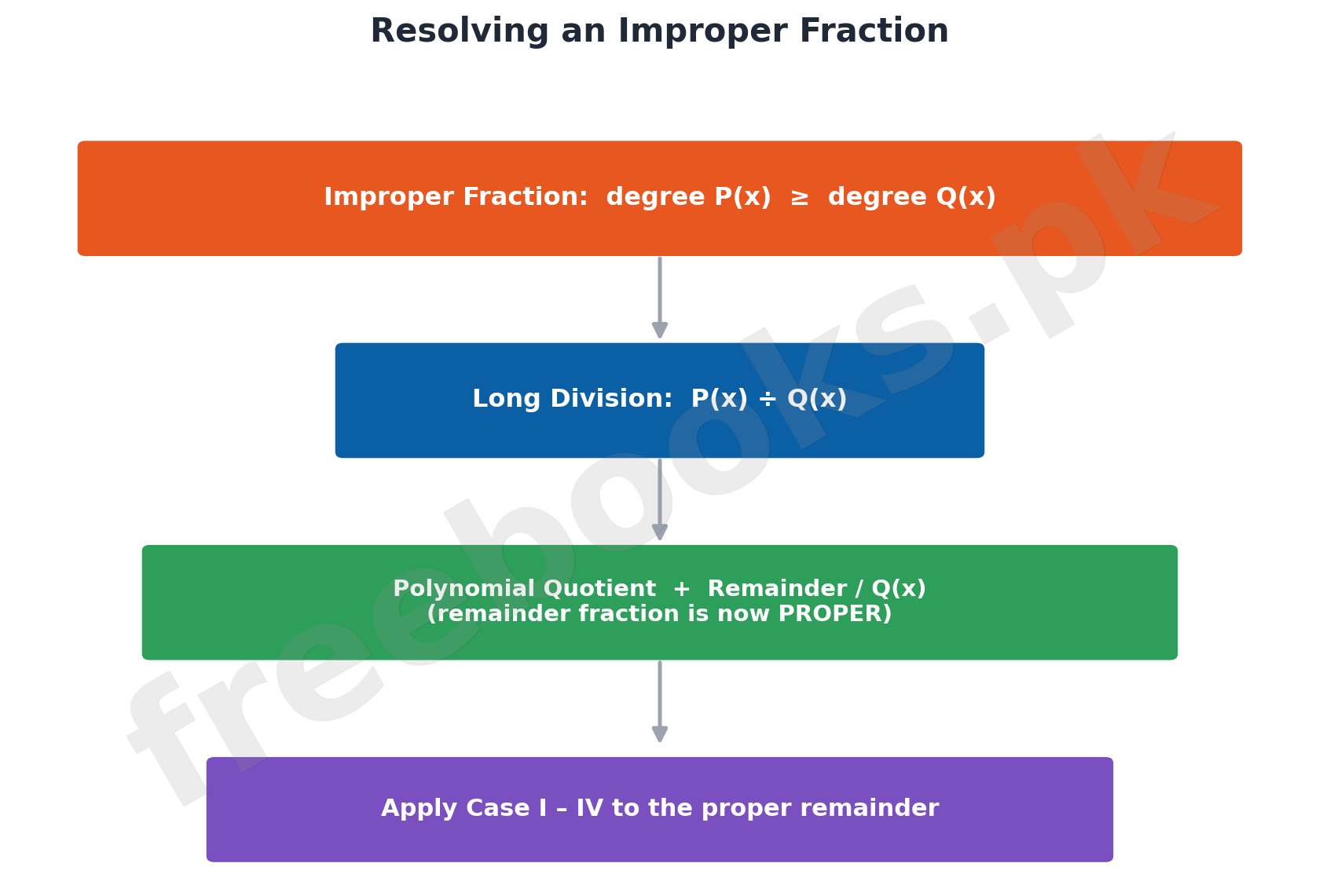
The method of partial fractions only works on proper fractions. If a fraction is improper, it must first be reduced by long division: dividing the numerator by the denominator produces a polynomial quotient plus a remainder over the original denominator, and since the remainder's degree is always less than the denominator's degree, this remainder fraction is now proper and ready for decomposition.
5.2 Equations, Identities, and the Coefficient-Comparison Theorem
A conditional equation is true only for certain particular values of the variable, while an identity is true for every value of the variable. Partial fraction decomposition always produces an identity — once the constants are correctly found, the decomposed sum equals the original fraction for every value of x (except where the denominator is zero).
The key theorem used throughout this unit: if two polynomials are equal for all values of x, they have the same degree and the coefficients of every matching power of x must be equal. This theorem, combined with substituting convenient values of x that make a particular factor zero, is how every unknown constant in a partial fraction decomposition is found.
5.3 Case I: Non-Repeated Linear Factors
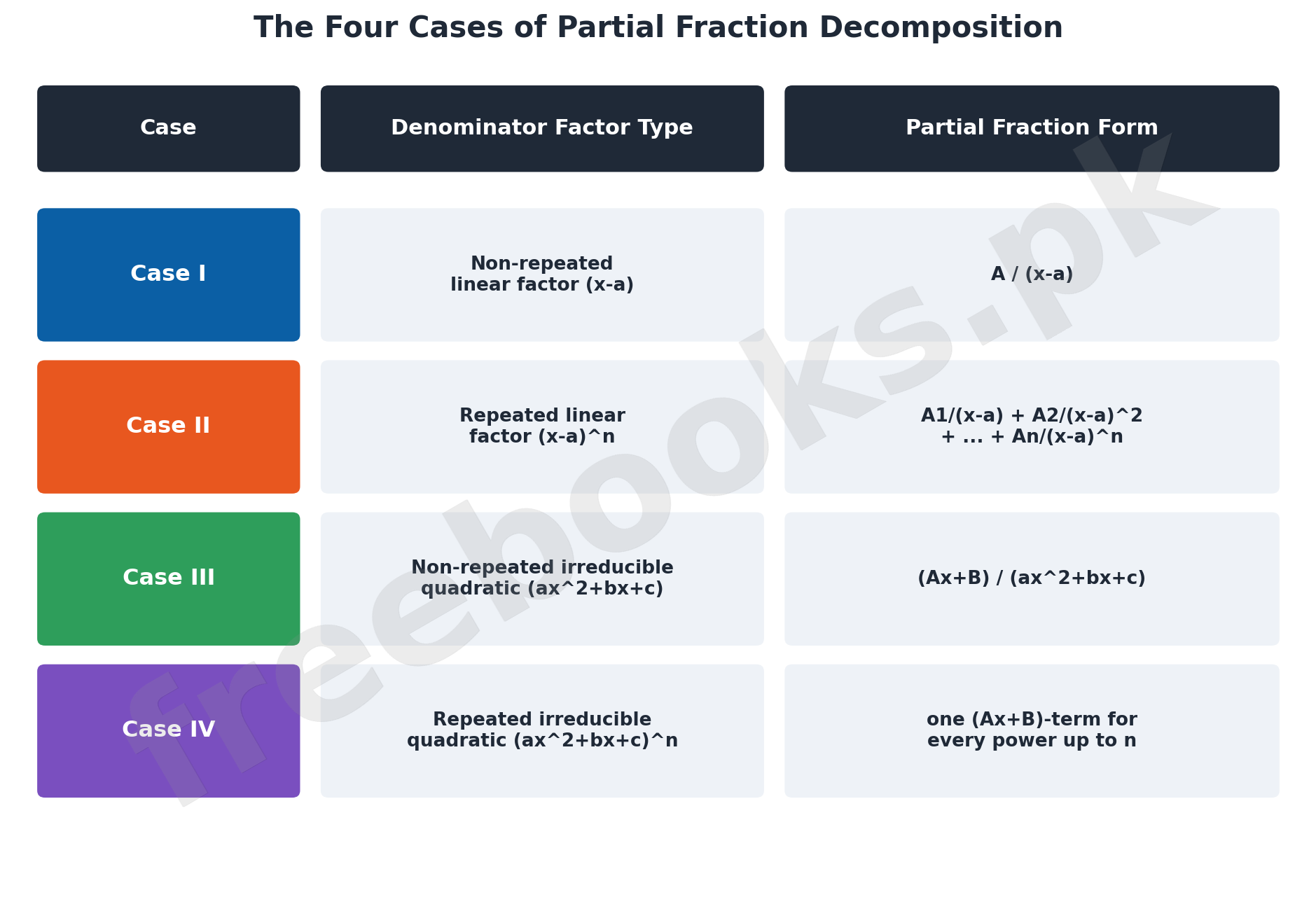
When the denominator factors as Q(x) = (x-a1)(x-a2)…(x-an), with every root distinct, the fraction decomposes as P(x)/Q(x) = A1/(x-a1) + A2/(x-a2) + … + An/(x-an) — one constant-numerator term for each distinct linear factor.
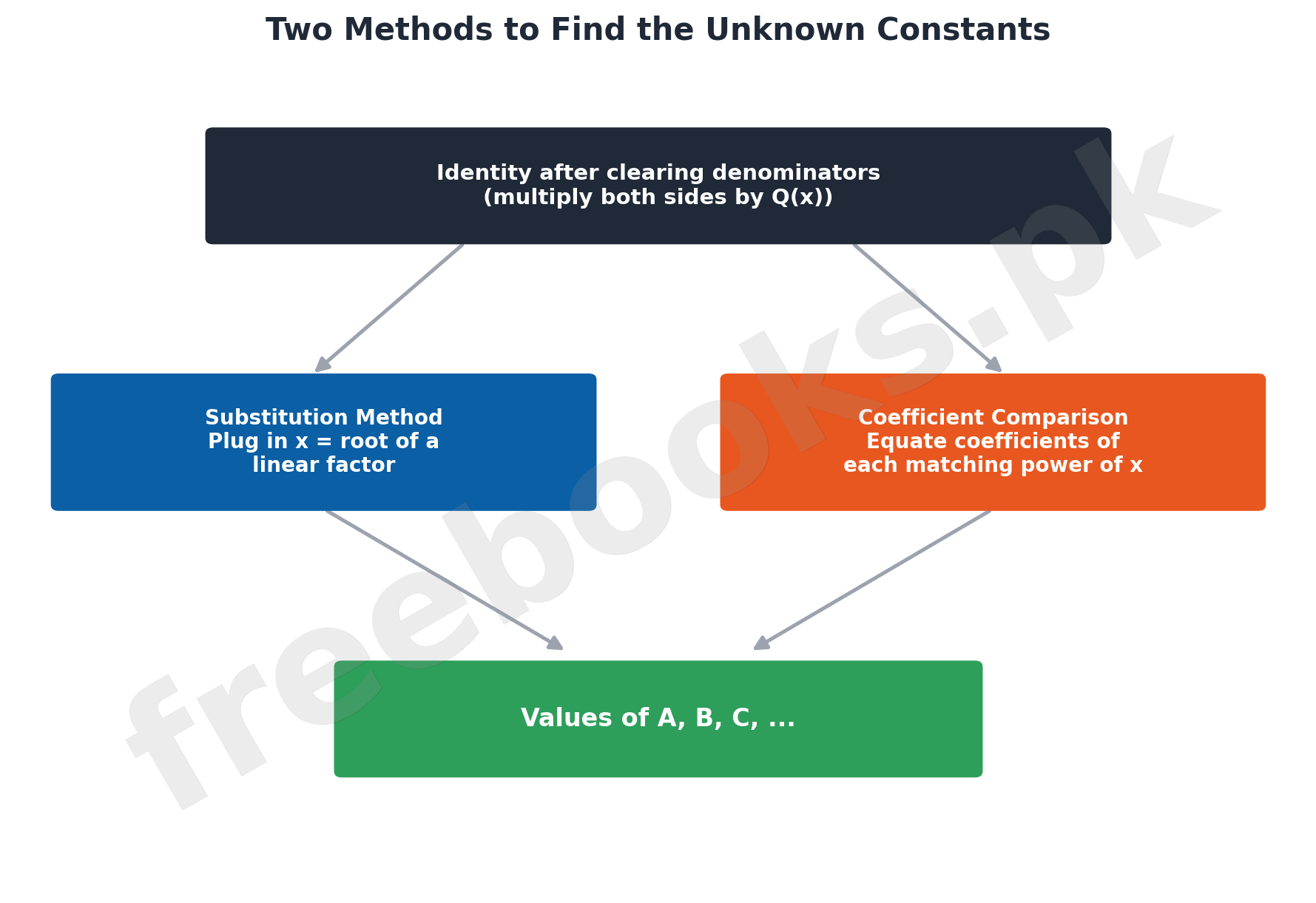
Multiplying both sides by Q(x) clears every denominator and produces an identity in x. Each constant can then be found either by equating the coefficients of matching powers of x on both sides, or — much faster — by substituting x = a_i for each root in turn, which makes every term except the one containing A_i vanish completely.
5.4 Case II: Repeated Linear Factors
When the denominator contains a repeated linear factor (x-a)^n, the decomposition needs one term for every power from 1 up to n, not just a single term: A1/(x-a) + A2/(x-a)^2 + … + An/(x-a)^n.
After clearing denominators, the highest-power constant An is usually found immediately by substituting x=a, since every other term vanishes at that value. The remaining constants are then found by equating the coefficients of the remaining powers of x.
5.5 Case III: Non-Repeated Irreducible Quadratic Factors
An irreducible quadratic factor is one that cannot be split into two real linear factors, such as x^2+1 or x^2+x+1. When the denominator contains such a factor (not repeated), its partial fraction term takes the form (Ax+B)/(ax^2+bx+c) — a linear expression in the numerator, not just a constant.
Any ordinary linear factors that also appear in the denominator still get standard constant-numerator terms exactly as in Case I. The unknown constants are usually found using a mix of convenient substitution for the linear factors and equating coefficients of matching powers of x for the quadratic term's A and B.
5.6 Case IV: Repeated Irreducible Quadratic Factors
When the denominator contains a repeated irreducible quadratic factor (ax^2+bx+c)^n, the decomposition needs one linear-numerator term for every power from 1 to n: (A1x+B1)/(ax^2+bx+c) + (A2x+B2)/(ax^2+bx+c)^2 + … + (Anx+Bn)/(ax^2+bx+c)^n.
As with Case II, this almost always requires equating the coefficients of every matching power of x after clearing denominators, since there is no single convenient real substitution that isolates each unknown constant directly the way substituting a linear factor's root does.
Important Definitions
What is a rational fraction?
An expression P(x)/Q(x) where P(x) and Q(x) are polynomials and Q(x) is not equal to zero.
What is a proper rational fraction?
One in which the degree of the numerator P(x) is less than the degree of the denominator Q(x).
What is an improper rational fraction?
One in which the degree of the numerator is equal to or greater than the degree of the denominator.
What is the difference between a conditional equation and an identity?
A conditional equation is true only for particular values of the variable; an identity is true for every value of the variable.
What is partial fraction resolution?
The process of expressing a single rational fraction as a sum of two or more simpler rational fractions.
What is an irreducible quadratic factor?
A quadratic expression that cannot be written as the product of two linear factors with real coefficients.
What form does the partial fraction take for a non-repeated linear factor (x-a)?
A/(x-a), where A is a constant to be found.
What form does the partial fraction take for a non-repeated irreducible quadratic factor?
(Ax+B)/(ax^2+bx+c), with a linear expression in the numerator.
How is an improper rational fraction prepared for partial fraction resolution?
By long division of the numerator by the denominator, writing it as a polynomial plus a proper fraction, then resolving the proper fraction.
What theorem allows coefficients to be equated in an identity?
If two polynomials are equal for all values of the variable, they have the same degree and the coefficients of every matching power of the variable must be equal.
Key Facts and Relations
| Topic | Key Fact / Relation |
|---|---|
| Proper fraction condition | degree of P(x) < degree of Q(x) |
| Improper fraction reduction | P(x)/Q(x) = polynomial quotient + remainder/Q(x), found by long division |
| Case I: non-repeated linear factors | P(x)/[(x-a1)…(x-an)] = A1/(x-a1) + A2/(x-a2) + … + An/(x-an) |
| Case II: repeated linear factor (x-a)^n | A1/(x-a) + A2/(x-a)^2 + … + An/(x-a)^n |
| Case III: non-repeated irreducible quadratic | (Ax+B) / (ax^2+bx+c) |
| Case IV: repeated irreducible quadratic (ax^2+bx+c)^n | (A1x+B1)/(ax^2+bx+c) + … + (Anx+Bn)/(ax^2+bx+c)^n |
| Substitution shortcut | To find the constant for factor (x-a), substitute x=a after clearing denominators |
| Coefficient-comparison rule | Equal polynomials have equal coefficients for every matching power of x |
Diagrams
The Four Cases of Partial Fraction Decomposition: A summary table listing all four cases — non-repeated linear, repeated linear, non-repeated irreducible quadratic, and repeated irreducible quadratic factors — alongside the exact partial fraction form used for each
Resolving an Improper Fraction: A flow diagram showing an improper fraction being reduced by long division into a polynomial quotient plus a proper remainder fraction, which is then resolved using Case I-IV
Two Methods to Find the Unknown Constants: A flow diagram showing the identity obtained after clearing denominators branching into two methods — substitution (plugging in the roots of linear factors) and coefficient comparison (equating like powers of x) — both converging on the values of the unknown constants
Solved Examples
Example 1: Reducing an Improper Fraction
Problem: Express (2x^2+3)/(x-1) as a polynomial plus a proper fraction using long division.
- Divide the leading term: 2x^2 divided by x gives 2x. Multiply 2x by (x-1) to get 2x^2-2x, and subtract from 2x^2+3 to leave 2x+3.
- Divide the new leading term: 2x divided by x gives 2. Multiply 2 by (x-1) to get 2x-2, and subtract from 2x+3 to leave a remainder of 5.
- The quotient is 2x+2 and the remainder is 5, so the division stops here.
- Final answer: (2x^2+3)/(x-1) = 2x+2 + 5/(x-1).
Example 2: Case I: Non-Repeated Linear Factors (Substitution Method)
Problem: Resolve (5x-1)/[(x-2)(x+1)] into partial fractions.
- Suppose (5x-1)/[(x-2)(x+1)] = A/(x-2) + B/(x+1).
- Multiply both sides by (x-2)(x+1) to clear denominators: 5x-1 = A(x+1) + B(x-2).
- Substitute x=2 (making the B-term vanish): 5(2)-1 = A(3), so 9 = 3A, giving A = 3.
- Substitute x=-1 (making the A-term vanish): 5(-1)-1 = B(-3), so -6 = -3B, giving B = 2.
- Final answer: (5x-1)/[(x-2)(x+1)] = 3/(x-2) + 2/(x+1).
Example 3: Case II: Repeated Linear Factors
Problem: Resolve (3x-1)/(x-1)^2 into partial fractions.
- Suppose (3x-1)/(x-1)^2 = A/(x-1) + B/(x-1)^2.
- Multiply both sides by (x-1)^2 to clear denominators: 3x-1 = A(x-1) + B.
- Substitute x=1 (making the A-term vanish): 3(1)-1 = B, so B = 2.
- Equate the coefficients of x on both sides: 3 = A.
- Final answer: (3x-1)/(x-1)^2 = 3/(x-1) + 2/(x-1)^2.
Example 4: Case III: Non-Repeated Irreducible Quadratic Factor
Problem: Resolve (2x+1)/[(x^2+1)(x-1)] into partial fractions.
- Suppose (2x+1)/[(x^2+1)(x-1)] = (Ax+B)/(x^2+1) + C/(x-1).
- Multiply both sides by (x^2+1)(x-1) to clear denominators: 2x+1 = (Ax+B)(x-1) + C(x^2+1).
- Substitute x=1 (making the first term vanish): 2(1)+1 = C(2), so 3 = 2C, giving C = 3/2.
- Expand the right side and equate coefficients of x^2: 0 = A+C, so A = -3/2. Equate the constant terms: 1 = -B+C, so B = C-1 = 1/2.
- Final answer: (2x+1)/[(x^2+1)(x-1)] = (1-3x)/[2(x^2+1)] + 3/[2(x-1)].
Example 5: Case IV: Repeated Irreducible Quadratic Factor
Problem: Resolve x^3/(x^2+1)^2 into partial fractions.
- Suppose x^3/(x^2+1)^2 = (Ax+B)/(x^2+1) + (Cx+D)/(x^2+1)^2.
- Multiply both sides by (x^2+1)^2 to clear denominators: x^3 = (Ax+B)(x^2+1) + (Cx+D) = Ax^3 + Bx^2 + (A+C)x + (B+D).
- Equate coefficients of x^3: A=1. Equate coefficients of x^2: B=0.
- Equate coefficients of x: A+C=0, so C=-1. Equate the constant terms: B+D=0, so D=0.
- Final answer: x^3/(x^2+1)^2 = x/(x^2+1) – x/(x^2+1)^2.
Example 6: Combining Substitution and Coefficient Comparison
Problem: Resolve (x^2+2x+3)/[(x-1)(x+2)^2] into partial fractions.
- Suppose (x^2+2x+3)/[(x-1)(x+2)^2] = A/(x-1) + B/(x+2) + C/(x+2)^2.
- Multiply both sides by (x-1)(x+2)^2 to clear denominators: x^2+2x+3 = A(x+2)^2 + B(x-1)(x+2) + C(x-1).
- Substitute x=1: 1+2+3 = A(9), so A = 6/9 = 2/3.
- Substitute x=-2: 4-4+3 = C(-3), so C = -1.
- Equate the coefficients of x^2: 1 = A+B, so B = 1 – 2/3 = 1/3.
- Final answer: (x^2+2x+3)/[(x-1)(x+2)^2] = (2/3)/(x-1) + (1/3)/(x+2) – 1/(x+2)^2.
Example 7: Verifying a Partial Fraction Decomposition
Problem: Verify that 4/(x+3) + 3/(x+4) recombines to give (7x+25)/[(x+3)(x+4)].
- Find the common denominator (x+3)(x+4): 4/(x+3) + 3/(x+4) = [4(x+4) + 3(x+3)] / [(x+3)(x+4)].
- Expand the numerator: 4(x+4) + 3(x+3) = 4x+16+3x+9 = 7x+25.
- So 4/(x+3) + 3/(x+4) = (7x+25)/[(x+3)(x+4)], which matches the original fraction exactly.
- This 'add back together' check is a reliable way to confirm any partial fraction answer, and is especially useful before using the decomposed form in a later step such as integration in calculus.
- Final answer: the decomposition is verified — 4/(x+3) + 3/(x+4) recombines to (7x+25)/[(x+3)(x+4)].
Short Questions & Answers
What is a proper rational fraction?
One in which the degree of the numerator is less than the degree of the denominator.
How is an improper rational fraction prepared for partial fractions?
By long division, reducing it to a polynomial plus a proper fraction.
What is an identity?
An equation that holds true for all values of the variable, not just particular ones.
What form is used for a non-repeated linear factor (x-a)?
A/(x-a).
What form is used for a repeated linear factor (x-a)^2?
A/(x-a) + B/(x-a)^2.
What makes a quadratic factor irreducible?
It cannot be factored into two real linear factors.
What is the fastest way to find the constant for a non-repeated linear factor?
Substitute the value of x that makes that factor equal to zero.
Long Questions & Answers
Explain the difference between a proper and an improper rational fraction, and describe how an improper fraction is prepared before it can be resolved into partial fractions.
What is a rational fraction, and what distinguishes proper from improper?
A rational fraction is P(x)/Q(x) with Q(x) not equal to zero; it is proper if the degree of P(x) is less than the degree of Q(x), and improper if the degree of P(x) is equal to or greater than the degree of Q(x).
Why can't partial fraction decomposition be applied directly to an improper fraction?
The standard partial fraction forms (constant or linear numerators over factors of the denominator) only ever add up to a proper fraction, so applying them directly to an improper fraction would not produce a valid identity.
How is an improper fraction converted into a form ready for partial fractions?
Long division is used to divide the numerator by the denominator, producing a polynomial quotient plus a remainder over the original denominator; since the remainder's degree is always less than the denominator's degree, this remainder fraction is now proper and can be decomposed normally.
Work through an example of this conversion.
For (2x^2+3)/(x-1), dividing gives a quotient of 2x+2 and a remainder of 5, so (2x^2+3)/(x-1) = 2x+2 + 5/(x-1); the polynomial part 2x+2 is left as is, and only the proper fraction 5/(x-1) would need further partial fraction work if its denominator had more than one factor.
Describe all four cases of partial fraction decomposition based on the type of factor found in the denominator, including the general form of the partial fractions used in each case.
What form is used when the denominator has only non-repeated linear factors?
Q(x) = (x-a1)(x-a2)…(x-an) with all different roots gives P(x)/Q(x) = A1/(x-a1) + A2/(x-a2) + … + An/(x-an), one constant-numerator term per distinct linear factor.
What form is used when the denominator has a repeated linear factor?
A repeated factor (x-a)^n requires one term for every power from 1 up to n: A1/(x-a) + A2/(x-a)^2 + … + An/(x-a)^n, not just a single term.
What form is used when the denominator has a non-repeated irreducible quadratic factor?
An irreducible quadratic factor ax^2+bx+c (one that cannot be split into real linear factors) gets a linear-numerator term, (Ax+B)/(ax^2+bx+c), instead of a constant-numerator term.
What form is used when the denominator has a repeated irreducible quadratic factor?
A repeated irreducible quadratic factor (ax^2+bx+c)^n requires one linear-numerator term for every power from 1 to n: (A1x+B1)/(ax^2+bx+c) + (A2x+B2)/(ax^2+bx+c)^2 + … + (Anx+Bn)/(ax^2+bx+c)^n.
Multiple Choice Questions (MCQs)
A rational fraction P(x)/Q(x) is proper if: (A) degree P > degree Q (B) degree P < degree Q (C) degree P = degree Q always (D) Q(x) = 0
Correct answer: (B) degree P < degree Q. A proper fraction has numerator degree strictly less than denominator degree.
An improper rational fraction is first converted using: (A) Factoring only (B) Long division (C) Substitution only (D) Squaring
Correct answer: (B) Long division. Long division reduces an improper fraction to a polynomial plus a proper remainder fraction.
An identity is true for: (A) Only one value of x (B) A few particular values of x (C) All values of the variable (D) No values of x
Correct answer: (C) All values of the variable. An identity holds true for every value of the variable, unlike a conditional equation.
For a non-repeated linear factor (x-a), the partial fraction has the form: (A) A/(x-a) (B) A/(x-a)^2 (C) (Ax+B)/(x-a) (D) Ax
Correct answer: (A) A/(x-a). A non-repeated linear factor gets a single constant-numerator term, A/(x-a).
For a repeated linear factor (x-a)^2, the decomposition needs: (A) Only one term (B) Two terms: A/(x-a) and B/(x-a)^2 (C) Three terms always (D) No terms
Correct answer: (B) Two terms: A/(x-a) and B/(x-a)^2. A repeated factor to the power 2 needs one term for each power up to 2.
An irreducible quadratic factor: (A) Can always be split into two real linear factors (B) Cannot be split into two real linear factors (C) Is always a perfect square (D) Has no real coefficients
Correct answer: (B) Cannot be split into two real linear factors. An irreducible quadratic cannot be factored into two real linear factors.
The partial fraction for a non-repeated irreducible quadratic factor has numerator: (A) A constant (B) A linear expression Ax+B (C) A quadratic expression (D) Always zero
Correct answer: (B) A linear expression Ax+B. Irreducible quadratic factors require a linear numerator, Ax+B, not just a constant.
The fastest way to find the constant for a non-repeated linear factor (x-a) is to: (A) Equate all coefficients (B) Substitute x = a into the cleared identity (C) Integrate both sides (D) Take the derivative
Correct answer: (B) Substitute x = a into the cleared identity. Substituting x=a makes every other term vanish, instantly giving that constant.
Partial fraction decomposition is especially useful in: (A) Geometry (B) Calculus (e.g. integration) (C) Trigonometry only (D) Probability
Correct answer: (B) Calculus (e.g. integration). Decomposing a complicated fraction into simple pieces makes integration in calculus much easier.
To resolve (3x-1)/(x-1)^2, the correct form is: (A) A/(x-1) (B) A/(x-1) + B/(x-1)^2 (C) (Ax+B)/(x-1)^2 (D) A/(x-1)^2 only
Correct answer: (B) A/(x-1) + B/(x-1)^2. A repeated linear factor to the power 2 needs both A/(x-1) and B/(x-1)^2.
Quick Revision Summary
- A rational fraction P(x)/Q(x) is proper if degree P(x) < degree Q(x), improper otherwise
- An improper fraction is reduced by long division to a polynomial plus a proper fraction before resolving
- An identity holds for all values of the variable; a conditional equation holds only for particular values
- Case I (non-repeated linear factors): P(x)/Q(x) = A1/(x-a1) + A2/(x-a2) + …
- Case II (repeated linear factor (x-a)^n): needs A1/(x-a) + A2/(x-a)^2 + … + An/(x-a)^n
- Case III (non-repeated irreducible quadratic): uses (Ax+B)/(ax^2+bx+c)
- Case IV (repeated irreducible quadratic (ax^2+bx+c)^n): needs one (Ax+B)-type term per power up to n
- Substituting x = a (the root of a linear factor) instantly finds that factor's constant
- Coefficients of matching powers of x must be equal in an identity — used when substitution alone isn't enough
- Always factor Q(x) completely into irreducible pieces before setting up the partial fraction form
- Multiply both sides by the full denominator Q(x) to clear all fractions before solving for constants
- Recombining the partial fractions is a reliable way to check that a decomposition is correct
Exam Tips
- Always check whether a fraction is proper or improper FIRST — improper fractions need long division before anything else
- Factor the denominator completely (into linear and irreducible quadratic factors) before writing the partial fraction form
- Use substitution (plugging in the root of a linear factor) whenever possible — it is much faster than comparing coefficients
- For repeated factors, remember to include a term for EVERY power up to n, not just the highest one
- For irreducible quadratic factors, always use a linear numerator Ax+B, never just a constant
- After finding all constants, recombine the partial fractions to verify they add up to the original fraction