A quadratic function f(x) = ax^2+bx+c graphs as a parabola, and this unit develops the tools needed to fully analyse that parabola: sketching it from its intercepts and vertex, and finding its exact maximum or minimum value by completing the square. It then tackles a subtlety that trips many students up — a quadratic function is not one-to-one over its whole domain, so finding its inverse requires first restricting the domain to one side of the vertex.
The unit then moves into absolute value quadratic equations and inequalities, rational and radical equations that reduce to a quadratic equation once cleared of fractions or radicals, and closes with real-world word problems — from room dimensions to braking distances — that translate naturally into a quadratic equation or inequality once the given conditions are written symbolically.
Learning Objectives
- Define a quadratic function and identify its standard form
- Sketch a quadratic function's graph and identify its vertex, x-intercepts, and y-intercept
- Determine whether a quadratic function's vertex is a maximum or minimum point
- Find the maximum or minimum value of a quadratic function by completing the square
- Find the inverse of a quadratic function on a restricted domain, and determine its domain and range
- Solve absolute value quadratic equations, checking for extraneous roots
- Solve absolute value quadratic inequalities using critical values and test points
- Solve rational equations that reduce to a quadratic equation
- Solve radical equations that reduce to a quadratic equation, checking for extraneous roots
- Apply quadratic equations and inequalities to solve real-world word problems
Key Concepts
3.1 The Quadratic Function and Its Graph
A quadratic function is a polynomial function of degree two, written in standard form as f(x) = ax^2+bx+c, where a, b, c are real numbers and a is not equal to 0. Its graph is a parabola that opens upward if a>0 and downward if a<0. The tip of the parabola, called the vertex and labelled (h, k), is a turning point lying on the parabola's vertical axis of symmetry — it is a minimum point when a>0 and a maximum point when a<0.
To sketch a quadratic function, find its y-intercept (set x=0), its x-intercepts (solve f(x)=0), and its vertex (h=-b/2a, k=f(h)). Once these are plotted, the direction the parabola opens shows immediately whether the function is increasing or decreasing on either side of the vertex.
3.2 Maximum and Minimum Values by Completing the Square
Completing the square rewrites f(x)=ax^2+bx+c in vertex form, f(x) = a(x-h)^2+k, where h=-b/2a and k=c-b^2/4a. This is done by factoring a out of the x^2 and x terms, adding and subtracting the square of half the new coefficient of x to form a perfect square trinomial, and simplifying.
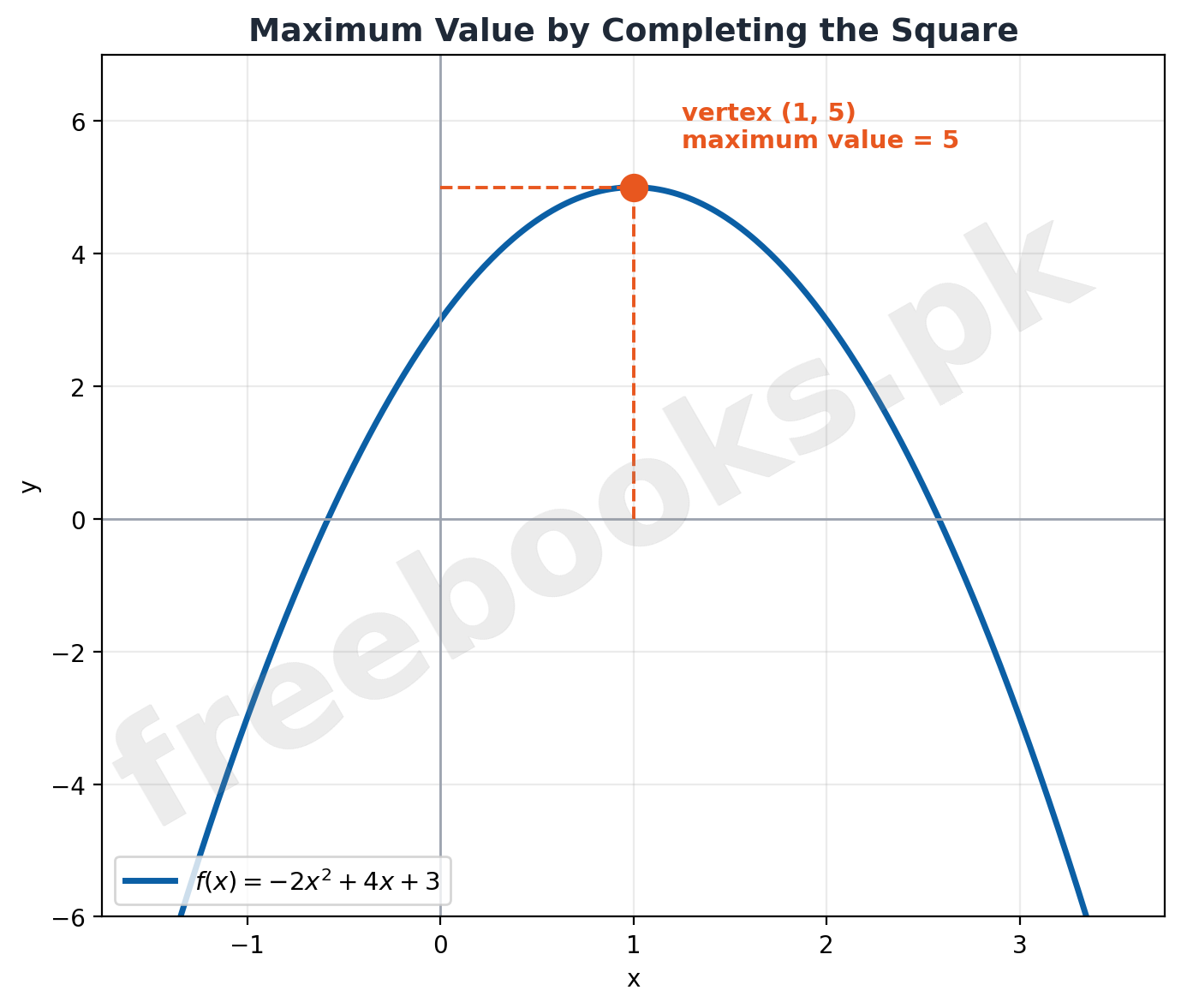
In vertex form, the squared term a(x-h)^2 is always zero (at x=h) or has the same sign as a everywhere else. So if a>0, the smallest value f(x) can take is k, giving a minimum value of k at x=h; if a<0, the largest value f(x) can take is k, giving a maximum value of k at x=h — this finds the exact maximum or minimum without needing to sketch the graph first.
3.3 Inverse of a Quadratic Function
A quadratic function is generally not one-to-one over its entire domain, since two different x-values on opposite sides of the vertex can produce the same output — it fails the horizontal line test. To find an inverse, the domain must first be restricted to one side of the vertex, commonly x>=h or x<=h, which makes the function one-to-one on that restricted domain.
To find the inverse formula, swap x and y in y=f(x), then solve the resulting equation for y using the quadratic formula — this produces a "plus" branch and a "minus" branch. Since only one of these branches actually maps back onto the correct restricted domain, the domain and range of the original restricted function are used (often by testing a value) to identify and keep the correct branch, discarding the other as extraneous.
3.4 Absolute Value Quadratic Equations and Inequalities
The absolute value of x is defined as |x|=x when x>=0 and |x|=-x when x<0. An absolute value quadratic equation |ax^2+bx+c|=d is solved by splitting it into two ordinary equations, ax^2+bx+c=d and ax^2+bx+c=-d, solving both, and then substituting every candidate answer back into the original equation to discard any extraneous root.
An absolute value quadratic inequality such as |ax^2+bx+c|<d is rewritten as the compound inequality -d<ax^2+bx+c<d, which splits into two separate quadratic inequalities to be solved using critical values and test points; the final solution set is the INTERSECTION of both regions' solutions. For |ax^2+bx+c|>d, the inequality splits into ax^2+bx+c<-d OR ax^2+bx+c>d instead, and the final solution set is the UNION of the two.
3.5 Rational and Radical Equations Reducible to a Quadratic Equation
A rational equation contains one or more rational expressions with the variable in the denominator. Multiplying every term of the equation by the least common denominator (LCD) clears all the fractions at once, typically leaving a quadratic equation that is solved by the usual methods — while remembering that any value which was originally forbidden (because it made a denominator zero) must still be excluded from the final solution set.
A radical equation contains the variable under a root sign. It is solved by isolating a radical on one side and squaring both sides, repeating the process if a second radical remains, until a polynomial (usually quadratic) equation results. Because squaring can introduce solutions that do not satisfy the original equation, every candidate solution must be substituted back into the ORIGINAL radical equation, and any extraneous root discarded.
3.6 Real-World Applications
Many word problems translate directly into a quadratic equation: assign a variable to the unknown quantity, translate the given conditions into symbols to form an equation, solve it using the usual methods, and reject any solution that does not make physical sense — such as a negative length or a negative amount of time.
Real-world quadratic inequalities work the same way: a threshold condition (such as a maximum safe braking distance, or a minimum required height) is set up as an inequality using the given function, solved for the variable using critical values and test points, and the resulting interval is interpreted in the context of the original problem.
Important Definitions
What is a quadratic function?
A polynomial function of degree two, written f(x)=ax^2+bx+c with a, b, c real numbers and a not equal to 0.
What is the vertex of a parabola?
The turning point (h,k) of the parabola, lying on its axis of symmetry; it is a minimum point if a>0 and a maximum point if a<0.
What is the vertex form of a quadratic function?
f(x) = a(x-h)^2+k, obtained by completing the square, where (h,k) is the vertex.
What is the axis of symmetry of a parabola?
The vertical line x=h passing through the vertex, about which the parabola is symmetric.
Why must the domain of a quadratic function be restricted to find its inverse?
Because a quadratic function is not one-to-one over its whole domain; restricting the domain to x>=h or x<=h makes it one-to-one and therefore invertible.
What is the absolute value of x?
|x| = x if x is greater than or equal to 0, and |x| = -x if x is less than 0.
What is an extraneous root?
A value obtained while solving an equation (for example after squaring, or from an absolute-value split) that satisfies the transformed equation but not the original equation, and must be rejected.
What is a rational equation?
An equation containing one or more rational expressions with the variable in the denominator.
What is a radical equation?
An equation in which the variable appears under a root (radical) sign.
How is a quadratic inequality's solution set typically found?
By finding the critical values (the roots of the corresponding equation), using them to divide the number line into regions, and testing a point from each region in the original inequality.
Key Facts and Relations
| Topic | Key Fact / Relation |
|---|---|
| Standard form | f(x) = ax^2+bx+c, a not equal to 0 |
| Vertex coordinates | h = -b/2a, k = f(h) = c – b^2/4a |
| Vertex form | f(x) = a(x-h)^2+k |
| Max/Min rule | a>0: minimum value k at x=h; a<0: maximum value k at x=h |
| Inverse domain restriction | Restrict to x>=h or x<=h before inverting |
| Absolute value definition | |x|=x (x>=0), |x|=-x (x<0) |
| Absolute value equation split | |E|=d => E=d or E=-d |
| Absolute value inequality (< form) | |E|<d => -d<E<d |
| Absolute value inequality (> form) | |E|>d => E<-d or E>d |
| Rational equation method | Multiply every term by the LCD to clear denominators |
| Radical equation method | Isolate a radical, square both sides, repeat if needed, then check for extraneous roots |
Diagrams
Maximum Value by Completing the Square: The graph of f(x) = -2x^2+4x+3, with its vertex at (1, 5) marked and dashed lines showing that the maximum value of the function is 5, occurring at x=1
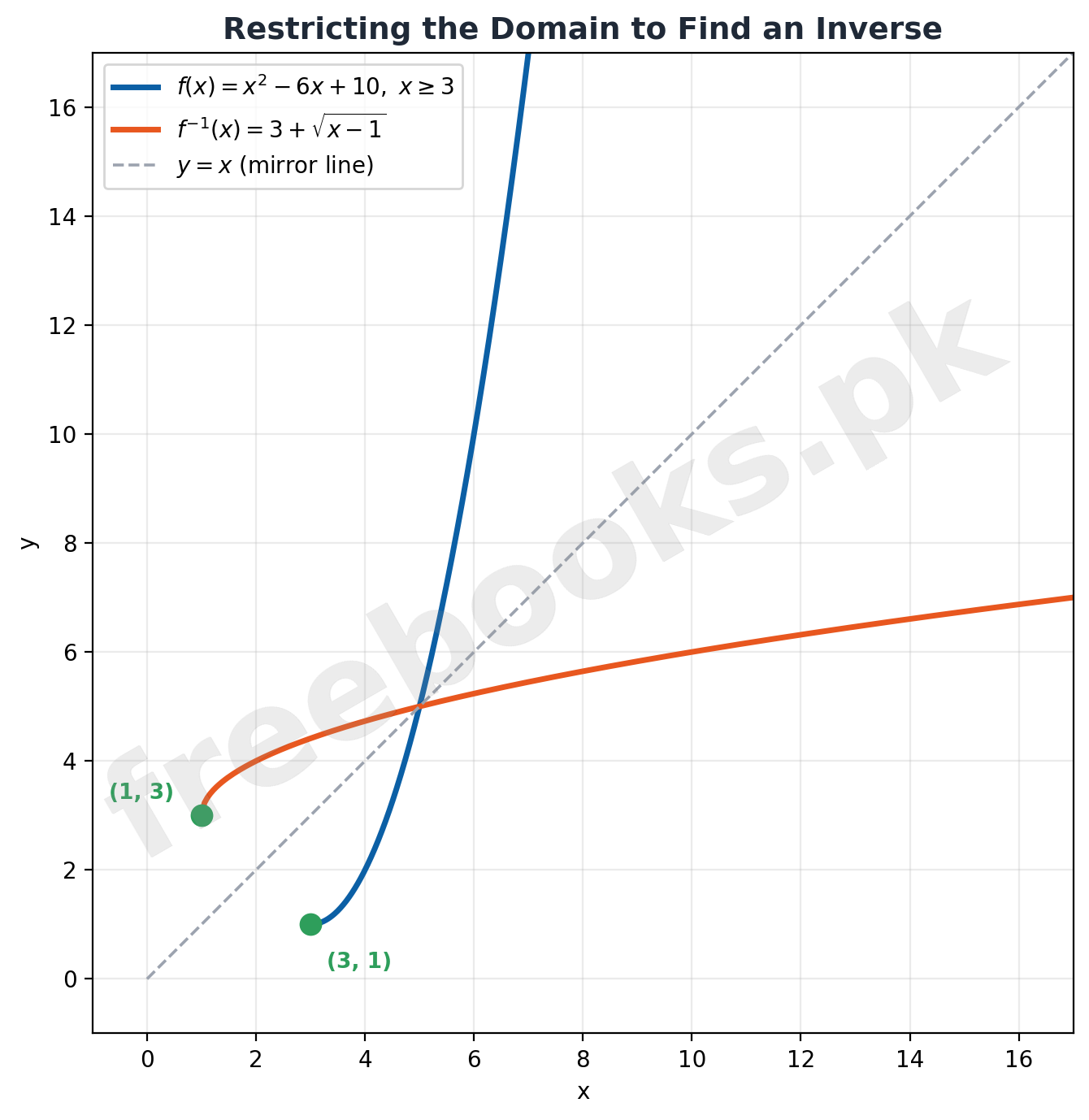
Restricting the Domain to Find an Inverse: The graph of f(x) = x^2-6x+10 restricted to x>=3, together with its inverse f^-1(x) = 3+sqrt(x-1) and the reference line y=x, showing the two graphs as mirror images of each other
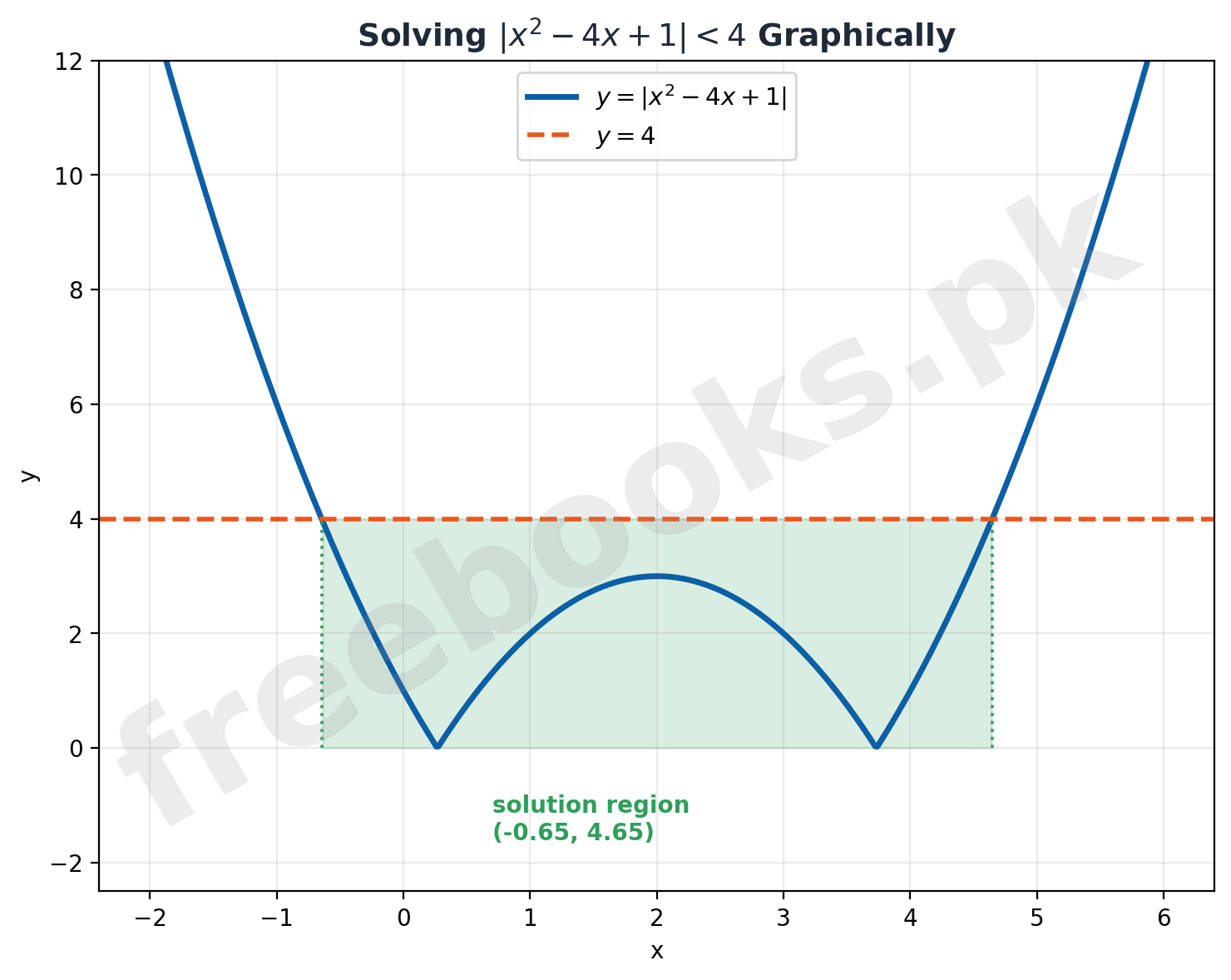
Solving an Absolute Value Quadratic Inequality Graphically: The graph of y = |x^2-4x+1| together with the horizontal line y=4, with the solution region where the curve lies below the line shaded and its endpoints marked
Solved Examples
Example 1: Sketching and Analyzing a Quadratic Function
Problem: Sketch and analyze y = x^2 – 4x – 5.
- y-intercept: set x=0 — y = 0-0-5 = -5, giving the point (0, -5).
- x-intercepts: solve x^2-4x-5=0. Factoring gives (x-5)(x+1)=0, so x=5 or x=-1.
- Vertex: h = -b/2a = -(-4)/2(1) = 2. k = (2)^2-4(2)-5 = 4-8-5 = -9. Vertex = (2, -9).
- Since a=1>0, the vertex is a minimum; the function is decreasing on (-infinity, 2) and increasing on (2, infinity).
- Final answer: vertex (2,-9) is a minimum point; x-intercepts (5,0) and (-1,0); y-intercept (0,-5).
Example 2: Maximum or Minimum Value by Completing the Square
Problem: Find the maximum or minimum value of f(x) = 3x^2 – 12x + 7 by completing the square.
- Factor 3 out of the x-terms: f(x) = 3(x^2-4x) + 7.
- Add and subtract (half of -4, squared) = 4 inside the brackets: f(x) = 3(x^2-4x+4-4) + 7 = 3[(x-2)^2-4] + 7.
- Simplify: f(x) = 3(x-2)^2 – 12 + 7 = 3(x-2)^2 – 5.
- Since a=3>0, the minimum value is -5, occurring at x=2.
- Final answer: minimum value -5 at x=2.
Example 3: Finding the Inverse of a Quadratic Function
Problem: Find the inverse of f(x) = x^2 – 6x + 10, x >= 3, and state its domain and range.
- Complete the square: f(x) = (x-3)^2 + 1. Domain f = [3, infinity); minimum value 1 at x=3, so Range f = [1, infinity).
- Let y = x^2-6x+10. Swap x and y: x = y^2-6y+10, so y^2-6y+(10-x) = 0.
- Apply the quadratic formula: y = [6 +/- sqrt(36-4(10-x))]/2 = [6 +/- sqrt(4x-4)]/2 = 3 +/- sqrt(x-1).
- Since the original domain requires x>=3, the inverse must output values >=3, so the '+' branch is correct: f^-1(x) = 3 + sqrt(x-1).
- Final answer: f^-1(x) = 3+sqrt(x-1); domain of f^-1 = [1,infinity); range of f^-1 = [3,infinity).
Example 4: Solving an Absolute Value Quadratic Equation
Problem: Solve |x^2 – 9| = 7.
- Split into two equations: x^2-9 = 7 or x^2-9 = -7.
- First equation: x^2 = 16, so x = +/-4.
- Second equation: x^2 = 2, so x = +/- sqrt(2).
- Check all four values in the original equation: |16-9|=7 (true for x=+/-4); |2-9|=|-7|=7 (true for x=+/-sqrt(2)). No extraneous roots.
- Final answer: solution set = {-4, -sqrt(2), sqrt(2), 4}.
Example 5: Solving an Absolute Value Quadratic Inequality
Problem: Solve |x^2 – 4x + 1| < 4.
- Rewrite as a compound inequality: -4 < x^2-4x+1 < 4.
- Left part: x^2-4x+1 > -4, i.e. x^2-4x+5 > 0. Its discriminant is 16-20=-4<0, and since the leading coefficient is positive, this is TRUE for every real x.
- Right part: x^2-4x+1 < 4, i.e. x^2-4x-3 < 0. Its roots are x = [4 +/- sqrt(16+12)]/2 = 2 +/- sqrt(7). Since the parabola opens upward, the inequality holds between the roots: (2-sqrt(7), 2+sqrt(7)).
- Since the left part holds everywhere, the final solution is just the right part's interval.
- Final answer: solution set = (2-sqrt(7), 2+sqrt(7)), approximately (-0.65, 4.65).
Example 6: Solving a Radical Equation Reducible to a Quadratic
Problem: Solve sqrt(x+5) – sqrt(x-3) = 2.
- Isolate one radical: sqrt(x+5) = 2 + sqrt(x-3).
- Square both sides: x+5 = 4 + 4*sqrt(x-3) + (x-3) = x+1+4*sqrt(x-3).
- Simplify: x+5-x-1 = 4*sqrt(x-3), so 4 = 4*sqrt(x-3), so 1 = sqrt(x-3).
- Square again: 1 = x-3, so x = 4.
- Check in the original equation: sqrt(4+5)-sqrt(4-3) = sqrt(9)-sqrt(1) = 3-1 = 2. Correct — no extraneous root.
- Final answer: x = 4.
Example 7: Application: A Real-World Word Problem
Problem: The length of a rectangular garden is 4 metres more than its width. If the area of the garden is 96 square metres, find its length and width.
- Let the width = x metres, so the length = x+4 metres.
- Area condition: x(x+4) = 96, so x^2+4x-96 = 0.
- Factor: (x+12)(x-8) = 0, so x = -12 or x = 8.
- Since width cannot be negative, reject x=-12; take x=8. Then length = x+4 = 12.
- Final answer: width = 8 metres, length = 12 metres.
Short Questions & Answers
What is the standard form of a quadratic function?
f(x) = ax^2+bx+c, where a, b, c are real numbers and a is not equal to 0.
When is the vertex of a parabola a maximum point?
When the leading coefficient a is negative (a<0).
State the vertex form of a quadratic function.
f(x) = a(x-h)^2+k, where (h,k) is the vertex.
Why must a quadratic function's domain be restricted before finding its inverse?
Because a quadratic function is not one-to-one over its whole domain.
How is |x^2-9|=7 split into two equations?
x^2-9 = 7 or x^2-9 = -7.
How is a rational equation typically solved?
By multiplying every term by the least common denominator (LCD) to clear the fractions, then solving the resulting polynomial equation.
Why must solutions of a radical equation be checked in the original equation?
Because squaring both sides can introduce extraneous roots that satisfy the squared equation but not the original one.
Long Questions & Answers
Explain how completing the square is used to find the maximum or minimum value of a quadratic function, and how the same idea is used to find its inverse on a restricted domain.
How does completing the square convert f(x)=ax^2+bx+c into vertex form?
Factor a out of the x^2 and x terms, add and subtract the square of half the new coefficient of x inside the brackets to form a perfect square trinomial, then simplify — this produces f(x)=a(x-h)^2+k, where h=-b/2a and k=c-b^2/4a.
How does the vertex form reveal the maximum or minimum value?
In f(x)=a(x-h)^2+k, the squared term a(x-h)^2 is always zero or has the same sign as a; if a>0 the smallest possible value of f(x) is k (a minimum, at x=h), and if a<0 the largest possible value of f(x) is k (a maximum, at x=h).
Why is a quadratic function's domain restricted before finding its inverse?
A quadratic function fails the horizontal line test over its full domain — two different x-values on opposite sides of the vertex can produce the same output — so it is not one-to-one and has no inverse function unless its domain is restricted to one side of the vertex, x>=h or x<=h.
How is the correct branch of the inverse chosen after restricting the domain?
Solving the swapped equation with the quadratic formula produces a '+' branch and a '-' branch; only one of these branches actually maps the range of the restricted original function back onto its correct restricted domain, so a test value (or reasoning about which branch stays within the required domain) is used to discard the other, extraneous branch.
Explain the process for solving absolute value quadratic equations and inequalities, and describe how rational and radical equations are reduced to quadratic equations.
How is an absolute value quadratic equation |E|=d solved?
It is split into two ordinary equations, E=d and E=-d, both solved using standard quadratic methods; every resulting candidate value must then be substituted back into the original absolute value equation to confirm it is not extraneous.
How is an absolute value quadratic inequality such as |E|<d solved?
It is rewritten as the compound inequality -d<E<d, which splits into two separate quadratic inequalities; each is solved by finding its critical values and testing a point in each resulting region, and the final solution set is the intersection of both regions' solutions.
How is a rational equation reduced to a quadratic equation?
Every term is multiplied by the least common denominator of all the fractions present, which clears the denominators and typically leaves a quadratic (or lower-degree) polynomial equation, solved by the usual methods — while remembering to exclude any value that was originally forbidden because it made a denominator zero.
How is a radical equation reduced to a quadratic equation, and what must be checked afterward?
A radical is isolated on one side and both sides are squared to remove it, repeating if a second radical remains, until a polynomial equation results; because squaring can introduce solutions that do not satisfy the original radical equation, every candidate solution must be substituted back into the ORIGINAL equation, and any extraneous root must be discarded.
Multiple Choice Questions (MCQs)
The standard form of a quadratic function is: (A) f(x)=ax+b (B) f(x)=ax^2+bx+c, a not equal to 0 (C) f(x)=ax^3+bx+c (D) f(x)=a/x+b
Correct answer: (B) f(x)=ax^2+bx+c, a not equal to 0. A quadratic function is a degree-two polynomial function, f(x)=ax^2+bx+c with a not equal to 0.
In vertex form f(x)=a(x-h)^2+k, if a<0 the vertex is a: (A) Minimum point (B) Maximum point (C) x-intercept (D) y-intercept
Correct answer: (B) Maximum point. When a<0, the parabola opens downward, so the vertex is the highest point — a maximum.
The vertex coordinates of a parabola y=ax^2+bx+c are given by: (A) h=-b/2a, k=f(h) (B) h=b/2a, k=f(h) (C) h=-c/2a, k=f(b) (D) h=2a, k=b
Correct answer: (A) h=-b/2a, k=f(h). The vertex is found using h=-b/2a, then substituting back to get k=f(h).
A quadratic function must have its domain restricted before finding its inverse because: (A) It is always negative (B) It is not one-to-one over its full domain (C) It has no y-intercept (D) It is not onto
Correct answer: (B) It is not one-to-one over its full domain. A quadratic function fails the horizontal line test over its whole domain, so it is not one-to-one until the domain is restricted.
|x^2-9|=7 splits into: (A) x^2-9=7 only (B) x^2-9=7 or x^2-9=-7 (C) x^2=7 only (D) x^2-9=-7 only
Correct answer: (B) x^2-9=7 or x^2-9=-7. An absolute value equation |E|=d splits into E=d or E=-d.
The inequality |E|<d is equivalent to: (A) E<d only (B) E>-d only (C) -d<E<d (D) E<-d or E>d
Correct answer: (C) -d<E<d. |E|<d means E lies strictly between -d and d, i.e. -d<E<d.
To clear denominators in a rational equation, you should: (A) Add the denominators (B) Multiply every term by the LCD (C) Ignore the denominators (D) Square both sides
Correct answer: (B) Multiply every term by the LCD. Multiplying every term by the least common denominator (LCD) clears all fractions at once.
Solving a radical equation by squaring both sides can introduce: (A) Extra domain restrictions (B) Extraneous roots (C) Negative coefficients (D) Imaginary vertices
Correct answer: (B) Extraneous roots. Squaring both sides of an equation can produce extraneous roots — values that satisfy the squared equation but not the original.
In a word problem where x represents a length, a negative solution for x should be: (A) Accepted as valid (B) Rejected as not physically meaningful (C) Doubled (D) Rounded to zero
Correct answer: (B) Rejected as not physically meaningful. A length cannot be negative, so any negative solution is rejected as not physically meaningful.
The maximum value of f(x) = -2(x-1)^2+5 is: (A) 1 (B) 2 (C) 5 (D) -2
Correct answer: (C) 5. In vertex form f(x)=a(x-h)^2+k with a<0, the maximum value is k, which here is 5.
Quick Revision Summary
- Standard form: f(x)=ax^2+bx+c, a not equal to 0; the graph is a parabola
- Vertex (h,k): h=-b/2a, k=f(h); minimum if a>0, maximum if a<0
- Vertex form: f(x)=a(x-h)^2+k, found by completing the square
- A quadratic function's domain must be restricted (x>=h or x<=h) before it has an inverse
- |x|=x for x>=0, |x|=-x for x<0
- |E|=d splits into E=d or E=-d; always check for extraneous roots
- |E|<d splits into -d<E<d; |E|>d splits into E<-d or E>d
- Rational equations are cleared of fractions by multiplying through by the LCD
- Radical equations are solved by isolating a radical, squaring, and checking for extraneous roots
- Real-world word problems: assign a variable, form an equation from the conditions, solve, reject physically impossible answers
- Quadratic inequalities are solved using critical values and test points in each region
- Every extraneous-root check applies to squared equations, absolute-value splits, and rational equations alike
Exam Tips
- Always find the y-intercept, x-intercepts, and vertex before sketching a parabola — three points are enough to draw an accurate shape
- Remember: a>0 means the parabola opens upward and gives a minimum; a<0 opens downward and gives a maximum
- After finding an inverse using the quadratic formula, use the domain of the ORIGINAL restricted function to decide which +/- branch is correct
- When solving |E|=d, always substitute every candidate answer back into the ORIGINAL absolute value equation to catch extraneous roots
- For absolute value inequalities, solve the two split inequalities separately and only combine them at the very end
- In word problems, always check whether a negative solution makes physical sense before including it in your final answer