Light is a form of energy that travels as waves and allows us to see the world around us. This chapter explores how light reflects from mirrors, refracts (bends) when passing between different materials, and how lenses shape light to form images. Key topics include the laws of reflection and refraction, Snell's law and refractive index, total internal reflection and the critical angle, and how optical fibres exploit this principle for high-speed telecommunications.
The chapter also covers thin lenses (converging and diverging), ray diagrams, real versus virtual images, linear magnification, and everyday optical devices such as magnifying glasses, cameras, slide projectors, and photograph enlargers. It closes with how the human eye forms images, the causes and correction of short-sightedness and long-sightedness, the dispersion of white light into a spectrum by a prism, and two fascinating extensions of lens principles — gravitational lensing in astronomy and acoustic lenses for sound.
Learning Objectives
- Define and use the terms normal, angle of incidence, and angle of reflection
- Describe an experiment to find the position and characteristics of the image formed by a plane mirror
- Apply the law of reflection, and the qualitative principle of refraction toward/away from the normal, to solve simple problems
- Define refractive index as n = c/v and as n = sin i / sin r (Snell's law), and apply it to solve problems
- Define critical angle and total internal reflection, and derive and apply n = 1/sin C
- Evaluate the use of optical fibres in telecommunications and state their advantages
- Analyze the action of converging and diverging lenses on parallel light, and define focal length, principal axis, and principal focus
- Draw ray diagrams for image formation by a converging lens, differentiate real and virtual images, and calculate linear magnification
- Describe the use of convex lenses in magnifying glasses, cameras, projectors, and photographic enlargers
- Explain dispersion of light by a prism, describe image formation and defects of the eye and their correction, and state that gravity can bend light (gravitational lensing)
Key Concepts
14.1 Reflection of Light
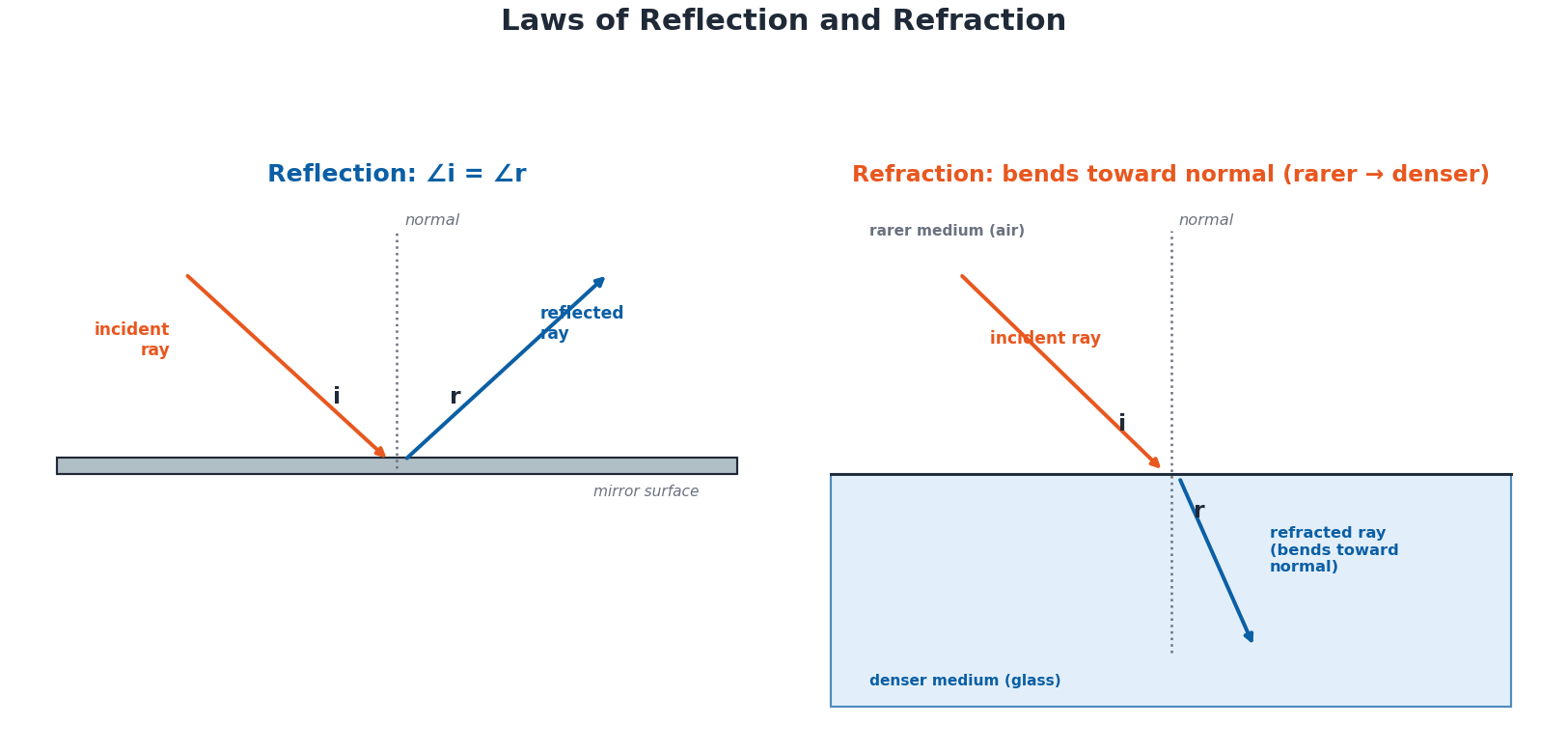
Reflection of light occurs when light strikes a surface and bounces back instead of passing through it, typically on smooth, shiny surfaces like mirrors. Regular (specular) reflection happens on smooth surfaces, reflecting light in one direction and forming a clear image; diffused (irregular) reflection happens on rough surfaces, scattering light in many directions so no clear image forms. The laws of reflection state that the incident ray, reflected ray, and normal all lie in the same plane, and that the angle of incidence always equals the angle of reflection (∠i = ∠r).
A plane mirror forms an image with four key properties: it is erect (upright, like the object); it is the same size as the object (di = do); it is laterally inverted (left and right sides appear reversed, as with the letter 'D'); and it is virtual (cannot be captured on a screen, since it forms behind the mirror where light rays only appear to meet, not actually converge). These properties can be verified experimentally by placing an object in front of an upright mirror, tracing the reflected rays using the law of reflection, and extending them backward to locate the image position.
14.2 Refraction of Light and Snell's Law
Refraction occurs when light changes direction as it passes from one medium into another, such as from air into water or glass, because light travels at different speeds in different media. Light bends toward the normal when entering a denser medium (where it slows down), and bends away from the normal when entering a rarer medium (where it speeds up); if the angle of incidence is zero, light continues straight without bending. Refraction explains everyday effects like a pencil appearing bent in water, the working of lenses, and the formation of rainbows.
The laws of refraction state that the incident ray, refracted ray, and normal lie in the same plane, and that Snell's law holds: sin i / sin r = n, a constant for a given pair of media, where n is the refractive index of the second medium relative to the first. Worked Example: light enters water (n = 1.33) from air at an angle of incidence of 40°; using sin r = sin 40°/1.33 = 0.483, the angle of refraction r = sin⁻¹(0.483) = 28.9°.
14.3 Refractive Index, Critical Angle, and Total Internal Reflection
The refractive index n of a medium measures how much light bends when entering it, defined as n = c/v, the ratio of the speed of light in vacuum/air (c ≈ 3×10⁸ m/s) to its speed in that medium (v); denser media slow light down more and have higher refractive indices. Worked Example: for water (n = 1.33), the speed of light v = c/n = (3×10⁸)/1.33 = 2.26×10⁸ m/s. As the angle of incidence increases when light travels from a denser to a rarer medium, the angle of refraction increases faster; at the critical angle C, the refracted ray grazes along the boundary at 90°.
If the angle of incidence exceeds the critical angle, no light refracts out at all — instead, it reflects entirely back into the denser medium, a phenomenon called total internal reflection. Starting from Snell's law (n₁ sin i = n₂ sin r) and setting the refraction angle to 90° at the critical angle C gives sin C = n₂/n₁; when the second medium is air (n₂ = 1), this simplifies to n = 1/sin C, which relates a denser medium's refractive index directly to its critical angle. Worked Example: for water (n = 1.33), C = sin⁻¹(1/1.33) = sin⁻¹(0.752) = 48.8°.
14.4 Optical Fibres
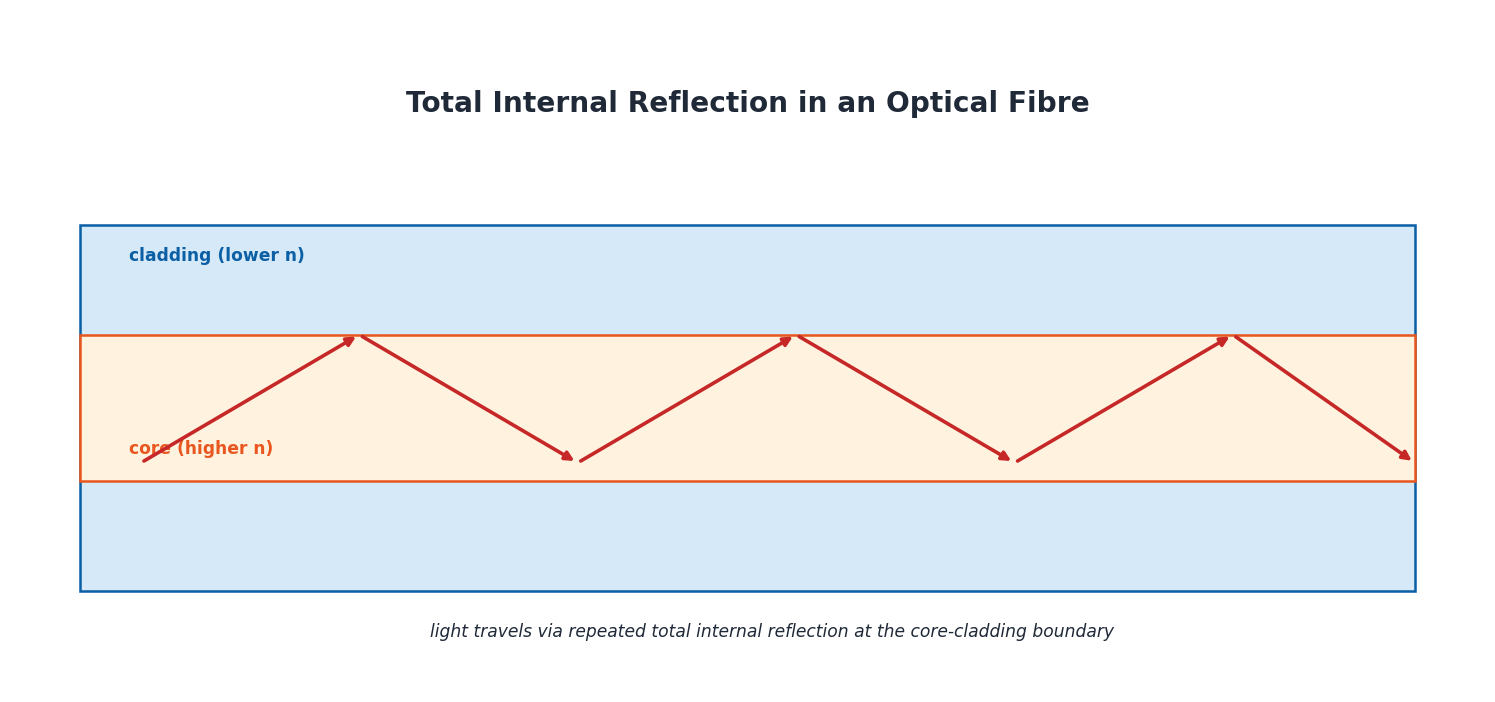
An optical fibre is a thin, hair-like strand of glass or plastic that uses total internal reflection to transmit light — and the data it carries — over long distances with minimal loss. It has two parts: the core (inner part, higher refractive index, carries the light) and the cladding (outer layer, lower refractive index, causes total internal reflection at the core-cladding boundary). Light entering the core strikes this boundary at an angle greater than the critical angle, reflecting repeatedly back into the core and travelling the fibre's full length.
Compared to traditional copper cables, optical fibres offer several advantages central to modern telecommunications: much higher bandwidth (more data per second), lower power consumption and longer lifespan, faster speed (light pulses travel near the speed of light), reliable long-distance transmission (ideal for undersea and intercontinental cables) without significant signal loss, and strong resistance to electrical interference, since they use light rather than electrical signals.
14.5 Lenses: Types and Key Terms
A lens is a transparent object with at least one curved surface that refracts light to form an image. A convex (converging) lens is thicker at the centre than at the edges and brings parallel light rays together at a point; a concave (diverging) lens is thinner at the centre than at the edges and spreads parallel light rays apart. Key terms include: focal length (f) — the distance from the lens to the principal focus, positive for converging lenses and negative for diverging lenses; principal axis — the imaginary straight line through the lens centre along which light does not bend; principal focus — the point where parallel rays converge (converging lens) or appear to diverge from (diverging lens); optical centre — the lens's geometric middle, through which light passes undeviated; and centre of curvature — generally located at twice the focal length from the lens.
The lens/mirror formula relates focal length (f), object distance (p), and image distance (q): 1/f = 1/p + 1/q, used to determine image position for both lenses and mirrors. For a convex lens, parallel rays bend toward the principal axis and converge at the focal point; for a concave lens, parallel rays bend away from the principal axis and appear (when extended backward) to diverge from a virtual focal point on the same side as the incoming light. The power of a lens is the reciprocal of its focal length, P = 1/f, measured in diopters (D), where 1 D = 1 m⁻¹; convex lenses have positive power, concave lenses negative power, and higher power means stronger light-bending.
14.6 Image Formation by Lenses and Linear Magnification
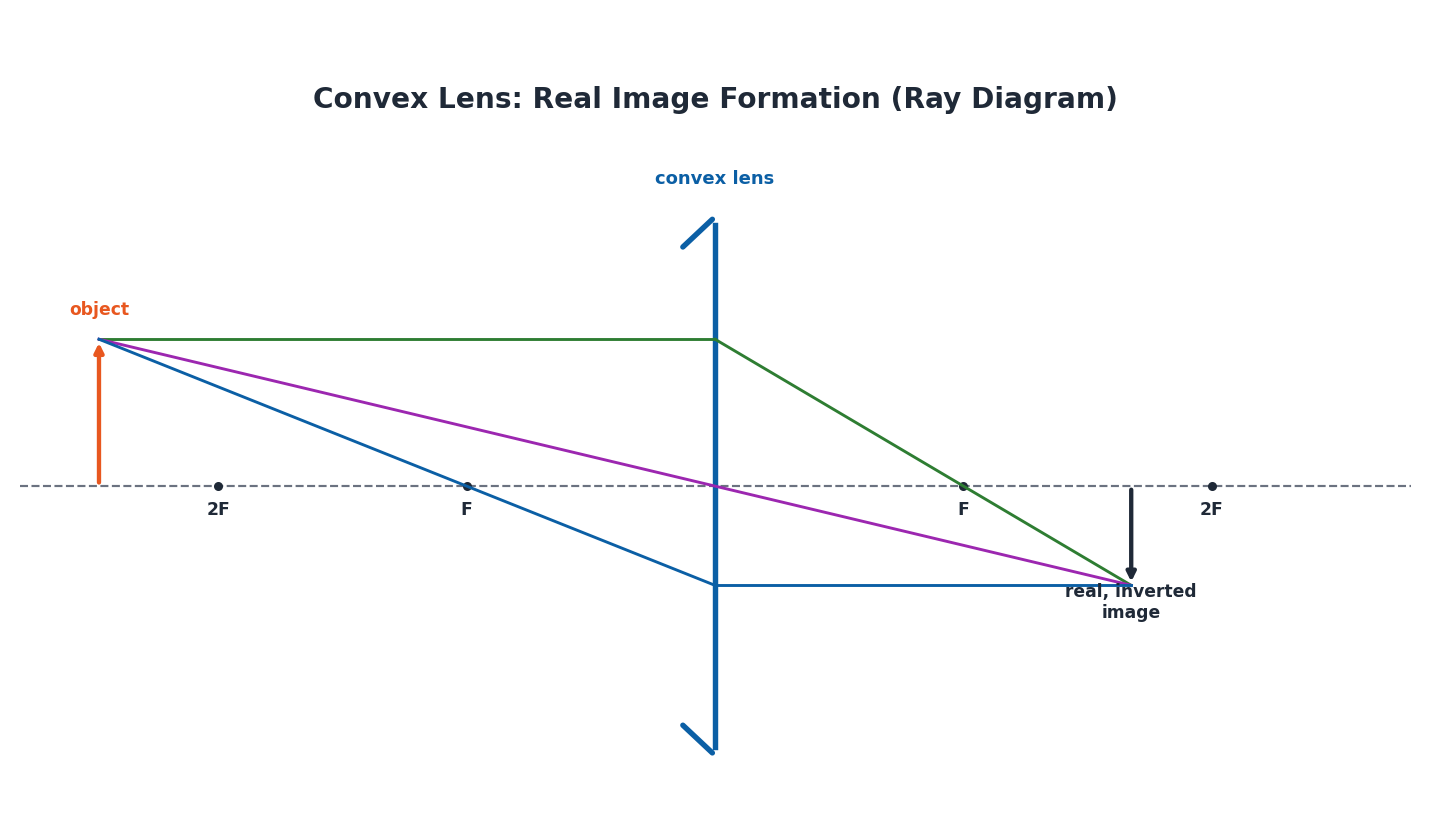
For a convex lens, three simple rules construct ray diagrams: a ray parallel to the principal axis refracts through the focal point F; a ray through the optical centre continues straight, undeviated; and a ray through F on the way in emerges parallel to the principal axis. Where the object sits relative to F and 2F determines the image: beyond 2F gives a real, inverted, diminished image; at 2F gives a real, inverted, same-size image; between F and 2F gives a real, inverted, enlarged image; at F gives an image at infinity; and between the lens and F gives a virtual, upright, enlarged image (as in a magnifying glass) — the last case is the only one producing a virtual image with a convex lens.
A real image forms where light rays actually converge, can be projected onto a screen, and is always inverted; a virtual image forms where rays only appear to diverge from (never actually meeting), cannot be projected on a screen, and is always upright. Linear magnification is the ratio of image height to object height: M = hᵢ/hₒ, indicating how much larger or smaller the image is compared to the object (a negative value indicates an inverted image). Worked Example: an 8 cm tall object forms an image with magnification M = -2; hᵢ = M × hₒ = -2 × 8 = -16 cm, meaning the image is inverted and twice the object's height.
14.7 Optical Devices: Magnifying Glass, Camera, Projector, and Enlarger
A magnifying glass is simply a convex lens used with the object placed closer than its focal length (p < f); refracted rays don't actually meet but appear to originate from behind the lens, creating a virtual, upright, magnified image — this basic setup is also called a simple microscope. A camera is a light-proof box with a convex lens at the front and a light-sensitive sensor or film at the back, fixed at the lens's focal length; with the object placed beyond 2F, it forms a real, inverted, diminished image on the sensor.
A slide projector uses a light source with a concave mirror (to produce parallel rays), a condenser lens system (to spread light evenly across the slide), and a projection convex lens; the slide is placed upside down between F and 2F, and the projection lens forms a real, magnified, inverted image on the screen — correctly oriented because the lens itself inverts the already-inverted slide. A photograph enlarger works similarly, placing a photographic negative between F and 2F to project a real, inverted, enlarged image onto photographic paper, allowing small negatives to be printed as large photographs.
14.8 The Human Eye and Vision Defects
In a healthy (normal) eye, light rays from an object pass through the cornea and lens and focus directly onto the retina, forming a sharp, clear image — this closely resembles how a convex lens forms a real image. The near point, the closest distance at which the eye can see clearly, is about 25 cm for a normal person. Short-sightedness (myopia) is a condition where a person sees nearby objects clearly but distant objects appear blurry, because the eye lens bends light too strongly (or the eyeball is too long), causing the image to form in front of the retina; it is corrected using concave (diverging) lenses, which spread the light out before it enters the eye so the eye's own lens can focus it correctly on the retina.
Long-sightedness (hypermetropia) is the opposite condition, where distant objects appear clear but nearby objects appear blurry, because the eye lens is too weak (or the eyeball is too short), causing the image to form behind the retina; it is corrected using convex (converging) lenses, which bend light more strongly before it enters the eye so it focuses directly on the retina rather than behind it.
14.9 Dispersion of Light, Gravitational Lensing, and Acoustic Lenses
Dispersion of light is the splitting of white light into its seven constituent colours (red, orange, yellow, green, blue, indigo, violet — the visible spectrum) when it passes through a prism, because each wavelength of light refracts at a slightly different angle: shorter wavelengths (violet, blue) bend more, while longer wavelengths (red, orange) bend less. Beyond visible light, prisms also disperse infrared and ultraviolet radiation, invisible to the human eye but detectable using instruments like infrared thermometers, which measure the infrared radiation emitted by an object to determine its temperature without contact.
Gravitational lensing occurs when the strong gravitational field of a massive object, such as a black hole or galaxy, bends the path of light passing near it — acting much like an optical lens and causing distant objects to appear magnified, distorted, or even duplicated into multiple images; astronomers use this effect to study distant galaxies, dark matter, and the structure of the universe. Acoustic lenses apply the same wave-manipulation principle to sound instead of light, using materials shaped to focus or spread sound waves — used in medical ultrasound imaging, SONAR systems, and noise control, focusing sound to a point or spreading it over an area as needed.
Important Definitions
Define the normal, angle of incidence, and angle of reflection.
The normal is a line drawn perpendicular to a surface at the point light strikes it; the angle of incidence is the angle between the incident ray and the normal; the angle of reflection is the angle between the reflected ray and the normal.
Define refractive index.
A measure of how much light bends entering a medium, defined as n = c/v (speed of light in vacuum/air divided by speed in the medium), or equivalently n = sin i/sin r via Snell's law.
Define critical angle.
The angle of incidence in a denser medium for which the angle of refraction is exactly 90°, i.e., the refracted ray travels along the boundary between the two media.
Define total internal reflection.
The complete reflection of a light ray back into a denser medium when it strikes the boundary with a rarer medium at an angle of incidence greater than the critical angle.
Define focal length.
The distance from a lens's optical centre to its principal focus, positive for converging lenses and negative for diverging lenses.
Define principal focus (focal point).
The point on the principal axis where rays parallel to the axis converge (converging lens) or appear to diverge from (diverging lens) after refraction.
Define linear magnification.
The ratio of image height to object height, M = hᵢ/hₒ, indicating how much larger or smaller an image is compared to its object.
Define dispersion of light.
The splitting of white light into its seven constituent colours (red through violet) as it passes through a prism, because different wavelengths refract at different angles.
Key Formulas
| Topic | Formula |
|---|---|
| Law of reflection | ∠i = ∠r (angle of incidence = angle of reflection) |
| Snell's law | n = sin i / sin r |
| Refractive index (speed form) | n = c / v |
| Critical angle / TIR relation | n = 1 / sin C, C = sin⁻¹(1/n) |
| Lens/mirror formula | 1/f = 1/p + 1/q |
| Power of a lens | P = 1/f (unit: diopter D = m⁻¹) |
| Linear magnification | M = hᵢ / hₒ |
| Speed of light in vacuum | c ≈ 3 × 10⁸ m s⁻¹ |
Diagrams
Laws of Reflection and Refraction: A ray diagram showing the normal, angle of incidence, and angle of reflection at a mirror, alongside a ray bending toward the normal on entering a denser medium
Convex Lens Ray Diagram: Real Image Formation: The three standard construction rays (parallel-to-axis, through optical centre, through focal point) showing a convex lens forming a real, inverted image
Total Internal Reflection in an Optical Fibre: Light entering the core of an optical fibre and undergoing repeated total internal reflection at the core-cladding boundary as it travels the fibre's length
Short Questions & Answers
What happens when light passes from air to water?
Light slows down and bends toward the normal, since water is a denser medium than air; this bending is called refraction.
Define refractive index. What is the refractive index of air and water?
Refractive index n = c/v, the ratio of light's speed in vacuum/air to its speed in a medium. Air has a refractive index of approximately 1.00, and water has a refractive index of approximately 1.33.
What is the principle behind optical fibres?
Optical fibres work on the principle of total internal reflection: light entering the core strikes the core-cladding boundary at an angle greater than the critical angle and reflects repeatedly back into the core, travelling the full length of the fibre with minimal loss.
Describe briefly how a convex lens forms a real or virtual image.
If the object is placed beyond the focal length (p > f), the convex lens forms a real, inverted image where light rays actually converge; if the object is placed within the focal length (p < f), the rays only appear to diverge from behind the lens, forming a virtual, upright, magnified image.
How does the power of a lens relate to its focal length?
Power is the reciprocal of focal length, P = 1/f, measured in diopters (D); a shorter focal length means higher power (stronger bending of light), and convex lenses have positive power while concave lenses have negative power.
Write Snell's law and define the terms used in the equation.
Snell's law states sin i / sin r = n, where i is the angle of incidence, r is the angle of refraction, and n is the refractive index of the second medium relative to the first.
What are the four properties of an image formed by a plane mirror?
The image is erect (upright), the same size as the object, laterally inverted (left-right reversed), and virtual (cannot be captured on a screen).
What is the difference between a real image and a virtual image?
A real image forms where light rays actually converge, can be projected onto a screen, and is always inverted; a virtual image forms where rays only appear to diverge from, cannot be projected on a screen, and is always upright.
Long Questions & Answers
Explain the laws of reflection, and describe an experiment to determine the position and properties of the image formed by a plane mirror.
The laws of reflection state that the incident ray, the reflected ray, and the normal (a line perpendicular to the surface at the point of reflection) all lie in the same plane, and that the angle of incidence always equals the angle of reflection (∠i = ∠r). These two laws govern how light bounces off any reflective surface, from mirrors to still water. To find the position and characteristics of a plane mirror's image experimentally, a mirror is set upright with an object placed in front of it and illuminated so it is clearly visible; an observer traces the paths of at least two rays of light that leave the object, reflect off the mirror according to the law of reflection, and reach the eye. Because these reflected rays appear to diverge from a point behind the mirror, extending them backward with dotted lines until they intersect locates the position of the image, revealing that it lies as far behind the mirror as the object is in front of it. This method confirms the four defining properties of a plane-mirror image: it is erect (upright, matching the object's orientation); it is the same size as the object (dᵢ = dₒ); it is laterally inverted, meaning left and right are reversed (demonstrated clearly by how the letter 'D' appears reversed in a mirror); and it is virtual, since it cannot be projected onto a screen because the light rays forming it never actually converge — they only appear to, from behind the mirror's surface.
Explain refraction of light and Snell's law, and derive the relationship n = 1/sin C between refractive index and critical angle.
Refraction is the bending of light as it passes from one medium into another due to a change in speed: light bends toward the normal when entering a denser medium (where it slows down) and away from the normal when entering a rarer medium (where it speeds up). This behaviour is governed by Snell's law: sin i / sin r = n, where i is the angle of incidence, r is the angle of refraction, and n is the refractive index of the second medium relative to the first — itself defined as n = c/v, the ratio of light's speed in vacuum/air to its speed in the given medium. When light travels from a denser medium toward a rarer one (for example, glass to air), increasing the angle of incidence causes the angle of refraction to increase even faster; at a specific angle of incidence, called the critical angle C, the refracted ray no longer enters the second medium at all but travels exactly along the boundary, meaning the angle of refraction equals 90°. To derive the relationship between n and C, we start from the more general form of Snell's law, n₁ sin i = n₂ sin r, where medium 1 is the denser medium and medium 2 is air. At the critical angle, i = C and r = 90°, so sin r = 1, giving n₁ sin C = n₂. If the second medium is air, n₂ = 1, so sin C = 1/n₁, and rearranging gives the final relationship: n = 1/sin C, or equivalently C = sin⁻¹(1/n). If the angle of incidence is increased even further beyond the critical angle, no light escapes into the rarer medium at all — instead, the ray reflects entirely back into the denser medium, a phenomenon known as total internal reflection.
Describe the structure and working principle of optical fibres, and explain two of their key advantages in telecommunications.
An optical fibre is an extremely thin, flexible strand made of glass or plastic, engineered to carry light — and the digital information encoded in it — over very long distances with minimal loss of signal. Structurally, it consists of two main parts: an inner core, made of a material with a relatively high refractive index, through which the light actually travels; and a surrounding cladding layer, made of a material with a deliberately lower refractive index than the core. When light enters one end of the fibre's core, it repeatedly strikes the boundary between the core and the cladding at an angle greater than the critical angle for that pair of materials; because this angle exceeds the critical angle, the light undergoes total internal reflection at each point of contact rather than escaping into the cladding, bouncing back into the core over and over as it travels the full length of the fibre, even around gentle bends and corners. This makes optical fibres exceptionally well suited to modern telecommunications for several key reasons. First, they offer very high bandwidth, meaning they can carry far more data per second than traditional copper cables, which is essential for supporting today's high-speed internet and large-scale data transfer. Second, because they transmit information as pulses of light rather than electrical signals, they are completely immune to electrical or electromagnetic interference, which often disrupts signals in copper wiring — combined with their ability to carry signals across very long distances (including undersea intercontinental cables) with minimal loss, this makes optical fibres both faster and significantly more reliable than the copper cables they have largely replaced.
Explain how a convex lens forms real and virtual images using ray diagrams, and describe how similar lens principles explain and correct short-sightedness and long-sightedness in the human eye.
Image formation by a convex lens can be understood using three simple construction rays: a ray travelling parallel to the principal axis refracts through the lens and passes through the focal point F on the far side; a ray passing through the lens's optical centre continues in a straight line, completely undeviated; and a ray that passes through F on its way toward the lens emerges parallel to the principal axis after refraction. Where these traced rays intersect (or appear to, when extended backward) locates the image. When an object is placed beyond the lens's focal length, these rays actually converge on the far side of the lens, producing a real image — one that can be projected onto a screen and is always inverted; the image's exact position, size, and orientation depend on precisely how far beyond F the object sits (for example, at 2F the image is same-sized and inverted, while between F and 2F it is enlarged and inverted). When an object is instead placed closer to the lens than its focal length, the refracted rays diverge rather than converge, and only appear — when extended backward — to originate from a point on the same side of the lens as the object; this produces a virtual image, which is always upright, cannot be projected onto a screen, and appears magnified — the operating principle behind a simple magnifying glass. This same lens behaviour explains vision defects in the human eye. In a healthy eye, the eye's own lens focuses light from an object precisely onto the retina, producing a clear image. In short-sightedness (myopia), the eye lens bends light too strongly (or the eyeball is too elongated), so the image forms in front of the retina instead of on it, leaving distant objects blurry; this is corrected with a concave (diverging) lens placed in front of the eye, which spreads the incoming light out slightly before it reaches the eye's own lens, allowing it to focus correctly on the retina. In long-sightedness (hypermetropia), the opposite problem occurs — the eye lens is too weak (or the eyeball too short), so the image forms behind the retina, leaving nearby objects blurry; this is corrected with a convex (converging) lens, which bends incoming light more strongly before it enters the eye, moving the focus point forward onto the retina.
Multiple Choice Questions (MCQs)
What type of image is always formed by a convex mirror? (A) Real and inverted (B) Virtual and diminished (C) Real and magnified (D) Virtual and magnified
Correct answer: (B) Virtual and diminished. A convex mirror always forms a virtual, upright, and diminished image, regardless of object distance.
The optical device which uses a convex lens to magnify an object by creating a virtual image is: (A) camera (B) microscope (simple) (C) magnifying glass (D) slide projector
Correct answer: (C) magnifying glass. A magnifying glass is a convex lens used with the object closer than the focal length, producing a virtual, magnified, upright image.
Which statement best describes total internal reflection? (A) Light bends when it enters a new medium (B) Light is completely reflected at the boundary of two media (C) Light slows down as it enters a denser medium (D) Light passes through a medium without changing direction
Correct answer: (B) Light is completely reflected at the boundary of two media. Total internal reflection occurs when light traveling in a denser medium hits the boundary at an angle greater than the critical angle and is completely reflected back, with no light escaping into the rarer medium.
A ray of light travelling from water to air bends: (A) toward the normal (B) away from the normal (C) at 90° to the normal (D) parallel to the normal
Correct answer: (B) away from the normal. Moving from a denser medium (water) to a rarer medium (air) causes the ray to speed up and bend away from the normal.
The optical device which works on the principle of inverting an image for projection is: (A) magnifying glass (B) photograph enlarger (C) slide projector (D) plane mirror
Correct answer: (C) slide projector. A slide projector inverts the already-inverted slide (placed upside down) to project a correctly oriented, magnified image onto a screen.
What happens to light when it enters an optical fibre? (A) It is absorbed by the fibre (B) It undergoes total internal reflection (C) It gets refracted at every point (D) It travels in a straight line without deviation
Correct answer: (B) It undergoes total internal reflection. Light entering an optical fibre's core undergoes repeated total internal reflection at the core-cladding boundary, allowing it to travel long distances.
Which phenomenon explains why a pencil appears bent when partially immersed in water? (A) Reflection (B) Diffraction (C) Refraction (D) Interference
Correct answer: (C) Refraction. Refraction bends light rays from the submerged part of the pencil, making it appear to shift and look bent at the water's surface.
An object with height 4 cm forms an image of height 12 cm through a lens. The linear magnification is: (A) 0.33 (B) 3 (C) 8 (D) 16
Correct answer: (B) 3. M = hᵢ/hₒ = 12/4 = 3.
A convex lens with a focal length of 20 cm (0.2 m) has a power of: (A) 0.2 D (B) 2 D (C) 5 D (D) 20 D
Correct answer: (C) 5 D. P = 1/f = 1/0.2 = 5 D.
White light splits into its seven constituent colours when passed through a prism because: (A) all colours have the same wavelength (B) different wavelengths refract at different angles (C) the prism absorbs some colours (D) the prism reflects all colours equally
Correct answer: (B) different wavelengths refract at different angles. Each wavelength of light refracts by a slightly different amount inside the prism, with shorter wavelengths (violet) bending more than longer wavelengths (red), causing dispersion into the visible spectrum.
Quick Revision Summary
- Reflection: ∠i = ∠r; plane mirror image is erect, same size, laterally inverted, virtual
- Refraction: light bends toward normal entering denser medium, away from normal entering rarer medium; Snell's law n = sin i/sin r
- Refractive index n = c/v; critical angle C = sin⁻¹(1/n); TIR occurs when i > C, denser→rarer medium only
- Optical fibres: core (high n) + cladding (low n), light travels via repeated TIR — high bandwidth, low interference, long-distance
- Lens formula: 1/f = 1/p + 1/q; Power P = 1/f (diopters); convex lens +f/+P, concave lens −f/−P
- Convex lens: object beyond F → real, inverted image; object within F → virtual, upright, magnified image (magnifying glass)
- Linear magnification M = hᵢ/hₒ; camera (object beyond 2F, real diminished image); projector/enlarger (object between F & 2F, real enlarged image)
- Myopia (short-sight): image forms before retina, corrected with concave lens. Hypermetropia (long-sight): image forms behind retina, corrected with convex lens
- Dispersion: prism splits white light into 7 colours (different wavelengths refract differently); gravitational lensing bends light via gravity; acoustic lenses focus sound
Exam Tips
- Always draw and label the normal first in any reflection/refraction diagram — angles are measured from it, not from the surface
- Remember: denser medium → bends toward normal & slows down; rarer medium → bends away from normal & speeds up
- For critical angle/TIR problems, confirm light is going from denser to rarer medium — the formula n = 1/sin C only applies in that direction
- Keep real image (inverted, projectable) and virtual image (upright, not projectable) definitions crystal clear — a very common exam confusion
- For lens ray diagrams, always draw at least two of the three standard rays (parallel-to-axis, through-centre, through-focus) to locate the image reliably
- Myopia = corrected with CONCAVE lens (diverging); Hypermetropia = corrected with CONVEX lens (converging) — an easy pair to mix up under exam pressure