Heat and temperature govern countless everyday phenomena, from the warmth of sunlight to the chill of a cold drink. This chapter explains thermal expansion in solids, liquids, and gases; specific heat capacity and why water's large specific heat matters; how substances change state; evaporation and its cooling effect; latent heat; and the special phenomenon of superconductivity.
Understanding these principles explains how refrigerators, car cooling systems, thermometers, and bridges are designed, and even helps explain Earth's climate and coastal weather patterns.
Learning Objectives
- Describe qualitatively the thermal expansion of solids (linear and volumetric) and explain thermal expansion of liquids (real and apparent) and gases
- Discuss gas pressure and its changes in terms of particle collisions with container walls
- Discuss applications and consequences of thermal expansion in real life
- Define and calculate specific heat capacity for solids and liquids, and discuss the everyday effects of water's large specific heat
- Describe the changes in state between solids, liquids, and gases, and compare relative magnitudes of thermal expansion
- Describe evaporation in terms of particle behaviour and discuss how temperature, humidity, surface area, and air movement affect it
- Explain how evaporation causes cooling, and describe CFC-free refrigeration
- Define latent heat of fusion and vaporization, and describe how they are determined experimentally using a temperature-time graph
- Describe superconductivity and state that certain materials exhibit it near absolute zero
Key Concepts
10.1 Thermal Expansion
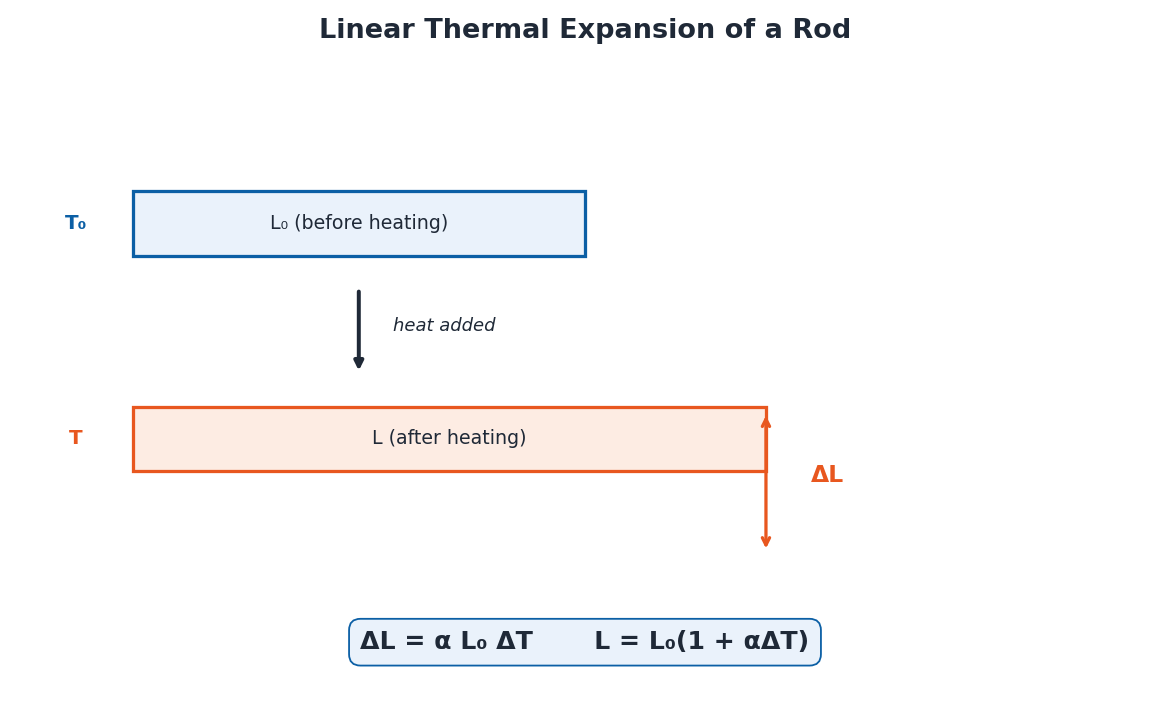
Thermal expansion is the change in length, area, or volume of a substance when it is heated; as temperature rises, particles gain kinetic energy, move faster, and spread apart, causing expansion. Cooling causes the reverse: thermal contraction, as particles lose energy and move closer together.
For solids, linear thermal expansion describes the change in length: ΔL = αL₀ΔT, where α is the coefficient of linear expansion (unit K⁻¹), L₀ is original length, and ΔT is the temperature change; rearranged, L = L₀(1 + αΔT). Volume thermal expansion in solids follows ΔV = βV₀ΔT, where β is the coefficient of volume expansion; rearranged, V = V₀(1 + βΔT). In solids, tightly packed atoms vibrate more vigorously when heated and, having no room to move inward, push the structure outward.
In liquids, heating increases molecular speed, causing liquid to spread apart and take up more volume; since liquids have no fixed shape, they expand freely in all directions, following ΔV = βV₀ΔT. In a heated flask, the glass container expands first (apparent decrease, AB), then the liquid's real expansion (BC) exceeds it, with the visible level rise being the apparent expansion (AC); real expansion is always greater than apparent expansion, and BC = AC + AB.
In gases, increasing temperature increases particle kinetic energy, causing more frequent, forceful collisions with container walls; in a flexible container, volume expands instead of pressure rising, consistent with Charles' law (volume ∝ temperature at constant pressure). Gas expansion powers hot air balloons (heated air becomes less dense and rises) and can also be dangerous, as in exploding aerosol cans exposed to heat.
10.2 Consequences of Thermal Expansion in Real Life
Thermal expansion has many practical applications and consequences: thermometers use liquid expansion in a narrow tube to measure temperature; small gaps are left in railway tracks to prevent 'sun kinks' (bending from unaccommodated summer expansion); bridges include expansion joints to allow safe expansion and contraction; running warm water over a stuck metal jar lid makes it expand and loosen; gas containers like aerosols can explode from heat-induced pressure buildup, hence warning labels and pressure relief valves; water pipes use flexible joints and loops to absorb expansion and prevent bursts; and hot air balloons intentionally use heated, expanded (less dense) air to generate lift.
10.3 Specific Heat Capacity
The heat energy needed to warm a material depends on its mass, the temperature change required, and the nature of the material itself, expressed as Q = mcΔT, where Q is heat energy, m is mass, c is specific heat capacity, and ΔT is temperature change. Specific heat capacity is the heat energy needed to raise the temperature of 1 kg of a substance by 1°C (or 1 K), with SI unit J kg⁻¹ K⁻¹.
Materials with high specific heat capacity (such as wood and rubber) need more heat to warm up, making them useful for insulation and cooking utensil handles; metals like steel and copper have low specific heat capacity, heating and cooling quickly, making them suitable for kettles, radiators, and heat engines. Water has an especially high specific heat capacity of 4200 J kg⁻¹ K⁻¹, letting it absorb large amounts of heat with only small temperature rises — this is why large water bodies moderate coastal climates (soil heats up roughly five times faster than water under the same heat input, since dry soil's specific heat capacity is only about 810 J kg⁻¹ K⁻¹) and why water is used in automobile cooling systems, circulating through engine jackets to absorb heat, then releasing it via the radiator with the help of a thermostat and fan.
10.4 Change in State
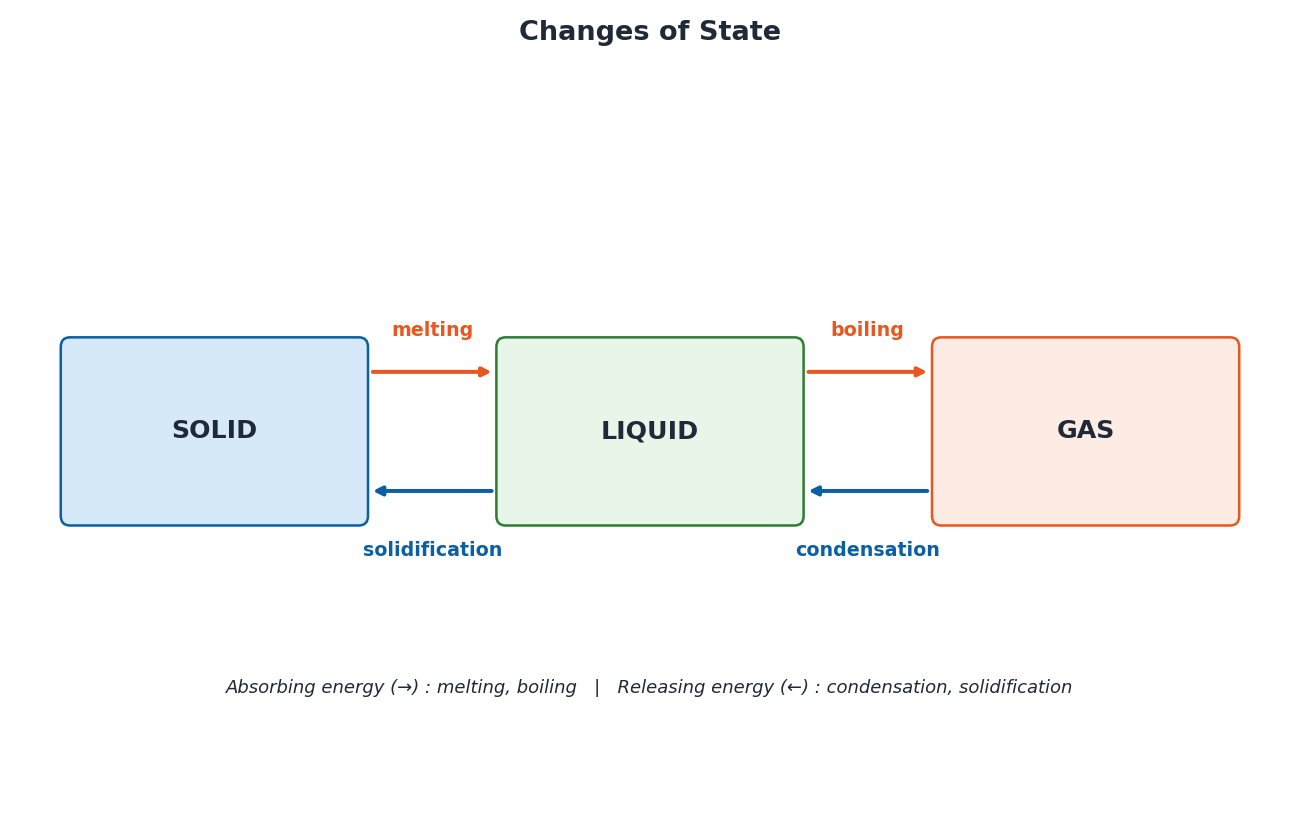
When a substance absorbs or loses energy, the kinetic energy of its particles changes, which can cause a change of state. Absorbing energy increases particle motion and spacing, causing melting (solid→liquid) or boiling (liquid→gas). Losing energy decreases particle motion and spacing, causing condensation (gas→liquid) or solidification (liquid→solid). Intermolecular forces are strongest in solids (least particle separation) and weakest in gases (greatest separation), which is why gases show the greatest relative thermal expansion and solids the least.
10.5 Evaporation
Evaporation is a natural process by which a liquid changes into a gas at its surface without boiling; it occurs at all temperatures (faster at higher ones) since some surface particles gain enough energy to escape as vapour, without requiring the whole liquid to be heated. Evaporation is affected by several factors: higher temperature speeds evaporation (more energetic molecules); larger surface area speeds evaporation (more liquid exposed to air); greater air movement carries away vapour molecules, preventing saturation and speeding evaporation; higher humidity slows evaporation (air already holds more moisture); the liquid's nature affects its rate (alcohol evaporates faster than water, needing less energy to escape); and lower atmospheric pressure enhances evaporation (less resistance to molecules escaping).
During evaporation, the escaping higher-energy molecules take heat away from the remaining liquid, cooling it — this is why sweat cools our bodies and why wet clothes dry (and cool) faster on hot days. Modern refrigeration systems use environmentally friendly refrigerants (instead of ozone-depleting CFCs) that evaporate at low temperatures inside cooling coils, absorbing heat from the refrigerator's interior; the vapour is then compressed and condensed back to liquid outside the cooling compartment, enabling a continuous evaporation-condensation cooling cycle.
10.6 Latent Heat
Latent heat is the heat energy required to change the state of a substance without changing its temperature; this energy breaks or forms bonds between particles rather than increasing their motion. Latent heat of fusion is the heat energy needed to convert 1 kg of a solid into a liquid at its melting point at constant temperature, given by Q = mLf, where Lf is the latent heat of fusion. For example, ice absorbs heat at 0°C but stays at 0°C until fully melted; the latent heat of fusion of ice is 3.36 × 10⁵ J kg⁻¹.
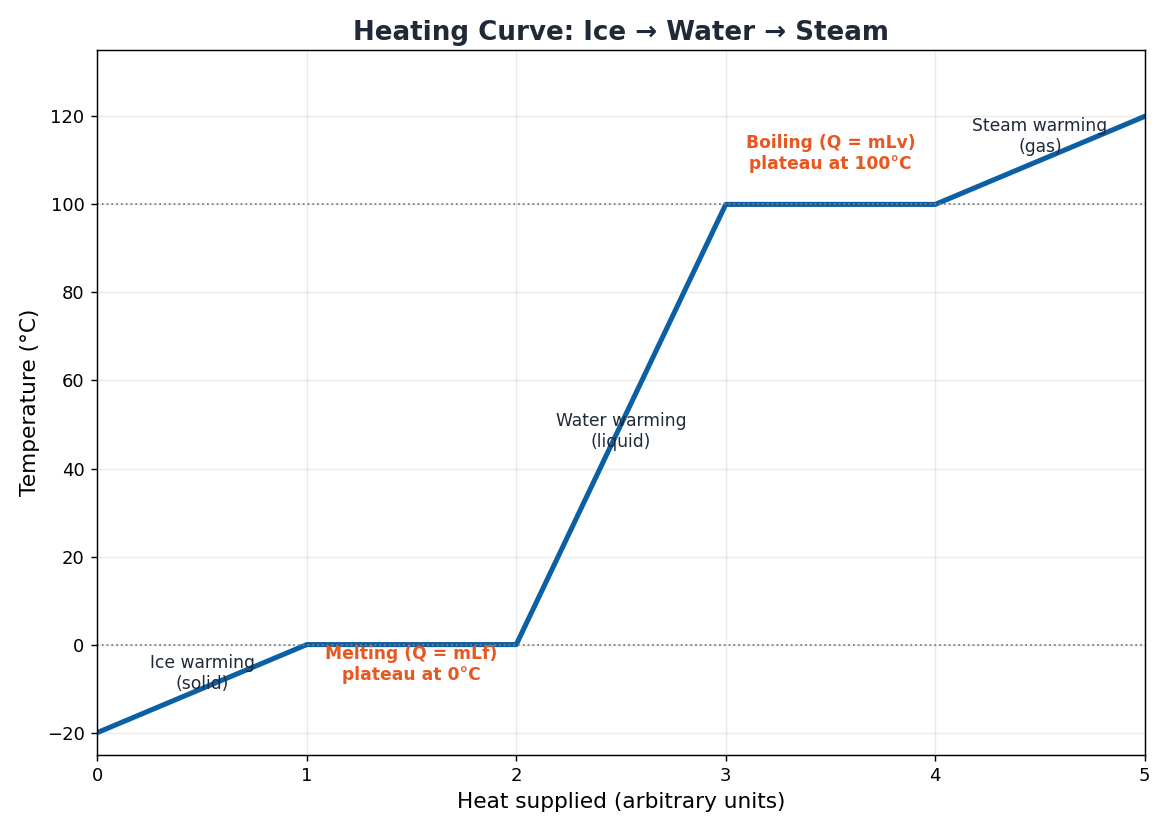
Latent heat of vaporization is the heat energy needed to change 1 kg of a liquid into gas at its boiling point at constant temperature, given by Q = mLv. The latent heat of vaporization of water is 2.26 × 10⁶ J kg⁻¹, meaning that much energy converts 1 kg of water into steam at 100°C without any temperature rise. These values can be determined experimentally by heating ice steadily, recording temperature against time (or heat supplied), and plotting the resulting graph, which shows flat plateaus at the melting point (0°C) and boiling point (100°C) where temperature stays constant despite continued heating — these plateaus correspond to the latent heats of fusion and vaporization respectively.
10.7 Superconductivity
Superconductivity is a special property in which certain materials exhibit zero electrical resistance when cooled below a critical temperature (Tc); in this state, electric current flows without any energy loss, since there are no collisions to resist the flow of electrons. A graph of electrical resistivity against temperature shows a superconductor's resistivity dropping abruptly to zero below Tc, while a normal metal's resistivity decreases only gradually. Examples include mercury (superconducting below 4.2 K), lead (below 7.2 K), and high-temperature ceramic superconductors (working at temperatures as high as 135 K). Superconductors are used in MRI machines (generating strong magnetic fields for medical imaging), maglev trains (levitating above tracks to eliminate friction), and particle accelerators (used to study fundamental particles).
Important Definitions
What is thermal expansion?
The change in length, area, or volume of a substance when it is heated, caused by increased particle motion and spacing.
Define the coefficient of linear expansion (α).
The fractional increase in length per unit original length per degree rise in temperature: α = ΔL/(L₀ΔT), with SI unit K⁻¹.
Define specific heat capacity.
The amount of heat energy needed to raise the temperature of 1 kg of a substance by 1°C (or 1 K); SI unit J kg⁻¹ K⁻¹.
What is evaporation?
A natural process in which a liquid changes into a gas at its surface, at any temperature, without boiling.
Define latent heat.
The heat energy required to change the state of a substance without changing its temperature, used to break or form bonds between particles.
Define latent heat of fusion.
The heat energy required to convert 1 kg of a solid into a liquid at its melting point while temperature stays constant: Q = mLf.
Define latent heat of vaporization.
The heat energy required to convert 1 kg of a liquid into a gas at its boiling point while temperature stays constant: Q = mLv.
What is superconductivity?
A property in which certain materials exhibit zero electrical resistance when cooled below a critical temperature, allowing current to flow without energy loss.
Key Formulas
| Topic | Formula |
|---|---|
| Linear thermal expansion | ΔL = αL₀ΔT, L = L₀(1 + αΔT) |
| Volume thermal expansion | ΔV = βV₀ΔT, V = V₀(1 + βΔT) |
| Heat energy (specific heat) | Q = mcΔT |
| Latent heat of fusion | Q = mLf |
| Latent heat of vaporization | Q = mLv |
| Specific heat capacity of water | c(water) = 4200 J kg⁻¹ K⁻¹ |
| Latent heat of fusion of ice | Lf = 3.36 × 10⁵ J kg⁻¹ |
| Latent heat of vaporization of water | Lv = 2.26 × 10⁶ J kg⁻¹ |
Diagrams
Linear Thermal Expansion of a Rod: A metal rod before and after heating, showing the increase in length ΔL and the linear expansion formula
Changes of State: Solid, liquid, and gas states with the named processes (melting, boiling, condensation, solidification) connecting them
Heating Curve: Ice to Water to Steam: Temperature vs heat supplied graph showing flat plateaus at the melting and boiling points, corresponding to latent heat
Short Questions & Answers
What factors influence the thermal expansion of solids?
The original length (or volume) of the solid, the temperature change, and the material's coefficient of expansion (α or β), which depends on the nature of the material.
What is latent heat of fusion?
The heat energy required to convert 1 kg of a solid into a liquid at its melting point without any change in temperature, given by Q = mLf.
Why do different materials show different thermal expansion?
Because each material has its own characteristic expansion coefficient (α or β), determined by its atomic/molecular structure and the strength of bonds between its particles.
How does evaporation contribute to cooling in everyday life?
As higher-energy molecules escape the liquid surface during evaporation, they carry heat away with them, cooling the remaining liquid — this is why sweating cools the body and wet surfaces feel cold.
What is latent heat of vaporization, and how is it calculated?
The heat energy required to convert 1 kg of a liquid into gas at its boiling point without a change in temperature, calculated using Q = mLv.
Why does metal feel colder than wood at the same temperature?
Metal is a good conductor and quickly conducts heat away from your hand, while wood is a poor conductor (insulator) and conducts heat away much more slowly, so it feels warmer even though both are at the same temperature.
What is superconductivity?
A state in which certain materials, cooled below a critical temperature, exhibit zero electrical resistance, allowing current to flow without any energy loss.
Why is water's high specific heat capacity important for climate?
Because water absorbs and releases large amounts of heat with only small temperature changes, coastal areas near oceans or large lakes experience milder, less extreme seasonal temperature swings than inland areas.
Long Questions & Answers
Explain thermal expansion in solids, liquids, and gases, and describe how each is quantified.
In solids, heating causes increased vibration of tightly packed atoms, which pushes the material's structure outward since there is no room for inward movement; linear expansion (change in length) follows ΔL = αL₀ΔT, and volume expansion follows ΔV = βV₀ΔT, where α and β are material-specific expansion coefficients. In liquids, since there is no fixed shape, heating causes molecules to move faster and spread apart in all directions, following the same volume expansion formula ΔV = βV₀ΔT; a heated liquid in a flask shows real expansion (BC) exceeding apparent expansion (AC) because the container itself also expands (AB), with BC = AC + AB. In gases, heating increases particle kinetic energy, causing molecules to collide with container walls more forcefully and frequently; in a flexible container this causes volume to increase (following Charles' law, volume ∝ temperature at constant pressure), while in a rigid container it instead causes pressure to rise. Overall, gases show the greatest relative thermal expansion, followed by liquids, with solids expanding the least, because intermolecular forces are weakest in gases and strongest in solids.
Describe the effects of water's high specific heat capacity, with reference to climate and engineering applications.
Water has a specific heat capacity of 4200 J kg⁻¹ K⁻¹, far higher than most substances (dry soil, for instance, has only about 810 J kg⁻¹ K⁻¹) — meaning water can absorb or release a large quantity of heat energy while its own temperature changes only slightly. This property has major climatic effects: large bodies of water like oceans and lakes absorb heat during the day and release it slowly at night, moderating nearby land temperatures and giving coastal regions milder, less extreme seasonal climates compared to inland areas, which heat up and cool down far more quickly. This property is also exploited in engineering: automobile cooling systems circulate water through jackets around hot engine cylinders, where it absorbs heat; a thermostat then regulates whether this heated water is sent to the radiator, where a fan cools it with outside air before it returns to the engine to absorb more heat, in a continuous protective cycle that prevents engine overheating.
Explain what latent heat is, and describe how the latent heat of fusion of ice could be determined experimentally.
Latent heat is the heat energy required to change the state of a substance without any change in its temperature; instead of increasing particle motion (and hence temperature), this energy is used to break the intermolecular bonds holding particles in their current state. To determine the latent heat of fusion of ice experimentally, small pieces of ice are placed in a beaker with a thermometer, and the beaker is heated steadily; as the ice melts, the temperature is observed to remain constant at 0°C until all the ice has turned to water, and the time taken for this complete melting is recorded. Further heating then raises the water's temperature from 0°C toward 100°C, and this time is also recorded. Plotting a graph of temperature against time (or against heat supplied, if a known constant heating rate is used) produces a curve with a flat plateau at 0°C, corresponding to the melting process; using the known mass of ice, the rate of heat supply, and the time spent on the plateau, the latent heat of fusion Q = mLf can be calculated by solving for Lf.
Describe superconductivity, how it differs from normal electrical conduction, and its practical applications.
Superconductivity is a special state in which certain materials, when cooled below a specific critical temperature (Tc), exhibit exactly zero electrical resistance — unlike normal metals, whose resistivity decreases only gradually as temperature falls but never reaches zero. In a superconductor below its critical temperature, electrons no longer experience the collisions that normally cause electrical resistance, so electric current can flow indefinitely without any loss of energy. Examples of superconducting materials include mercury (below 4.2 K), lead (below 7.2 K), and certain high-temperature ceramic superconductors that work at temperatures up to around 135 K, which is far easier to achieve than temperatures near absolute zero. Superconductors have important practical applications: MRI machines use them to generate the very strong, stable magnetic fields needed for medical imaging; maglev trains use superconducting magnets to levitate above their tracks, eliminating friction and enabling very high speeds; and particle accelerators use them to generate the powerful magnetic fields needed to guide and study fundamental particles.
Multiple Choice Questions (MCQs)
When the temperature of a copper rod is increased, its length: (A) remains the same (B) increases (C) decreases (D) becomes double
Correct answer: (B) increases. Heating a solid causes thermal expansion, increasing its length according to ΔL = αL₀ΔT.
The increase in unit length of a material per degree rise in temperature is called the coefficient of: (A) cubic expansion (B) volume expansion (C) linear expansion (D) none of these
Correct answer: (C) linear expansion. This defines the coefficient of linear expansion, α, used in ΔL = αL₀ΔT.
A liquid that evaporates turns into: (A) Gas (B) Water vapour (C) Air (D) Both (a) and (b)
Correct answer: (D) Both (a) and (b). Evaporation converts a liquid into its gaseous form, commonly referred to as vapour — both descriptions are correct.
The property that determines how much heat a solid can absorb before its temperature changes significantly is: (A) Density (B) Specific heat capacity (C) Colour (D) Hardness
Correct answer: (B) Specific heat capacity. Specific heat capacity determines how much heat energy is needed to produce a given temperature change in a substance.
High-temperature superconductors typically involve which type of material? (A) Pure metals (B) Organic compounds (C) Ceramics (D) Liquid crystals
Correct answer: (C) Ceramics. Certain ceramic materials have been found to exhibit superconductivity at relatively higher temperatures (up to around 135 K).
The formula Q = mLf is used to calculate: (A) Specific heat capacity (B) Heat energy for latent heat of fusion (C) Heat energy for latent heat of vaporization (D) Coefficient of expansion
Correct answer: (B) Heat energy for latent heat of fusion. Q = mLf calculates the heat energy required to melt a mass m of a solid at its melting point (latent heat of fusion).
Water's specific heat capacity is approximately: (A) 810 J kg⁻¹ K⁻¹ (B) 1000 J kg⁻¹ K⁻¹ (C) 2260 J kg⁻¹ K⁻¹ (D) 4200 J kg⁻¹ K⁻¹
Correct answer: (D) 4200 J kg⁻¹ K⁻¹. Water's specific heat capacity is 4200 J kg⁻¹ K⁻¹, notably higher than most common substances.
During evaporation, the liquid that remains becomes: (A) Hotter (B) Cooler (C) Unchanged in temperature (D) Instantly frozen
Correct answer: (B) Cooler. The escaping high-energy molecules carry heat away, so the remaining liquid cools down.
A gas in a rigid, non-flexible container that is heated will show a rise in: (A) Volume only (B) Pressure (C) Mass (D) Density only
Correct answer: (B) Pressure. Since the container's volume cannot change, increased particle collisions instead raise the pressure inside.
Which of these correctly ranks relative thermal expansion from greatest to least? (A) Solids > Liquids > Gases (B) Gases > Liquids > Solids (C) Liquids > Gases > Solids (D) Gases > Solids > Liquids
Correct answer: (B) Gases > Liquids > Solids. Gases have the weakest intermolecular forces and expand the most; solids have the strongest forces and expand the least.
Quick Revision Summary
- Thermal expansion: solids ΔL=αL₀ΔT (linear), ΔV=βV₀ΔT (volume); liquids expand freely (real > apparent expansion); gases follow Charles' law
- Consequences: railway gaps, bridge expansion joints, jar lid trick, aerosol warnings, flexible pipe joints, hot air balloons
- Specific heat: Q = mcΔT; water's high c (4200 J/kg·K) moderates coastal climate and cools car engines
- Change of state: melting/boiling (energy absorbed), condensation/solidification (energy released)
- Evaporation: surface-only, all temperatures; affected by temperature, surface area, air movement, humidity, liquid type, pressure
- Evaporation causes cooling (sweating, CFC-free refrigeration cycles)
- Latent heat: Q=mLf (fusion), Q=mLv (vaporization); temperature stays constant during phase change (heating curve plateaus)
- Superconductivity: zero resistance below critical temperature Tc; used in MRI, maglev trains, particle accelerators
Exam Tips
- Always convert temperature changes to Kelvin or consistent units before substituting into ΔL=αL₀ΔT or ΔV=βV₀ΔT
- Remember real expansion = apparent expansion + container expansion (BC = AC + AB) for liquid-in-flask problems
- Distinguish clearly between 'heat' (Q, energy) and 'temperature' (T) in written answers — a very common source of lost marks
- Memorise the key constants: c(water)=4200 J/kg·K, Lf(ice)=3.36×10⁵ J/kg, Lv(water)=2.26×10⁶ J/kg
- For heating-curve questions, identify the flat (plateau) regions as phase changes — temperature does not rise while latent heat is being absorbed
- Link each thermal expansion 'consequence' (bridges, railways, jar lids, pipes) to whether it accommodates or prevents expansion