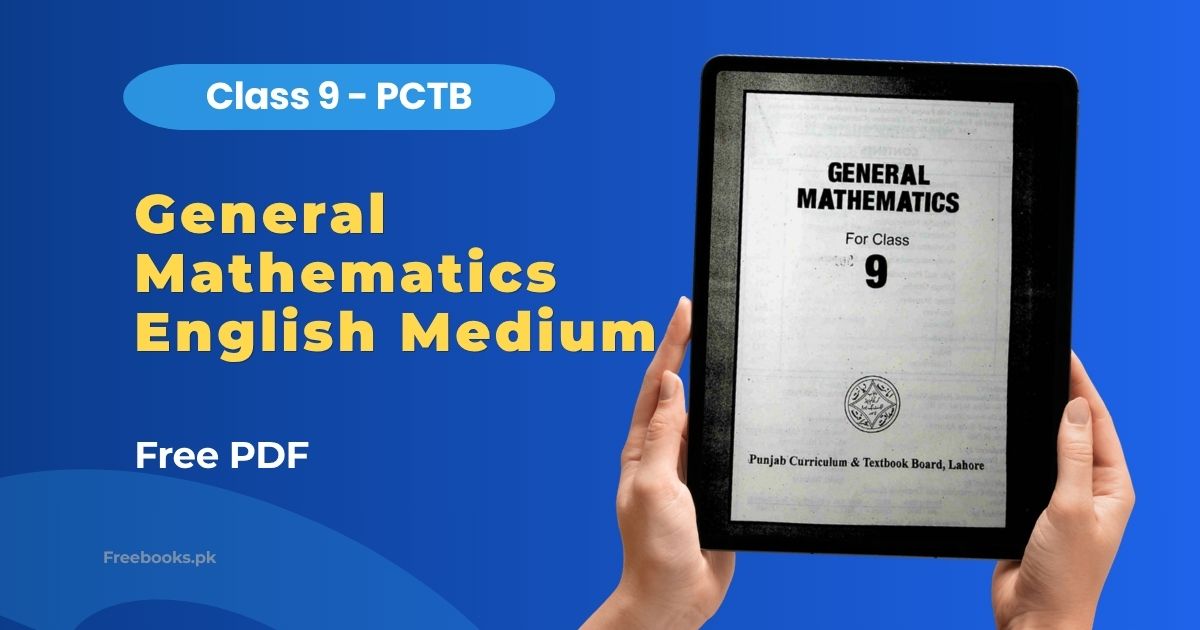
General Mathematics for Class 9 is published by Ali Brotheran, Lahore, and is approved by the Punjab Curriculum Authority (PCA) under the National Curriculum 2006. The book is designed for students in the Arts and General groups at the matric level. It covers ten units ranging from percentage, ratio and proportion to basic statistics.
For 9th class students who are not taking science subjects, this book covers the full General Mathematics board exam syllabus. Each unit is explained clearly with examples, solved exercises, and practice questions. The PDF makes it easy to revise topics at home and prepare chapter by chapter for the Punjab Board exam.
Book Overview
| Class | 9 (SSC Part 1) |
| Subject | General Mathematics |
| Category | Class 9 |
| Board | Punjab Board (PCA, Lahore) |
| Publisher | Ali Brotheran, Lahore |
| Total Chapters | 10 |
| Medium | English |
| Format |
Chapter List
Unit 1 – Percentage, Ratio and Proportion
Covers percentage as a fraction with denominator 100, ratio, direct and inverse proportion, and compound proportion, with real-life applications and graded practice problems.
Important Questions:
- What does percentage mean? Answer: It means “per hundred,” so a percentage is a fraction with denominator 100.
- What is a ratio? Answer: A comparison of two quantities of the same kind showing how many times one contains the other, without any units.
- What is a proportion? Answer: A statement that two ratios are equal, written as a:b::c:d, where a and d are the extremes and b and c are the means.
- What is the difference between direct and inverse proportion? Answer: In direct proportion both quantities increase or decrease together, while in inverse proportion one increases as the other decreases.
Unit 2 – Zakat, Ushr and Inheritance
Explains the calculation of Zakat and Ushr according to Islamic principles, including Nisab and prescribed rates, and introduces distribution of inheritance (Tarka) among legal heirs using mathematical ratios.
Important Questions:
- What is Nisab for Zakat? Answer: The minimum amount of wealth, such as 7.5 tola gold or 52.5 tola silver, a Muslim must own before Zakat becomes obligatory.
- What is the rate of Zakat? Answer: 2.5 percent (1/40) of the total value of exposed or unexposed wealth held for one full year.
- What is Ushr? Answer: A levy on agricultural produce paid by a landowner, distinct from Zakat, calculated on harvested crops.
- How is inheritance (Tarka) distributed? Answer: According to fixed shares assigned to legal heirs under Islamic principles, calculated as a ratio of the total estate.
Unit 3 – Business Mathematics
Covers cost price and selling price relations for profit and loss, discount calculations, and business partnership problems relevant to everyday trade situations.
Important Questions:
- How is profit calculated? Answer: Profit equals Selling Price minus Cost Price, when the Selling Price is greater than the Cost Price.
- What is the formula for profit percentage? Answer: Profit percent equals Profit divided by Cost Price, multiplied by 100.
- How is Selling Price found when Cost Price and profit percent are known? Answer: SP equals CP multiplied by (100 + Profit%), divided by 100.
- What is discount? Answer: A reduction given on the marked price of an item, calculated as a percentage of the marked price.
Unit 4 – Financial Mathematics
Introduces commercial banking, currency exchange, profit/markup calculations, insurance, and vehicle leasing and financing, covering concepts used in personal and commercial finance.
Important Questions:
- What is a PLS savings account? Answer: A bank deposit account operating on a profit-and-loss sharing basis instead of fixed interest, common in Islamic banking.
- What is markup? Answer: The amount charged on borrowed money, similar to interest, calculated on the principal for a given period.
- What is a negotiable instrument? Answer: A document such as a cheque, demand draft, or pay order that can be transferred to settle a payment.
- What is leasing in vehicle financing? Answer: An arrangement where a down payment is made and the remaining vehicle cost is repaid through monthly instalments.
Unit 5 – Consumer Mathematics
Covers direct and indirect taxes including sales tax, excise duty, property tax and income tax, calculating utility bills for electricity, gas and telephone, and computing personal income from wages, overtime, and commission.
Important Questions:
- What is the difference between direct and indirect tax? Answer: Direct tax is charged directly on income or property, like income tax, while indirect tax is added to the price of goods and services, like sales tax.
- How is sales tax calculated on a purchase? Answer: By multiplying the marked price by the sales tax rate and adding it to the original price.
- How is a utility bill amount calculated? Answer: By finding the difference between the present and previous meter readings and multiplying the units consumed by the applicable rate.
- How do gross and net income differ? Answer: Gross income is total earnings before any deductions, while net income is what remains after deductions like income tax.
Unit 6 – Exponents and Logarithms
Explains radicals and radicands, laws of exponents, scientific notation, and logarithms including characteristic and mantissa. Covers the use of log tables for calculations and solving related problems.
Important Questions:
- What is a radical? Answer: An expression involving a root, such as a square root, that can also be written in exponential form.
- What is the definition of a logarithm? Answer: The power to which a base must be raised to produce a given number, written as log base a of y equals x when a raised to x equals y.
- What are the characteristic and mantissa of a logarithm? Answer: The characteristic is the whole number part of a logarithm, and the mantissa is its decimal part, found using log tables.
- How does the law log(mn) = log m + log n simplify calculations? Answer: It converts multiplication into addition, making complex multiplication problems easier to solve using logarithm tables.
Unit 7 – Arithmetic and Geometric Sequences
Introduces sequences and progressions, arithmetic and geometric sequences, their general terms, and arithmetic and geometric means, with practical worked examples.
Important Questions:
- What is a sequence? Answer: An arrangement of numbers written in a definite order according to a specific rule, also called a progression.
- How is the nth term of an arithmetic sequence found? Answer: Using the formula an = a1 + (n-1)d, where a1 is the first term and d is the common difference.
- What is a geometric sequence? Answer: A sequence in which each term is found by multiplying the previous term by a fixed ratio.
- What is the arithmetic mean between two numbers? Answer: The average of the two numbers, inserted between them so that all three form an arithmetic sequence.
Unit 8 – Sets and Functions
Covers set notation, types of sets, Venn diagrams, set operations including union, intersection and complement, De Morgan’s laws, and an introduction to binary relations and functions and their types.
Important Questions:
- What is the union of two sets? Answer: A set containing all elements that belong to either of the two sets, without repetition.
- What is the intersection of two sets? Answer: A set containing only the elements common to both sets.
- What is a one-to-one (injective) function? Answer: A function in which every element of the range corresponds to exactly one element of the domain.
- What is De Morgan’s law used for? Answer: To express the complement of a union or intersection of sets in terms of the complements of the individual sets.
Unit 9 – Linear Graphs
Explains plotting ordered pairs on the Cartesian plane, drawing linear graphs of the forms y = c, x = a, y = mx and y = mx + c, and interpreting conversion graphs in real-life contexts.
Important Questions:
- What is an ordered pair? Answer: A pair of numbers written in a fixed order, (x, y), used to locate a point on the Cartesian plane.
- What does the equation y = mx + c represent? Answer: A straight line graph, where m is the slope and c is the point where the line crosses the y-axis.
- What is a conversion graph used for? Answer: To read one quantity directly from another when the two are in direct proportion, such as converting miles to kilometres.
- How is the graph of y = c different from x = a? Answer: y = c is a horizontal line parallel to the x-axis, while x = a is a vertical line parallel to the y-axis.
Unit 10 – Basic Statistics
Covers construction of frequency distribution and cumulative frequency tables, histograms and frequency polygons, and calculation of mean, median, mode, and measures of dispersion such as range, variance and standard deviation.
Important Questions:
- What is a frequency distribution table? Answer: A table that organizes raw data into classes or intervals along with the number of times each value occurs.
- How is the arithmetic mean calculated for grouped data? Answer: By multiplying each class’s midpoint by its frequency, summing these products, and dividing by the total frequency.
- What is the difference between mean, median and mode? Answer: The mean is the average value, the median is the middle value when data is ordered, and the mode is the most frequently occurring value.
- What does standard deviation measure? Answer: The amount of variation or spread of data values around the mean.
Download General Mathematics Class 9 Book PDF
Click the button below to open the complete General Mathematics Class 9 book PDF. It opens in a new tab and is ready to read or save on any device.
⬇ Download PDFWho Should Read This
This book is for Class 9 students in the Arts or General group preparing for the Punjab Board SSC Part 1 exam. It is also useful for Commerce group students who need a solid foundation in practical mathematics. Students looking to strengthen their understanding of everyday math topics will benefit from this book.
Applicable Boards
This book is approved by the Punjab Curriculum Authority (PCA) and is used in Punjab Board schools. Students from the Federal Board and AJK Board can also benefit from it, as the General Mathematics syllabus is very similar. Students from other provincial boards will find most topics overlapping.
FAQs
Is this General Mathematics book for Class 9 Punjab Board?
Yes. It is approved by the Punjab Curriculum Authority (PCA) and covers the full General Mathematics syllabus for SSC Part 1 (Class 9).
What is the difference between General Math and Science Math at Class 9?
General Mathematics is for students in the Arts and General groups. It focuses on practical topics like business math, zakat, statistics, and logarithms. Science students study a separate Mathematics book with algebra and geometry.
How many chapters are in General Mathematics Class 9?
There are 10 units, from Percentage, Ratio and Proportion to Basic Statistics.
Can students from other boards use this book?
Yes. Federal Board and AJK Board students can use it as the syllabus is largely the same. Most topics also overlap with other provincial board curricula.
Is this the latest edition?
The PDF is the 5th edition (2019) approved under the National Curriculum 2006. The chapter content has not changed in recent editions.
Is the PDF free to download?
Yes. The General Mathematics Class 9 book PDF is completely free to download and read on any device.
Related Books
- General Mathematics Class 10
- General Mathematics Class 10 (Urdu Medium)
- General Mathematics Class 9 (Urdu Medium)
- English Grammar & Composition Class 9
- Mathematics Class 9 (English Medium)
- Mathematics Class 9 (Urdu Medium)
Study Resources for Mathematics Class 9
Free exam-preparation resources for Mathematics Class 9 from the Freebooks.pk Editorial Team — the free PDF textbook, chapter-wise notes (definitions, short & long questions and MCQs), the latest paper pairing scheme. Study online or download.
© Copyright Policy
Freebooks.pk is an educational resource for students in Pakistan. Textbooks and other books belong to their respective boards, authors and publishers, and all rights remain with them. If you are the copyright holder of any material on this page and want it changed or removed, please contact us or file a request under our DMCA policy. We review every request and remove reported content promptly.