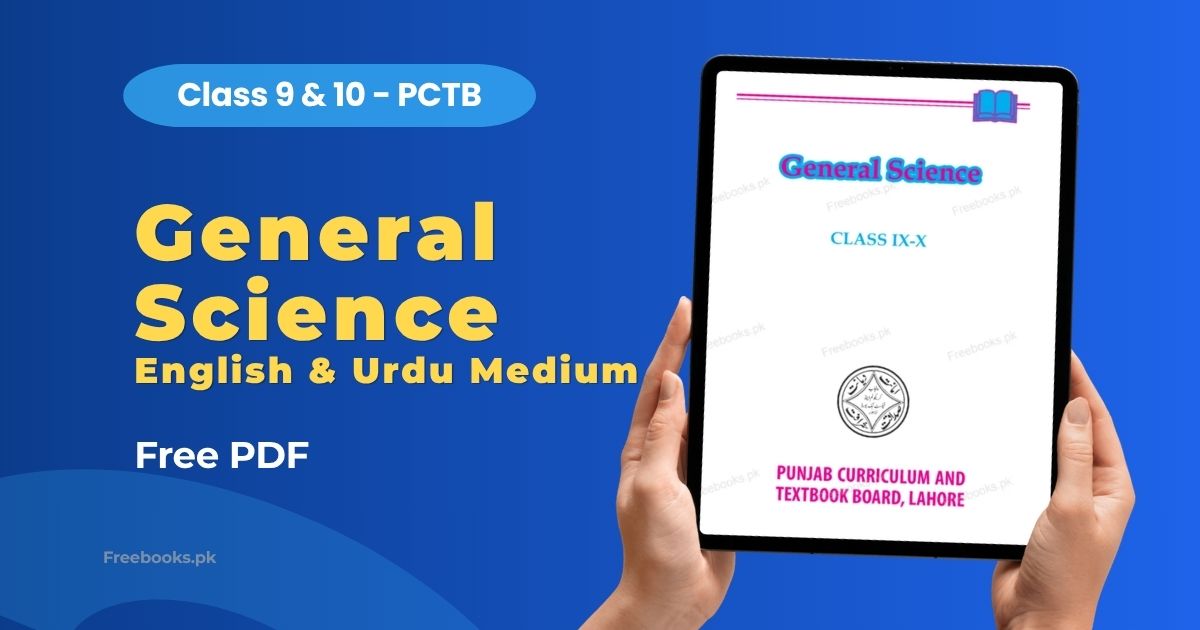
General Science for Classes IX-X is the combined Punjab textbook used in both Class 9 and Class 10. It was published by the Punjab Curriculum and Textbook Board, now part of PECTAA. Its 11 chapters move from the history of science through chemistry, biology and health to energy, electricity, electronics, medical technology and Pakistan’s space and nuclear programmes.
This page is a chapter-by-chapter study guide. For each chapter you will find a summary, key points, a common mistake to avoid and two important questions with short answers. A separate section lists facts in this edition that have changed or need care.
Book Overview
- Class: 9 and 10 (combined book)
- Subject: General Science
- Board: Punjab
- Publisher: Punjab Curriculum and Textbook Board, Lahore (now part of PECTAA)
- Total Chapters: 11, plus a one-page note on dengue fever
- Length: 176 printed pages
- Copy used for this guide: English edition, January 2018 printing
- Approval: Federal Ministry of Education, Curriculum Wing, letter dated 22 December 2003
- Authors: Prof. Nazir Ahmad Chughtai, Prof. Dr. Ejaz Rasool, Dr. Capt. Muhammad Akhtar (R), Prof. Mrs. Rizwana Cheema, Mr. Aamir Riaz, Prof. Dr. Javed Iqbal, Dr. Mahmood-ul-Hasan, Prof. Muhammad Nisar, Prof. Surriya Usmani (R)
- Editors: Prof. M. A. Shahid, Prof. Shahnawaz Cheema, Dr. Abid Zia, Prof. Muhammad Nisar
Chapter List
Chapter 1: Introduction and Role of Science
pp. 1–13 · Key topics: history of science, science in Islam, Muslim and Pakistani scientists, branches of science, limits of science
The chapter opens with how knowledge of nature grew, from early humans and Greek philosophers to the Muslim scholars of 600 to 1400 A.D. It links the Quran’s call to observe and reflect with scientific thinking, then profiles five Muslim and six Pakistani scientists. The second half defines the main branches of science and shows how they overlap in fields such as biochemistry and astrophysics. It closes with what science has done for daily life and what it still cannot do.
Key Points:
- Jabir Bin Hayyan (722-817) is called the founder of chemistry and prepared nitric, sulphuric and hydrochloric acids.
- Al-Razi (865-925) described smallpox and measles in detail and sorted chemicals into minerals, botanicals, animals and derived substances.
- Ibn-ul-Haitham (965-1039) worked on light, discovered the pinhole camera and wrote Kitab-ul-Manazir.
- Al-Bairuni (973-1048) calculated the radius of the Earth near Pind Dadan Khan; his famous book is Tahreer-ul-Amakin.
- Bu Ali Sina (980-1037) wrote Al-Qanoon-fil-Tib in 14 volumes.
- Dr. Abdus Salam shared the 1979 Nobel Prize in Physics for work on the weak nuclear and electromagnetic forces.
- Dr. A. Q. Khan headed the Kahuta laboratories; the Chaghi nuclear tests were held on 28 and 30 May 1998.
Common Mistake: Matching the wrong scholar to a work. Kitab-ul-Manazir belongs to Ibn-ul-Haitham, Tahreer-ul-Amakin to Al-Bairuni, and the detailed account of smallpox to Al-Razi, not Jabir.
Important Questions:
- What is the difference between biophysics and biochemistry? Biophysics studies biology with the principles of physics; biochemistry studies biology with the help of chemistry.
- Name three limitations of science. Some genetic diseases remain incurable, natural disasters such as earthquakes cannot be prevented or reliably foretold, and the disposal of nuclear waste is still a problem.
Chapter 2: Our Life and Chemistry
pp. 14–28 · Key topics: carbon, hydrogen, oxygen, allotropes of carbon, organic chemistry, water, air, essential elements
Life is built mainly from carbon, hydrogen and oxygen, which join in compounds such as carbohydrates, fats and proteins. The chapter connects these elements to respiration and photosynthesis, then studies carbon in its allotropic and non-allotropic forms. Separate sections explain the unusual properties of water and the composition of air, including the role of oxygen, nitrogen, carbon dioxide and the rare gases. The last part reviews nine elements, among them iron, sodium, calcium, phosphorus and iodine, with their uses in industry, plants and the body.
Key Points:
- Respiration breaks glucose down to carbon dioxide, water and energy; photosynthesis is broadly its reverse.
- Diamond, graphite and bucky balls are the allotropic forms named; charcoal, soot and coke are non-allotropic forms.
- Water is densest at 4°C, so ice floats and water below the ice stays liquid, which protects aquatic life.
- Air by volume is about 78% nitrogen, 21% oxygen and 0.9% argon.
- The nitrogen cycle moves nitrogen between air, soil and living things.
- Divers breathe an 80% helium and 20% oxygen mixture to prevent the bends.
- Iodine shortage increases goitre; iron is central to haemoglobin; magnesium is part of chlorophyll.
Common Mistake: Calling every carbon compound organic. Carbon monoxide, carbon dioxide and metal carbonates contain carbon but are not classified as organic.
Important Questions:
- What is allotropy? When an element exists in more than one physical form in the same state. Carbon is the main example.
- Why does water expand on freezing? Water molecules are less tightly packed in ice than in liquid water, so the same mass takes up more volume.
Chapter 3: Biochemistry and Biotechnology
pp. 29–39 · Key topics: metabolism, enzymes, blood groups, DNA, genetic engineering, antibiotics, vaccines, recycling
Metabolism is the sum of the building-up (anabolic) and breaking-down (catabolic) reactions in living things. After showing how carbohydrates, fats and proteins are digested and used, the chapter explains enzymes and the composition of blood, including the ABO and Rh systems. DNA is then presented as hereditary material, leading to genetic engineering and its use in crops and livestock. The final sections describe groups of antibiotics, the first vaccine and the recycling of waste.
Key Points:
- Enzymes are protein catalysts and are specific: amylase acts on starch but not on proteins or fats.
- Blood has plasma, red cells, white cells and platelets; serum is plasma without its clotting protein.
- Group O is the universal donor and group AB the universal recipient.
- DNA is made of nucleotides, each with a base, a sugar and a phosphate; the human genome has about 3.2 billion base pairs.
- A transgenic organism is one that has received a foreign gene.
- Penicillin acts on a narrow range of bacteria; tetracyclines are broad spectrum.
- Edward Jenner tested the first smallpox vaccine in 1796.
Common Mistake: Thinking antibiotics treat viruses. They act on bacteria, and the book says plainly that they cannot harm viruses.
Important Questions:
- What are the steps in producing a genetically engineered organism? Identify the gene of interest, remove it from the donor, join it into a chromosome or DNA, and introduce it into the recipient.
- Why is recycling important? It reduces rubbish and pollution, conserves raw materials and resources, saves water through sewage treatment, and saves energy and money.
Chapter 4: Human Health
pp. 40–51 · Key topics: food components, vitamins, minerals, energy needs, balanced diet, endocrine glands, life stages, exercise, first aid
The chapter starts with the six components of food and what each one does in the body. It then shows how energy needs change with age, sex, work and climate, and what a balanced diet means for infants, young people, older people and pregnant or breast-feeding women. Coordination in the body is explained through the nervous and endocrine systems. It finishes with the stages of human life, the value of exercise, and first aid for bites, burns, eye injuries and coma.
Key Points:
- One gram of carbohydrate gives about 4.1 kcal and one gram of fat about 9.3 kcal.
- Vitamins A, D, E and K are fat soluble; B and C are water soluble.
- Deficiencies to learn: A night blindness, B1 beriberi, C scurvy, D rickets in children and osteomalacia in adults.
- The pituitary is called the master gland; the thyroid makes thyroxine, which needs iodine.
- Insulin lowers blood sugar and glucagon raises it; both come from the pancreas.
- For a burn, run tap water over the area and do not apply butter, grease, oil or toothpaste.
- If dust enters the eye, do not rub it; wash it gently with clean water.
Common Mistake: Mixing up rickets and scurvy. Rickets comes from a lack of vitamin D and scurvy from a lack of vitamin C.
Important Questions:
- What is a balanced diet? A diet with well-proportioned amounts of all nutrients, so that none is in excess or short, according to the needs of the body.
- Why do children need more energy per kilogram than old people? They need energy for growth and puberty as well as repair and maintenance, and their metabolic rate is higher.
Chapter 5: Diseases, Cause and Prevention
pp. 52–70, with the dengue note on p. 176 · Key topics: viral, bacterial, fungal and parasitic diseases, spread of germs, immunization, smoking, mental illness, drugs
This is the longest health chapter. Diseases are grouped by what causes them, and each entry gives symptoms, spread and prevention. The chapter then traces how germs travel through air, touch, faeces, animals, wounds and water, and how sterilization, control of carriers, vaccination and hygiene break those routes. Later sections deal with the damage done by smoking, with mental illness, and with the difference between medicines and addictive drugs. Dengue fever is covered on a separate page at the end of the book.
Key Points:
- Viral: smallpox, polio, influenza, measles, AIDS, hepatitis. Bacterial: TB, whooping cough, diphtheria, tetanus, typhoid, cholera.
- Malaria is carried by the female Anopheles mosquito, and dengue by the female Aedes aegypti.
- Ringworm is a fungal infection; roundworm (Ascaris) and thread worm are parasites.
- Childhood immunization protects against TB, whooping cough, measles, diphtheria, polio and tetanus.
- BCG is given at birth; the book gives measles vaccination at 9 months.
- Tobacco smoke holds nicotine, tar and carbon monoxide; nicotine is the addictive chemical.
- In dengue, paracetamol is used for fever, while aspirin and Brufen are avoided because they can worsen bleeding.
Common Mistake: Reading the book’s line that AIDS is not an infectious disease to mean it cannot be passed on. HIV can be passed on through infected blood, shared syringes or blades, sexual contact and from mother to baby. The book’s point is that it does not spread through touch, sitting together, shaking hands or working together.
Important Questions:
- How can malaria be prevented? Kill mosquitoes with insecticide spray, fill or treat stagnant water, use nets and repellents, and complete the prescribed course of medicine.
- Why should antibiotics not be used for influenza or measles? These are viral diseases and antibiotics do not control viruses.
Chapter 6: Environment and Natural Resources
pp. 71–90 · Key topics: atmosphere, ozone, greenhouse effect, pollution, fossil fuels, minerals, agriculture, wildlife, population
The chapter explains the four layers of the atmosphere, the loss of ozone and the greenhouse effect. It then takes air, water and land pollution in turn, with causes, effects and ways of reducing them. Pakistan’s fossil fuels, minerals, crops, and dairy, poultry and fish farming come next. It ends with endangered wildlife, national parks and the effects of rising population on land, cities and quality of life.
Key Points:
- Layers in order: troposphere to about 18 km, stratosphere to 50 km, mesosphere to about 85 km, then thermosphere.
- Ozone in the upper stratosphere filters ultraviolet radiation; CFCs thin it.
- Carbon dioxide, methane and CFCs trap long-wave heat, which causes global warming.
- Sulphur dioxide and oxides of nitrogen cause acid rain.
- Coal, oil and gas are non-renewable fossil fuels.
- Waterlogging and salinity arise when unlined canals raise the water table.
- Endangered species named include the Marcopolo sheep, snow leopard, Indus river dolphin and houbara bustard.
Common Mistake: Treating the mesosphere as the hottest layer. It is the coldest, at about -100°C, while the thermosphere is the hottest.
Important Questions:
- What is the greenhouse effect? Short-wave solar radiation passes in and warms the Earth, but gases such as carbon dioxide stop the long-wave heat from escaping, so the temperature rises.
- Name two problems caused by a rising population. Pressure on resources such as housing, clean water and food, and environmental damage such as deforestation, soil erosion and the growth of slums.
Chapter 7: Energy
pp. 91–109 · Key topics: work, forms of energy, conservation law, electricity generation, kilowatt-hour, thermal pollution, nuclear hazards
Work is defined scientifically, and energy as the ability to do it. The chapter describes eight forms of energy and how one changes into another under the law of conservation. It compares traditional sources of electricity (hydroelectric, thermal, nuclear) with solar, wind, tidal, geothermal and biomass power. The last sections cover how electricity and gas are measured, thermal pollution, radiation hazards and practical ways of saving energy.
Key Points:
- Work = force × distance in the direction of the force; its unit, like that of energy, is the joule.
- Kinetic energy depends on mass and speed; potential energy depends on position.
- Energy can be neither created nor destroyed, only changed in form.
- Fission splits heavy nuclei and fusion joins light ones; the Sun’s energy comes from fusion.
- Power = energy ÷ time, and 1 kWh is the energy used by a 1000 W appliance in one hour.
- A 100 W bulb uses one unit in 10 hours; a 2500 W air conditioner uses 2.5 units in an hour.
- One Btu equals 1055 joules.
Common Mistake: Saying energy is used up. It is changed from one form to another, and in most cases ends up as heat.
Important Questions:
- Why does a stone at a height have potential energy? Work was done against gravity to lift it, and that work is stored in the stone. When released, it can fall and do work.
- Give two ways to dispose of nuclear waste, and the concern with them. Burial in deep tunnels or storage in sealed containers on the sea bed. The book says no method is considered completely safe.
Chapter 8: Current Electricity
pp. 110–127 · Key topics: current, potential difference, Ohm’s law, resistance, capacitors, transformers, AC and DC, house wiring, safety, meters
The chapter builds from the flow of charge to potential difference, using a water pump as a comparison, and then to Ohm’s law and resistance. Circuit parts come next: switches, resistors, capacitors and transformers. It explains AC and DC, the wiring of a house and how to work out units of electricity used. It closes with electrical dangers, first aid for shock and the instruments used to measure current and voltage.
Key Points:
- Current is charge per unit time: I = Q ÷ t, measured in amperes.
- Conventional current flows from positive to negative; electrons move the other way.
- Ohm’s law: V = IR, when temperature and physical state stay the same.
- In a transformer, Vs ÷ Vp = Ns ÷ Np; a step-up transformer has more turns on the secondary.
- Home supply is 220 V AC, and appliances are connected in parallel.
- Switches and fuses go in the live wire so that an appliance is not live when switched off.
- An ammeter has low resistance and goes in series; a voltmeter has high resistance and goes in parallel.
Common Mistake: Connecting an ammeter in parallel or a voltmeter in series. Remember that the ammeter has to carry the current and the voltmeter only compares two points.
Important Questions:
- Why is electricity sent at very high voltage? Sending it at 220 volts over long distances would waste a major portion of the energy, so it is sent at high voltage and reduced near consumers by transformers.
- What should you do first if someone has received an electric shock? Check whether they are still touching the appliance. Switch off the main supply, or separate them with a dry wooden or plastic object, before touching them.
Chapter 9: Basic Electronics
pp. 128–149 · Key topics: semiconductors, diodes, radio waves, television, computers, binary numbers, telecommunication, internet
Electronics begins with silicon and germanium, doping and the N-type and P-type materials that make a diode. The chapter shows how diodes rectify current, emit light and sense light. It explains how radio and television signals travel, including by cable and satellite. It then covers the parts of a computer, analogue and digital signals, binary numbers and methods of communication from telegraph to e-mail.
Key Points:
- A pentavalent impurity such as arsenic gives N-type material; a trivalent one such as aluminium gives P-type.
- In forward bias the anode goes to the positive terminal and current flows; in reverse bias it is almost zero.
- A rectifier converts AC into DC.
- A geostationary satellite orbits at about 36,000 km and takes 24 hours; three of them can cover the world.
- The main hardware groups are input devices, CPU, output devices and storage.
- The binary form of 361 is 101101001, found by repeated division by 2.
- A modem converts digital signals to analogue and back.
Common Mistake: Calling the memory part of the input stage. Input devices only feed data in; RAM, ROM, the control unit and the ALU belong to the CPU as the book divides them.
Important Questions:
- How does a CD store information? Tiny pits and shining flats are made on its surface. A laser reads them: flats reflect the beam, giving 1, and pits do not, giving 0.
- What is the difference between analogue and digital signals? An analogue signal is a continuously varying voltage; a digital signal is a series of separate on and off pulses.
Chapter 10: Science and Technology
pp. 150–167 · Key topics: lasers, fibre optics, satellites, radar, radioactivity, X-rays, ultrasound, ECG, EEG, MRI, CT scan, industries of Pakistan
After a short review of Pakistan’s progress, the chapter describes technologies that depend on physics: lasers, optical fibres, satellites and radar. It introduces the three kinds of radiation, the uses of radioisotopes and the precautions they need. Medical tools are then explained one by one, from X-rays and ultrasound to ECG, EEG, MRI, CT scans and angiography. The final section outlines six industries of Pakistan.
Key Points:
- Laser stands for light amplification by stimulated emission of radiation; the first laser used a ruby crystal.
- Optical fibres work by total internal reflection.
- Alpha particles are helium nuclei, beta particles are electrons, and gamma rays are electromagnetic radiation with the greatest penetration.
- Ultrasound has a frequency above 20 kHz and uses no radiation.
- ECG records the electrical activity of the heart and EEG that of the brain.
- Sugar is made through extraction, purification, evaporation, crystallization, centrifugation, then drying and bagging.
- Bagasse and molasses are by-products of sugar manufacture.
Common Mistake: Confusing X-ray and CT scan. A CT scan sends several X-ray beams from different angles and involves more X-rays, so it is used only for a sound medical reason.
Important Questions:
- What are isotopes? Nuclei with the same atomic number but different mass numbers, such as chlorine-35 and chlorine-37.
- Why are lead containers used for radioactive sources? Lead does not allow radiation to pass through, so thick lead walls protect people nearby.
Chapter 11: Space and Nuclear Programme of Pakistan
pp. 168–175 · Key topics: history of spaceflight, satellites, SUPARCO, Rahbar, Badar-1, PAEC, PINSTECH, KANUPP, CHASNUPP
The shortest chapter begins with spaceflight worldwide, from Sputnik-1 to the Moon landing and the Hubble telescope. It then explains how SUPARCO developed Pakistan’s space work, from its first rocket to the Badar-1 satellite. The nuclear section traces the Pakistan Atomic Energy Commission, its research institutes and its power plants. It shows how nuclear technology is applied in agriculture, medicine and industry.
Key Points:
- Sputnik-1 was launched on 4 October 1957; Apollo 11 landed on the Moon on 20 July 1969.
- SUPARCO was established in 1961 and has its headquarters in Karachi.
- Rahbar, Pakistan’s first rocket, was launched on 7 June 1962.
- Badar-1, Pakistan’s first satellite, was launched in July 1990.
- PINSTECH was set up in 1965 and has research reactors PARR-1 and PARR-2.
- KANUPP (1972, built with Canada) is given as 137 MW and CHASNUPP as 300 MW.
- NIFA works on crops, plant disease and food preservation.
Common Mistake: Confusing Rahbar with Badar-1. Rahbar was a rocket and Badar-1 a satellite. In the same way, Skua was a later series of rockets, not the first.
Important Questions:
- What are the basic objectives of SUPARCO? Space research, study of the ozone layer and atmospheric pollution, astronomy, study of radio waves, exploring minerals through remote sensing, and setting up ground stations and launching rockets and satellites.
- Name three peaceful uses of nuclear technology in Pakistan. Producing electricity, improving crop varieties and preserving food, and diagnosing and treating disease.
Points to Check in This Edition
This book was approved in 2003, and some of its facts have changed or need care. For exams, follow your teacher and the book’s own wording where the two differ. These notes are for understanding.
- Snake bite (p. 49): the book says to tie the limb tightly and let the wound bleed. Current World Health Organization advice is against tight tourniquets. In a real emergency, keep the person still, keep the bitten limb still and get to a hospital as quickly as possible.
- Hepatitis A (p. 56): the book says no vaccine exists. A hepatitis A vaccine is now available.
- Vitamin B2 (p. 42): the book links it to pernicious anaemia, which is actually caused by a lack of vitamin B12.
- Energy from carbohydrate: p. 30 gives 3.8 kcal per gram, while p. 43 and the Chapter 4 questions use 4.1 kcal.
- Carbon dioxide in air: Chapter 2 says 0.03% and Chapter 6 says 0.04%. The Chapter 6 multiple-choice question offers 0.04%.
- Penicillin (p. 35): the book credits Fleming and Florey together in 1928. Fleming made the discovery in 1928; Florey helped develop it into a medicine later.
- Dolly the sheep (p. 34): she appears under genetic engineering, but she was a clone.
- Chernobyl (p. 104): the book places the 1986 accident in Russia. The plant is in present-day Ukraine, then part of the Soviet Union.
- Population (Chapter 6): 130.5 million and 2.6% growth are 1998 figures, so check current census data for anything outside the exam.
- Nuclear plants (Chapter 11): Pakistan has built more units at Chashma and Karachi since this book was written.
- Technology (Chapter 9): cassettes, floppy disks, picture tubes, telex and fax describe the period of the book. Learn them for the syllabus and expect newer devices in real life.
- Vaccination: check the current EPI schedule or a health centre rather than the book for the timing of doses.
- Mental health (Chapter 5): the book’s groupings are older than those doctors use today. Anyone feeling low for a long time should talk to a trusted adult or a doctor.
How to Study This Book
The book falls into three blocks: chemistry, biology and health in Chapters 2 to 5, environment in Chapter 6, and physics and technology in Chapters 7 to 11. Chapter 1 stands alone and is mostly names and dates, so make one table of each scientist, their field and their main work.
Chapter 2 prepares you for Chapter 3, because respiration, carbon compounds and proteins return in metabolism. Chapter 7 should come before Chapter 8, as kilowatt-hour and energy reappear in electricity bills. Chapter 8 helps with Chapter 9, since a diode needs an understanding of current and potential difference, and Chapter 10 uses radiation and waves from both.
For diseases, draw one table with four columns: disease, cause, spread and prevention. Practise numericals on Ohm’s law, kilowatt-hours, transformers and binary conversion in writing. Each chapter ends with Important Points, a Glossary and Questions, so use those for final revision.
Who Should Read This Book
This guide is for Class 9 and Class 10 students in Punjab who take General Science, most often in the Arts group. Teachers and parents can use it for a quick view of each chapter and the questions that matter most.
Applicable Boards
The book is a Punjab textbook and this guide is written for students of the Punjab boards. Students of other boards can read it for understanding, but should check their own syllabus for the chapters and paper pattern that apply to them.
Official Copy of General Science Class 10
The buttons below open the official PECTAA copies of this textbook in English and Urdu medium.
→ Visit Official Copy (English)
These files are hosted on the official Google Drive of PECTAA (formerly the Punjab Curriculum & Textbook Board, PCTB). Freebooks.pk does not host them.
FAQs
Is this General Science book used in both Class 9 and Class 10?
Yes. It is one combined Class IX-X textbook. Ask your teacher which chapters are set for your year.
How many chapters does the book have?
Eleven, from Introduction and Role of Science to Space and Nuclear Programme of Pakistan, followed by a one-page note on dengue fever.
Is Ohm law in this book?
Yes. Chapter 8 states the law, gives V = IR and defines resistance.
Does the electronics chapter teach transistors?
No. Chapter 9 covers semiconductors and diodes, then moves on to radio, television, computers and communication.
Which diseases does Chapter 5 cover?
Viral diseases such as polio, measles, AIDS and hepatitis, bacterial diseases such as TB and typhoid, fungal infections, and parasitic diseases such as malaria and worm infections. Dengue is on page 176.
Which edition was this guide written from?
The English edition, January 2018 printing. The official Urdu copy is linked separately above.
Related Books
- General Science Class 9
- English Grammar & Composition Class 10
- Chemistry Class 10 (Urdu Medium)
- Biology Class 10 (English Medium)
- Biology Class 10 (Urdu Medium)
- Chemistry Class 10 (English Medium)
© Copyright Policy
Freebooks.pk is an educational resource for students in Pakistan. Textbooks and other books belong to their respective boards, authors and publishers, and all rights remain with them. If you are the copyright holder of any material on this page and want it changed or removed, please contact us or file a request under our DMCA policy. We review every request and remove reported content promptly.