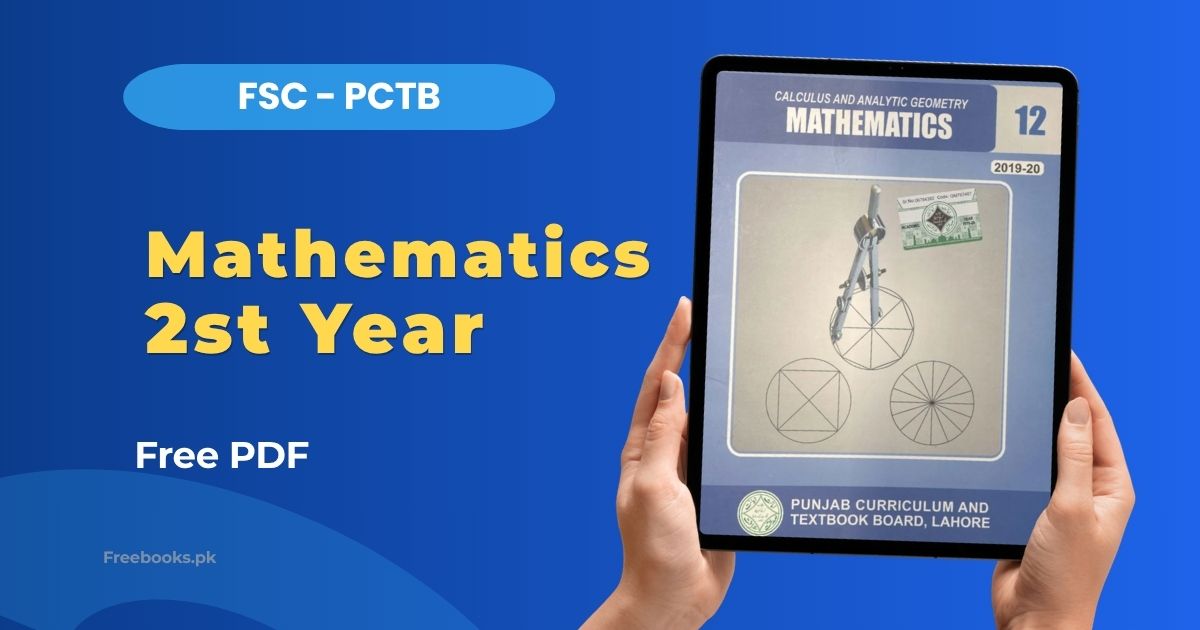
Mathematics 2nd Year book (Class 12) is published by the Punjab Curriculum and Textbook Board (PCTB), Lahore. Officially titled Calculus and Analytic Geometry, this book is the standard FSC Part 2 Mathematics textbook used across Punjab Board colleges. It covers seven units from Functions and Limits to Vectors.
For FSC Part 2 students, this book is the main resource for the board Mathematics paper. It builds directly on Class 11 concepts and goes deeper into calculus, analytic geometry, and linear programming. The PDF lets students revise key theorems, practice integration and differentiation problems, and prepare thoroughly before the final board exam.
Book Overview
| Class | 12 (FSC Part 2 / Second Year) |
| Subject | Mathematics (Calculus and Analytic Geometry) |
| Category | FSC |
| Board | Punjab Board (PCTB, Lahore) |
| Total Chapters | 7 |
| Format |
Chapter List
Unit 1 – Functions and Limits
Reviews algebraic, trigonometric and other function types before building the formal idea of a limit. Explains one-sided limits, limit theorems, and continuity, laying the groundwork for differentiation and physics applications such as instantaneous rates of change.
Important Questions:
- What is a function? Answer: A rule that assigns exactly one value of y in the range to each value of x in the domain.
- What does the limit of a function represent? Answer: The value that f(x) approaches as x gets closer to a particular point, without necessarily reaching it.
- When is a function continuous at a point? Answer: When the limit of the function at that point exists, is finite, and equals the function’s actual value there.
- Why are limits important before studying differentiation? Answer: Because the derivative itself is defined using the limit of the average rate of change as the interval approaches zero.
Unit 2 – Differentiation
Builds differentiation from first principles, then covers rules for algebraic, trigonometric, exponential and logarithmic functions, along with higher-order and implicit differentiation. Applications include maxima, minima, and related rates — directly useful for physics and engineering problems.
Important Questions:
- What is the derivative of a function? Answer: The limit of the average rate of change of the function as the change in the independent variable approaches zero.
- What is implicit differentiation used for? Answer: To differentiate equations where y is not directly expressed in terms of x.
- How are maxima and minima found using derivatives? Answer: By setting the first derivative equal to zero to find critical points, then using the second derivative to test whether each point is a maximum or minimum.
- What is a related rates problem? Answer: A problem where two or more quantities change with time and are connected by an equation, allowing one rate to be found from another.
Unit 3 – Integration
Introduces anti-derivatives, standard integration formulas, and techniques like substitution and integration by parts. Covers definite integrals and their use in finding the area under a curve — a concept widely applied in physics for work, distance, and other cumulative quantities.
Important Questions:
- What is integration? Answer: The reverse process of differentiation, used to find a function when its derivative is known.
- What is the difference between definite and indefinite integrals? Answer: An indefinite integral gives a general function plus a constant, while a definite integral gives a specific numerical value between two limits.
- What is the substitution method in integration? Answer: A technique that simplifies an integral by replacing part of the expression with a new variable to match a standard integration formula.
- How is a definite integral used to find area under a curve? Answer: By evaluating the integral of the function between the given x-limits, which gives the exact area bounded by the curve and the x-axis.
Unit 4 – Introduction to Analytic Geometry
Covers the straight line in Cartesian coordinates, including slope, different forms of the line equation, the distance formula, the angle between two lines, and the concept of a family of lines — skills used throughout physics and engineering diagrams.
Important Questions:
- What is the slope of a line? Answer: A measure of the steepness of a line, calculated as the change in y divided by the change in x between two points.
- What is the point-slope form of a line equation? Answer: y minus y1 equals m times (x minus x1), used to find the equation of a line when a point and the slope are known.
- How is the distance between two points calculated? Answer: Using the distance formula, the square root of the sum of the squares of the differences in their x and y coordinates.
- What is meant by the family of lines? Answer: A set of lines that share a common property, such as passing through a fixed point or having a fixed slope, represented by a single equation with a parameter.
Unit 5 – Linear Inequalities and Linear Programming
Explains how to graph systems of linear inequalities to find feasible regions, then applies the graphical method of linear programming to maximize or minimize a quantity — a technique used in resource allocation and optimization problems relevant to engineering and industry.
Important Questions:
- What is a linear inequality? Answer: A mathematical statement comparing two expressions using greater than, less than, or their “or equal to” forms, instead of an equals sign.
- What is a feasible region? Answer: The region on a graph that satisfies all the given constraints of a linear programming problem simultaneously.
- What is the objective function in linear programming? Answer: The function representing the quantity to be maximized or minimized, such as cost or profit.
- How is the optimal solution found in a linear programming problem? Answer: By evaluating the objective function at each corner point of the feasible region and selecting the point that gives the maximum or minimum value.
Unit 6 – Conic Section
Studies the circle, parabola, ellipse and hyperbola as sections of a cone, deriving their standard equations and key properties such as centre, vertex, foci and directrix. These curves describe orbital paths and reflector shapes used in physics and engineering.
Important Questions:
- What is a conic section? Answer: A curve obtained by cutting a right circular cone with a plane, producing shapes such as a circle, parabola, ellipse, or hyperbola.
- What is the standard equation of a circle with centre at the origin? Answer: x squared plus y squared equals r squared, where r is the radius.
- What defines a parabola? Answer: The set of all points equidistant from a fixed point called the focus and a fixed line called the directrix.
- How do an ellipse and a hyperbola differ? Answer: An ellipse is the set of points where the sum of distances from two foci is constant, while a hyperbola is the set of points where the difference of distances from two foci is constant.
Unit 7 – Vectors
Introduces vectors in 2D and 3D space, covering vector addition, scalar multiplication, the dot product, the cross product, and the scalar triple product. These operations are essential for describing force, velocity and other directional quantities in physics.
Important Questions:
- What is the difference between a scalar and a vector? Answer: A scalar has only magnitude, while a vector has both magnitude and direction.
- What does the dot product of two vectors represent? Answer: A scalar quantity equal to the product of the magnitudes of the two vectors and the cosine of the angle between them.
- What does the cross product of two vectors give? Answer: A new vector perpendicular to both original vectors, with magnitude equal to the product of their magnitudes and the sine of the angle between them.
- What is a unit vector? Answer: A vector with magnitude equal to one, used to indicate direction only.
Download Mathematics Class 12 Book PDF
Three editions are available below. Click the button for the edition you need — each opens in a new tab and is ready to read or save on any device.
Latest Edition (2020 onwards)
⬇ Download PDF (2020 Edition)E-Learn Punjab Edition
⬇ Download PDF (E-Learn Punjab)Old Edition
⬇ Download PDF (Old Edition)Who Should Read This
This book is for FSC Part 2 (Second Year) Pre-Engineering and Pre-Medical students preparing for the Punjab Board annual exam. It is also essential for ECAT preparation, as calculus, analytic geometry, vectors, and conic sections from this book are heavily tested. Students aiming for engineering and technology programmes will find this book especially important.
Applicable Boards
This textbook is published by PCTB and is used in Punjab Board colleges. Students from the Federal Board (FBISE) and AJK Board can also use it, as the FSC Part 2 Mathematics syllabus is largely the same. Students from Sindh and KPK boards will find most chapters relevant as well.
FAQs
Is this the Mathematics book for FSC Part 2 Punjab Board?
Yes. It is the official PCTB textbook titled Calculus and Analytic Geometry, used for FSC Part 2 (Class 12) in Punjab Board colleges.
How many chapters are in Mathematics Class 12?
There are 7 units: Functions and Limits, Differentiation, Integration, Analytic Geometry, Linear Programming, Conic Section, and Vectors.
Which edition should I download?
Download the 2020 edition if your college follows the latest PCTB curriculum. The chapter content is the same across all editions — only minor printing updates differ.
Is this book useful for ECAT preparation?
Yes. Calculus, conic sections, vectors, and linear programming from this book are directly tested in ECAT for engineering university admissions.
Can Federal Board students use this book?
Yes. The FSC Part 2 Mathematics syllabus is very similar for Punjab and Federal boards. Federal Board students can use this book for additional practice.
Is the PDF free to download?
Yes. All three editions of the Mathematics Class 12 book PDF are completely free to download and read on any device.
Related Books
- Mathematics 1st Year FSC Book
- Mathematics 2nd Year ICS Book
- Mathematics 1st Year ICS Book
- Mathematics 1st Year ICOM Book
- English 2nd Year FSC Book
- English Grammar & Composition 2nd Year FSC Book
Study Resources for Mathematics 2nd Year
Free exam-preparation resources for Mathematics 2nd Year from the Freebooks.pk Editorial Team — the free PDF textbook, chapter-wise notes (definitions, short & long questions and MCQs), the latest paper pairing scheme. Study online or download.
© Copyright Policy
Freebooks.pk is an educational resource for students in Pakistan. Textbooks and other books belong to their respective boards, authors and publishers, and all rights remain with them. If you are the copyright holder of any material on this page and want it changed or removed, please contact us or file a request under our DMCA policy. We review every request and remove reported content promptly.