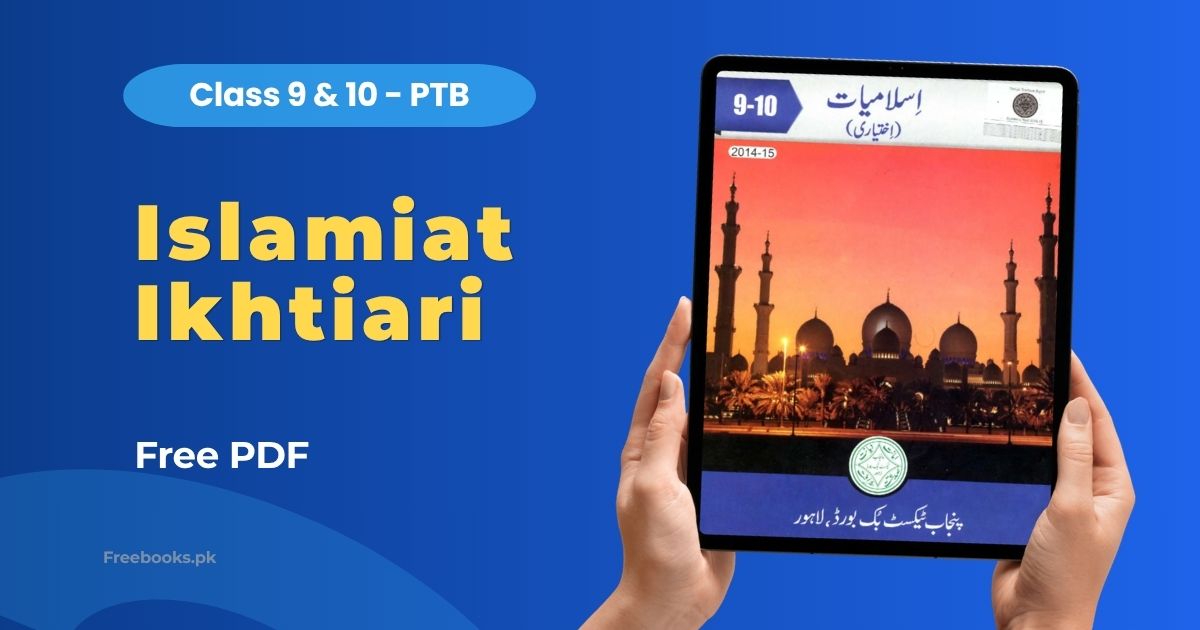
Islamiat Ikhtiari (Islamic Studies Elective) is an optional subject for Class 9 students in Punjab. This textbook is published by the Punjab Textbook Board (PTB), Lahore, and is part of the official syllabus for students who choose Islamiat as an elective subject. It is a combined Class 9 and 10 book, and this page covers the first three Babs: Al-Quran, Al-Ahadith An-Nabaviyah and Taleemat-e-Islam.
Class 9 students who have selected Islamiat Ikhtiari will find this portion essential for exam preparation. These three Babs cover Quranic verses with translation and tafsir, selected Ahadith of the Prophet (PBUH), and the core teachings of Islam such as Tauheed, Taharat, Adl and Jihad. Studying this book regularly will help you understand the subject deeply and prepare well for your annual board exams.
Book Overview
- Class: 9 (Combined Class 9-10 Book)
- Subject: Islamiat Ikhtiari (Islamic Studies Elective)
- Category: School Books
- Board: Punjab Board (Punjab Textbook Board, Lahore)
- Chapters on This Page: Baab 1-3 (Al-Quran, Al-Ahadith An-Nabaviyah, Taleemat-e-Islam)
- Full Book: 5 Babs (Baab 4-5, Seerat-e-Tayyaba and Arabic Grammar, are covered on the Class 10 page)
- Medium: Urdu
- Format: PDF
Chapter List
Bab 1 – Al-Quran
Bab 1 opens with the importance and status of the Holy Quran as Allah’s final revealed book and explains its five broad subjects: beliefs (Aqaid), worship (Ibadaat), day-to-day dealings (Muamalaat), morals (Akhlaqiyat) and the stories of earlier nations (Qasas). It then lists eight etiquettes of recitation, including physical purity, reciting Ta’awwuz and Tasmiyah, slow and correct pronunciation (Tarteel), and reciting a measured portion regularly. The rest of the chapter presents selected Quranic ayat with Urdu translation and detailed tafsir, grouped around Tauheed and Allah’s attributes, the dua of Hazrat Ibrahim and Hazrat Ismail for a final messenger, the rights of parents, and social commands such as verifying news before acting and avoiding mockery, suspicion and backbiting. It closes with ayat prohibiting extravagance, killing children, adultery, murder and cheating in trade, and the Quran’s declaration that all human beings are equal.
Important Questions:
- What are the five main subjects of the Quran? Aqaid (beliefs), Ibadaat (worship), Muamalaat (dealings), Akhlaqiyat (morals) and Qasas (stories of nations).
- Name any two etiquettes of reciting the Quran. Being in a state of purity (Wudu) and reciting Ta’awwuz and Tasmiyah before starting.
- What did Hazrat Ibrahim and Hazrat Ismail pray for while raising the walls of the Kaaba? That Allah send a messenger from their descendants who would recite His verses and teach the Book and wisdom.
- According to the Quran, what makes people equal in the sight of Allah? Their taqwa (God-consciousness), not their race, colour or lineage.
Bab 2 – Al-Ahadith An-Nabaviyah
Bab 2 explains why Hadith is essential alongside the Quran, since the Quran commands prayer, zakat, hajj and fasting in principle while the Prophet’s (PBUH) sayings and practice supply their exact method and detail. It then presents selected Ahadith with Arabic text, translation and explanation. These cover the fear of Allah as the root of wisdom, prayer as the first deed to be judged on the Day of Judgement, and fasting as an act reserved purely for Allah’s reward. Several Ahadith describe good character: never considering any good deed too small, greeting others first, showing mercy to the young and respect to elders, and being grateful to people as a form of gratitude to Allah. Others warn against the three signs of a hypocrite, arrogance, jealousy and tribalism in support of injustice. The chapter ends with Ahadith on Muslim brotherhood, comparing believers to one body that feels the pain of every limb.
Important Questions:
- Why is Hadith necessary in addition to the Quran? Because the Quran gives commands like prayer and zakat in principle, while Hadith explains their exact method, timing and detail.
- What are the three signs of a hypocrite mentioned in Hadith? Lying when he speaks, breaking his promise, and betraying trust.
- According to Hadith, who is the most complete believer in faith? The one with the best character (Akhlaq).
- How does Hadith describe the relationship between believers? Like one body — when one part suffers, the whole body feels restless and feverish.
Bab 3 – Taleemat-e-Islam
Bab 3 covers eight core teachings of Islam. It begins with Tauheed, the belief that Allah alone is worthy of worship, and obedience to the Prophet (PBUH) as inseparable from obedience to Allah. It then explains Taharat (purity) in four forms: purity of morals, body, dress and home, followed by Islam’s strong encouragement of seeking knowledge and establishing justice (Adl) even with enemies. A detailed section on Jihad explains its meaning, importance and its two kinds, Jihad bin-Nafs (struggle against one’s own desires) and Jihad bil-Maal (spending wealth in Allah’s way), along with the conduct required of Muslims before and during war. The chapter also lists lawful ways of earning a livelihood such as farming, trade, industry and employment, and unlawful ones such as interest (Riba), gambling, bribery, begging, hoarding and black-marketing. It closes with Iffat-o-Haya (chastity and modesty), describing its three levels and its role in shaping good character.
Important Questions:
- What are the two kinds of Jihad explained in this chapter? Jihad bin-Nafs (struggle against one’s own desires) and Jihad bil-Maal (spending wealth in Allah’s way).
- Name the four types of Taharat (purity) mentioned in the chapter. Purity of morals, body, dress and home.
- Give two examples of unlawful ways of earning mentioned in the chapter. Riba (interest) and gambling; bribery, begging and hoarding are also listed.
- What are the three levels of Haya (modesty) described in the chapter? Obeying Allah’s commands and avoiding what He has forbidden, not causing harm to others, and feeling shy of oneself in privacy while remembering that Allah is always watching.
Download Islamiat Ikhtiari Class 9 PDF
Click the button below to download the complete Islamiat Ikhtiari Class 9-10 textbook in PDF format, which includes all 5 Babs. The file is free and available directly from Google Drive.
Who Should Read This Book
- Class 9 students of Punjab Board who have opted for Islamiat Ikhtiari
- Students preparing for annual board exams in Islamic Studies elective
- Students of other provincial boards with a similar Islamiat Ikhtiari syllabus
- Anyone wanting to learn more about Quran, Hadith, and Islamic teachings
Applicable Boards
- Punjab Board (PTB) – Primary board for this edition
- Federal Board (FBISE) – Similar Islamiat Ikhtiari syllabus
- Other provincial boards with comparable elective Islamic Studies curriculum
FAQs
Is this Islamiat Ikhtiari book for Class 9 Punjab Board?
Yes, this is the official Islamiat Ikhtiari textbook published by Punjab Textbook Board (PTB) for students who opted for Islamic Studies as an elective subject in Class 9.
Can Class 10 students use this same book?
Yes, this is a combined Class 9-10 book. Baab 4 (Seerat-e-Tayyaba) and Baab 5 (Arabic Grammar) are covered in detail on our separate Class 10 page, with the same PDF download link.
Is this the latest edition?
This is the standard Punjab Textbook Board edition approved for use in Punjab schools for the Islamiat Ikhtiari elective subject.
Does it include solved exercises?
The PDF contains the complete textbook as published by PTB, including all topics and content. Solved guide versions may be available separately.
What is the difference between Islamiat Lazmi and Islamiat Ikhtiari?
Islamiat Lazmi is compulsory for all students, while Islamiat Ikhtiari is an elective subject chosen by students with additional in-depth Islamic studies content.
Related Books
- Islamiat (Ikhtiari) Class 10
- English Grammar & Composition Class 9
- Mathematics Class 9 (English Medium)
- Mathematics Class 9 (Urdu Medium)
- Biology Class 9 (English Medium)
- Biology Class 9 (Urdu Medium)
Study Resources for Islamiat Class 9
Free exam-preparation resources for Islamiat Class 9 from the Freebooks.pk Editorial Team — the latest paper pairing scheme. Study online or download.
© Copyright Policy
Freebooks.pk is an educational resource for students in Pakistan. Textbooks and other books belong to their respective boards, authors and publishers, and all rights remain with them. If you are the copyright holder of any material on this page and want it changed or removed, please contact us or file a request under our DMCA policy. We review every request and remove reported content promptly.
Iktiari