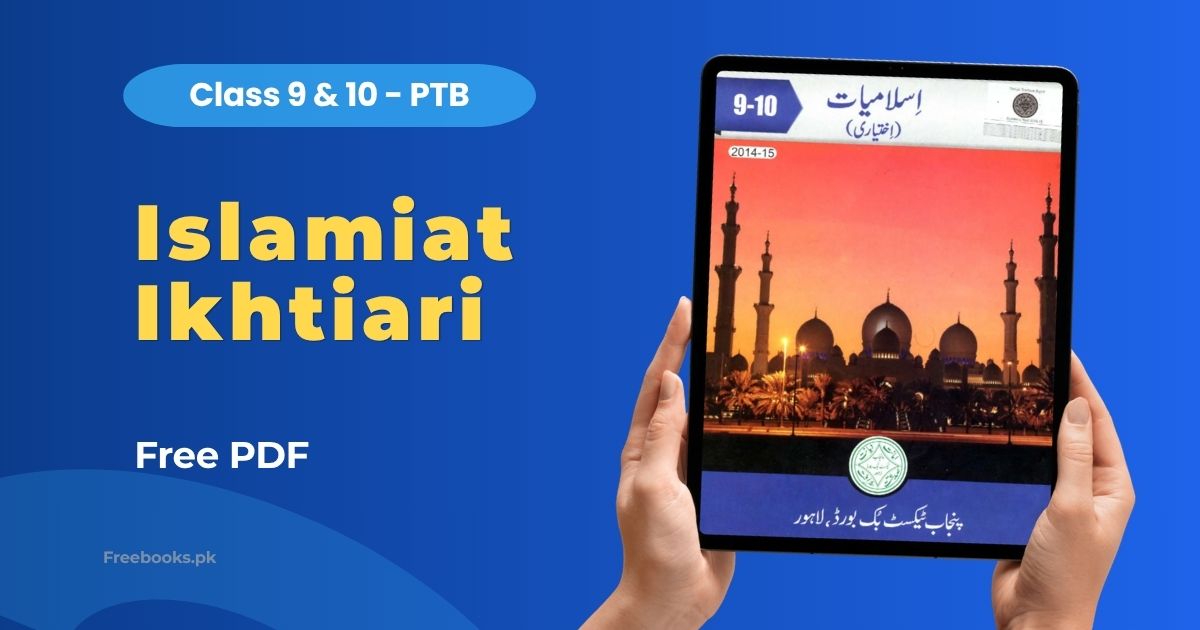
Islamiat Ikhtiari (Islamic Studies Elective) is an optional subject for Class 10 students in Punjab. This textbook is published by the Punjab Textbook Board (PTB), Lahore, and is part of the official syllabus for students who choose Islamiat as an elective subject. It is a combined Class 9 and 10 book, and this page covers the final two Babs: Seerat-e-Tayyaba and Arabic Zaban ki Grammar.
Class 10 students who have selected Islamiat Ikhtiari must study this portion thoroughly for their final board exams. These two Babs cover the life and character of the Holy Prophet (PBUH), including the Makki and Madani periods and the finality of Prophethood, along with the basics of Arabic grammar needed to understand Quranic Arabic. Strong revision of this book before exams will help you achieve better results and a deeper understanding of Islamic studies.
Book Overview
- Class: 10 (Combined Class 9-10 Book)
- Subject: Islamiat Ikhtiari (Islamic Studies Elective)
- Category: School Books
- Board: Punjab Board (Punjab Textbook Board, Lahore)
- Chapters on This Page: Baab 4-5 (Seerat-e-Tayyaba, Arabic Zaban ki Grammar)
- Full Book: 5 Babs (Baab 1-3, Al-Quran, Al-Ahadith and Taleemat-e-Islam, are covered on the Class 9 page)
- Medium: Urdu
- Format: PDF
Chapter List
Bab 4 – Seerat-e-Tayyaba
Bab 4 opens with the preaching struggles of earlier Aulul Azm prophets: Hazrat Ibrahim’s confrontation with Namrud and the idol-worshippers, Hazrat Musa’s escape from Pharaoh across the parted sea, and Hazrat Isa’s mission to Bani Israel with his Hawariyeen (disciples), showing the sacrifices every messenger made for Allah’s message. It then traces the Prophet’s (PBUH) own mission in two stages. The Makki period covers the mockery, boycott and persecution faced from the Quraysh, offers of wealth and kingship in exchange for abandoning his message, and the journey to Taif. The Madani period explains the building of Masjid-e-Nabawi, the bond of brotherhood (Muakhaat) between Muhajireen and Ansar, the Mithaq-e-Madina, the battles of Uhud and the Trench, the treaty of Hudaybiyah, and the Khutbah Hajjatul Wida. A separate section explains Khatm-e-Nabuwat, the finality of Prophethood, supported by Quranic verses and Hadith. The chapter closes with the Prophet’s (PBUH) pure character: his simplicity, doing his own housework, kindness to children, servants and animals, fair treatment of enemies, and unmatched steadfastness.
Important Questions:
- What does the Mithaq-e-Madina represent in Islamic history? It is considered the world’s first written constitution, agreed between the Muslims and Jews of Madina.
- Name the battle where Muslims dug a trench around Madina for defence. Ghazwa Khandaq (the Battle of the Trench), also called Ghazwa Ahzab.
- What did the Prophet (PBUH) say when Abu Talib asked him to stop preaching? That even if the Quraysh placed the sun in his right hand and the moon in his left, he would not give up his mission.
- Give one example of the Prophet’s (PBUH) kindness described in this chapter. He did his own household chores, mended his own clothes, and treated servants, children and animals with gentleness and mercy.
Bab 5 – Arabic Zaban ki Grammar
Bab 5 introduces the basic building blocks of Arabic grammar needed to understand the Quran and Hadith. It begins with Kalima and its three types, Ism (noun), Fi’l (verb) and Harf (particle), followed by Ism Nakirah (indefinite) and Ism Ma’rifah (definite), and Muzakkar (masculine) and Muannath (feminine) nouns with their signs. Students learn the three numbers of Arabic nouns: Mufrad (singular), Tasniya (dual) and Jam’ (plural), including Jam’ Mukassar (broken plural) and Jam’ Saalim (regular masculine and feminine plurals). The chapter explains Zameer (pronouns), both Muttasil (attached) and Munfasil (separate), and the three tenses of the Arabic verb, Fi’l Maazi (past), Fi’l Mudari (present/future) and Fi’l Amr (imperative), with their conjugation patterns. It also covers Murakkab (phrases and sentences), including Jumla Ismiya and Jumla Fi’liya, and common particles such as Waw, Ba, Min, Ila, Fi and Ala, along with question words like Hal, Man and Ma.
Important Questions:
- What are the three types of Kalima in Arabic grammar? Ism (noun), Fi’l (verb) and Harf (particle).
- What is the difference between Ism Nakirah and Ism Ma’rifah? Nakirah is an indefinite noun (any one of a kind), while Ma’rifah is a definite noun referring to something specific.
- Name the three numbers used for Arabic nouns. Mufrad (singular), Tasniya (dual) and Jam’ (plural).
- What is the difference between Jumla Ismiya and Jumla Fi’liya? A Jumla Ismiya begins with a noun, while a Jumla Fi’liya begins with a verb.
Download Islamiat Ikhtiari Class 10 PDF
Click the button below to download the complete Islamiat Ikhtiari Class 9-10 textbook in PDF format, which includes all 5 Babs. The file is free and available directly from Google Drive.
Who Should Read This Book
- Class 10 students of Punjab Board who have opted for Islamiat Ikhtiari
- Students preparing for final annual board exams in Islamic Studies elective
- Students of other provincial boards with a similar Islamiat Ikhtiari syllabus
- Anyone wanting to learn more about the Seerat of the Prophet (PBUH) and Arabic grammar
Applicable Boards
- Punjab Board (PTB) – Primary board for this edition
- Federal Board (FBISE) – Similar Islamiat Ikhtiari syllabus
- Other provincial boards with comparable elective Islamic Studies curriculum
FAQs
Is this Islamiat Ikhtiari book for Class 10 Punjab Board?
Yes, this is the official Islamiat Ikhtiari textbook published by Punjab Textbook Board (PTB) for students who opted for Islamic Studies as an elective subject in Class 10.
Can Class 9 students use this same book?
Yes, this is a combined Class 9-10 book. Baab 1 (Al-Quran), Baab 2 (Al-Ahadith) and Baab 3 (Taleemat-e-Islam) are covered in detail on our separate Class 9 page, with the same PDF download link.
Is this the latest edition?
This is the standard Punjab Textbook Board edition approved for use in Punjab schools for the Islamiat Ikhtiari elective subject.
Does it include solved exercises?
The PDF contains the complete textbook as published by PTB, including all topics and content. Solved guide versions may be available separately.
What is the difference between Islamiat Lazmi and Islamiat Ikhtiari?
Islamiat Lazmi is compulsory for all students, while Islamiat Ikhtiari is an elective subject chosen by students with additional in-depth Islamic studies content.
Related Books
- Islamiat (Ikhtiari) Class 9
- English Grammar & Composition Class 10
- Chemistry Class 10 (Urdu Medium)
- Biology Class 10 (English Medium)
- Biology Class 10 (Urdu Medium)
- Chemistry Class 10 (English Medium)
Study Resources for Islamiat Class 10
Free exam-preparation resources for Islamiat Class 10 from the Freebooks.pk Editorial Team — the latest paper pairing scheme. Study online or download.
© Copyright Policy
Freebooks.pk is an educational resource for students in Pakistan. Textbooks and other books belong to their respective boards, authors and publishers, and all rights remain with them. If you are the copyright holder of any material on this page and want it changed or removed, please contact us or file a request under our DMCA policy. We review every request and remove reported content promptly.