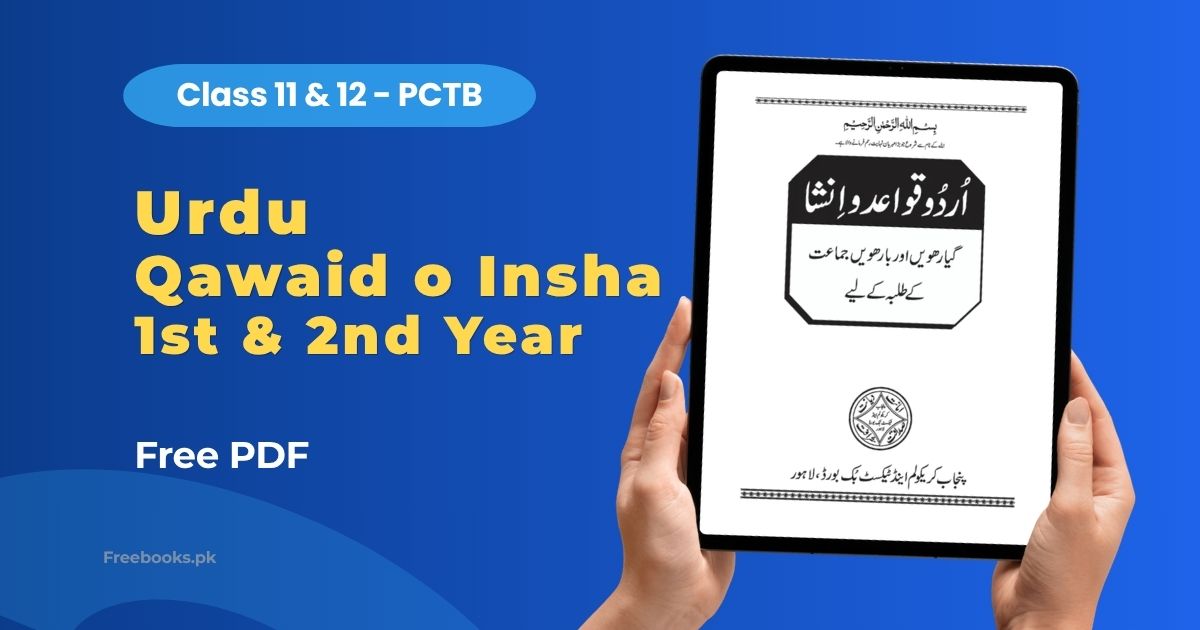
Urdu Qawaid o Insha for Class 11 is published by the Punjab Curriculum and Textbook Board (PCTB), Lahore. This page covers the FA Part 1 grammar and composition reference — the complete Qawaid (grammar) portion of the two-year syllabus, along with the Insha Pardazi topics the board specifically assigns to Part 1 students.
For FA Part 1 students, this book carries real weight in the Urdu paper’s grammar and writing section. The Qawaid portion moves from basic letter classification through gender, plural formation, punctuation, idioms, and prosody, while the Insha Pardazi section for Part 1 focuses on précis writing, applications, receipts, dialogue, and reports. Working through each topic here makes revision faster and writing answers in the exam easier.
Book Overview
| Class | 11 (FA Part 1) |
| Subject | Urdu Grammar and Composition (Qawaid o Insha) |
| Category | FA |
| Board | Punjab Board (PCTB, Lahore) |
| Total Topics | 29 (18 Qawaid + 11 Insha Pardazi, shared across Part 1 & Part 2) |
| This Page’s Focus | Full Qawaid (18 topics) + Part 1 Insha Pardazi (5 topics) |
| Format |
Qawaid (Grammar) Topics
Grammar is common to both years of the FA syllabus. All 18 topics are covered here in full, with a short summary and important questions for each.
1. Ilm-e-Qawaid: Taaruf; Urdu Huroof-e-Tahajji (Introduction to Grammar; Urdu Alphabet)
Explains that grammar (qawaid) rests on two foundations, Sarf (morphology) and Nahw (syntax). Sarf deals with individual words — their classification into ism (noun), fail (verb), and harf (particle) — and how these words change form. Nahw deals with the sentence and how combined words and phrases relate to each other. This topic also introduces the Urdu alphabet as the base unit for reading and writing.
Important Questions:
- What are the two main branches of Urdu grammar? Sarf (morphology, dealing with words) and Nahw (syntax, dealing with sentences).
- What does Ilm-e-Sarf study? Kalma (words) and how their singular, plural, gender, and form change according to rules.
- What does Ilm-e-Nahw study? Jumla (the sentence) and how combined words and phrases relate to build meaning.
- Why is knowledge of grammar necessary for language learning? Because grammar rules govern how words and sentences are correctly formed and understood.
2. Shamsi aur Qamri Huroof; Rasm-ul-Khat (Solar & Lunar Letters; Orthography)
Explains Arabic letters that behave differently after “al”: Huroof-e-Shamsi (solar letters like ت،ث،د،ذ،ر،ز،س،ش،ص،ض،ط،ظ،ل،ن) where “al” is not pronounced and merges into the next letter with tashdeed, and Huroof-e-Qamri (lunar letters like ا،ب،ج،ح،خ،ع،غ،ف،ق،ل،م،و،ی) where “al” is pronounced clearly. It also defines Rasm-ul-Khat as the written symbols used to represent spoken sounds.
Important Questions:
- What is the difference between Shamsi and Qamri letters? Shamsi letters absorb the “al” sound before them (not pronounced), while Qamri letters keep “al” pronounced clearly.
- Give an example each of a Shamsi and Qamri word. Al-Shams (شمس) is Shamsi; Al-Qamar (قمر) is Qamri.
- What does Rasm-ul-Khat mean? The written symbols (script) used to express spoken language in permanent form.
- How many letters fall under Huroof-e-Shamsi in Arabic? Fourteen letters, including ت، ث، د، ذ، ر، ز، س، ش، ص، ض، ط، ظ، ل، ن۔
3. Sarf-o-Nahw (Morphology and Syntax)
Defines Sarf as the study of individual words (kalma) — their singular/plural, gender, and grammatical form — while Nahw studies the jumla (sentence), focusing on how combined words and phrases form correct, meaningful sentences. It also introduces Tazkeer-o-Taneeth (gender), dividing it into real (haqeeqi) and non-real (ghair haqeeqi) categories.
Important Questions:
- What is the subject matter of Ilm-e-Sarf? The kalma or word, and how its form changes according to grammatical rules.
- What is the subject matter of Ilm-e-Nahw? The jumla or sentence, and the relationships between its combined words.
- What are the two types of Tazkeer-o-Taneeth (gender)? Haqeeqi (real, for living beings) and Ghair Haqeeqi (non-real, for inanimate things).
- Why is gender important in Urdu grammar? Because verbs and adjectives must agree with the gender of the noun they relate to.
4. Tazkeer-o-Taneeth: Haqeeqi wa Ghair Haqeeqi (Gender: Real and Non-Real)
Lists common feminine words (like chaadar, tarazu, plate, kitaab) and lays out rules for identifying gender, such as: names of Allah and prophets are masculine, all rivers except Ganga and Jamna are masculine, all trees and mountains are masculine, all months are masculine, and stars/planets are masculine except Zuhra, Mushtari, Zohal, and Barham. It also introduces how to form plurals from singular nouns.
Important Questions:
- Give one rule for identifying masculine gender in Urdu. All months of the year are masculine.
- Which planets are treated as feminine despite the general rule? Zuhra, Mushtari, Zohal, and Barham.
- How do you form the plural of a masculine word ending in alif or ہ؟ By changing the alif or ہ to ے (ye-e-majhool), like ladka to ladke.
- How is the plural of a feminine word ending in ی formed? By adding اں, like larki to larkiyan.
5. Wahid-o-Jama (Singular and Plural)
Explains that Wahid means “one” and Jama means “more than one,” and details multiple methods of forming plurals in Urdu — changing alif/ہ to ے for masculine words, adding اں for feminine words ending in ی, and adjusting nasal sounds elsewhere. It also covers Persian-style Urdu plurals (adding اں for animate nouns, بہ for inanimate nouns) and Arabic-style broken plurals like دین to ادیان.
Important Questions:
- What is the meaning of Wahid and Jama? Wahid means singular (one), Jama means plural (more than one).
- How is the plural of “larka” formed? By changing the alif to ے, giving larke.
- How does Urdu form plurals borrowed from Persian? By adding اں to animate nouns (mard to mardaan) or بہ to inanimate nouns (sang to sangbaan).
- Give an example of an Arabic-style broken plural used in Urdu. Deen becomes Adyaan; Da’wa becomes Ada’iya.
6. Sabqay aur Lahiqay (Prefixes and Suffixes)
Defines Sabqa (prefix) as a meaningful or meaningless word or letter placed before a root word to create new meaning (like adab to be-adab), and Lahiqa (suffix) as one placed after a root word (like qalam to qalamdaan). It lists common Urdu prefixes (بے، پُر، بلا، خوش، لا، نا، ہم) and suffixes (مند، ناک، ور، آلود) with examples.
Important Questions:
- What is the difference between a Sabqa and a Lahiqa? A Sabqa (prefix) is added before a root word; a Lahiqa (suffix) is added after a root word.
- Give an example of a word formed using the prefix “بے”. Be-adab (بے + ادب), meaning disrespectful.
- Give an example of a word formed using the suffix “ناک”. Dardnaak (درد + ناک), meaning painful.
- How does the prefix “خوش” change the meaning of a word? It adds a positive quality, like khushbu (fragrance) or khush-khulq (good-natured).
7. Rumooz-e-Auqaf (Punctuation)
Defines Rumooz-e-Auqaf as the symbols that separate one sentence or phrase from another so a reader knows how and where to pause. It lists the main punctuation marks used in Urdu — Sakta (comma), Waqfa (semicolon), Rabita (colon), Tafseeliya (colon-dash for lists), Khatma (full stop), question mark, and exclamation mark — explaining where and how much each should pause the reader.
Important Questions:
- What is the purpose of Rumooz-e-Auqaf in writing? To show the reader how to pause and read sentences correctly, making the meaning clear.
- What is Sakta, and where is it used? The comma (،), used for the shortest pause, e.g., between items in a list.
- When is Rabita (colon) used? Before quoting someone’s words, a saying, or introducing a related clause.
- What happens to writing without punctuation marks? It becomes hard to read correctly and the meaning can become confused.
8. Huroof; Murakkab Naqis Ka Taaruf (Particles; Introduction to Compounds)
Defines Huroof (particles) as words with no independent meaning of their own — they only gain meaning by connecting other words, like “par,” “ka,” and “aur.” It lists categories of Huroof by function: Huroof-e-Jaar (connecting nouns and verbs), Huroof-e-Izafat (showing possession: کا، کے، کی), Huroof-e-Atf (joining: و، اور), Huroof-e-Istifham (questioning), and Huroof-e-Nida (calling out).
Important Questions:
- What is a Harf (particle) in Urdu grammar? A word with no independent meaning that connects other words to create meaning together.
- Give an example of Huroof-e-Izafat. کا، کے، کی — used to show possession or relationship.
- What are Huroof-e-Istifham used for? Asking questions, like کیا، کیوں، کہاں، کب۔
- What are Huroof-e-Nida used for? Calling or addressing someone, like اے، یا۔
9. Murakkab Naqis (Incomplete Compounds)
Explains Murakkab Naqis as a combination of words that does not give the listener a complete meaning on its own. It details four main types: Murakkab Izafi (joined by کا، کے، کی), Murakkab Tosifi (adjective + noun, like nek aadmi), Murakkab Atfi (joined by و or aur, like arz-o-sama), and Murakkab Adadi (number + counted noun, like gyarah ghantay). It also introduces Imdaadi Afaal (auxiliary verbs).
Important Questions:
- What is Murakkab Naqis? A combination of words that does not convey a complete meaning by itself.
- Give an example of Murakkab Izafi. “Ahmad ke abba jaan” — joined using the possessive particle کے۔
- What is Murakkab Tosifi? A compound formed of an adjective and a noun, like “nek aadmi” (good man).
- What is an Imdaadi Fail (auxiliary verb)? A helping verb added after the main verb to add force, nuance, or refinement to its meaning.
10. Imdaadi Afaal (Auxiliary Verbs)
Explains that auxiliary verbs (like dena, lena, aana, jaana, dalna, parna, rehna, hona, baithna, uthna, sakna, paana, karna, chahna, rakhna) are added after a main verb to strengthen or refine its meaning. It provides worked example sentences for each auxiliary verb showing how the same base verb changes tone and shade of meaning depending on which helper verb follows it.
Important Questions:
- What is the function of an auxiliary verb (Imdaadi Fail)? It adds strength, nuance, or refinement to the meaning of the main verb it follows.
- Does every basic verb work as an auxiliary verb? No — not all basic verbs are used as auxiliary verbs, and not all auxiliary verbs are basic verbs.
- Give an example sentence using “rakhna” as an auxiliary verb. “Maine usay samjha rakha hai” (I have already made him understand).
- Where does the auxiliary verb usually appear relative to the main verb? Usually right after the main verb, though occasionally it can come before it in poetic usage.
11. Mutabiqat aur Mutabiqat kay Usool (Agreement and Its Rules)
Defines Mutabiqat as the grammatical agreement between a verb and its subject/object, an adjective and its noun, and a possessive particle and what it possesses. It lays out detailed rules — a repeated subject takes a repeated verb, a feminine subject takes a feminine verb, a plural subject takes a plural verb, and multiple subjects of different genders take a verb matching the final subject — each explained with example sentences.
Important Questions:
- What does Mutabiqat mean in Urdu grammar? Agreement — matching the verb, adjective, or possessive particle correctly with the noun it relates to.
- If a sentence has a plural subject, what form should the verb take? The verb must also be plural, e.g., “ladke kitab parhte hain.”
- What happens when two nouns of different genders act as subject without a connecting harf? The verb takes the plural form, e.g., “maa baap hamesha bachon par shafqat karte hain.”
- Why do names of newspapers and books always take a singular verb? Because titles are treated as a single named entity, so the verb stays singular, e.g., “Hikayat-e-Sa’adi parhi.”
12. Ghalat Jumlon ki Durusti (Correction of Incorrect Sentences)
Lists common Urdu writing mistakes and their corrections, covering rules like: never use two synonymous words together in one sentence (avoid “aab-e-zamzam ka pani,” just say “aab-e-zamzam”), follow correct imla (spelling) so words are written as pronounced, and never mismatch nasal sounds in feminine verb forms. It also explains correct usage of muhawaras, izafat, and words like “mubada” that should never be paired with “nahi.”
Important Questions:
- Why is “aab-e-zamzam ka pani” considered incorrect? Because it repeats the meaning of “water” twice — “aab” already means water, so adding “pani” is redundant.
- What is the correct rule for using “mubada” in a sentence? “Mubada” should never be paired with “nahi,” since it already implies “so that not.”
- What word must always follow “chunkeh” in a correct Urdu sentence? “Is liye” — e.g., “chunkeh woh bemaar hai, is liye aaj na-hazir hai.”
- Why should izafat (زیر) and harf-e-atf (و) not be used with Urdu or Hindi words? Because these are reserved for Persian and Arabic word combinations only.
13. Rozmarra aur Muhawara (Idioms and Colloquial Expressions)
Distinguishes Rozmarra (everyday native speech patterns used close to their literal meaning) from Muhawara (idioms used in figurative, not literal, sense), noting that every muhawara is a rozmarra but not every rozmarra is a muhawara. It provides an alphabetical list of common Urdu idioms with meanings and example sentences, such as “aankh ka tara” (a beloved person) and “aasman sar par uthana” (to make a lot of noise).
Important Questions:
- What is the difference between Rozmarra and Muhawara? Rozmarra is used close to its literal meaning, while Muhawara is used in a figurative, non-literal sense.
- Can the words of a muhawara be changed or rearranged? No, the exact wording of a muhawara must be preserved to keep its idiomatic meaning.
- What does the muhawara “aankh ka tara” mean? A beloved or most cherished person, as in “bachay hamesha maa ki aankh ka tara hotay hain.”
- What does “aasman sar par uthana” mean? To make a great deal of noise or commotion.
14. Zarb-ul-Amsaal (Proverbs)
Defines Zarb-ul-Amsaal (proverbs/kahawat) as short traditional sayings that capture a truth, habit, or principle about everyday life, adding effectiveness and beauty to writing. It lists many well-known Urdu proverbs with their meanings and contexts, such as “aap bhalai ki bajaye” (blaming others for your own fault) and “akela chana kya bhaar phorega” (one person alone cannot achieve much).
Important Questions:
- What is the meaning of Zarb-ul-Amsaal? Proverbs or sayings (kahawat) that express a common truth or principle about life.
- What does “akela chana kya bhaar phorega” mean? A single person alone cannot achieve a big task — cooperation is needed.
- What does “aam kay aam gutliyon kay daam” mean? Getting double benefit from something that is already beneficial in one way.
- Why are proverbs valuable in Urdu writing? They add persuasive force, cultural depth, and beauty to written and spoken expression.
15. Ilm-e-Bayan (The Science of Rhetoric)
Introduces Ilm-e-Bayan as the study of the qualities of eloquent writing and speech, dividing it into four types: Tashbih (simile, comparing one thing to another with a connecting word like “ki tarah”), Isti’ara (metaphor, using a word figuratively without stating the compared thing directly), Majaz-e-Mursal, and Kinaya (indirect expression). It explains Tashbih’s four parts: mushabbah, mushabbah bihi, wajah shibah, and harf-e-tashbih.
Important Questions:
- What are the four types of Ilm-e-Bayan? Tashbih (simile), Isti’ara (metaphor), Majaz-e-Mursal, and Kinaya.
- What are the four parts (arkaan) of a Tashbih? Mushabbah, Mushabbah Bihi, Wajah Shibah, and Harf-e-Tashbih.
- Give an example of Tashbih. “Yeh kaghaz doodh ki tarah safed hai” — comparing paper’s whiteness to milk.
- What makes Isti’ara different from Tashbih? In Isti’ara, the thing being compared (mushabbah) is not directly mentioned — only the thing it’s compared to is used, in its figurative sense.
16. Ilm-e-Badi (The Science of Literary Embellishment)
Introduces Ilm-e-Badi as the study of techniques that beautify poetic and prose expression, divided into Sanaye-e-Lafzi (word-based devices) and Sanaye-e-Manvi (meaning-based devices). It explains several devices with examples, including Sanat-e-Tazad (opposite words together, like hansna and rona), Sanat-e-Mubaligha (exaggeration), Sanat-e-Talmeeh (alluding to a famous story, like Namrud’s fire), and Sanat-e-Takrar (deliberate word repetition).
Important Questions:
- What is the purpose of Ilm-e-Badi in literature? To study and apply techniques that add beauty and refinement to poetic and prose expression.
- What is Sanat-e-Tazad? A literary device that pairs opposite words together in the same line, like “hansna aur rona.”
- What is Sanat-e-Talmeeh? Alluding to a well-known story, event, or personality within a verse, like referencing Namrud’s fire in Iqbal’s poetry.
- What is Sanat-e-Takrar? The deliberate repetition of a word within a verse to create a rhythmic or emotional effect.
17. Ilm-e-Arooz (Prosody)
Introduces Ilm-e-Arooz as the study of poetic meter (wazn), explaining how syllables are measured using units called Sabab, Watad, and Fasila based on combinations of moving (mutaharrik) and still (saakin) letters, which combine to form arkaan (metrical feet) and eventually a complete bahr (metrical pattern). It credits Khalil bin Ahmad Basri as the founder of this science.
Important Questions:
- What does Ilm-e-Arooz study? The meter (wazn) of poetry — the patterns of moving and still letters that determine whether a verse is metrically correct.
- Who is credited as the founder of Ilm-e-Arooz? Khalil bin Ahmad Basri.
- What is a Sabab in Urdu prosody? A two-letter unit of meter, either Sabab-e-Khafeef (moving then still) or Sabab-e-Saqeel (both moving).
- What is a Bahr in poetry? A specific fixed metrical pattern that poets use for composing verses.
18. Chand Sheri Istalahat; Asnaf-e-Nazm-o-Nasr (Poetic Terminology; Genres of Poetry and Prose)
Defines key poetic terms — Misra (a single line/half of a couplet), She’r (a couplet expressing one idea), Qafia (rhyming words at the end of each verse), Radeef (the repeated word following the qafia), and Matla (the opening couplet of a ghazal where both lines rhyme). It also introduces genres of Nazm (poetry) like Hamd (praise of Allah), Naat (praise of the Prophet ﷺ), and Qasida (a formal poem of praise in four parts).
Important Questions:
- What is a Qafia in Urdu poetry? The rhyming word or sound that appears at the end of each verse in a ghazal or poem.
- What is the difference between Qafia and Radeef? Qafia is the rhyming word itself; Radeef is the repeated word or phrase that comes after the qafia in every verse.
- What is a Matla? The opening couplet of a ghazal, in which both lines (misras) rhyme with each other.
- What are the four parts of a Qasida? Tashbib (introduction), Gareez (transition), Madah (praise of the subject), and Maqta (closing verse).
Insha Pardazi (Composition) Topics — Part 1
These are the composition forms the Punjab Board assigns specifically to FA Part 1 (Class 11) students.
1. Talkhees Nigari (Précis Writing)
Defines Talkhees as writing the essence of a passage in the fewest possible words while keeping its core meaning intact. It gives clear guidelines: keep the précis to about one-third of the original passage’s length, always include the main points, write it as a single coherent paragraph, convert any dialogue into narrative form, and suggest a suitable title for the passage.
Important Questions:
- What is the recommended length for a précis compared to the original passage? About one-third of the original passage’s length.
- Should a précis be written in dialogue form? No, any dialogue in the original should be converted into narrative (bayan) form.
- What should a précis writer avoid? Unnecessary phrases, synonyms, and unnecessary similes/comparisons (tashbihaat).
- What additional element should accompany a good précis? A suitable, well-chosen title (unwan) for the passage.
2. Darkhwast Naveesi (Application Writing)
Defines Darkhwast as a formal written request submitted by an individual or group to an officer or authority to resolve a need, problem, or complaint. It outlines the five essential parts of an application — opening/address, subject line, salutation, main body, and closing with date — along with formatting instructions for addressing officials correctly and writing the request clearly.
Important Questions:
- What are the five main parts of a Darkhwast? Opening/address (sarnama), subject (mazmoon), salutation (aadaab), main body (nafs-e-mazmoon), and closing with date.
- What word is typically used to begin the main request in an application? “Guzarish hai” or “Iltimas hai.”
- How should the officer’s designation be addressed in the opening line? With respect, writing their post/title, institution name, and address, e.g., “Janab Principal, Government College.”
- What should the closing of a Darkhwast include? A polite closing phrase (like “shukar-guzar hounga”), followed by the applicant’s designation, name, and date.
3. Raseedat (Receipts)
Explains that a Raseed is a formal legal document confirming the exchange of money or goods between two parties, signed by the receiver and witnesses. It lists specific terms used in receipt-writing (mablagh for amount, marbba for land area, raas for large animals, shakh for small animals) and provides step-by-step guidance on structure, witness names, and dates.
Important Questions:
- What is the legal purpose of a Raseed? To formally confirm and document that money or goods have been received, with witnesses and signatures for proof.
- What term is used in a receipt for the amount of money involved? “Mablagh.”
- What details must appear at the end of a receipt regarding the receiver? Their name, father’s name, tribe/caste, and permanent address (al-abd).
- Why are witness signatures important on a receipt? They provide legal proof that the transaction actually took place as described.
4. Mukalma Nigari (Dialogue Writing)
Defines Mukalma as a conversation between two or more people on a given topic, noting that a good dialogue uses natural, everyday speech close to real-life conversation rather than a stiff or formal tone. It lists key requirements: setting the context at the start, respecting the status of the person being addressed, showing character through natural language, and ending the conversation naturally.
Important Questions:
- What makes a dialogue (mukalma) effective? Natural, informal, everyday language that feels close to real-life conversation.
- What should be established at the beginning of a written dialogue? The context and setting — where and why the conversation is happening.
- Why is punctuation especially important in mukalma nigari? Because proper punctuation marks help show tone, pauses, and emotion in the exchange between speakers.
- How should a good dialogue end? Naturally and smoothly, without being cut off abruptly or feeling forced.
5. Rodad Naveesi (Report Writing)
Defines Rodad as a written account of an event, incident, or experience — either something planned (mu’ayyana, like a ceremony) or something unplanned (ghair mu’ayyana, like a sudden accident). It provides guidance: introduce the topic first, describe events in detail with date and time, keep the length appropriate, maintain chronological order, and introduce the people involved before concluding smoothly.
Important Questions:
- What are the two categories of topics for Rodad Naveesi? Mu’ayyana (planned events) and Ghair Mu’ayyana (unplanned/sudden events).
- What should a report always mention near the beginning? The date, day, and month of the event being described.
- Why is chronological and spatial order important in a rodad? It keeps the account clear and easy to follow for the reader.
- What should be done before concluding a report? Introduce the relevant people/personalities involved in the event.
Mazmoon Nawisi (essay writing), Maktoob Nigari (letter writing), Aap Beeti (autobiography), and Roznamcha (diary writing) — the Insha Pardazi topics the board assigns to Part 2 — along with four related grammar-in-writing topics, are covered in detail on our Urdu Qawaid o Insha 2nd Year page.
Download Urdu Qawaid o Insha Book PDF
Click the button below to open the complete Urdu Qawaid o Insha book PDF (for Class 11 & 12). It opens in a new tab and is ready to read or save on any device.
⬇ Download PDFWho Should Read This
This page is for FA Part 1 (Class 11) students preparing for the grammar and composition portion of the Punjab Board Urdu paper. It covers the full Qawaid syllabus plus the five Insha Pardazi topics assigned to Part 1. Part 2 students should also check our 2nd Year page for the composition topics assigned to their final year.
Applicable Boards
This textbook is published by PCTB and is used in Punjab Board colleges. Students from the Federal Board and AJK Board can also use it for grammar reference and composition practice, as the Urdu grammar syllabus is largely the same across boards.
FAQs
Is this Urdu grammar book for FA Part 1 only?
This page covers the full Qawaid (grammar) syllabus, common to both years, plus the five Insha Pardazi topics the Punjab Board assigns specifically to FA Part 1 (Class 11). Part 2 topics are covered on a separate page.
Why does the grammar section include all 18 topics on this page but not on the Part 2 page?
Qawaid is common to both years of the syllabus, so the full 18-topic breakdown with summaries and important questions is kept on this Part 1 page, and the Part 2 page links back here instead of repeating it.
Which Insha Pardazi topics are covered here for Part 1?
Talkhees Nigari (précis writing), Darkhwast Naveesi (applications), Raseedat (receipts), Mukalma Nigari (dialogue writing), and Rodad Naveesi (report writing).
Where can I find the Part 2 Insha Pardazi topics like essay and letter writing?
Essay writing, letter writing, autobiography, and diary writing are covered on our Urdu Qawaid o Insha 2nd Year page, along with four grammar-in-writing topics the board ties to Part 2.
Can Federal Board students use this book?
Yes. The Urdu grammar syllabus is largely the same for Punjab and Federal boards. Federal Board students can use this book for grammar reference and writing practice.
Is the PDF free to download?
Yes. The Urdu Qawaid o Insha book PDF is completely free to download and read on any device.
Related Books
- Urdu 2nd Year FA Book
- Islamiat 1st Year FA Book
- English 1st Year FA Book
- English Grammar & Composition 1st Year FA Book
- Akhlaqiat 1st Year FA Book
- Civics 1st Year FA Book
Study Resources for Urdu 1st Year
Free exam-preparation resources for Urdu 1st Year from the Freebooks.pk Editorial Team — the free PDF textbook, the latest paper pairing scheme. Study online or download.
© Copyright Policy
Freebooks.pk is an educational resource for students in Pakistan. Textbooks and other books belong to their respective boards, authors and publishers, and all rights remain with them. If you are the copyright holder of any material on this page and want it changed or removed, please contact us or file a request under our DMCA policy. We review every request and remove reported content promptly.