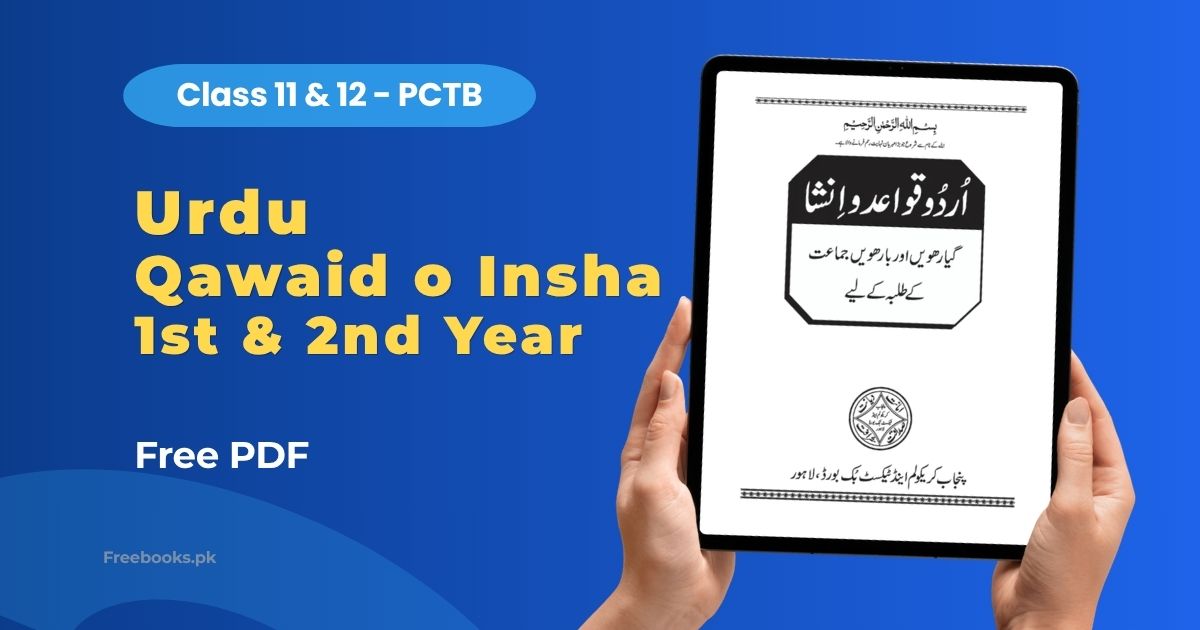
Urdu Qawaid o Insha for Class 12 is the same PCTB-published reference used across FA Part 1 and Part 2, but this page focuses on the composition and grammar topics the Punjab Board assigns specifically to Part 2 students — essay writing, letter writing, autobiography, diary writing, and four grammar topics tied directly to the Part 2 paper.
For FA Part 2 students, the board exam’s Insha Pardazi portion leans heavily on essay writing, along with letters, autobiographical pieces, and diary entries. This page also covers the four grammar topics the board specifically ties to Part 2 — punctuation in practice, agreement, particles, and correct use of auxiliary verbs — so students can revise exactly what their final-year paper tests.
Book Overview
| Class | 12 (FA Part 2) |
| Subject | Urdu Grammar and Composition (Qawaid o Insha) |
| Category | FA |
| Board | Punjab Board (PCTB, Lahore) |
| Total Topics | 29 (18 Qawaid + 11 Insha Pardazi, shared across Part 1 & Part 2) |
| This Page’s Focus | Part 2 Insha Pardazi (4 topics) + 4 grammar-in-writing topics |
| Format |
Insha Pardazi (Composition) Topics — Part 2
These are the composition forms the Punjab Board assigns specifically to FA Part 2 (Class 12) students.
1. Maktoob Nigari (Letter Writing)
Describes letter writing as an important prose form, sometimes called “half a meeting” (aadhi mulaqat) because it maintains connection between people. It divides letters into Rasmi (formal, written to strangers or officials) and Ghair Rasmi (informal, written to family and friends), and outlines the essential parts: place and date, salutation, main body, closing words, and the names/addresses of both writer and recipient.
Important Questions:
- Why is a letter sometimes called “aadhi mulaqat” (half a meeting)? Because it maintains a personal connection and exchange of news between two people, much like a real meeting.
- What is the difference between Rasmi and Ghair Rasmi letters? Rasmi letters are formal, written to officials or strangers with a clear purpose; Ghair Rasmi letters are informal, written to family and friends with open expression of feelings.
- What are the main parts of a letter? Place and date, salutation (alqaab), main body (nafs-e-mazmoon), closing words, and the names/addresses of writer and recipient.
- Where is the date usually written in a letter? At the top right of the page, along with the place of writing.
2. Aap Beeti (Autobiographical Writing)
Defines Aap Beeti (also called khud-nawisht) as an account of events and feelings that a person has personally experienced, requiring an honest, unbiased view of life along with an engaging writing style. In the FA syllabus, aap beeti topics are usually about inanimate objects or non-human things (like a flower or a book) rather than real people, written in a lightly first-person style.
Important Questions:
- What does Aap Beeti mean? A first-person account of events and experiences a person (or personified object) has genuinely gone through.
- What two qualities should a good Aap Beeti have? An unbiased/honest view of life and an engaging (muassir) style of writing.
- What kind of topics are typically assigned for Aap Beeti in the FA syllabus? Inanimate or non-human subjects, like a flower, book, or pen, rather than real historical figures.
- In what person is an Aap Beeti usually written? First person — “main” (I) or “hum” (we), as if the subject itself is speaking.
3. Roznamcha (Diary Writing)
Defines Roznamcha as a written, dated record of one’s daily activities kept as a personal memory aid. It provides guidelines: always begin each entry with the date, keep spelling and language correct and simple, maintain chronological order of the day’s events, and note down important happenings concisely, as shown in sample diary entries from a doctor’s and a timber merchant’s day.
Important Questions:
- What does the word Roznamcha literally mean? A book or notebook for recording the daily account of one’s routine — a diary.
- What should every diary entry begin with? The date of the entry.
- What tone and language should a Roznamcha use? Simple, easy-to-understand language, written honestly and concisely.
- Why is chronological order important in a diary entry? It keeps the record of the day’s events clear and easy to follow, from morning to night.
4. Mazmoon Nawisi (Essay Writing, Important Essays & Other Topics)
Defines Mazmoon Nawisi as structured writing on a chosen topic, dividing essays into categories like informational, narrative, argumentative, scientific, humorous, historical, and biographical. It explains the three-part essay structure — an engaging introduction, a well-organized main body using quotes, verses, and proverbs where appropriate, and a strong conclusion — and provides model essays such as Seerat-e-Tayyaba, plus a long reference list of other suggested essay titles for exam preparation.
Important Questions:
- What are the three main parts of a well-structured essay? Introduction (aghaaz), main body (nafs-e-mazmoon), and conclusion (ikhtitamiya).
- Name three types of essays listed in the syllabus. Informational (ma’loomati), narrative (waqi’ati), and argumentative (istadlaali) essays — among others like scientific, humorous, and biographical.
- What should the introduction of an essay accomplish? It should be concise but create curiosity in the reader to continue reading the full essay.
- Why are Quranic verses, hadith, and proverbs often used in an essay’s main body? They add authority, credibility, and persuasive weight to the writer’s argument.
Qawaid (Grammar) — Part 2 Exam Focus
Qawaid is common to both years of the syllabus, so the full 18-topic grammar breakdown with summaries and important questions is kept on our Urdu Qawaid o Insha 1st Year page. The four topics below are the ones the Punjab Board specifically ties to the Part 2 paper.
Rumooz-e-Auqaf (Punctuation): Covers the symbols — Sakta (comma), Waqfa (semicolon), Rabita (colon), Khatma (full stop), and others — that show a reader where and how long to pause, and how their correct use changes the clarity of a sentence.
Mutabiqat (Agreement): Covers the rules for matching a verb with its subject in number and gender, such as a plural subject taking a plural verb and a feminine subject taking a feminine verb, tested directly in Part 2 sentence-correction questions.
Huroof (Particles): Covers connecting words with no independent meaning of their own — Huroof-e-Jaar, Huroof-e-Izafat, Huroof-e-Atf, Huroof-e-Istifham, and Huroof-e-Nida — and how each is used correctly to link words and phrases in a sentence.
Imdaadi Afaal ka Durust Istimaal (Correct Use of Auxiliary Verbs): Covers how helping verbs like dena, lena, rakhna, and chahna are added after a main verb to add nuance or force, and how using the wrong auxiliary verb can change or weaken the intended meaning of a sentence.
For the full 18-topic Qawaid list — including gender, plurals, prefixes and suffixes, idioms, proverbs, rhetoric, and prosody — with complete summaries and important questions, see the 1st Year page. Talkhees Nigari, Darkhwast Naveesi, Raseedat, Mukalma Nigari, and Rodad Naveesi — the Part 1 Insha Pardazi topics — are also covered there.
Download Urdu Qawaid o Insha Book PDF
Click the button below to open the complete Urdu Qawaid o Insha book PDF (for Class 11 & 12). It opens in a new tab and is ready to read or save on any device.
⬇ Download PDFWho Should Read This
This page is for FA Part 2 (Class 12) students preparing for the composition and grammar-in-writing portion of the Punjab Board Urdu paper. It covers essay writing, letter writing, autobiography, and diary writing, plus four grammar topics tied to Part 2. Part 1 students should check our 1st Year page for the full Qawaid syllabus and Part 1 composition topics.
Applicable Boards
This textbook is published by PCTB and is used in Punjab Board colleges. Students from the Federal Board and AJK Board can also use it for grammar reference and composition practice, as the Urdu grammar syllabus is largely the same across boards.
FAQs
Is this Urdu grammar book for FA Part 2 only?
This page covers the Insha Pardazi topics and four grammar-in-writing topics the Punjab Board assigns specifically to FA Part 2 (Class 12). The full Qawaid syllabus and Part 1 composition topics are covered on a separate page.
Which Insha Pardazi topics are covered here for Part 2?
Maktoob Nigari (letter writing), Aap Beeti (autobiography), Roznamcha (diary writing), and Mazmoon Nawisi (essay writing, including important essays and other suggested topics).
Which grammar topics does this page cover for Part 2?
Rumooz-e-Auqaf (punctuation), Mutabiqat (agreement), Huroof (particles), and correct use of Imdaadi Afaal (auxiliary verbs) — the four grammar topics the board ties directly to the Part 2 paper.
Where can I find the full Qawaid (grammar) syllabus and Part 1 topics?
The complete 18-topic Qawaid breakdown, along with Part 1 Insha Pardazi topics like precis writing and applications, is on our Urdu Qawaid o Insha 1st Year page.
Can Federal Board students use this book?
Yes. The Urdu grammar syllabus is largely the same for Punjab and Federal boards. Federal Board students can use this book for grammar reference and writing practice.
Is the PDF free to download?
Yes. The Urdu Qawaid o Insha book PDF is completely free to download and read on any device.
Related Books
- Urdu 1st Year FA Book
- Akhlaqiat 2nd Year FA Book
- Pak Studies 2nd Year FA Book
- Mutalla Pakistan 2nd Year FA Book
- Civics 2nd Year FA Book
- Economics 2nd Year FA Book
Study Resources for Urdu 2nd Year
Free exam-preparation resources for Urdu 2nd Year from the Freebooks.pk Editorial Team — the free PDF textbook, the latest paper pairing scheme. Study online or download.
© Copyright Policy
Freebooks.pk is an educational resource for students in Pakistan. Textbooks and other books belong to their respective boards, authors and publishers, and all rights remain with them. If you are the copyright holder of any material on this page and want it changed or removed, please contact us or file a request under our DMCA policy. We review every request and remove reported content promptly.