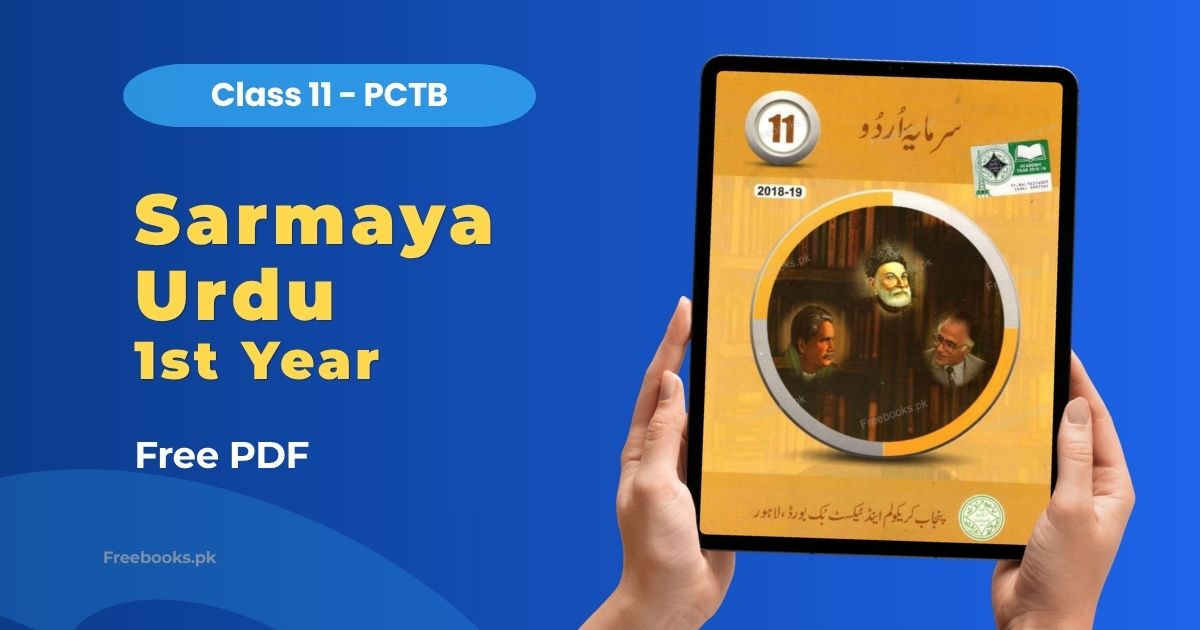
Sarmaya Urdu 1st Year (Class 11) is published by the Punjab Curriculum and Textbook Board (PCTB), Lahore. It is the standard Urdu textbook for FA and FSC Part 1 students in Punjab Board colleges. The book is divided into three sections: Nasr (prose), Nazm (poetry), and Ghazal. It brings together classic and modern Urdu literature from some of the most important writers and poets of the subcontinent.
For FA Part 1 students, Urdu is a compulsory subject and Sarmaya is the main literary resource for the board exam. The selections cover a wide range of themes from Islamic values and patriotism to social issues and human emotions. The PDF makes it easy to read, study, and revise all prose and poetry pieces before the final board exam.
Book Overview
- Class: 11 (FA/FSC Part 1 / First Year)
- Subject: Urdu (Sarmaya)
- Category: FA
- Board: Punjab Board (PCTB, Lahore)
- Sections: Nasr (Prose), Nazm (Poetry), Ghazal
- Total Pieces: 34 (14 Prose + 13 Poetry + 7 Ghazals)
- Format: PDF
Contents
Nasr (Prose)
The prose section contains 14 selections from prominent Urdu writers. These include essays, letters, sketches, and personal writings covering themes of Islamic values, character, literature, social commentary, and humour.
- Aswah Hasna — Syed Suleman Nadvi
- Apna Aap — Sir Syed Ahmad Khan
- Syed ke Akhlaq wa Khasail — Maulana Altaf Hussain Hali
- Abul Qasim Zanjani — Hamid Askari
- Adib ki Izzat — Prem Chand
- Ovar Coat — Ghulam Abbas
- Safarch — Ahmad Nadeem Qasmi
- Chirag ki Lo — Hajra Masroor
- Maktubaat-e-Ghalib — Mirza Asadullah Khan Ghalib
- Maktubaat-e-Iqbal — Allama Muhammad Iqbal
- Lahore ka Janfaralia — Prof. Abdullah Shah Bukhari
- Dosti ka Pagal — Sheikh Jameel
- Kya Aap Waqai Bol Sakte Hain? — Ibne Insha
- Aur Na Takker Mein Mariyoon Ka — Mustaq Ahmed Yusfi
Nazm (Poetry)
The poetry section contains 13 nazms from classical and modern Urdu poets. Themes include praise of the Prophet (PBUH), patriotism, nature, Islamic revival, social issues, and philosophy.
- Muhammad — Ameer Ahmad Meenatai
- Naat — Mahir ul Qadri
- Maidaan-e-Karbala — Saleem Raza
- Mustaqbil ki Jhalak — Maulana Zafar Ali Khan
- Barsaat — Akhtar Sheerani
- Hilal-e-Istiqlal — Hafiza Jahan Ara
- Khitaab Jawanan-e-Islam — Allama Iqbal
- Paigham — Allama Iqbal
- Abstract Art — Syed Jafri
- Qitaat — Mirza Mahmood Sardar
- Local Bus — Wala Wala
- Wihdaniyat — Must Tawakli (Translated by Tariq Qureishi)
- Milan — Meer Anees
Ghazal
The Ghazal section includes 7 ghazals from the masters of classical and modern Urdu poetry, covering themes of love, longing, philosophy, and human experience.
- Meer Taqi Meer
- Haider Ali Aatish
- Mirza Dagh Dehlavi
- Momin Khan Momin
- Hasrat Mohani
- Faiz Ahmad Faiz
- Ahmad Nadeem Qasmi
Download Sarmaya Urdu 1st Year Book PDF
Click the button below to open the complete Sarmaya Urdu Class 11 book PDF. It opens in a new tab and is ready to read or save on any device.
⬇ Download PDFWho Should Read This
Sarmaya Urdu is a compulsory subject for all FA and FSC Part 1 students in Punjab Board colleges. This book is the primary resource for the Urdu board exam paper. Students who want to develop an appreciation for classical and modern Urdu literature — prose, poetry, and ghazal — will also find it enriching beyond the exam.
Applicable Boards
This textbook is published by PCTB and is used in Punjab Board colleges for both FA and FSC students. Students from the Federal Board (FBISE) and AJK Board can also use it for reference, as the Urdu syllabus at this level is largely similar. The literary selections are valuable for any student of Urdu language and literature.
FAQs
Is Sarmaya Urdu for both FA and FSC Part 1 students?
Yes. Sarmaya Urdu is the compulsory Urdu textbook for all FA and FSC Part 1 (First Year) students in Punjab Board colleges.
How many pieces are in Sarmaya Urdu Class 11?
The book contains 34 literary pieces: 14 prose selections (Nasr), 13 nazms (Nazm), and 7 ghazals (Ghazal).
Which famous poets and writers are included in this book?
The book includes works by Allama Iqbal, Mirza Ghalib, Faiz Ahmad Faiz, Meer Taqi Meer, Sir Syed Ahmad Khan, Prem Chand, Ibne Insha, Hajra Masroor, and many other celebrated Urdu writers and poets.
What is the difference between Nasr, Nazm, and Ghazal sections?
Nasr contains prose pieces including essays, letters, and sketches. Nazm contains structured poetry with a theme. Ghazal is a classical poetic form with couplets on themes of love, longing, and philosophy.
Can Federal Board students use this book?
Yes. The Urdu syllabus is largely similar for Punjab and Federal boards. Federal Board students can use this book for reference and additional reading.
Is the PDF free to download?
Yes. The Sarmaya Urdu Class 11 book PDF is completely free to download and read on any device.
Related Books
- Urdu 2nd Year FA Book
- Islamiat 1st Year FA Book
- English 1st Year FA Book
- English Grammar & Composition 1st Year FA Book
- Akhlaqiat 1st Year FA Book
- Civics 1st Year FA Book
Study Resources for Urdu 1st Year
Free exam-preparation resources for Urdu 1st Year from the Freebooks.pk Editorial Team — the free PDF textbook, the latest paper pairing scheme. Study online or download.
© Copyright Policy
Freebooks.pk is an educational resource for students in Pakistan. Textbooks and other books belong to their respective boards, authors and publishers, and all rights remain with them. If you are the copyright holder of any material on this page and want it changed or removed, please contact us or file a request under our DMCA policy. We review every request and remove reported content promptly.