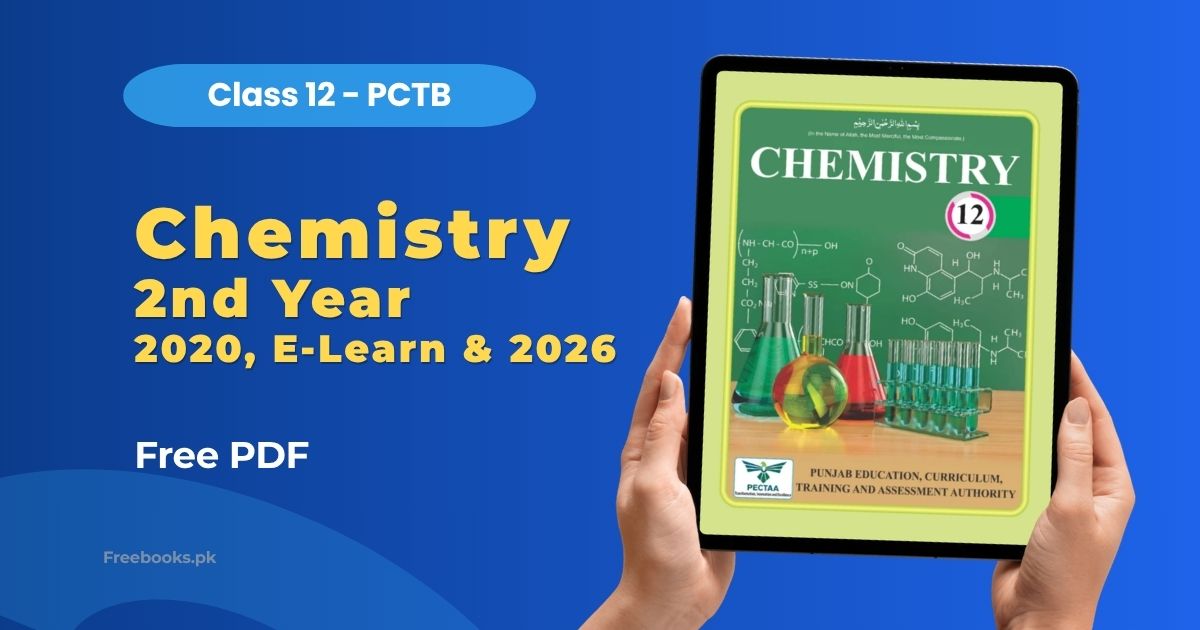
Chemistry 2nd Year (Class 12) is published by the Punjab Education, Curriculum, Training and Assessment Authority (PECTAA), Lahore. The latest 2025–26 edition is based on the Updated/Revised National Curriculum of Pakistan 2023. It covers seventeen units from Group 2 Elements to Water, spanning inorganic chemistry, organic chemistry, biochemistry, and analytical techniques.
For FSC Part 2 students, Chemistry Class 12 is a key subject for both board exams and entry tests. Organic chemistry, biochemistry, and spectroscopy units are especially important for MDCAT and ECAT preparation. The PDF is available in three editions so students can use whichever version their college follows.
Book Overview
| Class | 12 (FSC Part 2 / Second Year) |
| Subject | Chemistry |
| Category | FSC |
| Board | Punjab Board (PECTAA, Lahore) |
| Curriculum | NCP 2023 (Updated/Revised) |
| Total Chapters | 17 (Units 17–33) |
| Format | PDF (Free Download) |
Chapter List
Unit 17 – Group 2 Elements
This unit covers the alkaline earth metals (Be–Ba), their ns² electron configurations, and the trend of increasing reactivity down the group as ionisation energy falls. It explains their reactions with oxygen, water, and dilute acids — beryllium is anomalous, staying protected by a thin oxide layer — and covers thermal decomposition of carbonates and nitrates, which becomes easier down the group as the polarising power of the M2+ ion decreases. It also details solubility trends (hydroxides become more soluble down the group, sulphates less soluble) using hydration and lattice enthalpy, complex-ion formation, and industrial extraction such as the Dow process for magnesium.
Important Questions:
- Why does beryllium form a protective oxide layer while other Group 2 metals do not? Be2+ is very small with high charge density, forming strong Be–O bonding that produces a thin, compact, adherent oxide layer, unlike the weaker oxides of Mg–Ba.
- Write the balanced equation for thermal decomposition of strontium carbonate. SrCO3(s) → SrO(s) + CO2(g).
- Which Group 2 sulphate is least soluble in water? BaSO4, since solubility falls down the group as the drop in hydration enthalpy outweighs the drop in lattice enthalpy for this large anion.
- What products form when magnesium reacts with steam? MgO(s) and H2(g) — compare with cold water, which gives Mg(OH)2 and H2.
Unit 18 – Transition Metals
This unit defines transition elements as d-block elements that form ions with an incomplete d-subshell (explaining why zinc and scandium are excluded), then covers their variable oxidation states, catalytic behaviour (homogeneous and heterogeneous, including the Haber process), and complex-ion formation with different ligand types, coordination numbers, and geometries. It explains why transition-metal complexes are coloured (d-d electron transitions and ligand-field splitting) and covers stereoisomerism — including cisplatin versus transplatin as anticancer drugs — along with redox reactions such as MnO4–/Fe2+ and Cu2+/I– using standard electrode potentials.
Important Questions:
- Why is zinc not classified as a transition element? Zn2+ has a complete, filled 3d10 configuration with no incomplete d-subshell, so it cannot show variable oxidation states or colour.
- Give the coordination number of the central ion in [Fe(CN)6]4-. 6.
- Why is cisplatin medicinally active as an anticancer drug while transplatin is not? Only the cis isomer has a non-zero dipole moment, letting it bind DNA guanine bases and cross-link the double helix; transplatin’s dipoles cancel and it lacks this activity.
- Why does the Cu2+/I– reaction proceed forward despite an unfavourable net E°? The CuI formed precipitates out, continuously removing product and shifting the equilibrium to the right (Le Chatelier’s principle).
Unit 19 – Basics of Organic Chemistry
This unit introduces catenation — carbon’s ability to self-link into chains and rings — as the reason organic chemistry shows such huge structural diversity. It classifies hydrocarbons and functional groups, covers IUPAC nomenclature rules for all major families (alcohols, aldehydes, ketones, acids, amides, esters, ethers, amines, nitriles), and explains molecular, empirical, and structural formulae. It defines mechanism vocabulary (homolytic/heterolytic fission, electrophiles, nucleophiles, substitution/addition/elimination) and covers isomerism, including optical isomerism and chirality, using thalidomide as an example of why chirality matters in drug safety.
Important Questions:
- Define catenation and explain its importance. Catenation is carbon’s self-linkage into chains or rings via stable C–C bonds; it explains the enormous structural diversity of organic compounds.
- Why do alkanes have no functional group? They contain only non-polar C–C and C–H single bonds with no charge or multiple bonds, so there is no reactive site.
- Why is meso-tartaric acid optically inactive despite having two chiral carbons? It has an internal plane of symmetry, so the rotation from one chiral centre is exactly cancelled by the other.
- Differentiate a racemic mixture from a meso compound. A racemic mixture is an equal mix of two different enantiomers whose rotations cancel externally; a meso compound is a single molecule that is inherently inactive due to internal symmetry.
Unit 20 – Aromatic Hydrocarbons
This unit covers the delocalised structure of benzene (planar hexagon, sp² carbons, uniform 139 pm bond length) and its resonance stability — about 152 kJ/mol more stable than a hypothetical cyclohexatriene. It explains why benzene undergoes electrophilic substitution rather than addition (to preserve aromatic stability), and details the mechanisms of halogenation, nitration, and Friedel-Crafts alkylation/acylation using AlCl3 as a Lewis acid catalyst. It finishes with ortho/para-directing versus meta-directing substituent effects that control the position of further substitution.
Important Questions:
- Why does benzene undergo substitution rather than addition? Substitution preserves the stabilising delocalised electron system, while addition would destroy it.
- What is the role of AlCl3 in Friedel-Crafts alkylation? It is a Lewis acid catalyst that generates the alkyl carbocation electrophile and is regenerated at the end of the reaction.
- Why does bromine react faster with phenol than with benzene, without a catalyst? Phenol’s oxygen lone pair delocalises into the ring, increasing electron density and strongly activating it towards electrophilic attack.
- What does benzene’s resonance energy of about 152 kJ/mol indicate? That benzene is significantly more stable than a compound with three localised double bonds would be.
Unit 21 – Halogenoalkanes
This unit classifies halogenoalkanes as primary, secondary, or tertiary, and covers their preparation from alkanes, alkenes, and alcohols. It explains the reactivity order R–I > R–Br > R–Cl > R–F based on bond energy, and details the SN1 (unimolecular, tertiary substrates) and SN2 (bimolecular, primary substrates) nucleophilic substitution mechanisms with their rate laws, alongside competing elimination reactions. It also compares halogenoalkanes to halogenoarenes, which are far less reactive because lone-pair delocalisation gives the C–Cl bond partial double-bond character.
Important Questions:
- Why do primary halogenoalkanes react by the SN2 mechanism? Low steric hindrance allows the nucleophile to attack from the backside in a single concerted step.
- Why is chlorobenzene far less reactive than chloroethane towards substitution? The chlorine lone pair delocalises into the ring, giving the C–Cl bond partial double-bond character that is hard to break.
- Why does an iodoalkane give a precipitate with AgNO3 faster than a chloroalkane? The weaker C–I bond ionises faster, releasing I– more quickly.
- State the rate law for an SN1 reaction. Rate = k[Alkyl halide] — first order overall, since the rate-determining step is unimolecular ionisation.
Unit 22 – Hydroxy Compounds
This unit covers alcohols (primary, secondary, tertiary) and their preparation, then explains relative acidity — phenol is more acidic than water while ethanol is less acidic — due to resonance stabilisation of the phenoxide ion versus inductive destabilisation of the alkoxide ion. It details alcohol oxidation (primary to aldehyde to acid, secondary to ketone, tertiary unreactive), tested by the colour change of acidified K2Cr2O7 from orange to green, and covers phenol’s preparation and its activated ring reactions with dilute nitric acid and bromine water.
Important Questions:
- Why is ethanol less acidic than water but phenol more acidic? Ethanol’s alkyl group destabilises the alkoxide ion; phenol’s oxygen lone pair delocalises into the ring, stabilising the phenoxide ion by resonance.
- How can phenylamine be converted to phenol? React with NaNO2/dilute HCl below 10°C to form the diazonium salt, then warm with water to hydrolyse it to phenol.
- Why do nitration and bromination conditions differ for phenol versus benzene? Phenol’s ring is strongly activated by –OH, so it reacts with dilute HNO3 or bromine water alone, unlike benzene which needs concentrated acid or a catalyst.
- What colour change shows oxidation of a primary or secondary alcohol by acidified K2Cr2O7? Orange changes to green; a tertiary alcohol shows no colour change since it cannot be oxidised.
Unit 23 – Carbonyl Compounds and Carboxylic Acids
This unit covers aldehyde and ketone preparation by alcohol oxidation, and nucleophilic addition reactions of the polar C=O group with HCN and hydride reducing agents. It details identification tests — Tollens’ silver mirror and Fehling’s brick-red precipitate for aldehydes only, and the iodoform test for methyl-ketone groups — then covers carboxylic acid preparation and reactions, along with acidity trends (chlorine substitution increases acidity) and the comparative ease of hydrolysis of acyl chlorides, alkyl chlorides, and aryl chlorides.
Important Questions:
- Which reagent distinguishes an aldehyde from a ketone, and how? Tollens’ reagent — aldehydes give a silver mirror on warming; ketones give no reaction.
- Explain the relative acidities of chlorine-substituted carboxylic acids. Chlorine’s electron-withdrawing effect stabilises the carboxylate anion, so acidity increases with more chlorine atoms present.
- Compare the hydrolysis rates of acyl chlorides, alkyl chlorides, and aryl chlorides. Acyl chlorides hydrolyse fastest, alkyl chlorides slowly, and aryl chlorides barely at all due to C–Cl double-bond character from ring delocalisation.
- Give the products of hydrolysing ethyl ethanoate with dilute acid. Ethanoic acid and ethanol.
Unit 24 – Organic Nitrogen Compounds
This unit classifies amines and covers their preparation and basicity trends — alkylamines are stronger bases than ammonia, while phenylamine is weaker because its nitrogen lone pair delocalises into the ring. It details diazotisation reactions that distinguish primary, secondary, and tertiary amines, and azo-dye coupling reactions of diazonium salts. It also covers nitrile hydrolysis, amide properties and reduction, and amino acids as zwitterions joined by peptide bonds.
Important Questions:
- Why is phenylamine a weaker base than ammonia? Its nitrogen lone pair delocalises into the benzene ring, making it far less available to accept a proton.
- How would primary, secondary, and tertiary amines be distinguished with nitrous acid? Primary amines release nitrogen gas; secondary amines form a yellow oily nitrosamine; tertiary amines simply form a soluble salt with no visible change.
- What is a zwitterion? A dipolar form of an amino acid where the –COOH group has donated its proton to the –NH2 group, giving both –NH3+ and –COO– in the same molecule.
- Why are amides much weaker bases than amines? The nitrogen lone pair is delocalised into the carbonyl group by resonance, reducing its ability to accept a proton.
Unit 25 – Organic Synthesis
This unit introduces retrosynthesis — working backward from a target molecule to simpler starting materials — and applies it to pharmaceutical synthesis, including full retrosynthetic routes for paracetamol and aspirin. It introduces AI-assisted drug discovery through the real-world example of Halicin, an antibiotic discovered by an MIT machine-learning model screened against thousands of candidate molecules. It reinforces functional group interconversion as the core toolkit for planning efficient synthetic routes.
Important Questions:
- Differentiate synthesis from retrosynthesis. Synthesis builds a target molecule forward through real reactions; retrosynthesis works backward, disconnecting the target into simpler starting materials.
- What is the drug Halicin, and how was it discovered? An antibiotic effective against drug-resistant bacteria, discovered by an MIT machine-learning model trained to predict antibacterial activity.
- Name the two synthetic equivalents used to prepare aspirin. Salicylic acid and acetic anhydride, which react by esterification.
- How would a nitrile group be converted to an amine group? By reduction, using a reagent such as LiAlH4 or H2/Ni.
Unit 26 – Polymers
This unit distinguishes addition polymers (from C=C monomers, e.g. poly(ethene), PVC) from condensation polymers (releasing a small molecule like water, e.g. polyesters and polyamides such as Nylon 6,6). It shows how to identify polymer type, repeat unit, and monomers from a polymer structure, and covers the environmental difference between non-degradable poly(alkenes) and biodegradable polyesters/polyamides, along with applications of specific polymers in artificial organs and joints.
Important Questions:
- Name the monomer of PVC and explain its polymerisation type. Chloroethene (vinyl chloride); its C=C double bond opens up so monomers link without losing any atoms (addition polymerisation).
- Give the two monomers of Nylon 6,6. 1,6-diaminohexane and 1,4-hexanedioic acid (adipic acid), which condense with the loss of water.
- Why are polyesters and polyamides more biodegradable than poly(alkenes)? Their ester/amide linkages can be hydrolysed by microorganisms, while poly(alkenes) have only inert C–C backbones.
- Name the characteristic linkage in Kevlar and its polymerisation type. The amide linkage, formed by condensation polymerisation between a diamine and a dicarboxylic acid.
Unit 27 – Biochemistry
This unit covers carbohydrate classification and structure, the four levels of protein structure and enzyme catalysis via the lock-and-key model, including competitive and non-competitive inhibitors. It classifies lipids by their biological roles, and covers DNA’s double-helix structure (A-T with two hydrogen bonds, G-C with three) compared to single-stranded RNA, along with transcription, translation, and essential dietary minerals.
Important Questions:
- Differentiate competitive from non-competitive enzyme inhibitors. Competitive inhibitors resemble the substrate and compete for the active site; non-competitive inhibitors permanently change the active site’s shape, deactivating the enzyme.
- How many hydrogen bonds form between A-T and G-C base pairs? Two between adenine and thymine, three between guanine and cytosine.
- Why does a protein’s tertiary structure determine its enzyme function? Folding via R-group interactions creates a precisely shaped active site that binds only a specific substrate.
- What roles do DNA and RNA play in protein synthesis? DNA stores genetic information and is transcribed into mRNA, which is translated at ribosomes into a specific amino acid sequence, with tRNA delivering the amino acids.
Unit 28 – Chromatography
This unit covers paper, thin-layer, and gas chromatography — how each separates a mixture between a stationary and mobile phase, and how results are measured (Rf value for paper/TLC, retention time and peak area for gas chromatography). It covers real-world applications in forensic science, pharmaceuticals, food safety, and pollution detection, along with the limitations of each method.
Important Questions:
- Define the Rf value and give its formula. The ratio of distance travelled by a component to the distance travelled by the solvent front; it has no units.
- Why is pencil, not ink, used to mark the baseline? Ink contains dissolved coloured components that would move with the solvent and interfere with the chromatogram; pencil is insoluble.
- What is the mobile phase in gas chromatography? An inert carrier gas such as helium or nitrogen.
- Describe the main components of a gas chromatograph. An injector port, a coiled stationary-phase-coated column, a carrier gas supply, an oven, and a detector that records the chromatogram.
Unit 29 – Spectroscopy-1
This unit introduces the Index of Hydrogen Deficiency for counting rings and multiple bonds in a molecular formula, and covers UV-visible spectroscopy (light absorption increasing with conjugation) and infrared spectroscopy for identifying functional groups from characteristic absorption ranges. It details mass spectrometry — the molecular ion peak for molecular mass, fragmentation for structure, and isotope peaks for detecting chlorine or bromine atoms.
Important Questions:
- Calculate the Index of Hydrogen Deficiency for C4H6. IHD = 2, meaning two rings/double bonds, one of each, or one triple bond.
- What peak pattern indicates one bromine atom in a mass spectrum? The M+ and [M+2] peaks appear at roughly equal height, since the two bromine isotopes occur in near-equal abundance.
- Which functional group shows a broad IR absorption near 2500–3300 cm-1 plus a peak near 1700 cm-1? A carboxylic acid.
- Explain the difference between emission and absorption spectra. Emission spectra show bright lines when excited electrons fall to lower energy levels; absorption spectra show dark lines when ground-state electrons absorb specific-energy photons to jump higher.
Unit 30 – Spectroscopy-2 (NMR)
This unit explains the principle of proton NMR, using TMS as a reference standard, and covers chemical shift as an indicator of a proton’s chemical environment. It shows how to interpret low-resolution spectra (peak count and area ratio) and high-resolution splitting using the n+1 rule, plus the D2O shake technique for identifying exchangeable protons. It also introduces carbon-13 NMR for counting distinct carbon environments in a molecule.
Important Questions:
- Why is TMS used as the reference standard in proton NMR? Its 12 protons are all equivalent, chemically inert, volatile, and its peak appears at the extreme upfield end without overlapping other signals.
- State the n+1 rule and apply it to the –CH2– signal in ethanol. A signal splits into (n+1) peaks based on neighbouring protons; next to –CH3 (3 protons), the –CH2– signal splits into a quartet.
- What happens to the O-H/N-H peak in a D2O shake? It disappears from the spectrum, since D2O exchanges with these protons and deuterium needs a different flipping frequency.
- How many carbon-13 NMR peaks would propane show? Two — the two equivalent terminal CH3 carbons, and the separate central CH2 carbon.
Unit 31 – Materials and Energy
This unit covers metallurgy — mining, ore concentration, and reduction methods depending on a metal’s reactivity — plus ceramics, composites, and semiconductors, along with recycling challenges and X-ray crystallography for determining atomic structures. It covers fossil fuel processing, fractional distillation, and petrochemical cracking, and compares fuels by energy density and specific energy, finishing with nuclear fission, fusion, and solar energy.
Important Questions:
- Why is aluminium extracted by electrolysis rather than carbon reduction? Aluminium is more reactive than carbon, so only electrolysis can reduce Al3+ to the metal.
- Differentiate energy density from specific energy. Energy density is energy per unit volume; specific energy is energy per unit mass — hydrogen has high specific energy but low energy density.
- Describe the main steps in extracting a metal from its ore. Mining, ore concentration, conversion to oxide, reduction to metal, refining, and alloying.
- How do X-rays reveal a crystal’s atomic structure? Their wavelength matches interatomic spacing, so they diffract off the regularly arranged atoms, producing a pattern that reveals atomic positions when analysed.
Unit 32 – Medicine, Agriculture and Industry
This unit covers pharmacology basics such as the therapeutic index and drug mechanisms like penicillin’s action on bacterial cell walls. In agriculture, it covers N-P-K fertilizers, pesticide classes, and the effects of acid rain and genetic engineering on crops. In industry, it covers Pakistan’s key raw materials and major processes such as the Haber-Bosch, Contact, and Chlor-alkali processes, along with industrial safety measures.
Important Questions:
- Define the Therapeutic Index and what a high value indicates. The ratio of toxic dose to effective dose; a high value means a wide safety margin, i.e. a safer drug.
- What structural feature gives penicillin its antibacterial activity? Its strained beta-lactam ring, which binds and inactivates the enzyme that builds bacterial cell walls.
- Name the process used to produce caustic soda and chlorine from rock salt. The Chlor-alkali process (electrolysis of brine).
- How does acid rain damage soil fertility? It leaches essential nutrient ions from the soil while increasing the solubility of toxic aluminium ions absorbed by plant roots.
Unit 33 – Water
This unit covers water quality indicators such as Dissolved Oxygen, Biochemical Oxygen Demand, and Chemical Oxygen Demand, and classifies pollution sources as point-source or non-point-source. It details major pollutants — heavy metals, pesticides, and nutrients causing eutrophication — and covers wastewater treatment stages including coagulation, filtration, and disinfection, along with Punjab’s water-related environmental legislation.
Important Questions:
- Differentiate Biochemical Oxygen Demand from Chemical Oxygen Demand. BOD measures oxygen used by microorganisms over 5 days; COD measures oxygen needed to chemically oxidise organic and inorganic matter, and is usually higher.
- How does methylmercury cause Minamata disease? Bacteria convert mercury into fat-soluble methylmercury, which crosses the blood-brain barrier and acts as a potent neurotoxin after bioaccumulating up the food chain.
- What role does aluminium sulphate play in wastewater treatment? It acts as a coagulant, clumping fine suspended particles into larger floc masses that settle out or filter more easily.
- How does ion-exchange soften hard water? Calcium and magnesium ions are exchanged for sodium or hydrogen ions as water passes through a resin column.
Download Chemistry 2nd Year Book PDF
Three editions are available below. Click the button for the edition you need — each opens in a new tab and is ready to read or save on any device.
PECTAA 2025–26 Edition (Latest)
⬇ Download PDF (2025–26)PCTB 2020 Edition
⬇ Download PDF (2020)E-Learn Punjab Edition
⬇ Download PDF (E-Learn Punjab)Who Should Read This
This book is for FSC Part 2 (Second Year) science students preparing for the Punjab Board annual exam. It is also essential for MDCAT and ECAT preparation. Organic chemistry, biochemistry, and spectroscopy topics from this book are directly tested in MDCAT. ECAT students will find units on materials, energy, and industrial chemistry particularly useful.
Applicable Boards
This textbook is published by PECTAA and is used in Punjab Board colleges. Students from the Federal Board (FBISE) and AJK Board can also use it for reference as the FSC Part 2 Chemistry syllabus is largely the same. Students from Sindh and KPK boards will also find most units relevant.
FAQs
Is this the latest Chemistry book for FSC Part 2 Punjab Board?
Yes. The 2025-26 edition is the latest, published by PECTAA and based on the Updated/Revised National Curriculum of Pakistan 2023.
How many chapters are in Chemistry Class 12?
There are 17 units (Units 17 to 33), covering inorganic chemistry, organic chemistry, biochemistry, analytical techniques, and applied chemistry.
Is this book useful for MDCAT and ECAT preparation?
Yes. Organic chemistry, biochemistry, and spectroscopy from this book are directly tested in MDCAT. Materials, energy, and industrial chemistry units are important for ECAT.
Which edition should I download?
Download the PECTAA 2025-26 edition if your college follows the latest NCP 2023 curriculum. The PCTB 2020 and E-Learn editions cover the same core content and are useful for revision.
Can Federal Board students use this book?
Yes. The FSC Part 2 Chemistry syllabus is very similar for Punjab and Federal boards. Federal Board students can use this book for additional practice and reference.
Is the PDF free to download?
Yes. All three editions of the Chemistry Class 12 book PDF are completely free to download and read on any device.
Related Books
- Chemistry 1st Year FSC Book
- English 2nd Year FSC Book
- English Grammar & Composition 2nd Year FSC Book
- Mathematics 2nd Year FSC Book
- Biology 2nd Year FSC Book
- Physics 2nd Year FSC Book
Study Resources for Chemistry 2nd Year
Free exam-preparation resources for Chemistry 2nd Year from the Freebooks.pk Editorial Team — chapter-wise notes (definitions, short & long questions and MCQs), the latest paper pairing scheme. Study online or download.
© Copyright Policy
Freebooks.pk is an educational resource for students in Pakistan. Textbooks and other books belong to their respective boards, authors and publishers, and all rights remain with them. If you are the copyright holder of any material on this page and want it changed or removed, please contact us or file a request under our DMCA policy. We review every request and remove reported content promptly.