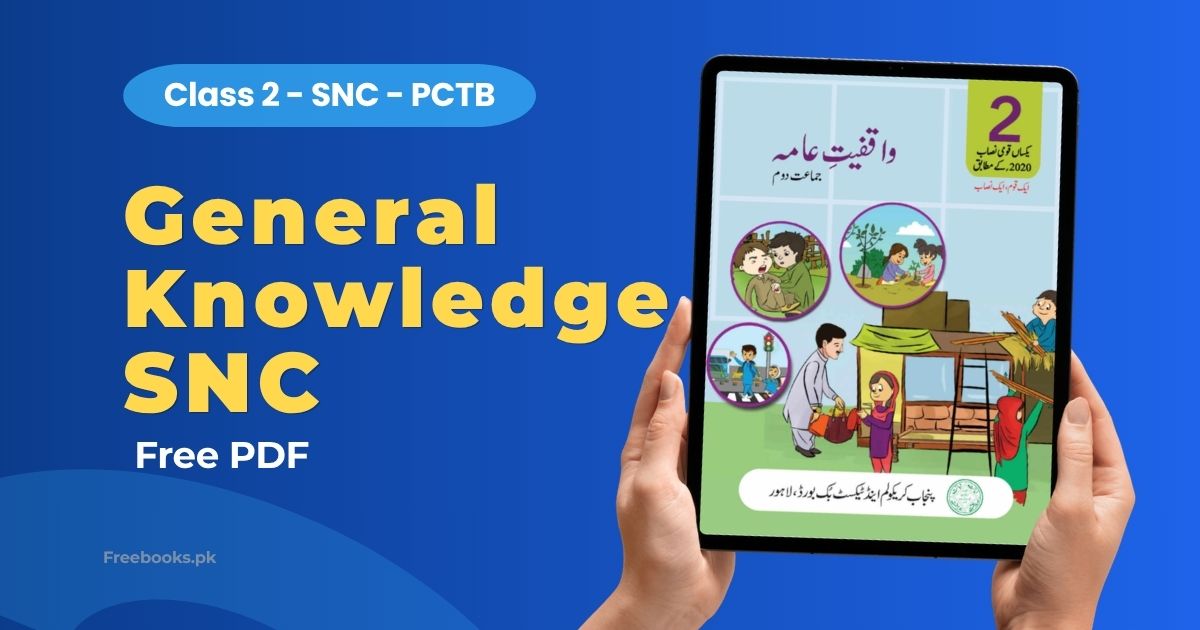
General Knowledge for Class 2 is part of the official Punjab Curriculum and Textbook Board (PCTB) syllabus, based on the Single National Curriculum (SNC) 2020. This page covers all 16 chapters of the book, from Pakistan’s provinces and flag to water, plants, animals, farming, and values like forgiveness and fairness.
For Class 2 students, this book introduces the country, community, and everyday science through simple pictures and activities rather than long definitions. Each chapter summary and its important questions on this page make revision quicker before class tests, so parents and teachers can go over the key ideas with young learners without re-reading the whole chapter.
Book Overview
| Class | 2 |
| Subject | General Knowledge |
| Board | Punjab Curriculum and Textbook Board (PCTB) |
| Curriculum | Single National Curriculum (SNC) 2020 |
| Total Chapters | 16 |
| Total Pages | 96 |
| Medium | Urdu |
| Format | PDF (Free Download) |
Chapter List
Chapter 1: Hamara Watan Pakistan (ہمارا وطن پاکستان)
Pakistan came into being on 14 August 1947, located in Asia, with Islamabad as its capital. It has four provinces — Punjab (largest by population), Sindh, Khyber Pakhtunkhwa, and Balochistan (largest by area) — plus the administered territories of Azad Jammu and Kashmir (capital Muzaffarabad) and Gilgit-Baltistan (capital Gilgit). The chapter introduces each region’s language, dress, and food: Sindhi culture with ajrak and sindhi topi; Punjabi culture centred on Lahore; Khyber Pakhtunkhwa’s mountains and Attan dance; Balochistan’s Quetta and dry fruit; and Kashmir and Gilgit-Baltistan’s mountain life. It also explains the national flag: green for Muslims, white for other faiths, the crescent for progress and the star for light and knowledge.
Important Questions:
- When did Pakistan come into being? Answer: 14 August 1947.
- What is the capital of Pakistan? Answer: Islamabad.
- Which province is the largest by area, and which is the largest by population? Answer: Balochistan is the largest by area; Punjab is the largest by population.
- What do the colours on Pakistan’s flag represent? Answer: Green represents Muslims and white represents people of other religions; the crescent stands for progress and the star for light and knowledge.
Chapter 2: Dehat Aur Shehar (دیہات اور شہر)
Most of Pakistan’s population lives in villages, where homes are open and spread out and the environment stays clean, though health and education facilities are limited. Cities have tall, solid buildings but noisier, less clean surroundings due to factories and traffic, alongside better health and education facilities. The chapter compares village life (farming, schools, little traffic) with city life (offices, universities, heavy traffic), and lists professions common to both village and city people — tailor, doctor, blacksmith, singer, cobbler, and mechanic.
Important Questions:
- Where does most of Pakistan’s population live, according to this chapter? Answer: In villages.
- What kind of facilities are better in cities than in villages, according to this chapter? Answer: Health and education facilities.
- Why is the environment in cities less clean than in villages? Answer: Because of the noise and pollution from factories and traffic.
- Name two professions common to both village and city people. Answer: Tailor and doctor (also: cobbler or mechanic).
Chapter 3: Huqooq o Faraiz (حقوق و فرائض)
The government runs the country and provides its citizens with facilities like health care, clean water, electricity, gas, playgrounds, and quality education, as well as schools, hospitals, courts, police stations, and roads. It must also protect citizens and let each one practise their own religion freely, respecting their places of worship and festivals. In return, citizens have duties: taking care of their health, respecting elders, following the law, using gas, water, and electricity carefully, and not damaging government or private property.
Important Questions:
- Name three facilities the government provides to citizens, according to this chapter. Answer: Schools, hospitals, and police stations (also: roads, courts).
- What right does the government give every citizen regarding religion? Answer: The freedom to live according to their own religion.
- Name two duties of a responsible citizen listed in this chapter. Answer: Following the law and respecting elders (also: using resources carefully, not damaging property).
- How can citizens become good citizens, according to this chapter? Answer: By following the law.
Chapter 4: Mazhabi Tehwar (مذہبی تہوار)
Muslims celebrate two Eids with joy: Eid-ul-Fitr on the 1st of Shawwal after the fasts of Ramadan, marked with prayers, greetings, and giving Sadqa-e-Fitr to the poor; and Eid-ul-Azha on the 10th of Zil-Hajj, commemorating Hazrat Ibrahim’s (AS) sacrifice, when sacrificial meat is shared with relatives and the poor. Milad-un-Nabi is observed on 12 Rabi-ul-Awwal with gatherings of durood and naat. The chapter also introduces festivals of other communities in Pakistan: Christmas on 25 December for Christians, Holi for Hindus, and Baisakhi, the Sikh new year, noting that Guru Nanak, the founder of Sikhism, was born in Nankana Sahib, Punjab.
Important Questions:
- On which date is Eid-ul-Fitr celebrated? Answer: The 1st of Shawwal, after the fasts of Ramadan.
- Whose sacrifice does Eid-ul-Azha commemorate? Answer: Hazrat Ibrahim’s (AS) sacrifice.
- On which date do Christians celebrate Christmas, and for whom? Answer: 25 December, for the birth of Hazrat Isa (AS).
- Where was Guru Nanak, the founder of Sikhism, born, according to this chapter? Answer: Nankana Sahib, Punjab.
Chapter 5: Qudrati Mahol Aur Wasail (قدرتی ماحول اور وسائل)
The earth is made up of living and non-living things — fields, mountains, animals, and humans — that together form the environment; living things grow and move, while non-living things do not. Natural resources given to us include land, water, air, and the sun, each meeting different human needs: land gives us minerals and farmland, water is for drinking and travel, air lets us breathe, and the sun is the greatest source of light and heat for growing crops. The chapter also covers minerals like iron, coal, salt, and precious stones, used to make jewellery and everyday items.
Important Questions:
- What are natural resources, according to this chapter? Answer: Things that nature has given us to meet human needs.
- Name the four types of natural resources listed in this chapter. Answer: Land, water, sun, and air.
- Why is the sun important for crops, according to this chapter? Answer: It is the greatest source of light and heat, without which crops cannot grow.
- Name two minerals mentioned in this chapter. Answer: Iron and coal (also: salt, precious stones).
Chapter 6: Pani (پانی)
Water is essential for every living thing, used for drinking, cooking, washing dishes and clothes, and watering fields. Its natural sources are rain, snow melting from glaciers and mountains, and underground water reached through wells, hand pumps, and tube wells; rain is the biggest source, feeding ponds, lakes, canals, and rivers. Surface water is cleaned at a filtration plant before reaching homes through pipelines, and boiling and filtering are the two ways to purify water. Areas like Tharparkar, Badin, Dadu, and Chaghi face water shortages due to low rainfall, so water must be used carefully.
Important Questions:
- What is the biggest natural source of water, according to this chapter? Answer: Rain.
- Name two ways of getting underground water, according to this chapter. Answer: Wells and tube wells (also: hand pumps).
- What are the two methods of purifying water mentioned in this chapter? Answer: Filtering and boiling.
- Name two areas of Pakistan mentioned in this chapter that face water shortages. Answer: Tharparkar and Badin (also: Dadu, Chaghi).
Chapter 7: Paudey (پودے)
Plants have four main parts, each with its own job: the root holds the plant firmly in the soil and absorbs water; the stem carries that water from the root to the branches and leaves; the leaf combines water, air, and light to make the plant’s food; and the flower adds beauty and produces fruit and seeds. Leaves come in different shapes, and some roots, like carrot and radish, are eaten as vegetables. Plants can be flowering or non-flowering, and grow from seeds, roots, or stems; soil, water, air, and sunlight are all necessary for their growth, and plants also help keep the climate pleasant.
Important Questions:
- What are the four main parts of a plant named in this chapter? Answer: Root, stem, leaf, and flower.
- What job does the root do, according to this chapter? Answer: It holds the plant firmly in the soil and absorbs water for it.
- Name two edible roots mentioned in this chapter. Answer: Carrot and radish (also: turnip, sweet potato).
- What four things does a plant need to grow, according to this chapter? Answer: Soil, water, air, and sunlight.
Chapter 8: Janwar (جانور)
Animals live either on land or in water; some land animals walk, some crawl, and some fly. The chapter introduces land animals like the snake and markhor and water animals like the starfish, fish, and octopus. Some animal babies look like their parents from birth, such as a foal and a chick, while others look completely different, like a tadpole compared to a frog. Different animals live in different homes: the camel lives in the desert, the rabbit in a burrow, the eagle in the mountains, the bird in a nest, the lion in the jungle, and the dolphin in the sea.
Important Questions:
- Give an example of an animal baby that looks like its parent from birth, according to this chapter. Answer: A foal (also: a chick or kitten).
- Give an example of an animal baby that looks different from its parent, according to this chapter. Answer: A tadpole, which looks different from the frog it becomes.
- Where does the camel live, according to this chapter? Answer: In the desert.
- Name two water animals mentioned in this chapter. Answer: Starfish and fish (also: octopus).
Chapter 9: Zaraat Aur Maweshi (زراعت اور مویشی)
Pakistan is an agricultural country, and its major crops include wheat, rice, cotton, sugarcane, and maize; most of the population lives in villages and works in farming. The chapter traces how crops become everyday products: wheat is ground into flour for bread, cotton is spun into thread and woven into cloth in factories, and sugarcane juice is used to make gur and sugar. Farmers also keep livestock: buffaloes and cows give milk, which is turned into yoghurt, butter, cheese, and ghee, while livestock also provide meat and hide for leather goods.
Important Questions:
- Name three major crops of Pakistan listed in this chapter. Answer: Wheat, rice, and cotton (also: sugarcane, maize).
- What is cotton used to make, according to this chapter? Answer: Thread, which is then woven into cloth.
- Name two things made from milk, according to this chapter. Answer: Yoghurt and butter (also: cheese, ghee).
- Besides milk, what two other things do we get from livestock, according to this chapter? Answer: Meat and hide (leather).
Chapter 10: Zamini Wasail Ki Hifazat (زمینی وسائل کی حفاظت)
Land resources like water are essential for human life and must be used carefully. Water is wasted when a motor is left running to fill a tank, a tap is left open while washing hands, or a pipeline breaks, and this waste creates problems for everyone. Forests are the home of animals and birds, provide wood for furniture and fuel, keep the climate pleasant, and prevent soil erosion and floods, so cutting trees unnecessarily should be avoided and new trees should be planted; using other fuel sources instead of wood and protecting forests from fire also help stop deforestation.
Important Questions:
- Name one way water is wasted at home, according to this chapter. Answer: Leaving a tap running while washing hands (also: a motor left on, a broken pipeline).
- Why are forests important, according to this chapter? Answer: They are home to animals and birds, provide wood, keep the climate pleasant, and prevent soil erosion and floods.
- Name one way this chapter suggests to stop deforestation. Answer: Using other sources of fuel instead of wood (also: protecting forests from fire, not cutting wood unnecessarily).
- What should we do to make up for trees that are cut down, according to this chapter? Answer: Plant more trees.
Chapter 11: Hararat Aur Roshni (حرارت اور روشنی)
The sun is the greatest natural source of heat and light, and the moon and stars also give light at night. People also use sources like candles, lanterns, electricity, and gas for heat and light when needed; ancient humans discovered fire by rubbing stones together. Heat keeps us warm and helps cook food, while light lets us see things and helps crops grow, and both heat and light feel stronger the closer we are to their source.
Important Questions:
- What is the greatest natural source of heat and light, according to this chapter? Answer: The sun.
- How did ancient humans discover fire, according to this chapter? Answer: By rubbing stones together.
- Name two artificial sources of heat and light mentioned in this chapter. Answer: Candles and electricity (also: lanterns, gas).
- Why is sunlight important for crops, according to this chapter? Answer: It helps them grow.
Chapter 12: Dusron Ki Madad Karna (دوسروں کی مدد کرنا)
This chapter uses two short stories to teach the value of helping others — Amna explaining a difficult math homework to her upset classmate Maryam, and Ahmed helping his friend Ali get treated after he fell and hurt his knee. It also covers sharing, explaining that sharing toys, books, and fruit with friends and siblings builds friendship, and interdependence, showing how people rely on each other in daily life, such as calling an electrician to fix electricity or workers to build a house.
Important Questions:
- How did Amna help her classmate Maryam in the story in this chapter? Answer: She explained the math homework that Maryam did not understand.
- How did Ahmed help his friend Ali? Answer: He picked him up after he fell and took him to the teacher to get his injury bandaged.
- Name two things this chapter says we should share with friends and siblings. Answer: Toys and books (also: fruit, television, furniture).
- Give an example of interdependence from this chapter. Answer: Calling an electrician to fix electricity at home, or workers to help build a house.
Chapter 13: Peshey (پیشے)
People adopt a profession to earn a living, such as a tailor for sewing clothes, a vegetable seller for selling vegetables, and a doctor for treating patients; doing so not only earns them a livelihood but also helps others. The chapter introduces several professions through pictures, including washerman, potter, police officer, and teacher, and stresses that everyone in these professions plays an important role in daily life and deserves to be thanked for their work.
Important Questions:
- Why do people adopt a profession, according to this chapter? Answer: To earn a living, and in doing so, to help others too.
- Give an example from this chapter of a profession and the work it does. Answer: A tailor sews clothes (also: a vegetable seller sells vegetables, a doctor treats patients).
- Name two professions introduced through pictures in this chapter. Answer: Police officer and teacher (also: washerman, potter).
- How does this chapter say we should treat people in different professions? Answer: We should be thankful to them, since every profession has an important role in our daily life.
Chapter 14: Dusron Ka Ihtiram (دوسروں کا احترام)
This chapter teaches that all human beings are born equal and deserve respect, even though families, religions, and cultures differ. It introduces three friends, Adnan, Arjit, and Joseph, who belong to different religions but help each other and respect one another’s views. It lists good habits like serving elders and waiting one’s turn patiently while talking, buying a ticket, or standing at the school canteen, and stresses that everyone’s needs, interests, ideas, and feelings deserve respect.
Important Questions:
- According to this chapter, are all human beings equal? Answer: Yes, all human beings are born equal and deserve respect.
- What is different between the three friends Adnan, Arjit, and Joseph in this chapter’s story, and what do they still do for each other? Answer: They belong to different religions, but they help each other and respect one another.
- Name two situations from this chapter where waiting your turn is important. Answer: Buying a ticket and standing at the school canteen (also: while talking to someone).
- What does this chapter say we should respect about other people? Answer: Their needs, interests, ideas, and feelings.
Chapter 15: Afw o Dargazar (عفو و درگزر)
This chapter tells the story of Sarah, who is teased and called names by her classmate Nida on her first day of school, yet still helps Nida with a pencil during an Urdu test the next day. Ashamed, Nida apologises, Sarah forgives her, and the two become friends. The chapter’s key points teach that we should never hurt anyone’s feelings, should apologise if we accidentally do, should forgive those who hurt us, should never mock anyone, and should always treat others with good manners.
Important Questions:
- How did Nida treat Sarah on her first day at school, according to the story in this chapter? Answer: She teased her and called her names, which made Sarah cry.
- How did Sarah help Nida the next day, even after being teased? Answer: She lent Nida her pencil during the Urdu test.
- What did Nida do once she realised her mistake? Answer: She apologised to Sarah, and Sarah forgave her.
- Name two key points about forgiveness taught in this chapter. Answer: We should not hurt anyone’s feelings, and we should forgive those who hurt us (also: apologise if we hurt someone, never mock anyone).
Chapter 16: Ghair Janibdari (غیر جانب داری)
This chapter tells the story of a monkey who complains to the lion, king of the jungle, that an elephant has been troubling him, breaking branches of his tree and stealing fruit he collected for his children. The elephant denies it, claiming he was visiting another forest, but the bear and the pigeon step forward as witnesses and confirm the monkey’s story. The lion rules fairly despite his friendship with the elephant, ordering him to serve the monkey and collect fruit for him for a month as punishment for troubling the monkey and lying about it.
Important Questions:
- What did the monkey complain about to the lion in this chapter’s story? Answer: That the elephant kept troubling him by breaking his tree’s branches and stealing fruit he had collected for his children.
- What excuse did the elephant give when accused? Answer: He claimed he had not gone near the monkey’s area and was visiting another forest instead.
- Who confirmed that the elephant was lying, according to this chapter? Answer: The bear and the pigeon, who witnessed the elephant troubling the monkey.
- What punishment did the lion give the elephant, and what lesson does the story teach? Answer: He ordered the elephant to serve the monkey and collect fruit for him for a month; the lesson is to always be fair and impartial.
Download General Knowledge Class 2 SNC PDF
Click the button below to download the free PDF of General Knowledge Class 2 SNC for Punjab Board (PCTB).
Who Should Read This
This book is meant for Class 2 students studying under the Punjab Board (PCTB) SNC syllabus. Parents and teachers introducing young children to their country, community, and basic science concepts will also find the chapter summaries and important questions useful for quick revision.
Applicable Boards
This book is designed for the Punjab Curriculum and Textbook Board (PCTB). Since it follows the Single National Curriculum (SNC) 2020, students from other boards that have also adopted the SNC syllabus for Class 2 General Knowledge can use this book too.
FAQs
Is this General Knowledge book for Class 2 students only?
Yes, this book is designed for Class 2 students under the Punjab Board SNC 2020 syllabus.
Can other students use this book?
Yes, students from other boards following the SNC syllabus for Class 2 General Knowledge can also use it.
Is this the latest edition?
Yes, this is the latest SNC 2020 edition approved by the Punjab Curriculum and Textbook Board.
Does the PDF include all 16 chapters?
Yes, the PDF covers all 16 chapters of the book, from Pakistan and its provinces to water, plants, animals, and values like forgiveness and fairness.
Is the download free?
Yes, the PDF download is completely free.
Does this book include exercises and questions?
Yes, each chapter includes exercises, and this page also lists important questions with short answers for quick revision.
What topics does this Class 2 General Knowledge book cover?
It covers Pakistan’s provinces and flag, rights and duties, religious festivals, natural resources, water, plants, animals, farming, simple science topics like heat and light, and values like helping others, respect, forgiveness, and fairness.
Related Books
- Ethics (Ikhlaqiat) Class 2 PDF Download – Punjab Board (PCTB)
- Islamiat Class 2 SNC PDF Download – Punjab Board (PCTB)
- General Knowledge Class 3 SNC PDF Download – Punjab Board (PCTB)
- Islamiat Class 3 SNC PDF Download – Punjab Board (PCTB)
Related Books
© Copyright Policy
Freebooks.pk is an educational resource for students in Pakistan. Textbooks and other books belong to their respective boards, authors and publishers, and all rights remain with them. If you are the copyright holder of any material on this page and want it changed or removed, please contact us or file a request under our DMCA policy. We review every request and remove reported content promptly.